Late August

Today marks one month since my brain surgery. My recovery is going well, but I’m still not back to full strength.

I’ve been walking in my neighborhood to build up my stamina. I’m still using the cane I received when I was discharged from the hospital, but I hope to ditch it soon.

When I walk, I don’t listen to music or podcasts. For safety reasons, I need to hear cars approaching, and I also keep my ears open for stimulating sounds—birds, wind chimes, children playing, etc.

A lot of times, I get ideas for poems while out on my walks. Often, one line will pop into my head and start me down the path of writing a poem. Recently, I was walking and thinking about the end of August, and this line came to me: It’s always sad when summer ends. I jotted the line down in the small notebook I carry with me. After some work, this is the poem I produced:

Late August

It’s always sad when summer ends.
But avoidance of the inevitable is impossible.
And in this season of life, a little winter must come.
So I tell myself to stop being disgruntled
by summer’s death and autumn’s arrival,
and instead get to work—starting with
descending the cellar steps and bringing up
the long johns, flannel shirts, and heavy wool socks.

It’s not the greatest poem in the world. But I like that I followed the trajectory the poem wanted to take—starting with one line, then others scribbled in my notebook, followed by revisions on the computer.

So I recognize the importance of awareness and paying attention to both external and internal stimuli to use as raw material for poetry (and stories, etc.).

And this reminds me of a line from the Grateful Dead song “Scarlet Begonias” (thank you, Robert Hunter):

Once in a while, you get shown the light
In the strangest of places if you look at it right …

Standard

Birthday Note

I celebrated my birthday yesterday by relaxing at home with my family. As kids are wont to do, my son, Colin, blew out the candle on the cake, so we had to light it twice.

Colin Joe getting reading to blow out the candle.

I snuck in a couple of wishes, but mostly I felt enormous gratitude for still being here for another day and another year.

The night before I reflected on my recovery from surgery and my birthday, journaling for a few minutes while standing near my bedroom dresser. I am not a habitual journal writer, but I have notebooks scattered throughout the house to be available when the urge strikes me. Often my journal entries—which I always convert to a long-running Word document—contain mundane facts and banal thoughts with no potential to become raw material for a poem, story, or essay. However, sometimes the act of moving my pen on paper will lead me to a line that initiates energy.

And this is what I came up with the other night. It’s not a great poem, but I was happy I wrote it in a spontaneous burst and finished it in one draft.

On the Eve of My Fifty-Fourth Birthday

There has to be more
to this life than
just what we see.

Or else there isn’t—
in which case
death won’t be
so scary.

It’ll just be a
harmless place
devoid of life.

And you and I
can handle that, right?

Standard

Quintessential Listening: Poetry Online Radio

I just wanted to share the recording of the podcast Quintessential Listening: Poetry Online Radio, hosted by Dr. Michael Anthony Ingram. I was the guest on the show on Thursday, July 6. You can find the link here.

Standard

Interview and Upcoming Poetry Podcast

I just wanted to share that I’ve been featured in a short interview on AwesomeGang.com. You can find it here.

Also, I will be the guest on a poetry podcast at 8 p.m. Eastern Time on Thursday, July 6. I will be reading selections from my latest collection, The Truth I Must Invent.

The show is Quintessential Listening: Poetry Online Radio, hosted by Dr. Michael Anthony Ingram. Here’s the link to connect on Thursday. 

https://www.blogtalkradio.com/ql_p/2023/07/07/quintessential-listening-poetry-online-radio-presents-francis-diclemente

Have a safe and happy Fourth of July weekend.

Standard

In Praise of Small Notebooks

While out for a walk this morning, I saw two deer bounding across a lawn. I also jotted down some lines that came to me, once again realizing the importance of always carrying a small notebook and pen. You never know when inspiration will strike, and my fingers are not deft enough to text the words on my phone.

It’s not the greatest poem in the world, but I’m glad it came out fully formed in the course of a morning.

Image Reconciliation

Take a look
at the photo.
See your face
in the picture.
Don’t hide
from the image.

Think of the
kid you were
so many
years ago.

Now look again.
This is who
you are.

This is who
you were
meant to be
all along—

The person
you see
right here,
right now.

Say hello
to yourself.
Be kind
to the human
before you.

This is
the only you
you’ve got.

Standard

External Stimuli

So much of my time is spent inside my head. Thoughts ricocheting in all directions—fears, goals, ideas, projects, timelines, and more rushing at me. I have multiple “To-Do” lists with many tasks that never get done (one list for work, one for life and family, and one for writing and art).

And because I am so scatterbrained, I often instruct myself to “slow down, look outward, pay attention, and observe.” In other words, to pause the internal conflict by seeking external stimuli.

And recently I was rewarded by discovering some visual and verbal creations in the course of my daily meanderings.

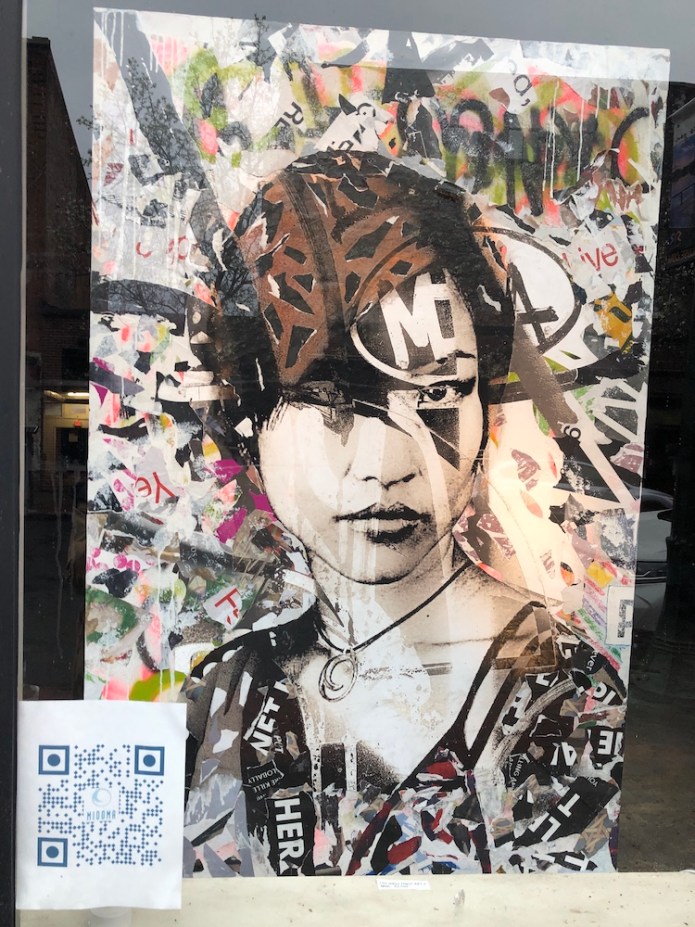
While walking to work one day, I saw artwork installed in the window of the former business Eureka Crafts on Walton Street in Armory Square. Numerous pieces were on display, but two large-scale, mixed-media objects caught my attention.

Enjoy Art 2 / Life (POJ) by not_miscellaneous.

The style reminded me of Andy Warhol silkscreen prints—most notably the Mick Jagger series.

Mick Jagger series by Andy Warhol.

The dynamic colors and composition of the works captivated me, but what kept me at the window for a few minutes was the intentional gaze of the subjects looking at the viewer—giving me the sense of the “observer being observed.” In this sense, the artwork connected to its audience.

Enjoy Art / Trades Only by not_miscellaneous.

I didn’t see an artist’s name or titles listed. But there was a QR code that read “WINDOW ART AUDIO TOUR,” with the word Midoma. I did some research and found a Midoma website with a heading that reads: “A Curated Selection by New York Artists for Fashion, Art + Beauty Lovers.”

The artwork is for sale here.

##

My second discovery came in one of the lobbies of the Nancy Cantor Warehouse in downtown Syracuse, home of the School of Design at Syracuse University, and where our SU marketing division is housed.

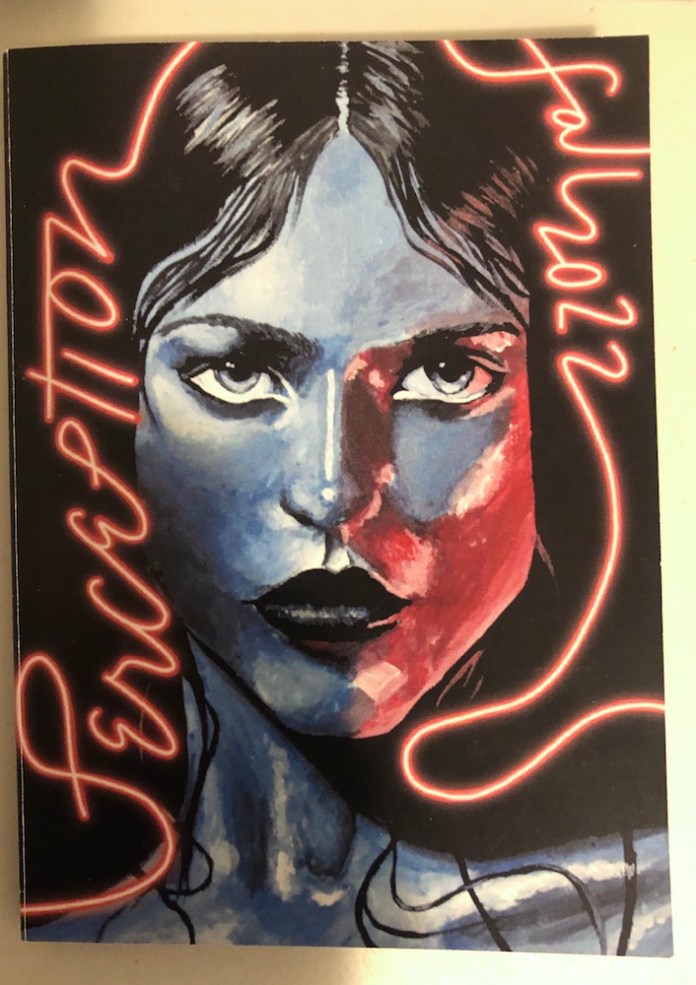
I saw a few copies of the student-run publication Perception spread out on a small, circular table. I grabbed a copy of the Fall 2022 issue.

The cover of the Fall 2022 issue of the student-run literary magazine Perception.

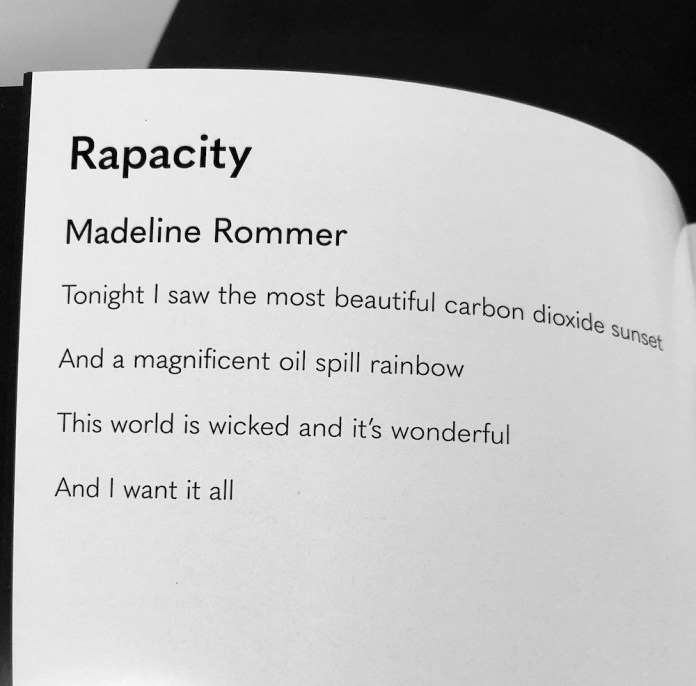
I haven’t had time to read the entire magazine, but the first poem I flipped to hit me hard with its brevity, rhythm, and raw language. I call this kind of verse a “thunderbolt poem,” because it slugs you in the gut and flings an arrow to the heart.

A classic example—Langston Hughes’s poem “Suicide’s Note”:

The calm,
Cool face of the river
Asked me for a kiss.

Though not in the same style as Hughes’s masterpiece, the poem “Rapacity” by Madeline Rommer provides the same effect. It drew me in because I don’t know what a “carbon dioxide sunset” is, but I love the imagery. And the power of the last two lines stuck with me.

The poem “Rapacity” by Madeline Rommer.

Standard

The Truth I Must Invent

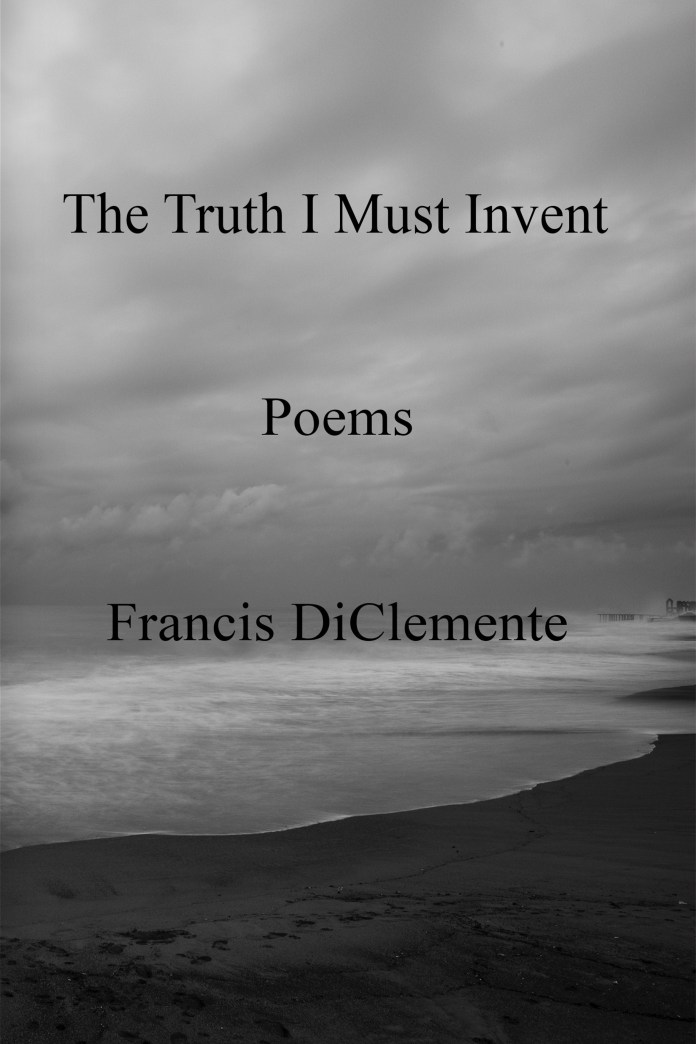
I’m excited to report I have a new poetry collection available. It’s entitled The Truth I Must Invent, and it was my pleasure working with publisher Akshay Sonthalia from Poets’ Choice to bring the book to fruition.

The Truth I Must Invent book cover. Cover Design by Koni Deraz; Cover Photo by Engin Akyurt; Book Design by Adil Ilyas.

You can find a print version on the publisher’s site. It’s also available on Bookshop.

The Truth I Must Invent is a collection of narrative and philosophical poems written in free-verse style. In it, I explore the themes of self, identity, loneliness, memory, existence, family, parenthood, disability, gratitude, and compassion. The work examines the conflicting web of emotions all adults face and the truths that lie in between. It also suggests that even in our darkest moments, joy and contentment can be found through resilience and a willingness to hope.

Here are a few excerpts:

Cake Mistake

Peggy made a huge mistake
when she baked a
grocery store celebration cake.
She put a D
where a T should be
in the middle of the
word CONGRATULATIONS.

The customer was pissed.
But Peggy kept silent
as the irate woman left the store
without paying for her order.

Peggy’s manager docked her pay,
and yelled at her for making
such a stupid mistake,
to which Peggy replied:

“Look, I never went to college
and there’s no spell-check when baking a cake.
And I’m sorry I screwed up, but I think that D
will taste just as sweet as a T,
so I’ll take that cake home for my kids to eat.”

Camera Angle

What would I choose
if I were given a chance
to lead a different life?

What mistakes
would I correct?
What new road
would I take?

But you can’t splice
the scenes of your life
to edit the past.
You can only point
the camera forward
and zoom into the future.

Observation After Eating Out

Pity for my son swells.
Yet I feel helpless,
Unable to intervene
To make his autism
Go away.

Our patience dwindles
As his outbursts intensify.
But love does not wane.
Instead, it grows stronger.

I have only one son.
Yes, he is different.
He is noisy and
Requires constant attention.
But I am thankful for
His presence in my life.
And who needs the quiet anyway?

©2023 Francis DiClemente
The Truth I Must Invent (Poets’ Choice)

Standard

Sidewalk Stories: Kindle Version

I’m excited to announce that there is a new Kindle version of my full-length poetry book Sidewalk Stories. The book is a collection of free-verse narrative and philosophical poems and was published by Kelsay Books in 2017.

Cover art by Donatas1205 (via Shutterstock).

Some of the story poems are autobiographical; other works are fictional, including some that imagine the inner life of animals. The collection explores the universal themes of gratitude, romance, self-esteem, family, illness, advancing age, and death.

Here are the blurbs from the back of the book:

What poet and songwriter Rob McKuen created during the turbulent late ’60s and ’70s in San Francisco with his book Stanyan Street and Other Sorrows, Francis DiClemente has accomplished in Sidewalk Stories. With the backdrop of the gritty streets of Syracuse, New York, DiClemente manages to create a poetic canvas and find beauty in the midst of the harsh realities of life in upstate New York.

—Joanne Storkan, screenwriter and film producer (Honest Engine Films)

Sidewalk Stories is an inspired collection of meditations and personal vignettes, vividly capturing the range of human experience. Francis DiClemente channels his inner Charles Bukowski to present an unflinching look at youth and encroaching middle age. Amidst unprepossessing urban decay, we meet a cast of characters whose stories of regret and missed opportunity are probably as much DiClemente’s as they are their own. That some of them manage to remain sanguine about the future—and their mortality—is part of DiClemente’s charm as a storyteller. These poems leap off the page and onto the sidewalks of our imagination.

—Rob Enslin, author/journalist

In Sidewalk Stories, poet Francis DiClemente invites us to be his companion on an intimate journey. We walk with him on gritty sidewalks, observe through his eyes the plight and the beauty of the beings with whom we share the world. An old woman, a blind man, a little girl twirling, even a rabbit and an overturned turtle are viewed with deep compassion. Here is a poet who doesn’t just look; he sees. And his vision is no less unflinching when he brings us with him into his own life.

But don’t worry. Though many of DiClemente’s poems are infused with a sense of loneliness, they also convey a stronger sense of courage and endurance. And watch for the irrepressible whimsy and humor as, for example, a cowboy lassos a star, and when the poet rants about the tyranny of poetry. With each poem in this collection, DiClemente will take you deep inside a thoughtful man, and then, deeper inside yourself.

—Kathleen Kramer, playwright and poet; author of the poetry collections Boiled Potato Blues and Planting Wild Grapes

And here are a few excerpts from the collection:

Stooped

An old woman hunched over,
looking down at the sidewalk,
adjusting her knit hat.
She limps forward,
shuffling along,
riddled with pain.
Her face reveals
the hurt she endures.
She receives no aid,
no intercession
from human or heaven.
I pass her on the sidewalk,
and I say a quick prayer
that her suffering wanes.
It may not do any good,
but I send the thought aloft
and hope someone is listening.
The woman crosses the street
and fades out of sight.
I then hear an inner voice say,
“You were there,
you could have helped her.”

Hard Shell

What goes through the mind of a turtle
When it’s sprawled on its back and can’t roll over?
Does it panic as its legs squirm in the air?
Does it stick out its tongue and try to scream for help?
Does it curse its maker as it writhes on the asphalt,
With the sun scorching its belly?
How long does it wait before giving up and accepting fate?

No. This turtle does not think.
It lacks the capacity to reason.
Instincts fire as it battles to survive:
“Get off your shell. Roll over. On your feet.”
It rocks from side to side as it labors to turn over.
It strains, twists, and kicks … but fails.

And no one will intervene—
There’s no Tom Sawyer kid with a hickory stick,
Skipping along and flipping the turtle over.
No semi truck rumbles down the road,
Stirring up a blast of air and setting the turtle upright.

It struggles alone, refusing to quit
As it attempts to conquer physics.
The turtle keeps working
Until the sun desiccates its flesh,
And it releases a final breath—
A low croak that goes unheard along the deserted road.
The turtle is gone and no one witnessed the fight.

Dinner in a Chinese Restaurant

February in Syracuse—
dinner at a Chinese restaurant
on a frigid Wednesday night.
Panda West on Marshall Street.
Steamed chicken with mixed vegetables
and a piping hot kettle of oolong tea.
Lights dimmed and nearby diners
conversing at low volume.
A Middle Eastern man discusses the
practice of anesthesiology
with a woman (a female colleague I presume),
who leans over the table toward the man,
eager to comprehend each word
emanating from his dark lips.

I scan the New York Times arts section
as I gobble my dinner,
then call to the waiter to box up the leftovers.
I pay the bill, leave the tip, and
depart the warmth of the restaurant,
returning to the dampness of Marshall Street.
I walk down South Crouse Avenue,
turn right on East Genesee Street,
and arrive at the door to my empty apartment.

I put the leftovers in the refrigerator,
and feel relieved that dinner is over.
I’m glad I don’t need to fix anything,
or eat another meal at my living room card table,
with a Netflix movie streaming on my laptop computer.

Tonight I was a person.
Tonight I ate dinner in a restaurant,
surrounded by human beings.
And even if I wasn’t part of their conversations,
at least I was there, out in the world,
regardless of being alone.

The Auction

If my poems were auctioned off,
what sum would they fetch?
What value would they hold
in the marketplace?
What dollar amount would anyone pay
for these words coalescing on paper,
these mad scribbles in verse form?
I can see it now:
Sotheby’s would start the bidding
and no one would make an offer.
The gavel would strike and the bidding close.
But before the auctioneer could move on
to the next item in the evening’s catalog,
I would raise my hand and ask
if I could pick up the unclaimed poems
and take them back to my room,
where they could stay free of charge.

Ode to Thomas Wolfe

A pebble, a brook, a passageway
to time flowing in reverse,
a mirrored labyrinth reflecting
memories of adolescence.
A path leading back
to the days of my youth,
from whence I came,
to where I am,
brimming with a hunger—
a gnawing restlessness
that never wanes.

Landscape

Beauty abounds.
Just look around
and you will see—
a quivering leaf,
a patch of grass,
billowing clouds,
and a slash of light
beneath the bridge.
It’s not a bad world, really—
we just need
to train our eyes
to gaze with wonder,
and marvel at the
transcendental pageantry.
It’s there before you.
But you must zoom out,
zoom out
and refocus the image.
There. Hold it.
Do you see it now?

Rise

To find peace
One must
Unravel the self,
Let it fall away,
Drop to the floor.
Unencumbered by
This anchor weight,
The man or woman
Who pursues
Spiritual freedom
Discovers the
Ability to soar.

Standard

Free Kindle for Outward Arrangements

It’s been two years since I published my last poetry collection, Outward Arrangements: Poems. To mark the anniversary, I am running a free Kindle book promotion. It starts today and ends on April 7. You can find the book here.

Outward Arrangements Cover

Standard

Words in the Night

This never happens to me—a poem came to me in a dream. Granted, it’s not much of a poem. But I appreciate the intercession of some muse tapping on my head while I slept.

In the dream, a news report revealed that artist Alanis Morissette had suffered an accident and had lost her singing voice (fortunately not true).

I was standing in the middle of a coffee shop when I heard the news on TV. I then announced two sentences to the baristas and a few customers seated at a long wood counter. I’ve edited the words slightly, but here’s the result:

The One Thing

What is the one thing
that makes you
uniquely you?
And who would
you become
if you lost that thing?

The beauty (and terror) of the question is that the response is different for everyone.

Standard