Busy Vacation

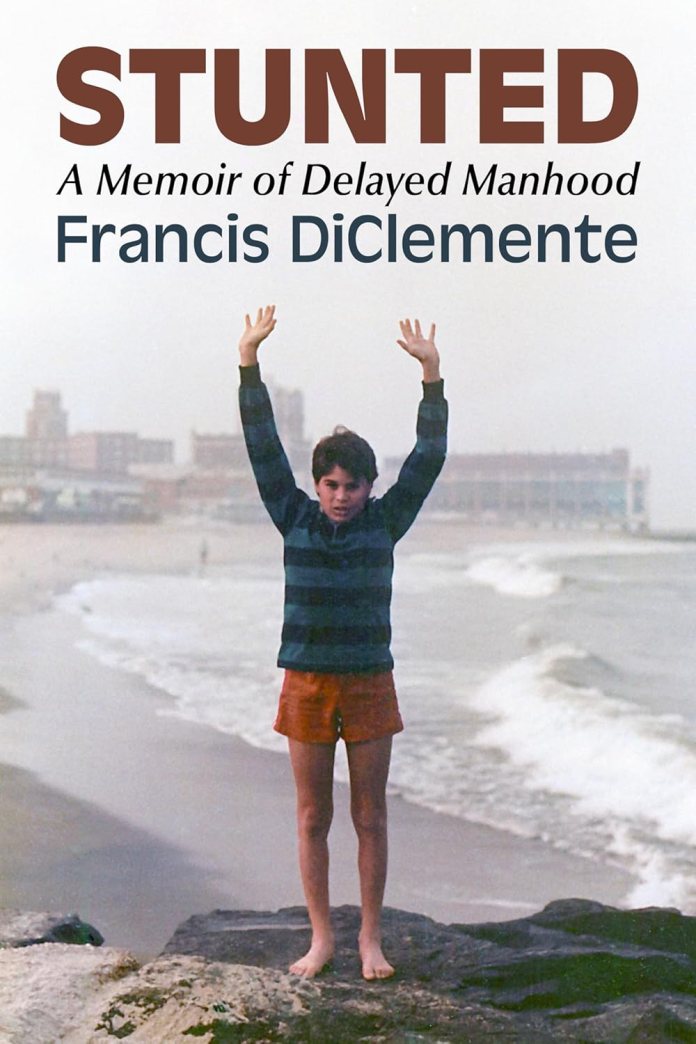
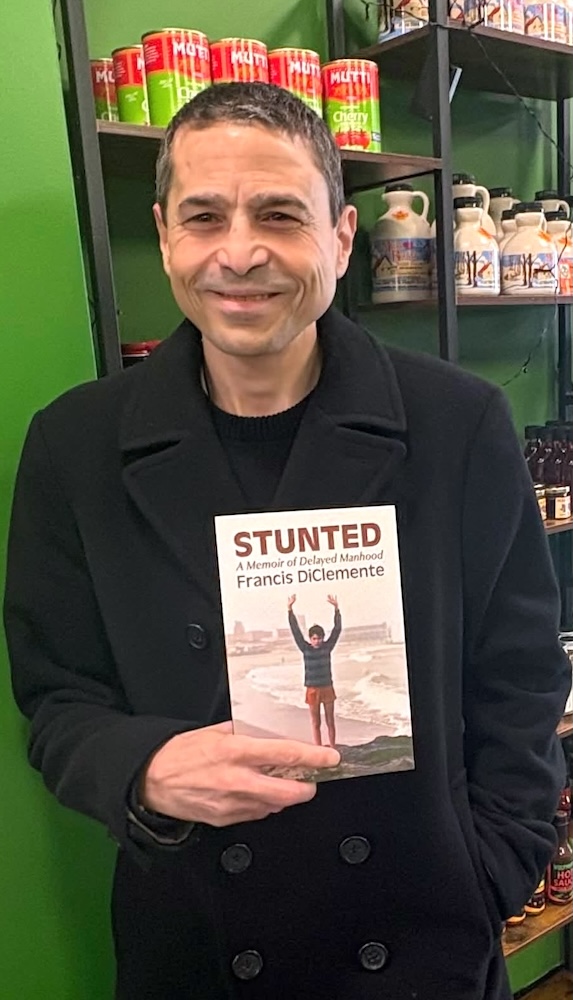
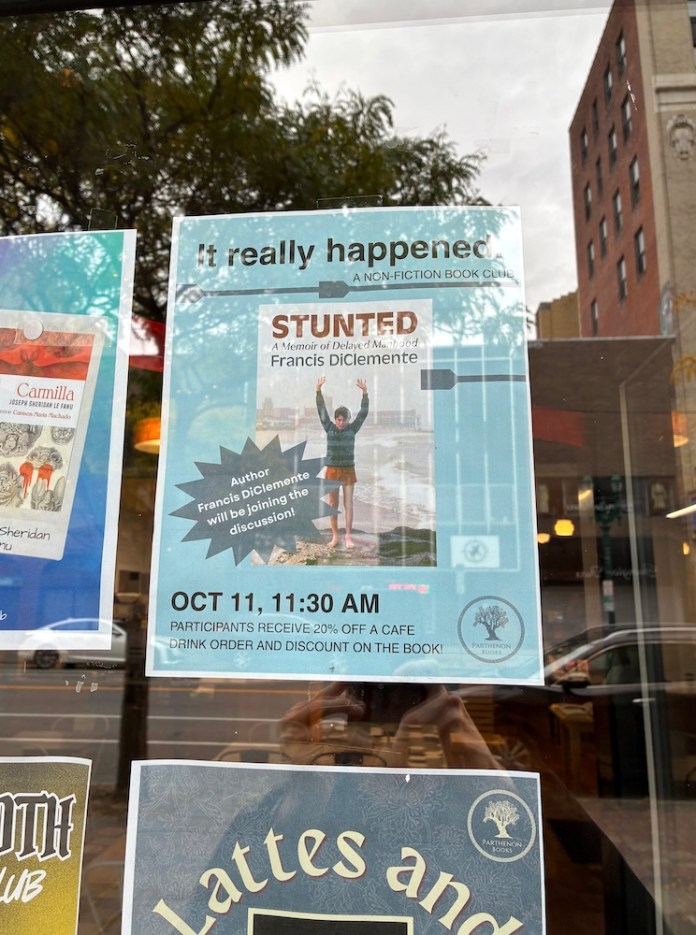
I had a busy and not-so-restful “staycation” in Syracuse this past week with events tied to the launch of my book, Stunted: A Memoir of Delayed Manhood. On Tuesday, June 23, I traveled to my hometown of Rome, New York, for a book reading at Jervis Public Library.

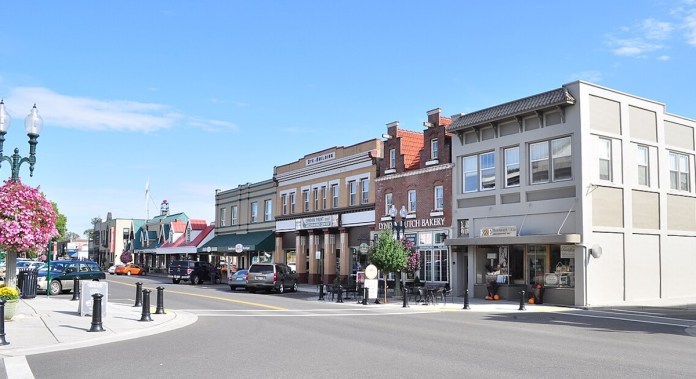
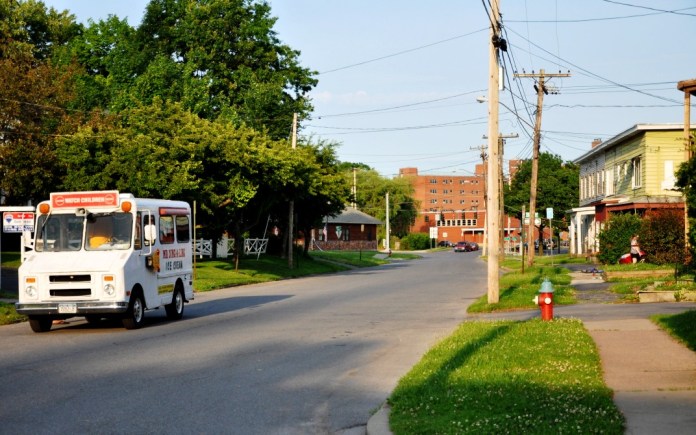
I hadn’t visited the city since Thanksgiving, and the maple trees were in full bloom with branches overhanging the streets in north Rome, presenting a dense, chartreuse canopy. Here’s a picture of some trees I saw near Jervis’s parking lot.

Since my dad, mother, and stepfather have all passed away, I don’t get back to the Copper City very often, and when driving northbound on Black River Boulevard or James Street, I feel more like a visitor than a native Roman. But even so, Rome will always be home to me.

I met my friend Bill Vinci (host of The Empire Plate web show) in the parking lot of Jervis, and we talked for about twenty minutes before he had to leave for a fantasy baseball meeting. It was a beautiful summer night, and attendance was sparse for the reading. But a former neighbor, some friends from high school, my brother, Dirk, and his partner, Donna, and my friend, Bill Soldato (author “Billy the Liquor Guy”) showed up, and I was able to reminisce and catch up with them.

Most of all, I was elated to be holding an event inside the confines of Jervis Public Library—reading from a book I had actually written. That’s because when I was a child, I discovered a love of books and reading at Jervis. And while I attended Mass at St. John the Baptist Church, Jervis served as my true cathedral of learning. It provided a foundation for what would become a literary life and was also a refuge, a safe space where I could escape the domestic unrest punctuated by my parents’ quarrels during my formative years.

During America’s Bicentennial year of 1976, my mother had enrolled me in a summer reading program at Jervis. I was six years old and turning seven that August. The librarian had divided the group into two teams, and we competed against each other for the book tally. I read eighteen books that summer, and I have the certificate to prove it.

While walking through the stacks before my reading, I remembered how the library had introduced me to writers like Ray Bradbury, Ernest Hemingway, John Steinbeck, Thomas Wolfe, Albert Camus, Hermann Hesse, Mark Twain, Sir Arthur Conan Doyle, Virginia Woolf, Charlotte Brontë, and so many others.

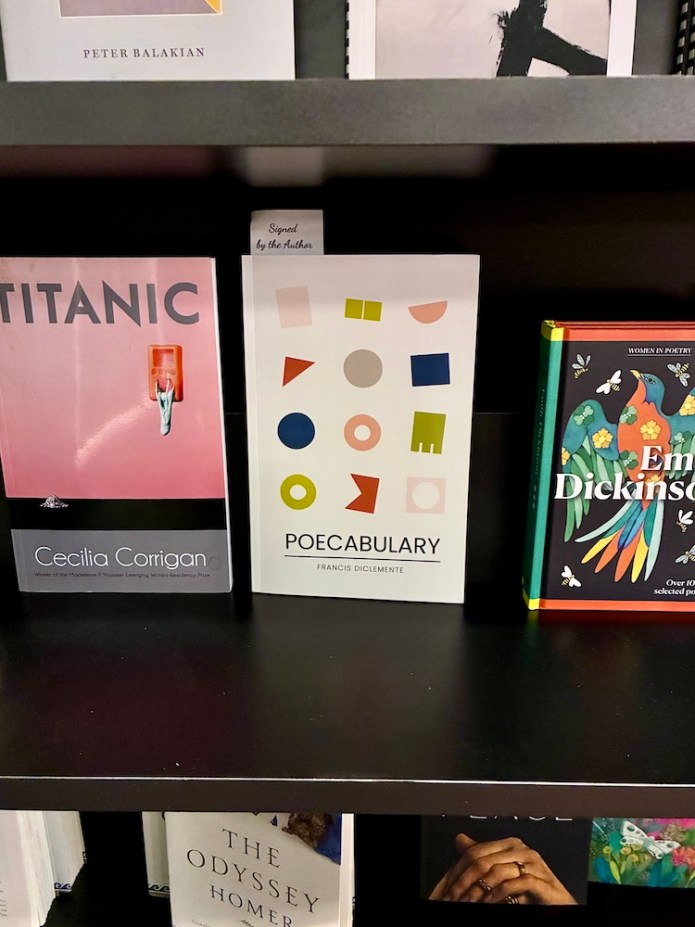
Later, I found some of my poetry books in Jervis’s circulating collection, resting on a shelf in the Literature section, sandwiched between poetry books written by Emily Dickinson and Ralph Waldo Emerson. I thought: “I’ll take it. Not too shabby company.”

##

The following day, Wednesday, June 24, I appeared as a guest on the lifestyle show Bridge Street on WSYR-TV (NewsChannel 9).

I was nervous about the segment because it’s live television. And as a longtime video producer, I’m used to being behind the scenes during production (where I am most comfortable), not acting as a guest or interview subject. Fortunately, once a female member of the crew mic’d me up, and I sat in the guest chair, the interview with hosts Iris St. Meran and Erik Columbia lasted only about five minutes.

Here’s the link if you want to watch it.

I’m abstaining because I don’t want to torture myself. On the way home, I thought about five things I should have said that slipped my mind in the haze of the bright lights and nervous energy of live TV. And to protect my fragile self-esteem, I don’t want to see how I looked and sounded on screen, which I know goes against a book promoting self-acceptance. But as I said in the interview, self-acceptance is a daily effort (and a struggle for me).

##

On Friday, June 26, I was fortunate to read some poems, along with three other poets, as a participant in Verse & Waltz: An Evening of Poetry and Brahms, presented by the Oneida Lake Arts and Heritage Center at St. David’s Parish Hall, in Fayetteville. One of the poems I read came from Stunted.

The theme of the night was “love,” and each poet was allotted about seven minutes. Because I do them so infrequently, I tend to overprepare for readings. I am apprehensive about reading my poems, and I feel the page is the primary home for my verses. I write to be read in text form, as opposed to being heard. So in getting ready for the event, I printed the poems I considered reading for the evening.

I ended up with too many options, but it was a great exercise because I edited a number of the poems—noticing in many places, the works would be much stronger if I cut lines. I also replaced words that would be difficult to pronounce; hence: clasps became clutches, aquiline became beak-like, and vestibule replaced lobby.

I read through my poems, then sat back and enjoyed the music in the second half of the program. And all the German waltzes and fine singing made me want to watch The Sound of Music again.

In preparing for the reading, I realized I have written many poems that have only been published in collections that are print on demand or had small print runs, meaning several verses have had limited release. I do submit poems to magazines and literary journals, but the fees restrict the number of submissions, and the competition for publication is also fierce.

So I’ll be going through my previous collections and publishing them as standalone posts on my blog.

Here are some poems culled from my potential reading list from Friday night. I’ll start with one that is unpublished.

The Safe

In my head
I know
the meaning
of living
is to unlock
the safe
enclosing
the heart
and give
what love
you own
to others.

I fall short—
collecting
but failing to
distribute
the love
I possess.
And so
I ask myself:
Just why am I
holding on to
all that surplus?

In Another Life

In another life,
we would have slow-danced
to Willie Nelson music
in a townie bar in the Catskills,
and made love in your father’s tool shed
on a Sunday afternoon.
In another life,
we would have been married
at sunset in Sylvan Beach, New York,
on a warm June night.

In another life,
we would have had a son named Isaac
and a daughter named Rose.

In another life,
I would have been a master pastry chef
and you a renowned neurosurgeon.

In another life,
troubles would have come,
as they always do,
but our love would have been unshaken.

In another life,
you would have been
more than just a glimpse,
a face in a car rushing by me
in the opposite direction.

(From Sidewalk Stories, Kelsay Books, 2017)

Mother at a School Bus Stop

A middle-aged woman with a white canvas coat
stands with her two young children
at a school bus stop on a misty gray morning.
The boy and girl are bundled up
and jabbering as they bounce around—
unaware that Mondays should be devoid of glee.

When the bus pulls up, the mother hugs the children.
The kids separate from her breast,
scurry up the steps and claim an empty seat up front.
The mother waves goodbye to the little faces
pressed against the window and watches
as the bus pushes away from the curb,
ejecting a thin cloud of exhaust.

The woman turns around,
waits for the traffic light to change
and then crosses the street,
marching up the block to return home.
Once there, dirty dishes, unmade beds and
cigarette butts heaped in black plastic ashtrays
demand her attention until mid-morning,
when the woman leaves the house and rushes to work.

She then counts down the hours
until the school bus returns to the curb
and her two kids hop off and leap into her arms,
almost in unison.

(From Dreaming of Lemon Trees: Selected Poems, Finishing Line Press, 2019)

Landscape

Beauty abounds.
Just look around
and you will see—
a quivering leaf,
a patch of grass,
billowing clouds,
and a slash of light
beneath the bridge.
It’s not a bad world, really—
we just need
to train our eyes
to gaze with wonder,
and marvel at the
transcendental pageantry.
It’s there before you.
But you must zoom out,
zoom out
and refocus the image.
There. Hold it.
Do you see it now?

(From Sidewalk Stories, Kelsay Books, 2017)

Vestiges

My parents are gone.
They walk the earth no more,
both succumbing to lung cancer,
both cremated and turned to ash.

With each passing year,
their images become more turbid in my mind,
as if their faces are shielded
by expanding gray-black clouds.
I try to retain what I remember—
my father’s deep-set, dark eyes and aquiline nose,
my mother’s small head bowed in thought or prayer
while smoking a cigarette in the kitchen.

I search for their eyes
in the constellations of the night sky.
I listen for their voices in the wind.
Is that Rite Aid plastic bag snapping in the breeze
the voice of my father whispering,
letting me know he’s still around …
somewhere … over there?
Does the squawking crow
perched in the leafless maple tree
carry the voice of my mother,
admonishing me for wearing a stained sweater?

Resorting to a dangerous habit,
I use people and objects as “stand-ins”
for my mother and father,
seeking in these replacements
some aspect of my parents’ identities.

A sloping, two-story duplex with cracked green paint
embodies the spirit of my father saddled with debt,
playing the lottery, hoping for one big payoff.
I want to climb up the porch steps and ring the doorbell,
if only to discover who resides there.

In a grocery store aisle on a Saturday night
I spot an older woman
standing in front of a row of Duncan Hines cake mixes.
With her short frame, dark hair, and glasses,
she casts a similar appearance to my mother.
She is scanning the labels,
perhaps looking for a new flavor,
maybe Apple Caramel, Red Velvet, or Lemon Supreme,
just something different to bake
as a surprise for her husband.
A feeling strikes me and
I wish to claim her as my “fill-in” mother.
I long to reach out to this stranger in the store,
fighting the compulsion
to place a hand on her shoulder
and tell her how much I miss her.

I fear that if my parents disappear
from my consciousness,
then I too will become invisible.
And the reality of a finite lifespan sets in,
as I calculate how many years I have left.
But I realize I am torturing myself
with this twisted personification game.
I must remember my parents are dead
and possess no spark of the living.
And I can no longer enslave them in my mind,
or try to resurrect them in other earthly forms.
I have to let them go.
I have to dismiss the need for physical ties,
while holding on to the memories they left behind.

And so on the night I see the woman
in the grocery store aisle,
I do not speak to her,
and she does not notice me lurking nearby.
But as I walk away from her,
I cannot resist the impulse to turn around
and look at her one last time—
just to make sure
my mother’s “double” is still standing there.
I want her to lift her head and smile at me,
but she never diverts her eyes
from the boxes of cake mixes lining the shelf.

(From Sidewalk Stories, Kelsay Books, 2017)


Standard

Father’s Day Forgotten

I thought I would post this poem, “Father’s Day Forgotten,” in the spirit of the day to honor dads. One note: the poem is fictional; the only connection with my real father is that he once owned a green couch when he lived in a small house on Mohawk Street in Rome, New York, after my parents divorced in the early 1980s.

A photo of my father and me following my Confirmation in 1984.

The poem appeared in my 2012 poetry collection Vestiges, published by Kelsay Books/Alabaster Leaves Publishing, and later in Dreaming of Lemon Trees: Selected Poems (Finishing Line Press, 2019).

Happy Father’s Day to all the dads and father figures out there.

“Father’s Day Forgotten”

Daddy and Christi parted ways at a bus depot
In the early morning hours.
No big scene, just a kiss on the cheek,
Then she turned around and was gone for good—
Hopping aboard a Trailways bus headed westbound for Chicago.
And she never looked back.

Daddy went home to his beer bottle and sofa seat,
And he drew the living room curtains on the rest of the world,
Letting those four eggshell walls close in and swallow him up,
Wasting away in three empty rooms and a bath.

And the memories can’t replace his lost daughter and wife.
So he tries not to remember his mistakes
Or how he drove them away.
Instead, he recalls Halloween pumpkins
Glowing on the front porch,
Training wheels moving along the uneven sidewalk,
Little hands reaching for bigger ones in the park,
And serving Saltine crackers and milk
To chase away the goblins that haunted
Dreams in the middle of the night.

Now Christi has a life of her own,
And she lets the answering machine catch
Daddy’s Sunday afternoon phone call.
She never picks up and rarely calls back.
So Daddy returns to the green couch
Pockmarked with cigarette burns.
He closes his eyes, opens the door to his memory vault
And watches the pictures play in slow-motion.
He rewinds again and again,
without noticing the film has faded
and the little girl has stepped out of the frame.

Standard

Daily Orange Q-and-A

The Daily Orange, the independent, student-run newspaper at Syracuse University, published a Q-and-A article featuring me and my book, Stunted: A Memoir of Delayed Manhood. I’m honored to appear in the pages of the newspaper, which I read religiously as a staff member at SU. You can read the piece here.


Standard

Poecabulary: One Year Later

One year ago this week, I published my wacky passion project, Poecabulary, which is a minimalist poetry collection and conceptual art piece. To celebrate, I am running a free Kindle book promotion through Friday, June 5. If anyone would prefer a PDF version, please email me at ffd1284@gmail.com.

Poecabulary front cover.

This project originated with some wordplay and Photoshop edits back in 2013. And while the collection contains fewer than 700 words (across 190 pages), it took me more than ten years to curate, select, refine, and edit the 156 word pairings that comprise the book.

Here’s the back-of-the book description:

Poecabulary is a minimalist poetry collection that blurs the line between vocabulary and verse. Words appear in unexpected pairings, creating connections that surprise, challenge, and invite reflection. Each combination is a deliberate act of linguistic play, where alliteration, sound, appearance, randomness, rhyme, and meaning collide.

The author explores how similar or opposing words interact, encouraging readers to discover their interpretations and associations. Both a playful exercise and a meditation on language, Poecabulary celebrates the power and flexibility of words.

This collection will resonate with language lovers, poetry enthusiasts, and anyone curious about how words shape meaning. Sample pairings include Autistic/Artistic, Diffident/Different, Lonely/Lovely, Perfection/Perception, and Reject/Respect.

Standard

Six-Month Reprieve

I’m brimming with gratitude for having wrapped up a great week. On Monday, Memorial Day, my memoir, Stunted: A Memoir of Delayed Manhood, was officially released by Toplight Books, an imprint of McFarland & Company. My Goodreads Giveaway continues until June 1 if you want to try to win a copy.

You can also find the book on Amazon or Bookshop.

On Tuesday afternoon, I had my sixth-month follow-up appointment with my neurosurgeon, Dr. H. I received the radiologist’s report early Tuesday morning when I logged into Upstate’s patient portal. Upon reading that the tumor had grown measurably since the last scan in September, two thoughts swam through my brain—can the radiation oncology team hit the tumor with another round of Gamma Knife radiosurgery, and, if not, can I schedule my brain surgery over the summer so it won’t disrupt my busy work schedule that ramps up during the fall semester at Syracuse University?

To make it to my appointment, I had to take a Centro bus out to the Upstate University Medicine office in the Township 5 shopping center in Camillus, which is an Area 51-sized example of suburban sprawl.

Here are the quotes from the report that troubled me:

There has been “significant interval enlargement of the sellar and suprasellar mass consistent with known craniopharyngioma. On the current examination the mass measures 2.3 x 1.4 x 2.1 cm. On the comparison study dated 9/3/2025 the mass measured 1.6 x 1.1 x 1.7 cm.

“. . . There is worsened superior displacement and compression of the optic chiasm right worse than left.”

Yet when I see the always sanguine, gum-snapping Dr. H., he’s unruffled by the latest report. Dressed in a green, plaid flannel shirt and brown khakis, he takes a seat and explains that he reviewed the previous scans, lined everything up, and determined that the tumor has not grown significantly. He tries to allay my fears by giving me a detailed description of how different MRI machines or variations in the “slices of images” can affect the interpretation of the scan.

My two latest MRI scans appear on computer screens. The image on the left is from September, and the one on the right is from this May. The craniopharyngioma is the circular object in the middle of the brain.

Dr. H’s recommendation: Wait and see. Reschedule another MRI in six months.

I have no objection to this approach, and I left the office feeling grateful for another six-month reprieve—another half a year to live with no scheduled surgical intervention.

At the same time, I know the tumor isn’t sitting idle. It’s in a constant state of aggregation, growing steadily as the fluid inside expands, and at some point, it will likely provoke headaches and double vision (more than just to my extreme right).

But I try not to fall victim to the futility of worrying about my health (easier said than done).

##

On Friday, Upstate posted my conversation with host Amber Smith on the Informed Patient podcast. I much prefer pitching questions instead of fielding them.

I’ve conducted countless interviews in my role as a video producer at SU since 2007, and it’s definitely weird to be on the other side, to be the interviewee and not the interviewer. But it gave me a warm feeling of nostalgia for my radio days (circa 1996-2006).

Standard

Book Release and Giveaway

Today marks the completion of a dream with the publication of my memoir, Stunted: A Memoir of Delayed Manhood. To celebrate my publication date, I am running a Goodreads giveaway. It ends on June 1, and I’ll be giving away two signed copies of the book.

I don’t have much experience with signing books, but I have never understood the practice of authors crossing out their printed name when they sign their books. To me it feels like defacing a work of art.

Standard

Silly Little Adventure of Earth

I finished reading Jack Kerouac’s The Dharma Bums and I wanted to share one more passage that stood out to me. In this scene, during a massive going-away party for the character Japhy, held in Berkeley, California, the narrator, Ray Smith (Kerouac), reflects on people and existence:

“Then I suddenly had the most tremendous feeling of the pitifulness of human beings, whatever they were, their faces, pained mouths, personalities, attempts to be gay, little petulances, feelings of loss, their dull and empty witticisms so soon forgotten: Ah, for what? I knew that the sound of silence was everywhere and therefore everything everywhere was silence. Suppose we suddenly wake up and see that what we thought was this and that, ain’t this and that at all? I staggered up the hill, greeted by birds, and looked at all the huddled sleeping figures on the floor. Who were all these strange ghosts rooted to the silly little adventure of earth with me? And who was I?”

My battered copy of The Dharma Bums by Jack Kerouac.

Standard

My Books Arrive

My first shipment of books from McFarland & Company arrived yesterday. I’m so glad to see this book become a real thing—not just an idea in my head—because the project took more than 10 years to complete.

“Stunted: A Memoir of Delayed Manhood” is a coming-of-age story about identity and self-acceptance, told through the lens of my journey to adulthood after being diagnosed with a brain tumor when I was 15 years old.

The contains about 40 black-and-white photographs, medical records dating back to 1984, and diary entries from the early 1990s and beyond. It’s also loaded with sports and pop culture references from the ’80s and ’90s (e.g., Doug Flutie and The Cure).

I’m scheduled to give a reading at 6 p.m. on Tuesday, June 23, at Jervis Public Library in Rome, where, as a youth, I discovered my love of books and was introduced to authors such as John Steinbeck, Ernest Hemingway, Ray Bradbury, Albert Camus, Hermann Hesse, Joyce Carol Oates, and many others. I hope I won’t be so nervous that I ramble and babble.

A certificate for my participation in a summer reading program at Jervis Public Library in Rome in 1976.

Standard

Writing in the Morning

An early spring morning.
The refrigerator hums
in the kitchen
and sunlight streams
into the living room
while I write in a spiral notebook,
the sound of the ballpoint pen tip
scratching against the white paper.

In this moment
I realize the act of writing—
the mechanical activity
of jotting down
one word after the other,
leading to verbal connections
and accumulated sentences—
delights me and uplifts my spirit,
even if the words I write
add up to nothing.

And I will keep writing
without knowing the result,
having no expectation of success,
because I must—
because stopping is impossible,
since writing was never a choice for me—
instead, it’s an involuntary exercise
with the pen moving across paper
providing evidence of my existence.

Standard