Excerpts: Poems for Lorca

Today, I present two poems from the chapbook Poems for Lorca, written by the late Syracuse journalist Walt Shepperd. I discovered the collection in the small gift shop in ArtRage Gallery.

I mistakenly thought the title referenced Spanish poet Federico García Lorca. But in the dedication page, Walt wrote: “For my daughter Lorca.”

Poems for Lorca by Walt Shepperd.

I’ve read this first poem multiple times, and I still don’t understand its meaning. But the ambiguous nature makes me appreciate the work even more. The words first hit me when I flipped through the book while walking along Crouse Avenue after leaving ArtRage on a sunny spring day. I think the poem has a timeless, universal quality.

An Easement for the Highway in Your Mind

The tinder has dried
and bridges
roots
and the canvas
in the windowframes
of someone else’s yesterdays
smolder
from sparks
carried
on an imperceptible breeze
down a road
between
trees
and tents
and tenements
over timbers
charred beyond support
of tomorrow’s weight.

They say
you can’t go home again
and they are mostly wrong
but your return
must be guided
by bulldozer tracks
and burial mounds
and streams filled in
with silt
of ruins crumbling
from your backward glance.

##

The second poem also has a great title and a sense of mystery.

I Dreamt I Took a Two Week Vacation
in an Audrey Hepburn Movie

I never wanted birthdays
and Christmas
and mother’s day
to be what now
it seems
they must become,
excuses for remembering
that time is now a luxury.

We build new worlds
and gather things
that patch the strands
that chafe our shells
that brace our memories
into barricades
that must stand by themselves
for time is now a luxury.

The things we gather
gather dust
the barricades
won’t stand a charge
the boxes burn
the seeds grow mold
the papers crumble in the new light,
and love becomes the luxury.

Shepperd, Walt. Poems for Lorca. W.D. Hoffstadt & Sons, 2012.

I intend to place the book in a Little Free Library in my neighborhood so another reader can appreciate Walt’s words.

Standard

Cut While Shaving

I recently finished reading The Last Night of the Earth Poems by Charles Bukowski (Ecco, 2002; previously published by Black Sparrow Press in 1992). Bukowski feels like an old friend to me, and I love picturing him sitting in his house, drinking wine and listening to classical music on the radio while he bangs away at the typewriter.

The book is a beefy collection filled with the typical Bukowski charm—a combination of vulgarity, humor and humanity.

As someone of advancing age, often filled with regret over the detours and wrong decisions I’ve made in my life, one particular poem hit home for me.

Cut While Shaving

It’s never quite right, he said, the way people look,
the way the music sounds, the way the words are
written.
It’s never quite right, he said, all the things we are
taught, all the loves we chase, all the deaths we
die, all the lives we live,
they are never quite right,
they are hardly close to right,
these lives we live
one after the other,
piled there as history,
the waste of the species,
the crushing of the light and the way,
it’s not quite right,
it’s hardly right at all
he said.

don’t I know it? I
answered.

I walked away from the mirror.
it was morning, it was afternoon, it was
night

nothing changed
it was locked in place.
something flashed, something broke, something
remained.

I walked down the stairway and
into it.

Standard

Goodreads Giveaway

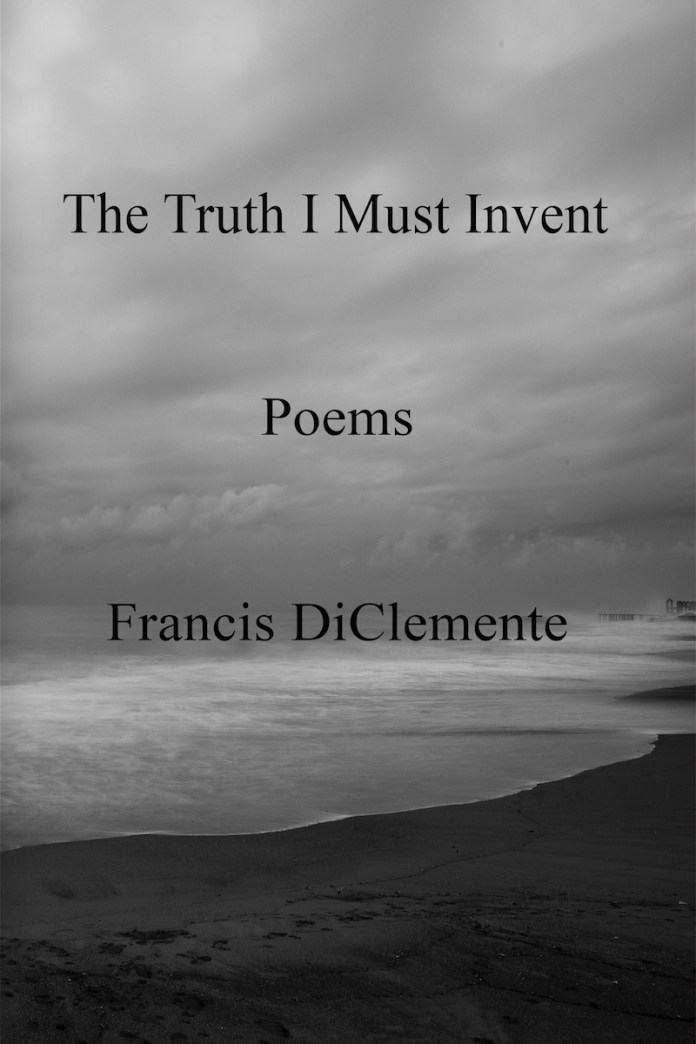
I am giving away two signed copies of my latest poetry collection, The Truth I Must Invent. You can enter on Goodreads. The giveaway ends on Feb. 23.

The Truth I Must Invent book cover.

The Truth I Must Invent is a collection of narrative and philosophical poems written in free-verse style. Employing a minimalistic approach and whimsical language, the book explores the themes of self, identity, loneliness, memory, existence, family, parenthood, disability, gratitude, and compassion.

Standard

Poetry Anthology

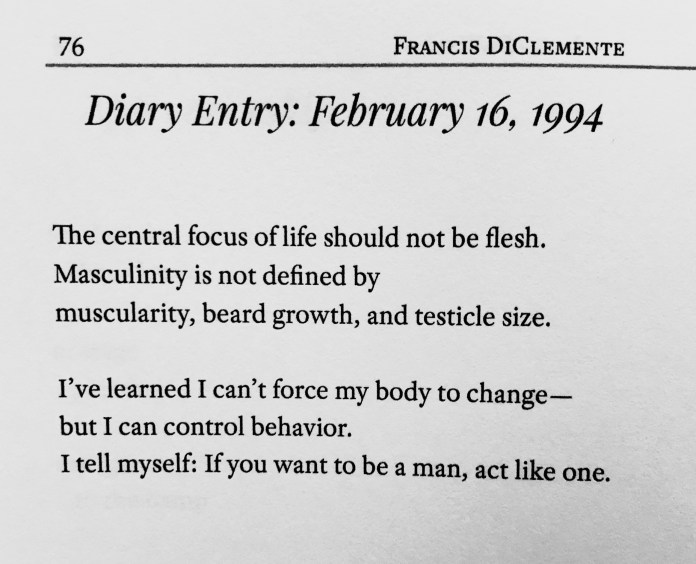
I am excited to share that one of my poems is published in a new anthology entitled Masculinity: an anthology of modern voices (Broken Sleep Books, 2024). The book is edited by Aaron Kent, Rick Dove and Stuart McPherson.

Anthology book cover. Cover design by Aaron Kent and Joseph Kent.

According to the book description, the anthology “aims to showcase the diversity of what it means to be a man and what it means to embrace its multitudes. These poems emphasize that masculinity is not a monolithic concept, but a dynamic, evolving force that can be shaped by culture, society, and personal experiences.”

Here’s my contribution:

Diary Entry: February 16, 1994. Copyright Francis DiClemente.

Standard

Illuminating Poem: The Thing Is

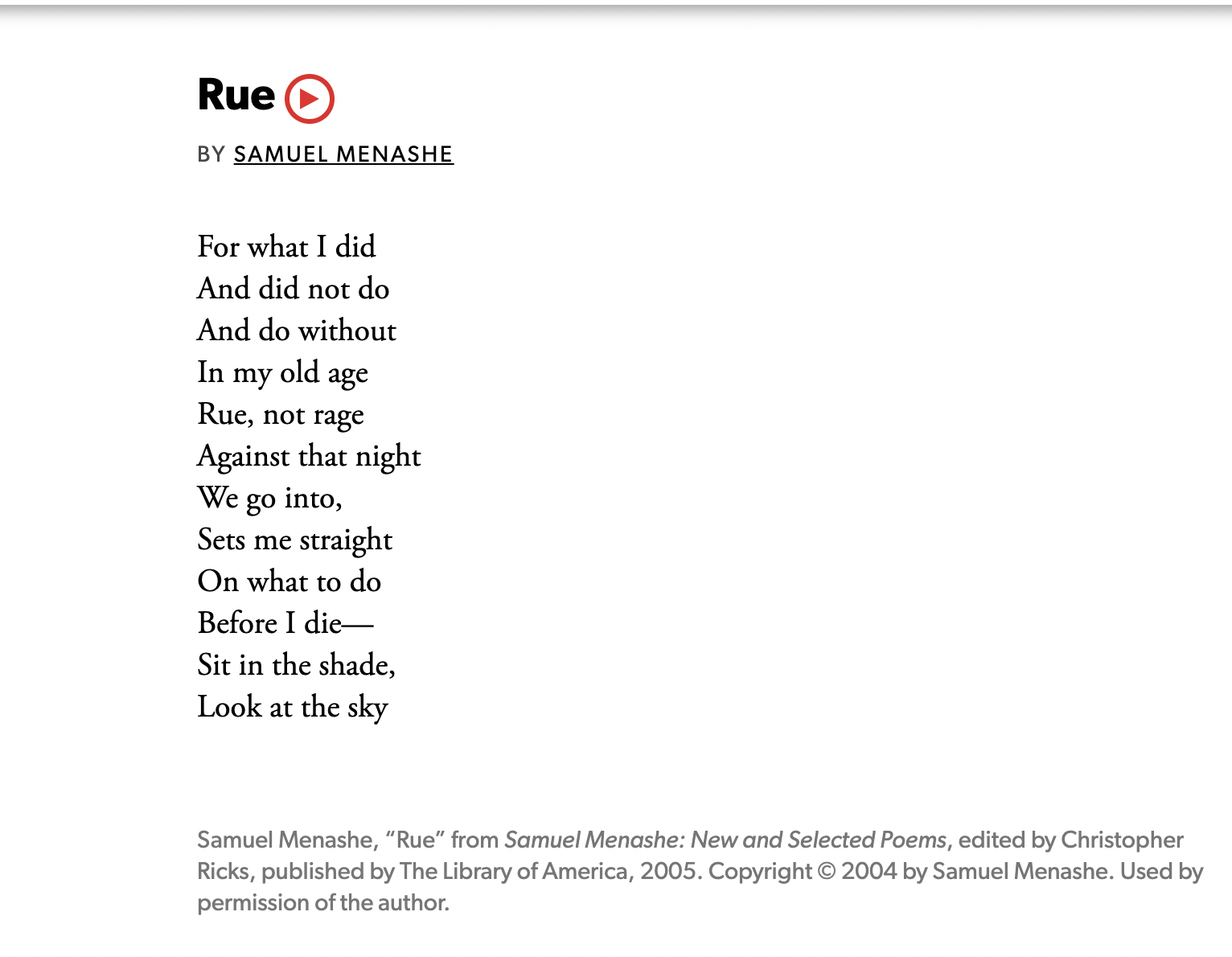
I want to share this poem I read in a Substack post by Maya C. Popa. It’s entitled “The Thing Is” from Mules of Love by Ellen Bass (published by BOA Editions in 2002). I love the language, clarity and gut-punching delivery. Some snippets that jumped out at me: “the silt of it,” “grief sits with you,” “obesity of grief” and “a plain face.”

“The Thing Is” by Ellen Bass from the book Mules of Love (BOA Editions, 2002)

Standard

New Year’s Reflections

New Year’s Eve 2023. Time to rewind and then hit reset.

I’m grateful for getting another 365 tokens to drop into the slot machine. Another 365 scratch-off lottery tickets to play. Another 365 chances to be better than the day before.
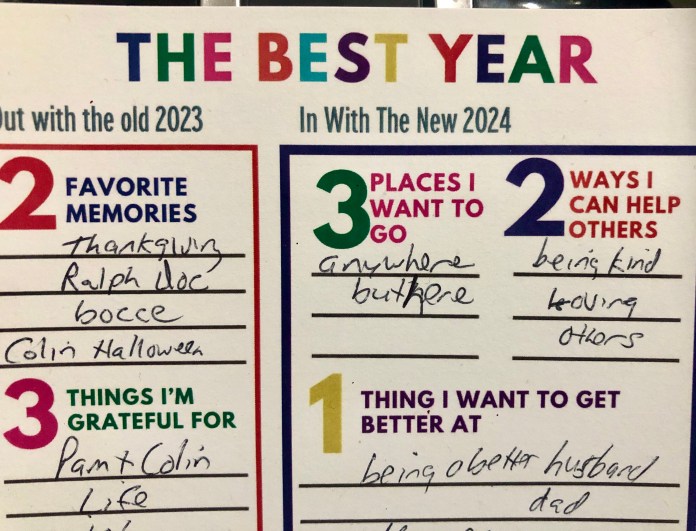
Card from David’s Refuge.

I’m closing out the year filled with both anxiety and excitement.

By all accounts, 2023 was a pretty good year for me. I made some strides as a writer and filmmaker.

I earned an Emmy (my second) as part of a production team at Syracuse University.
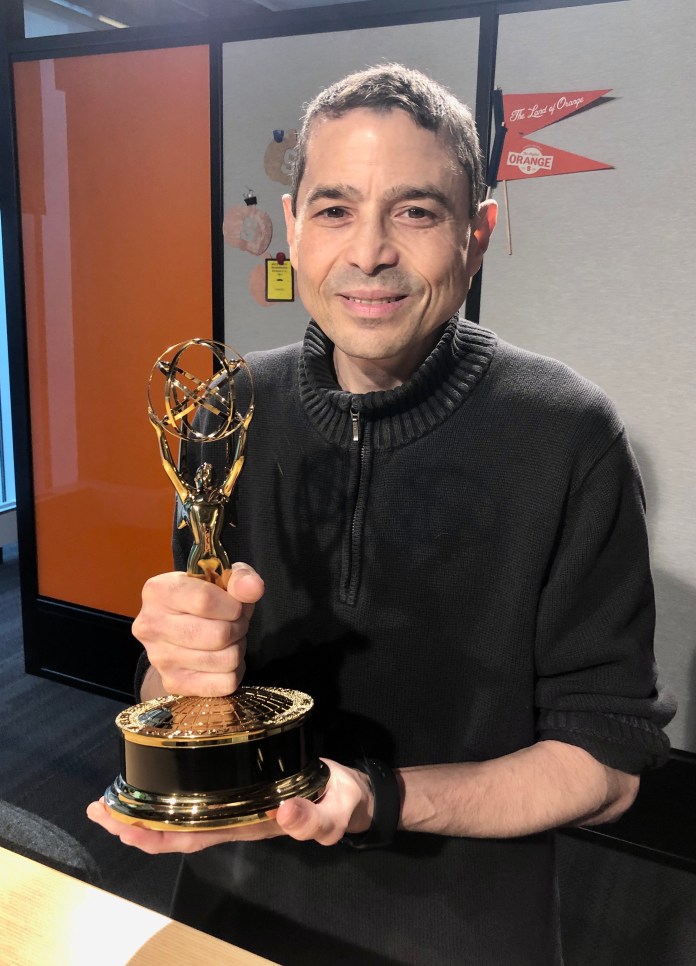
Photo by Shane Johnson.

I published a full-length poetry collection, The Truth I Must Invent. I published a couple of short stories and a short play in some literary magazines.
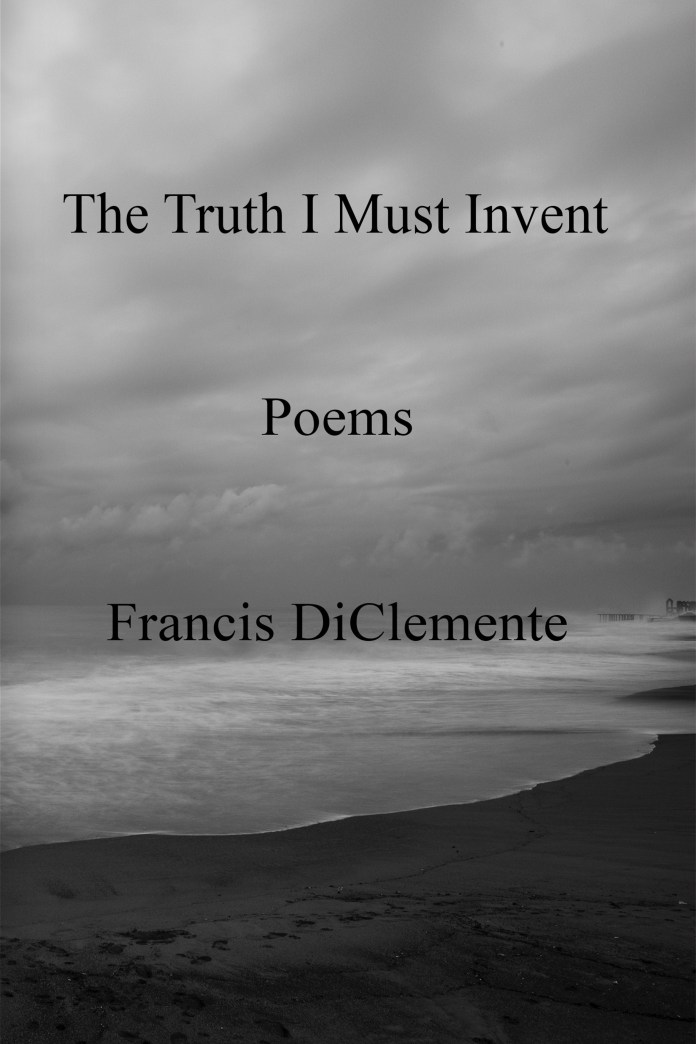
The Truth I Must Invent book cover.

I completed two short documentary films, Ralph Rotella: The Sole of Syracuse, which premiered at the Syracuse International Film Festival and was an official entry at the Culver City Film Festival, and The World Series of Bocce: A Celebration of Sport, Family and Community, which is awaiting festival decisions.

World Series of Bocce title screenshot.

I completed a feature screenplay and a full-length coming-of-age memoir (a ten-year project!). But despite numerous revisions, I still don’t know if the words on the page are memorable or whether either project will come to fruition (e.g., production or publication).

So those are my accomplishments in 2023. Big whoop, right? Yada-yada-yada. Blah-blah-blah.

Here are the standout moments during the last calendar year.

In June, my Aunt Teresa, a.k.a. Sister Carmella DeCosty, visited Central New York to attend the funeral of her brother, my Uncle Fee, in Rome, New York. She stayed with us in Syracuse, and we had a lot of fun catching up.
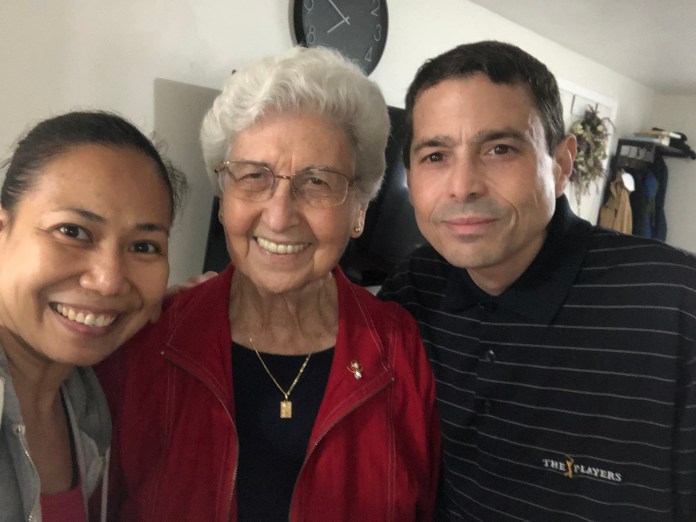
Pam and Aunt T.

A flashback of Aunt T. during a holiday at my maternal grandparents’ house. I think that’s me on her lap, with my mom in red and my Aunt Pat in black.

My seven-year-old son, Colin, who is autistic, enjoyed trick-or-treating for the first time this Halloween. I think he actually “got it” this year.

Colin getting ready to trick-or-treat.

I spent Thanksgiving with my brother Dirk and his family in Rome and my sister Lisa and her family from Ohio. The best part—no snow!

For the holiday season, my wife Pam hung a stocking for Colin in mid-December and gave him little presents every day—stuff like Kinder Joy eggs and Play-Doh. He seemed to understand the concept of Santa Claus, and he was excited to open presents on Christmas morning.

Pam and Colin.

Pam went back to school this fall, enrolling in an occupational therapy assistant program at Bryant & Stratton College. The workload was arduous, but Pam scored high grades during her first semester.

But the most significant event of 2023—I survived my sixth brain surgery with my brain function and memory intact. In July, a team of neurosurgeons and ENT surgeons at Upstate performed a transsphenoidal (through the nose) surgery to remove parts of a craniopharyngioma that had been growing near the pituitary region, affecting my vision. I had a cerebral spinal fluid leak during surgery, but the ENT surgeon repaired it, and the patch is holding nearly six months later.

I wish all good things for you in 2024. A partial list includes: Love, family, faith (whatever you choose that to be), employment, health, health insurance, kind co-workers, transportation, clean drinking water, food, a home, a roof, four walls, a furnace, indoor plumbing, electricity, clean air, and trees. Lots of trees. I am supremely thankful for all of the above.

I leave you with a couple of New Year’s-themed poems. It’s amazing what you can find when you do a word search on the Poetry Foundation website.

January by Weldon Kees

Morning: blue, cold, and still.
Eyes that have stared too long
Stare at the wedge of light
At the end of the frozen room
Where snow on the windowsill,
Packed and cold as a life,
Winters the sense of wrong.

Poetry magazine, March 1951.

New Year’s Eve by Maurice Lesemann

The towers give tongue, the wailing horns grow loud;
And this odd planet where we wake and are
Has once again, amid a tumult of cloud,
Swung safely and serenely round its star.

Poetry magazine, April 1932.


Standard

Gifting Books

I hate writing book promotion posts. But this is just a reminder that books make nice holiday gifts and they’re easy to wrap. My latest poetry collection, The Truth I Must Invent, can be purchased in numerous places. You can find it on Amazon, Barnes & Noble, and Bookshop. It’s also available from the publisher, Poets’ Choice. And a new author profile has been posted on the Poets’ Choice website. Happy holidays everyone.

The Truth I Must Invent book cover.

Standard

A Textual Thanksgiving

I want to wish everyone a Happy Thanksgiving. I have much to be grateful for this year, as Black Friday marks four months since my transsphenoidal (through the nose) brain surgery on July 24.

I have rebounded. I’m back to running and lifting light weights, and I can sneeze and blow my nose without any concern about bleeding or cerebral spinal fluid leaks. I am so thankful my recovery has been steady and unremarkable, with no complications (fingers still crossed).

Interpreting the medical jargon in my latest MRI report—it seems residual tumor matter is still pressing against the optic chiasm and affecting the optic nerve. And my vision has not been fully restored since the tumor grew back a few years ago (and likely never will be). I still have double vision when looking to the far right in my peripheral field, and I need a prism on my reading glasses, which I use when working on the computer. But I can drive because I have no double vision straight on.

I want to share a few  Thanksgiving-themed poems. I am currently reading Poems 1962-2012 by the late poet Louise Glück.

Here are two poems that struck me and are relevant for the season. I must admit I don’t understand the meaning of many of Louise’s poems, but I thoroughly respect and admire her artistry with language. And the works remain open to interpretation by the reader.

Autumnal by Louise Glück

Public sorrow, the acquired
gold of the leaf, the falling off,
the prefigured burning of the yield:
which is accomplished. At the lake’s edge,
the metal pails are full vats of fire.
So waste is elevated
into beauty. And the scattered dead
unite in one consuming vision of order.
In the end, everything is bare.
Above the cold, receptive earth
the trees bend. Beyond,
the lake shines, placid, giving back
the established blue of heaven.

The word
is bear: you give and give, you empty yourself
into a child. And you survive
the automatic loss. Against inhuman landscape,
the tree remains a figure for grief; its form
is forced accommodation. At the grave,
it is the woman, isn’t it, who bends,
the spear useless beside her.

Thanksgiving by Louise Glück

They have come again to graze the orchard,
knowing they will be denied.
The leaves have fallen; on the dry ground
the wind makes piles of them, sorting
all it destroys.

What doesn’t move, the snow will cover.
It will give them away; their hooves
make patterns which the snow remembers.
In the cleared field, they linger
as the summoned prey whose part
is not to forgive. They can afford to die.
They have their place in the dying order.

And in doing some research, I found another “Thanksgiving” poem, this one by Ella Wheeler Wilcox (1850-1919)

Thanksgiving by Ella Wheeler Wilcox

We walk on starry fields of white
And do not see the daisies;
For blessings common in our sight
We rarely offer praises.
We sigh for some supreme delight
To crown our lives with splendor,
And quite ignore our daily store
Of pleasures sweet and tender.

Our cares are bold and push their way
Upon our thought and feeling.
They hand about us all the day,
Our time from pleasure stealing.
So unobtrusive many a joy
We pass by and forget it,
But worry strives to own our lives,
And conquers if we let it.

There’s not a day in all the year
But holds some hidden pleasure,
And looking back, joys oft appear
To brim the past’s wide measure.
But blessings are like friends, I hold,
Who love and labor near us.
We ought to raise our notes of praise
While living hearts can hear us.

Full many a blessing wears the guise
Of worry or of trouble;
Far-seeing is the soul, and wise,
Who knows the mask is double.
But he who has the faith and strength
To thank his God for sorrow
Has found a joy without alloy
To gladden every morrow.

We ought to make the moments notes
Of happy, glad Thanksgiving;
The hours and days a silent phrase
Of music we are living.
And so the theme should swell and grow
As weeks and months pass o’er us,
And rise sublime at this good time,
A grand Thanksgiving chorus.

Lastly, at a recent appointment at my primary care doctor’s office, I noticed a framed picture of a prose poem entitled “Desiderata” hanging on the wall in an exam room.

The line at the bottom of the page reads, “Found in Old St. Paul’s Church, Baltimore, Dated 1692.” But the piece was actually written in 1927 by Max Ehrman, an Indiana attorney and poet. Some information on the website of Old St. Paul’s Church recounts the story.

And here is the full text. I highlighted some parts that stood out to me.

Desiderata by Max Ehrmann

Go placidly amid the noise and the haste, and remember what peace there may be in silence. As far as possible, without surrender, be on good terms with all persons.

Speak your truth quietly and clearly; and listen to others, even to the dull and the ignorant; they too have their story.

Avoid loud and aggressive persons; they are vexatious to the spirit. If you compare yourself with others, you may become vain or bitter, for always there will be greater and lesser persons than yourself.

Enjoy your achievements as well as your plans. Keep interested in your own career, however humble; it is a real possession in the changing fortunes of time.

Exercise caution in your business affairs, for the world is full of trickery. But let this not blind you to what virtue there is; many persons strive for high ideals, and everywhere life is full of heroism.

Be yourself. Especially do not feign affection. Neither be cynical about love; for in the face of all aridity and disenchantment, it is as perennial as the grass.

Take kindly the counsel of the years, gracefully surrendering the things of youth.

Nurture strength of spirit to shield you in sudden misfortune. But do not distress yourself with dark imaginings. Many fears are born of fatigue and loneliness.

Beyond a wholesome discipline, be gentle with yourself. You are a child of the universe no less than the trees and the stars; you have a right to be here.

And whether or not it is clear to you, no doubt the universe is unfolding as it should. Therefore be at peace with God, whatever you conceive Him to be. And whatever your labors and aspirations, in the noisy confusion of life, keep peace in your soul. With all its sham, drudgery and broken dreams, it is still a beautiful world. Be cheerful. Strive to be happy.


Standard

Urban Exploration

I had a morning eye doctor’s appointment earlier this week. And I had some time to kill before the dilation drops rendered my eyes useless for the rest of the day. After getting off the bus at Washington Street near City Hall, I cut across Montgomery Street while making my way to Presidential Plaza.

St. Paul’s Church. Photo by Francis DiClemente.

Brick wall with ivy. Photo by Francis DiClemente.

Along the way, I snapped a few photos with my antiquated, battery-challenged iPhone 8, jotted down a quick poem about some feathered denizens of the Salt City, and captured a moment of tranquility on a sunny morning downtown.

I felt grateful for the opportunity to capture a myriad of sights and sounds the universe sent my way. It was another reminder to always pay attention to my surroundings and be on the lookout for creative inspiration. Here’s the poem I wrote. It required significant revision as it made the transition from my pocket notebook to my computer.

Bird Chatter

Three pigeons
perched on a wire.

What are they
talking about
on this bright,
sunny morning?

But their conversation
is restricted—not for
human interpretation.

And the chatter ends
when the birds
lift from the wire,
taking off in formation,

flapping their wings,
and sending feathers
twirling to the ground.


Standard

Jumpcuts of Thought

I was flipping through one of my older poetry books—Dreaming of Lemon Trees: Selected Poems (Finishing Line Press, 2019)—and I came upon “Jumpcuts of Thought.” I like the stupid absurdity of it, and I thought I would share the poem, since many people have not read it in book form. It’s also one of the only poems I’ve written that employs the use of rhyme.

Jumpcuts of Thought

Clorox shine
and Rust Belt mine.

Ruddy hue
and Spade gumshoe.

Tootsie Pop
and soiled mop.

J.S. Bach
and Shakur, Tupac.

Codeine high
and ham on rye.

Minnie Mouse
and adobe house.

Petrie dish
and sardine fish.

Rockwell print
and strand of lint.

Ruby Dee
and Wounded Knee.

Swollen lip
and radar blip.

Clark Gable
and Aesop fable.

Toilet seat
and sirloin meat.

Shower stall
and Camus’s The Fall.

Mustard green
and college dean.

Lowell, Mass.
and Namath pass.

The odd pairings
go on and on,
in this celebration of incongruity—
a verbal exercise
to stimulate the mind.


Standard