I heard the sad news that one of my favorite teachers, Anthony Lanzi, passed away. This is an essay I wrote about him a few years ago.
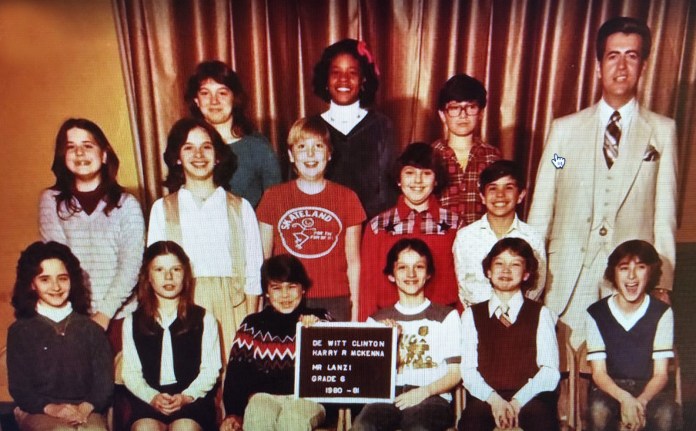
Mr. Lanzi’s sixth-grade class, DeWitt Clinton Elementary School, Rome, New York (1980-81). I’m third from the left in the first row.
Our sixth-grade teacher, Mr. Lanzi, was a towering figure with a swarthy complexion and dark, wavy hair teased high and coated with hairspray. Not a strand seemed out of place. Imagine, if you will, a taller, thinner, nattier version of Elvis Presley. That’s how I remember Mr. Lanzi.
I think he had previously studied or worked in the theater, and he wore a hint of makeup to class—light powder on his cheeks—as if he might be called upon in the middle of a school day to fill the role of an understudy and he wanted to be prepared to take the stage and claim his big break.
What I remember most about him were his powerful hands; if my best friend, Billy, and I acted up, Mr. Lanzi would casually walk behind us, the scent of his musky cologne wafting near our desks, place his hands on our shoulders, and squeeze our trapezius muscles. We would squirm in our seats, cease our misbehavior, and pay attention to his instruction.

My best friend Billy and I celebrate our sixth-grade graduation.
Mr. Lanzi’s passion for learning was contagious, and he made education a rich, interactive experience for students. He expanded our imaginations with projects and activities that surpassed textbook knowledge.
Our class hosted special events like Italian Day, when we cooked an Italian supper and learned about Italian culture. I remember trays of food spread out on red and white checkered tablecloths, and our menu included spaghetti, breadsticks, cannoli pastries, and even small cups of espresso (which we sweetened with heaping teaspoons of sugar).

Mr. Anthony Lanzi, our sixth-grade teacher.
Mr. Lanzi’s class produced an annual stage play; during my sixth-grade year we performed a version of Charles Dickens’s A Christmas Carol, and I played the Ghost of Christmas Present, dressing up as Santa Claus for the part. I was disappointed Mr. Lanzi didn’t cast me in the lead role of Ebenezer Scrooge, but he expressed confidence in me that I could make the Ghost of Christmas Present memorable.
He encouraged me to shout “Ho, ho, ho” when I entered the auditorium through the back doors and then sit on the lap of a strict fourth-grade teacher, Mrs. Stocknick, who sat in the audience. His direction led to rousing laughter and applause, and a jolt of energy and excitement rushed through my body as I climbed the steps to the stage.
The lessons Mr. Lanzi imparted have stuck with me to this day. He exposed me to the arts, and he showed me the importance of taking pride in your work.
Mr. Lanzi never had a “dress down” day; instead, he wore clean, dark suits devoid of wrinkles. He never went through the motions or watched the wall clock—wishing the seconds would tick down and the school day end.
And as a firm but compassionate teacher, he served as a strong role model, someone students could admire and emulate.
Mr. Lanzi demanded excellence from the students of DeWitt Clinton elementary school, even though the school was situated in a poor section of Rome, New York, and many of the kids came from low-income families. He expected us to succeed. He didn’t accept our excuses, and his faith in our abilities gave us confidence that we could achieve high goals.

DeWitt Clinton sixth-grade graduation, 1981.
I remember during one of our last classes, after we held our end-of-the-year picnic and before our graduation ceremony, my friend Aimee and I were talking about starting junior high school in the fall. Because Aimee and I were both short, we felt nervous about making the jump to seventh grade and feared getting “swallowed up” in the larger school and getting picked on by the bigger kids.
Mr. Lanzi overheard us and said, “Don’t worry. You’ll both be fine.” And then he smiled and said something like, “Remember, we expect great things from you.”