Book Giveaway

This week marks two years since my last poetry collection, The Truth I Must Invent, was released. The book is available from the publisher, Poets Choice. You can also find it on Bookshop and a Kindle version on Amazon.

The Truth I Must Invent is a collection of narrative and philosophical poems written in free-verse style. The book explores the themes of self, identity, loneliness, memory, existence, family, parenthood, disability, gratitude, and compassion.

I am giving away three print copies of the book, which I will mail to anyone in the U.S. You can use the contact form or email me directly at the gmail address listed in the form.

The Truth I Must Invent book cover.

Selections from the collection:

Man Inside Nighthawks

I assume I was nothing
before I found myself sitting here,
staring straight ahead.

I can’t move my head.
I can’t smoke the cigarette
pressed between the fingers
of my right hand or drink the cup
of coffee resting on top of the counter.
I can’t touch the woman seated next to me
or talk to the other men in the diner.

This is my life: suspended in warm, yellow light,
trapped in a soundless environment—
no water running, no fan whirring, or grill sizzling.
No sirens or street sounds beyond the glass.

Time drags on with no discernible shift—
no transition to morning.
Here, night never ends.

Yet my mind still works.
In fact, it never stops.
I’m cursed with thoughts that run continuously.

Why am I here?
And where exactly is here?
What purpose do I serve?

Do I have a past? Did I live elsewhere,
before I became frozen in this moment—
captured and imprisoned for eternity?

If only I could talk.
If only I could open my lips and make a sound.
Then I could scream for help.
But who would hear my voice?

If only I could stand up
and walk around,
stretch my legs and
stare outside the window.

But since I can’t move,
the composition will remain unaltered,
as I will stay locked in place
inside this painting,
hanging on a gallery wall.

Looking Through Spindles

I climb out of bed and clutch
the white balusters at the top of the stairs
as harsh words fly behind walls
too thin to hold my parents’ rage.

My sister creeps out of her room,
shrugs her shoulders,
and moves toward me in the hallway,
passing the door to the master bedroom.
She sits down next to me
and whispers, “What happened now?”
“I don’t know,” I say.
And we listen for clues, trying to determine
the cause of the latest fight.

Did Dad come to bed drunk
and make advances on our mother?
Did she recoil or lash out, scratching his eyes?
But we hear no violent action
on the other side of the white door—
only voices laced with acrimony.
And we remain seated on the stairs,
exhausted but unable to fall back asleep.

Zooming out, I see those siblings
in a Polaroid image, sealed under a plastic sheet
in a leather-bound photo album.
And as the adult looking back,
breaking the fourth wall,
I wonder why this memory pricks my brain
when so many others would illuminate my parents’
kindness, decency, and exemplary work ethic.
Why, when I could have chosen from
a myriad of positive scenarios,
does this one seize my attention,
demanding to be chronicled?

My mother and father are both dead
and can’t defend their actions.
And I feel riddled with guilt
for tarnishing their memories.
I also understand that the truth
doesn’t always tell the full story.
My conscience obligates me to explain that
while Mom and Dad weren’t perfect,
they loved us and endured sacrifices
to make our lives a little better.
And while that’s a weak way to end a poem,
the wider perspective allows me to
forgive my mother and father for being human—
for being real people and not just my parents.

Craniopharyngioma (Youthful Diary Entry)

Craniopharyngioma gave me
an excuse for being unattractive.
I had a problem inside my head.
It wasn’t my fault
I stood four foot eight inches tall
and looked like I was
twelve years old instead of eighteen—
and then nineteen
instead of twenty-four.
I couldn’t be blamed for
my sans-testosterone body
straddling the line
between male and female.

The brain tumor
spurred questions
about my appearance,
aroused ridicule,
and provoked sympathy.
I heard voices whispering:
“Guess how old that guy is?”
And, “Is that a dude or a chick?”

And while I waited for my
body to mature, to fall in line,
and to achieve normal progression,
I remember wishing the surgeons
had left the scalpel
inside my skull
before they closed me up,
knitting the stitches
from ear to ear.

I prayed the scalpel
would twist and twirl
while I slept at night—
carving my brain
like a jack-o’-lantern—
splitting the left and right
hemispheres,
and effacing the memory
of my existence.

Mattress Moment

You don’t get to cry
“No Fair”
Mr. Hyman Roth.

This is the life
you have chosen.

You don’t get to pine
for your salad days,
whatever the fuck that means.

You don’t get to
flip over the mattress
on the bed you’ve made.

The Wanting is the Hardest Part

Tom Petty was wrong.
The waiting isn’t the hardest part.
The wanting is the hardest part.

Wanting fucks everything up—
wanting a better job, a better marriage,
a better house, a better life.
That seed of desire fucks with your head,
makes you think you can be something you’re not.

What if I discarded desire? What if stopped wanting?
What if I no longer sought a better life?
Can I let go of that fantasy
and accept who I am right now,
without seeking a better version of myself—
the idealized me I hold inside my head?

Resolution

You must
Live the life
You have

And not
The one
You want.

Witness

I look up as a group of birds
circles buildings in downtown Syracuse.
I resist the urge to pull out my cellphone
and snap a picture for Instagram.

Instead, I hold my gaze skyward,
letting the wind swirl around my face
and the rain patter my forehead,
as the birds duck in unison
behind a limestone structure—
the moment preserved nowhere except in my mind.

No pictures retained or sound recorded.
No trace of the birds in digital form.
And I think that’s the point, that’s life—
a collection of these impromptu glimpses of existence,
built into a collage, a kaleidoscope of images
demanding attention when presented.

Crying at Bedtime

Nothing prepares a parent
for the tantrums of an autistic child.
There’s no well of patience to draw from.
You adapt. You divert. You distract.
You do whatever it takes to calm the child down—
until you earn that blessed moment of peace,
when his eyelids drop and he drifts off to sleep,
his small body folded in the cradle of your arms.

Fingers in Hair

I run my fingers through
my son’s tangled mop of brown hair
as he lies next to me in bed.
It’s 4:30 a.m. and we can’t fall asleep.

He waves his hands in front of his eyes,
making stimming motions,
and I imagine his head slamming
against the windshield,
a spiderweb crack forming
in the sheet of glass and
blood pouring from
an opening in his skull.

I press my hand to his head
to try to stop the bleeding,
but the crimson liquid
slips through my fingers
and stains the carpet
and fabric seat covers.

I am reminded of a
Gospel passage (Luke 12:7 NIV):
“Indeed, the very hairs
of your head are all numbered.”

I hold some of my son’s hairs
in my hand and realize
I cannot prevent a
car accident, fall, gunshot wound,
or disease from killing my son.
I can’t prolong or preserve his life.
I can only love him while he still lives.

His hands whip in front of his face,
and he prattles phrases
only he understands.
I bury my fingers deeper
into the mound of his hair and whisper,
“Come on now, sleepy time, Colin.”


Standard

Play Ball

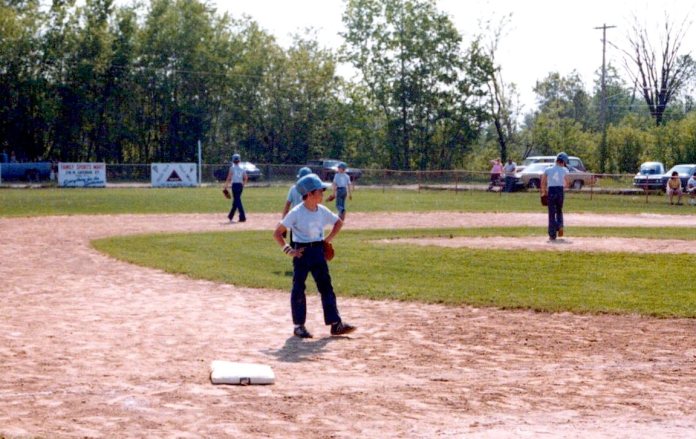
In celebration of opening day in Major League Baseball (Go Yankees!), I am posting two baseball-themed poems. Both appear in my collection Dreaming of Lemon Trees: Selected Poems (Finishing Line Press, 2019).

Playing third base in youth league baseball in Rome, New York, in the late 1970s.

The Shed

Independence Day, Late 1970s (Rome, New York)

Whipped-cream clouds smear a powder blue sky,
while Grandpa nurses a carafe of Chianti
and dreams of waltzing down Bourbon Street.
The DeCosty family gathers on the patio,
with Uncle Fee roasting sausage and peppers
and Nana dribbling olive oil over fresh tomatoes,
then adding alternating pinches of basil and parsley.

Inside the backyard bordered by overgrown hedges,
the rambunctious cousins wham Wiffle balls
with a thin, banana-colored plastic bat,
evoking the hollers of Grandpa …
who watches out for his mint-green aluminum shed,
situated perfectly in left-center field—
serving as our own Green Monster.

And when we get ahold of that little white ball,
it smacks up against the aluminum obstacle,
clashing like two marching band cymbals in a halftime show.
And with sweat coursing down his neck,
Grandpa barks out his familiar line under the patio awning:
“Son of a bitch … keep that goddamn ball away from my shed.”
But Nana is always on our side,
and cancels out his power and keeps him in check.
“Fiore, you let those kids play and mind your mouth,” she says.

Grandpa abandons his no-win cause,
turns up the volume on the Yankee game
and pours himself another glass of red wine.
He watches quietly as the shed stands erect
in the late afternoon sun,
sacrificing its facade for our slew of ground-rule doubles.

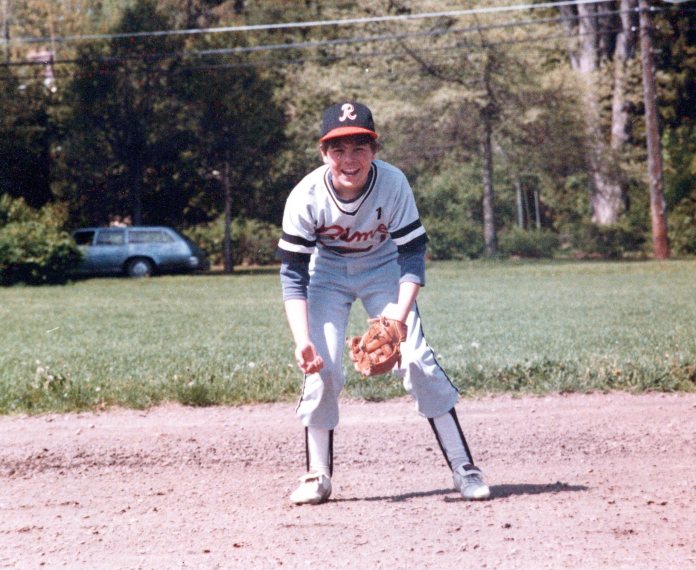
Playing freshman baseball in Rome, New York, in 1984.

Minors

Toledo in July—a Mud Hens game:
Big league dreamers with names like Bubba, Fausto and Tyler
toil away in the minors,
hustling for the scouts perched behind home plate,
diving for line drives and sliding head first,
with egos in check and mouths full of dirt.

Pillars of artificial light frame the setting sun,
and from beyond the azure sky,
the ghosts of washed-up utility infielders
and middle relief pitchers
pull for these hard luck Triple-A players.
They want to scream, “Take heed, savor it now,
for this is the best you will ever be.”
But they’re under orders to keep their mouths shut,
and can only blow a home run foul every once in a while.

The steel girder stands are filled with a crowd
that still believes in this clockless game.
They listen intently for the crack of the bat,
and sing with all their might during the seventh-inning stretch.

Little kids with hot pink shorts and noisy flip-flops
smear their faces with mustard and hug Muddy the mascot.
They scatter peanut shells and scamper after foul balls,
and for them the score is merely an afterthought.

The summer night comes to a close
with a game-ending double play and a fireworks barrage.
The fans file out and load into their cars,
going back to real life with memories of Mud Hens
now stitched in the seams of their minds.

Standard

Winter Blast Poems

With Central New York under a Lake Effect Snow Warning and temperatures set to plummet in the next few days, I am sharing some of my winter-themed poems, along with some recent photos.

Winter Evening

Night—streetlights flicker.
Snow falls softly on sidewalks.
Crews plow the streets clean.

Contrast

Feathers replace leaves
In the naked trees
Looming above Genesee Street,
As flocks of crows arrive to
Take their repose and roost for the night,
The clumps of birds stretching for blocks,
A curtain of black set against
The landscape bleached white by
Fresh-fallen snow and layers of rock salt.

Dreaming of Lemon Trees (Finishing Line Press, 2019)

Golden State

In California, the sun is shining.
In Syracuse, snow is falling.
I want to defrost my toes
by burying them in the sand
at Santa Monica Beach—
watch the waves crashing ashore,
hear the seagulls squawking
and smell the salty air.

But I’m pulled out
of this reverie
by the sound of a
shovel blade
striking pavement
and exhaust fumes
entering my nostrils,
bringing me back to the reality
of a Central New York
scene I can’t escape.

I get in the car and
the warm air from the
heater smacks me in the face
as I scan the FM radio stations,
hoping to come across
the Mamas and the Papas
singing “California Dreamin’.”
That’s as close as I’ll get
to the Golden State
on such a winter’s day.

Outward Arrangements: Poems (independently published, 2021)

Winter Walk

It takes one fall
on the icy sidewalk
for your life to be ruined.
That’s right, just one tumble—
arms flailing,
legs scissoring in the air,
back parallel to the ground,
eyes looking up at a gray sky
unable to intervene—
in a brief suspended
moment before wham—
skull meets ground and blackness ensues.

Traumatic brain injury follows,
and you slip into a coma.
Your family huddles bedside,
waiting for you to rouse,
to wake up and rejoin the living,
like a grizzly bear stepping out
of its den after hibernation.

If you do come out of it
with some brain activity intact,
you may be a shell—withering
in a long-term nursing home.
And while you exist inside,
the costs mount for your family,
and the world outside your window
drags on, unaware of your predicament.
All this because some ice tripped you up.

So don’t be surprised if you see me
walking gingerly on the
glassy surface of the sidewalk,
digging my heels into a
pile of rock salt near the curb,
spreading it around on my soles,
strapping on a pair of
Yaktrax over my boots,
or cutting across the snow-covered lawns.

I guess I don’t mind dying,
or being knocked unconscious,
but I would feel awfully foolish
if a patch of frozen moisture does me in.

Sidewalk Stories (Kelsay Books, 2017)

How to Survive Winter in Syracuse

The only way to survive
a Syracuse winter
is to think of the snow
as a friend and not a foe.

When you scrape the ice
crusted on your windshield
and the snow clogs the streets,
when your tires spin,
or your car veers off the road—
regarding the snow
as a friend and not a foe
will help you to tolerate the season.

Even when the snow lashes
your face as it blows sideways,
or frozen clumps melt inside your boots,
making your feet cold and damp,
you must remember to
view the snow as a friend instead of a foe.

And what a friend … a friend that keeps on
giving and giving and giving
six months out of the year.
To which I say:
Thank you, my dear friend,
but I don’t need your generosity.

Outward Arrangements: Poems (independently published, 2021)

Stranded in Syracuse

In a blizzard like this, you can’t determine gender.
People are just stooped figures,
black forms trudging through the heavy, wet snow,
swallowed by the maw of the storm.

Standard

My New Year’s Resolution

I usually don’t make New Year’s resolutions, but this one came to me amid my battle with a post-Christmas stomach bug (maybe norovirus). In my febrile state, I told myself, “I will stop looking back on the past with regret.”

As someone who writes memoir, I often live in the past—reviewing incidents and conversations that occurred years and decades ago and trying to cull sensory details from those moments to make scenes come alive on the page. So I spend a lot of time on yesterday. My office is overflowing with manuscripts documenting countless yesterdays.

A tree in my neighborhood, observed on Dec. 31, 2024.

But for my 2025 New Year’s resolution, I will attempt to stop that negative line of thought regarding “what could’ve been.” I will instruct myself to stop replaying the poor decisions I made in my progression from boy to man.

And I do have regrets. Many. Most nettlesome are the ones where I let fear stand in the way of opportunity—when I was too frightened to take a risk, either professionally or personally. Some of those decisions still haunt me. In this previous blog post, I wrote about my regret about not moving to California after graduating from college.

But in my sickened state, while I tossed and turned in my son’s twin bed—separated from my wife and son so as not to infect them—I thought, “What have all these regrets done for me?” They certainly don’t make the present more bearable or the future more promising. So why hold on to them?

So in 2025, when I get that tickling of regret inside my brain, I will try to shut it down before it festers.

And one of the poems from my collection The Truth I Must Invent seems fitting for me on this New Year’s Eve. I wish everyone a safe and happy New Year. The poem follows. And I apologize for the profanity, but a clean word replacement wouldn’t have the same effect.

The Wanting is the Hardest Part

Tom Petty was wrong.
The waiting isn’t the hardest part.
The wanting is the hardest part.

Wanting fucks everything up—
wanting a better job, a better marriage,
a better house, a better life.
That seed of desire fucks with your head,
makes you think you can be something you’re not.

What if I discarded desire? What if I stopped wanting?
What if I no longer sought a better life?
Can I let go of that fantasy
and accept who I am right now,
without seeking a better version of myself—
the idealized me I hold inside my head?

Standard

The Casualties of Autumn

It’s the season of beautiful colors, exquisite light and streaming A Charlie Brown Christmas by the Vince Guaraldi Trio. While returning home from a recent jog, the piles of leaves in my neighborhood incited an idea for a poem. Fortunately, I had a pen and some paper to capture the idea before it slipped away.

The Casualties of Autumn

Every leaf strewn in a pile
collected at the curb
had a life before it
separated from the tree
and twirled to the earth.
Is there a home reserved
for the departed souls of leaves—
a place of repose
for the casualties of autumn?


Standard

Falling Back

To mark the end of Daylight Saving Time, I present a poem inspired by autumn scenery. I drafted this poem more than 25 years ago while living with my sister in Toledo, Ohio. I have revised it multiple times over the years, never satisfied with the final result. While this version may not be perfect, I think it’s about the best I can do, and so I release it here.

Falling Back (2024)

Alone on an empty school playground in Toledo, Ohio,
my worn-out sneakers shuffle on asphalt
as I practice left-handed hook shots
on a bent basketball rim with a rusted chain-link net.
The sound of the bouncing ball reverberates
off the school’s red brick façade,
as my reflection jumps out at me in the first-floor windows
adorned with orange paper jack-o’-lanterns.

A towering oak tree with branches like octopus tentacles
observes me as I heave an air ball from three-point land.
It studies my movements while a sharp wind
strips away its cloak of golden-brown leaves.

The cold sticks to my fingertips as I lick them
to get a better grip on the Spalding rubber ball.
And with my nose running incessantly and my chest heaving,
I swallow the chill in the air, trapping it deep inside my lungs.

I pick up my dribble—then stop, smell, look and listen.
Streetlights flicker on in the suburban neighborhood,
and across the road, a pumpkin is perched
on the porch of a modest white house.
The scent of burning leaves wafts in the air.
Charcoal-gray clouds brood in the sky,
and on the western horizon, near a row of pine trees,
there’s a feathering of soft pink light.

At the nearby park, soccer goals stand naked and netless,
and on the gravel softball field,
silence reigns on the base paths and outfield grass.
In the schoolyard, monkey bars are free of tiny, groping hands,
and empty swings sway in the stiff breeze—
calling out for the children to return.

But summer delight has long since passed,
and now Daylight Saving Time concludes again,
with me falling back to the days of my youth in Rome, New York.
I remember two-hand-touch football at Franklyn’s Field,
Friday nights watching the Rome Free Academy Black Knights
trounce visiting opponents under bright stadium lights,
blades of grass and windshields glazed with morning frost,
and autumn’s first taste of a juicy Macintosh.
There is magic and harmony in nature’s ever-spinning cycle.
I need only to look around,
and I find myself back in upstate New York—
my body planted in Ohio, but my mind
transported home to my native land.

Now, since autumn is on my mind with another page of the calendar being ripped, October giving way to November, I want to share some family photos from Halloween.

Colin Joe walking in his school parade.

It was a special day for our family since our eight-year-old autistic son, Colin, participated in a parade at his elementary school and was excited and eager to go trick-or-treating in our neighborhood.

Colin Joe dressed as a doctor for Halloween.

In other years, we had to drag him out of the house. This year, dressed in his doctor’s costume, he slipped on his sneakers and gripped his pumpkin candy bucket, leading Mom and Dad in search of treats.

Pam and Colin, Halloween 2024.

Standard

Happy Accidents

It’s been over a month since I’ve posted anything on the blog. I’ve been inundated at my day job and working on some long-term writing projects in my off hours—plugging away in the messy, first-draft stage.

And in reviewing some old poems recently, I found a few that are my favorites. I thought I would share them.

They’re not the best poems in the world. I have no inflated sense about their worth.

But I love them because they were delivered to me almost in complete form, needing little revision. Instead of writing the poems, I merely served as a portal through which they could be born.

Phoenix landscape.

The first one I wrote under my carport in the parking lot at my apartment complex in Phoenix, Arizona (sometime between 1998 and 2001). I had been out driving late at night with the windows open, looking at the stars, smelling the desert sage, and listening to “Terrapin Station” by the Grateful Dead.

And these words came to me as I shut off the engine. I changed only two lines slightly in the final version.

Revelation (final)

A courtship of contempt,
filled with swirling fury and churning angst,
not halted by the hands of God.
Zealous rituals express unwavering faith,
and outstretched arms set hearts aflame.

Trees topple under a crescent moon—
a gleaming scythe that carves the frost-burnt night,
invoking stones to crush the gnarled root,
as fragments of identity rupture
into paralyzing self-hate.

Revelation (rough)

A courtship of contempt,
filled with swirling fury and churning angst,
not halted by the hands of God.
Zealous rituals express unwavering faith,
and outstretched arms set hearts aflame.

Trees topple under a crescent moon—
a gleaming scythe that carves the frost-burnt night,
invoking stones to crush the gnarled root,
as fragments of salvation disintegrate
into insurmountable self-hate.

Three other poems from that same Phoenix period follow. “Side Dish” emerged from one my evening walks before heading to work as a night shift news editor.

Inaudible Expression

A great sigh emitted,
arising and then dissipating,
but remaining forever unheard,
the echo of a soul reverberating,
in resignation of the inexorable.

The Feast of Life

Swallow the anguish.
Extract the juice
of this bitter fruit,
and expel the residue
upon the already
splattered canvas.

Side Dish

A mundane scene of modern living
played out one evening
while I walked along Ninth Street
near East Grovers Avenue in north Phoenix.

I heard the sound of a sliding glass door
opening from behind a retaining wall
running parallel to the sidewalk.

And although I had
no intention of eavesdropping,
I then overheard a woman call out:
“And now the great vegetable debate, green beans or corn?”

The question evoked a few seconds of silence,
followed by a man’s reply:
“Uh . . . both,” he said.

And as I turned the corner,
heading up the next block,
I was tempted to stop and ask the couple,
“Hey, what else is for dinner?”

The last poem popped into my head while driving eastbound on the New York State Thruway between Syracuse and Rome (sometime between 2006 and 2008).

Departure

Vagabond bones creakin’ down the road,
bound for somewhere in between,
a home-sweet-home dissenter,
relishing the unknown.


Standard

Smiles of a Summer Night

I’ve been digging through some old poems and found an unpublished poem inspired by Swedish director Ingmar Bergman’s 1955 comedy Smiles of a Summer Night.

Bergman is a huge inspiration for me, and I’m obsessed with his work. But Smiles is too light for my taste. I prefer the more somber, melancholy Bergman works—The Seventh Seal, Wild Strawberries, Persona, Through a Glass Darkly and Winter Light.

Nonetheless, I’m glad his summer comedy led to a poem. The verse never found its way into one of my collections because I don’t think it’s worthy of publication. I’m posting it here only because summer is slipping away, and I think it captures the feeling of the season.

Smiles of a Summer Night
(With Apologies to Ingmar Bergman)

Smiles of a summer night
emerge on a human canvas
smeared with cotton candy
and dripping watermelon juice.

Smiles of a summer night
collide in a lovers’ embrace
shielded by corn stalks.

Smiles of a summer night
burst open in collective
“oohs” and “ahs”
elicited by fireworks.

Smiles of a summer night
come caked with dirt after a
head-first slide into home plate.

Smiles of a summer night
are everything that is possible
under the setting sun.

Smiles of a summer night
are fleeting, fleeting, fleeting.
And smiles of summer night
with the onset of September are done.


Standard

Poetic Precision

During my staycation this week, I ventured to Bird Library at SU to peruse some novels by Larry McMurtry (author of Lonesome Dove, Terms of Endearment and The Last Picture Show). I took a little literary detour when I got sidetracked in the stacks—flipping through the volume New and Selected Poems by Samuel Menashe. Menashe’s author photo caught my attention because he reminds me of a young Christopher Walken.

New and Selected Poems by Samuel Menashe.

I’m drawn to Menashe’s concise and illuminating poems that tackle the universal themes of life, death and existentialism.

Here are some of my favorite poems.

Autumn

I walk outside the stone wall
Looking into the park at night
As armed trees frisk a windfall
Down paths that lampposts light.

The Dead of Winter

In my coat I sit
At the window sill
Wintering with snow
That did not melt
It fell long ago
At night, by stealth
I was where I am
When the snow began.

The Living End

Before long the end
Of the beginning
Begins to bend
To the beginning
Of the end you live
With some misgivings
About what you did.

Grief

Disbelief
To begin with—
Later, grief
Taking root
Grapples me
Wherever I am
Branches ram
Me in my bed
You are dead.

Voyage

Water opens without end
At the bow of the ship
Rising to descend
Away from it

Days become one
I am who I was.

Passive Resistance by Samuel Menashe.

Downpour

Windowed I observe
The waning snow
As rain unearths
That raw clay—
Adam’s afterbirth—
No one escapes
I lie down, immerse
Myself in sleep
The windows weep.

Samuel Menashe: New and Selected Poems, Bloodaxe Books; revised edition (January 1, 2009).

Standard

Excerpts: Poems for Lorca

Today, I present two poems from the chapbook Poems for Lorca, written by the late Syracuse journalist Walt Shepperd. I discovered the collection in the small gift shop in ArtRage Gallery.

I mistakenly thought the title referenced Spanish poet Federico García Lorca. But in the dedication page, Walt wrote: “For my daughter Lorca.”

Poems for Lorca by Walt Shepperd.

I’ve read this first poem multiple times, and I still don’t understand its meaning. But the ambiguous nature makes me appreciate the work even more. The words first hit me when I flipped through the book while walking along Crouse Avenue after leaving ArtRage on a sunny spring day. I think the poem has a timeless, universal quality.

An Easement for the Highway in Your Mind

The tinder has dried
and bridges
roots
and the canvas
in the windowframes
of someone else’s yesterdays
smolder
from sparks
carried
on an imperceptible breeze
down a road
between
trees
and tents
and tenements
over timbers
charred beyond support
of tomorrow’s weight.

They say
you can’t go home again
and they are mostly wrong
but your return
must be guided
by bulldozer tracks
and burial mounds
and streams filled in
with silt
of ruins crumbling
from your backward glance.

##

The second poem also has a great title and a sense of mystery.

I Dreamt I Took a Two Week Vacation
in an Audrey Hepburn Movie

I never wanted birthdays
and Christmas
and mother’s day
to be what now
it seems
they must become,
excuses for remembering
that time is now a luxury.

We build new worlds
and gather things
that patch the strands
that chafe our shells
that brace our memories
into barricades
that must stand by themselves
for time is now a luxury.

The things we gather
gather dust
the barricades
won’t stand a charge
the boxes burn
the seeds grow mold
the papers crumble in the new light,
and love becomes the luxury.

Shepperd, Walt. Poems for Lorca. W.D. Hoffstadt & Sons, 2012.

I intend to place the book in a Little Free Library in my neighborhood so another reader can appreciate Walt’s words.

Standard