Happy Accidents

It’s been over a month since I’ve posted anything on the blog. I’ve been inundated at my day job and working on some long-term writing projects in my off hours—plugging away in the messy, first-draft stage.

And in reviewing some old poems recently, I found a few that are my favorites. I thought I would share them.

They’re not the best poems in the world. I have no inflated sense about their worth.

But I love them because they were delivered to me almost in complete form, needing little revision. Instead of writing the poems, I merely served as a portal through which they could be born.

Phoenix landscape.

The first one I wrote under my carport in the parking lot at my apartment complex in Phoenix, Arizona (sometime between 1998 and 2001). I had been out driving late at night with the windows open, looking at the stars, smelling the desert sage, and listening to “Terrapin Station” by the Grateful Dead.

And these words came to me as I shut off the engine. I changed only two lines slightly in the final version.

Revelation (final)

A courtship of contempt,
filled with swirling fury and churning angst,
not halted by the hands of God.
Zealous rituals express unwavering faith,
and outstretched arms set hearts aflame.

Trees topple under a crescent moon—
a gleaming scythe that carves the frost-burnt night,
invoking stones to crush the gnarled root,
as fragments of identity rupture
into paralyzing self-hate.

Revelation (rough)

A courtship of contempt,
filled with swirling fury and churning angst,
not halted by the hands of God.
Zealous rituals express unwavering faith,
and outstretched arms set hearts aflame.

Trees topple under a crescent moon—
a gleaming scythe that carves the frost-burnt night,
invoking stones to crush the gnarled root,
as fragments of salvation disintegrate
into insurmountable self-hate.

Three other poems from that same Phoenix period follow. “Side Dish” emerged from one my evening walks before heading to work as a night shift news editor.

Inaudible Expression

A great sigh emitted,
arising and then dissipating,
but remaining forever unheard,
the echo of a soul reverberating,
in resignation of the inexorable.

The Feast of Life

Swallow the anguish.
Extract the juice
of this bitter fruit,
and expel the residue
upon the already
splattered canvas.

Side Dish

A mundane scene of modern living
played out one evening
while I walked along Ninth Street
near East Grovers Avenue in north Phoenix.

I heard the sound of a sliding glass door
opening from behind a retaining wall
running parallel to the sidewalk.

And although I had
no intention of eavesdropping,
I then overheard a woman call out:
“And now the great vegetable debate, green beans or corn?”

The question evoked a few seconds of silence,
followed by a man’s reply:
“Uh . . . both,” he said.

And as I turned the corner,
heading up the next block,
I was tempted to stop and ask the couple,
“Hey, what else is for dinner?”

The last poem popped into my head while driving eastbound on the New York State Thruway between Syracuse and Rome (sometime between 2006 and 2008).

Departure

Vagabond bones creakin’ down the road,
bound for somewhere in between,
a home-sweet-home dissenter,
relishing the unknown.


Standard

Smiles of a Summer Night

I’ve been digging through some old poems and found an unpublished poem inspired by Swedish director Ingmar Bergman’s 1955 comedy Smiles of a Summer Night.

Bergman is a huge inspiration for me, and I’m obsessed with his work. But Smiles is too light for my taste. I prefer the more somber, melancholy Bergman works—The Seventh Seal, Wild Strawberries, Persona, Through a Glass Darkly and Winter Light.

Nonetheless, I’m glad his summer comedy led to a poem. The verse never found its way into one of my collections because I don’t think it’s worthy of publication. I’m posting it here only because summer is slipping away, and I think it captures the feeling of the season.

Smiles of a Summer Night
(With Apologies to Ingmar Bergman)

Smiles of a summer night
emerge on a human canvas
smeared with cotton candy
and dripping watermelon juice.

Smiles of a summer night
collide in a lovers’ embrace
shielded by corn stalks.

Smiles of a summer night
burst open in collective
“oohs” and “ahs”
elicited by fireworks.

Smiles of a summer night
come caked with dirt after a
head-first slide into home plate.

Smiles of a summer night
are everything that is possible
under the setting sun.

Smiles of a summer night
are fleeting, fleeting, fleeting.
And smiles of summer night
with the onset of September are done.


Standard

Poetic Precision

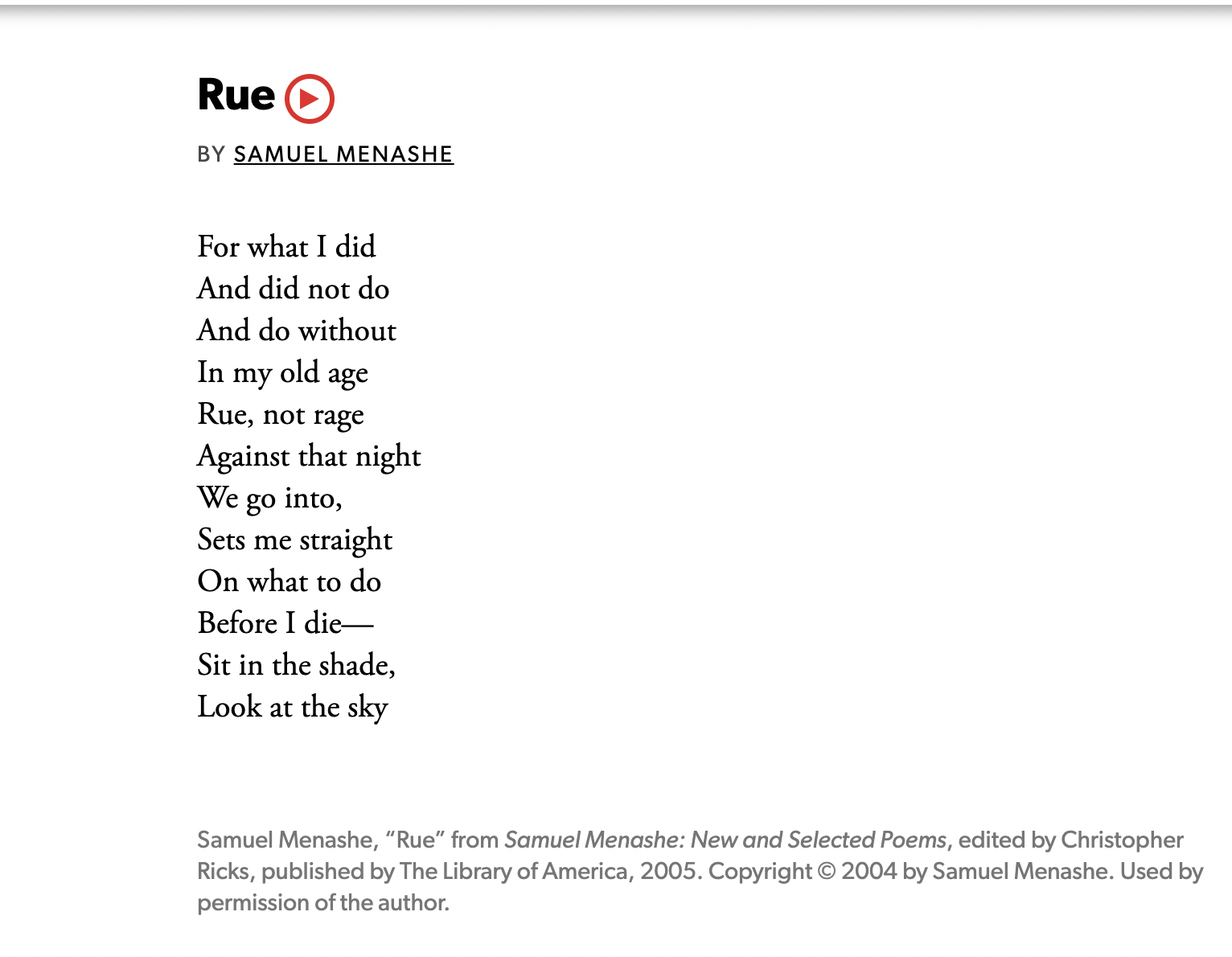
During my staycation this week, I ventured to Bird Library at SU to peruse some novels by Larry McMurtry (author of Lonesome Dove, Terms of Endearment and The Last Picture Show). I took a little literary detour when I got sidetracked in the stacks—flipping through the volume New and Selected Poems by Samuel Menashe. Menashe’s author photo caught my attention because he reminds me of a young Christopher Walken.

New and Selected Poems by Samuel Menashe.

I’m drawn to Menashe’s concise and illuminating poems that tackle the universal themes of life, death and existentialism.

Here are some of my favorite poems.

Autumn

I walk outside the stone wall
Looking into the park at night
As armed trees frisk a windfall
Down paths that lampposts light.

The Dead of Winter

In my coat I sit
At the window sill
Wintering with snow
That did not melt
It fell long ago
At night, by stealth
I was where I am
When the snow began.

The Living End

Before long the end
Of the beginning
Begins to bend
To the beginning
Of the end you live
With some misgivings
About what you did.

Grief

Disbelief
To begin with—
Later, grief
Taking root
Grapples me
Wherever I am
Branches ram
Me in my bed
You are dead.

Voyage

Water opens without end
At the bow of the ship
Rising to descend
Away from it

Days become one
I am who I was.

Passive Resistance by Samuel Menashe.

Downpour

Windowed I observe
The waning snow
As rain unearths
That raw clay—
Adam’s afterbirth—
No one escapes
I lie down, immerse
Myself in sleep
The windows weep.

Samuel Menashe: New and Selected Poems, Bloodaxe Books; revised edition (January 1, 2009).

Standard

Excerpts: Poems for Lorca

Today, I present two poems from the chapbook Poems for Lorca, written by the late Syracuse journalist Walt Shepperd. I discovered the collection in the small gift shop in ArtRage Gallery.

I mistakenly thought the title referenced Spanish poet Federico García Lorca. But in the dedication page, Walt wrote: “For my daughter Lorca.”

Poems for Lorca by Walt Shepperd.

I’ve read this first poem multiple times, and I still don’t understand its meaning. But the ambiguous nature makes me appreciate the work even more. The words first hit me when I flipped through the book while walking along Crouse Avenue after leaving ArtRage on a sunny spring day. I think the poem has a timeless, universal quality.

An Easement for the Highway in Your Mind

The tinder has dried
and bridges
roots
and the canvas
in the windowframes
of someone else’s yesterdays
smolder
from sparks
carried
on an imperceptible breeze
down a road
between
trees
and tents
and tenements
over timbers
charred beyond support
of tomorrow’s weight.

They say
you can’t go home again
and they are mostly wrong
but your return
must be guided
by bulldozer tracks
and burial mounds
and streams filled in
with silt
of ruins crumbling
from your backward glance.

##

The second poem also has a great title and a sense of mystery.

I Dreamt I Took a Two Week Vacation
in an Audrey Hepburn Movie

I never wanted birthdays
and Christmas
and mother’s day
to be what now
it seems
they must become,
excuses for remembering
that time is now a luxury.

We build new worlds
and gather things
that patch the strands
that chafe our shells
that brace our memories
into barricades
that must stand by themselves
for time is now a luxury.

The things we gather
gather dust
the barricades
won’t stand a charge
the boxes burn
the seeds grow mold
the papers crumble in the new light,
and love becomes the luxury.

Shepperd, Walt. Poems for Lorca. W.D. Hoffstadt & Sons, 2012.

I intend to place the book in a Little Free Library in my neighborhood so another reader can appreciate Walt’s words.

Standard

Cut While Shaving

I recently finished reading The Last Night of the Earth Poems by Charles Bukowski (Ecco, 2002; previously published by Black Sparrow Press in 1992). Bukowski feels like an old friend to me, and I love picturing him sitting in his house, drinking wine and listening to classical music on the radio while he bangs away at the typewriter.

The book is a beefy collection filled with the typical Bukowski charm—a combination of vulgarity, humor and humanity.

As someone of advancing age, often filled with regret over the detours and wrong decisions I’ve made in my life, one particular poem hit home for me.

Cut While Shaving

It’s never quite right, he said, the way people look,
the way the music sounds, the way the words are
written.
It’s never quite right, he said, all the things we are
taught, all the loves we chase, all the deaths we
die, all the lives we live,
they are never quite right,
they are hardly close to right,
these lives we live
one after the other,
piled there as history,
the waste of the species,
the crushing of the light and the way,
it’s not quite right,
it’s hardly right at all
he said.

don’t I know it? I
answered.

I walked away from the mirror.
it was morning, it was afternoon, it was
night

nothing changed
it was locked in place.
something flashed, something broke, something
remained.

I walked down the stairway and
into it.

Standard

Goodreads Giveaway

I am giving away two signed copies of my latest poetry collection, The Truth I Must Invent. You can enter on Goodreads. The giveaway ends on Feb. 23.

The Truth I Must Invent book cover.

The Truth I Must Invent is a collection of narrative and philosophical poems written in free-verse style. Employing a minimalistic approach and whimsical language, the book explores the themes of self, identity, loneliness, memory, existence, family, parenthood, disability, gratitude, and compassion.

Standard

Poetry Anthology

I am excited to share that one of my poems is published in a new anthology entitled Masculinity: an anthology of modern voices (Broken Sleep Books, 2024). The book is edited by Aaron Kent, Rick Dove and Stuart McPherson.

Anthology book cover. Cover design by Aaron Kent and Joseph Kent.

According to the book description, the anthology “aims to showcase the diversity of what it means to be a man and what it means to embrace its multitudes. These poems emphasize that masculinity is not a monolithic concept, but a dynamic, evolving force that can be shaped by culture, society, and personal experiences.”

Here’s my contribution:

Diary Entry: February 16, 1994. Copyright Francis DiClemente.

Standard

Illuminating Poem: The Thing Is

I want to share this poem I read in a Substack post by Maya C. Popa. It’s entitled “The Thing Is” from Mules of Love by Ellen Bass (published by BOA Editions in 2002). I love the language, clarity and gut-punching delivery. Some snippets that jumped out at me: “the silt of it,” “grief sits with you,” “obesity of grief” and “a plain face.”

“The Thing Is” by Ellen Bass from the book Mules of Love (BOA Editions, 2002)

Standard

New Year’s Reflections

New Year’s Eve 2023. Time to rewind and then hit reset.

I’m grateful for getting another 365 tokens to drop into the slot machine. Another 365 scratch-off lottery tickets to play. Another 365 chances to be better than the day before.

Card from David’s Refuge.

I’m closing out the year filled with both anxiety and excitement.

By all accounts, 2023 was a pretty good year for me. I made some strides as a writer and filmmaker.

I earned an Emmy (my second) as part of a production team at Syracuse University.

Photo by Shane Johnson.

I published a full-length poetry collection, The Truth I Must Invent. I published a couple of short stories and a short play in some literary magazines.

The Truth I Must Invent book cover.

I completed two short documentary films, Ralph Rotella: The Sole of Syracuse, which premiered at the Syracuse International Film Festival and was an official entry at the Culver City Film Festival, and The World Series of Bocce: A Celebration of Sport, Family and Community, which is awaiting festival decisions.

World Series of Bocce title screenshot.

I completed a feature screenplay and a full-length coming-of-age memoir (a ten-year project!). But despite numerous revisions, I still don’t know if the words on the page are memorable or whether either project will come to fruition (e.g., production or publication).

So those are my accomplishments in 2023. Big whoop, right? Yada-yada-yada. Blah-blah-blah.

Here are the standout moments during the last calendar year.

In June, my Aunt Teresa, a.k.a. Sister Carmella DeCosty, visited Central New York to attend the funeral of her brother, my Uncle Fee, in Rome, New York. She stayed with us in Syracuse, and we had a lot of fun catching up.

Pam and Aunt T.

A flashback of Aunt T. during a holiday at my maternal grandparents’ house. I think that’s me on her lap, with my mom in red and my Aunt Pat in black.

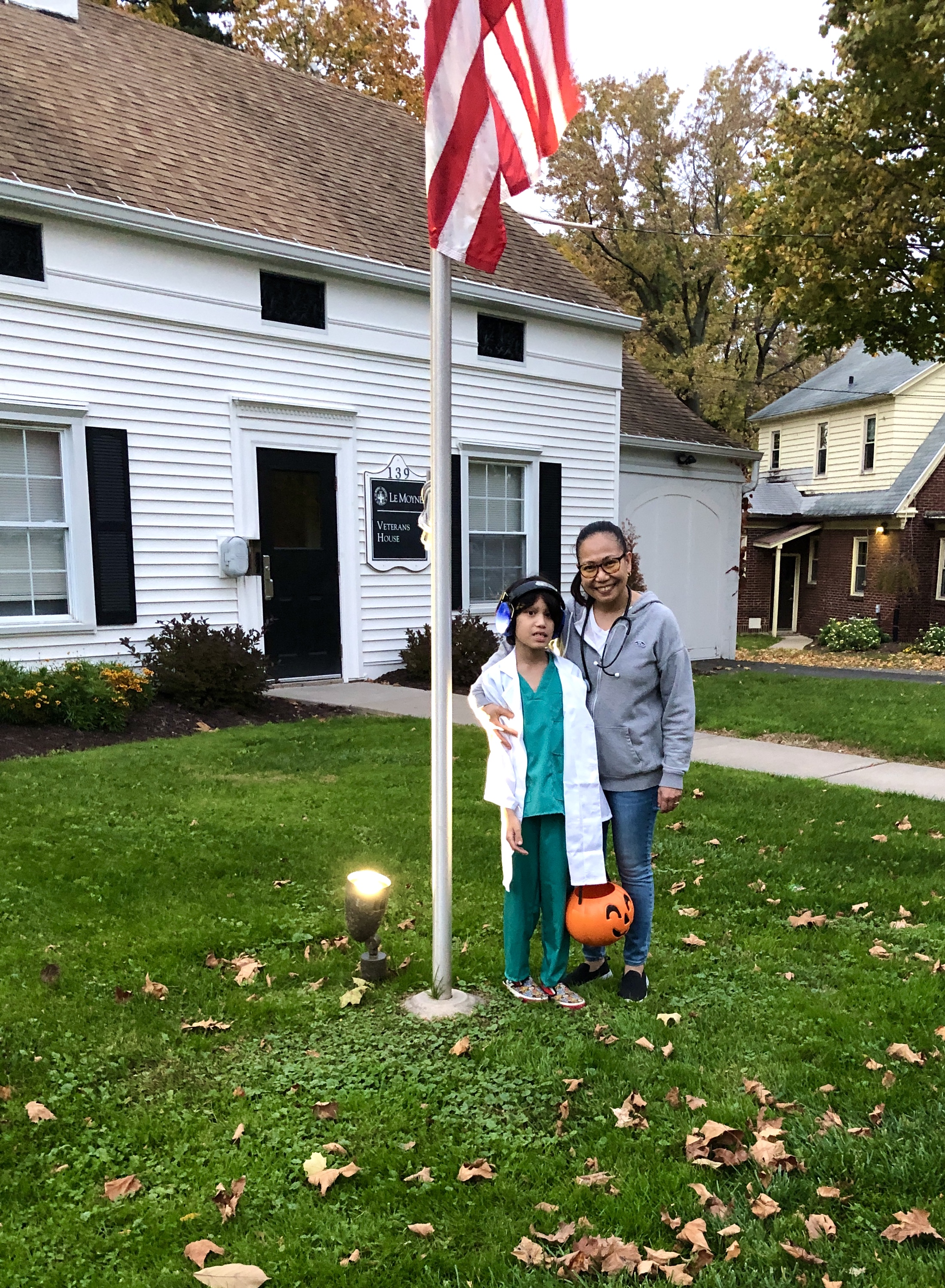
My seven-year-old son, Colin, who is autistic, enjoyed trick-or-treating for the first time this Halloween. I think he actually “got it” this year.

Colin getting ready to trick-or-treat.

I spent Thanksgiving with my brother Dirk and his family in Rome and my sister Lisa and her family from Ohio. The best part—no snow!

For the holiday season, my wife Pam hung a stocking for Colin in mid-December and gave him little presents every day—stuff like Kinder Joy eggs and Play-Doh. He seemed to understand the concept of Santa Claus, and he was excited to open presents on Christmas morning.

Pam and Colin.

Pam went back to school this fall, enrolling in an occupational therapy assistant program at Bryant & Stratton College. The workload was arduous, but Pam scored high grades during her first semester.

But the most significant event of 2023—I survived my sixth brain surgery with my brain function and memory intact. In July, a team of neurosurgeons and ENT surgeons at Upstate performed a transsphenoidal (through the nose) surgery to remove parts of a craniopharyngioma that had been growing near the pituitary region, affecting my vision. I had a cerebral spinal fluid leak during surgery, but the ENT surgeon repaired it, and the patch is holding nearly six months later.

I wish all good things for you in 2024. A partial list includes: Love, family, faith (whatever you choose that to be), employment, health, health insurance, kind co-workers, transportation, clean drinking water, food, a home, a roof, four walls, a furnace, indoor plumbing, electricity, clean air, and trees. Lots of trees. I am supremely thankful for all of the above.

I leave you with a couple of New Year’s-themed poems. It’s amazing what you can find when you do a word search on the Poetry Foundation website.

January by Weldon Kees

Morning: blue, cold, and still.
Eyes that have stared too long
Stare at the wedge of light
At the end of the frozen room
Where snow on the windowsill,
Packed and cold as a life,
Winters the sense of wrong.

Poetry magazine, March 1951.

New Year’s Eve by Maurice Lesemann

The towers give tongue, the wailing horns grow loud;
And this odd planet where we wake and are
Has once again, amid a tumult of cloud,
Swung safely and serenely round its star.

Poetry magazine, April 1932.


Standard

Gifting Books

I hate writing book promotion posts. But this is just a reminder that books make nice holiday gifts and they’re easy to wrap. My latest poetry collection, The Truth I Must Invent, can be purchased in numerous places. You can find it on Amazon, Barnes & Noble, and Bookshop. It’s also available from the publisher, Poets’ Choice. And a new author profile has been posted on the Poets’ Choice website. Happy holidays everyone.

The Truth I Must Invent book cover.

Standard