Oh William!

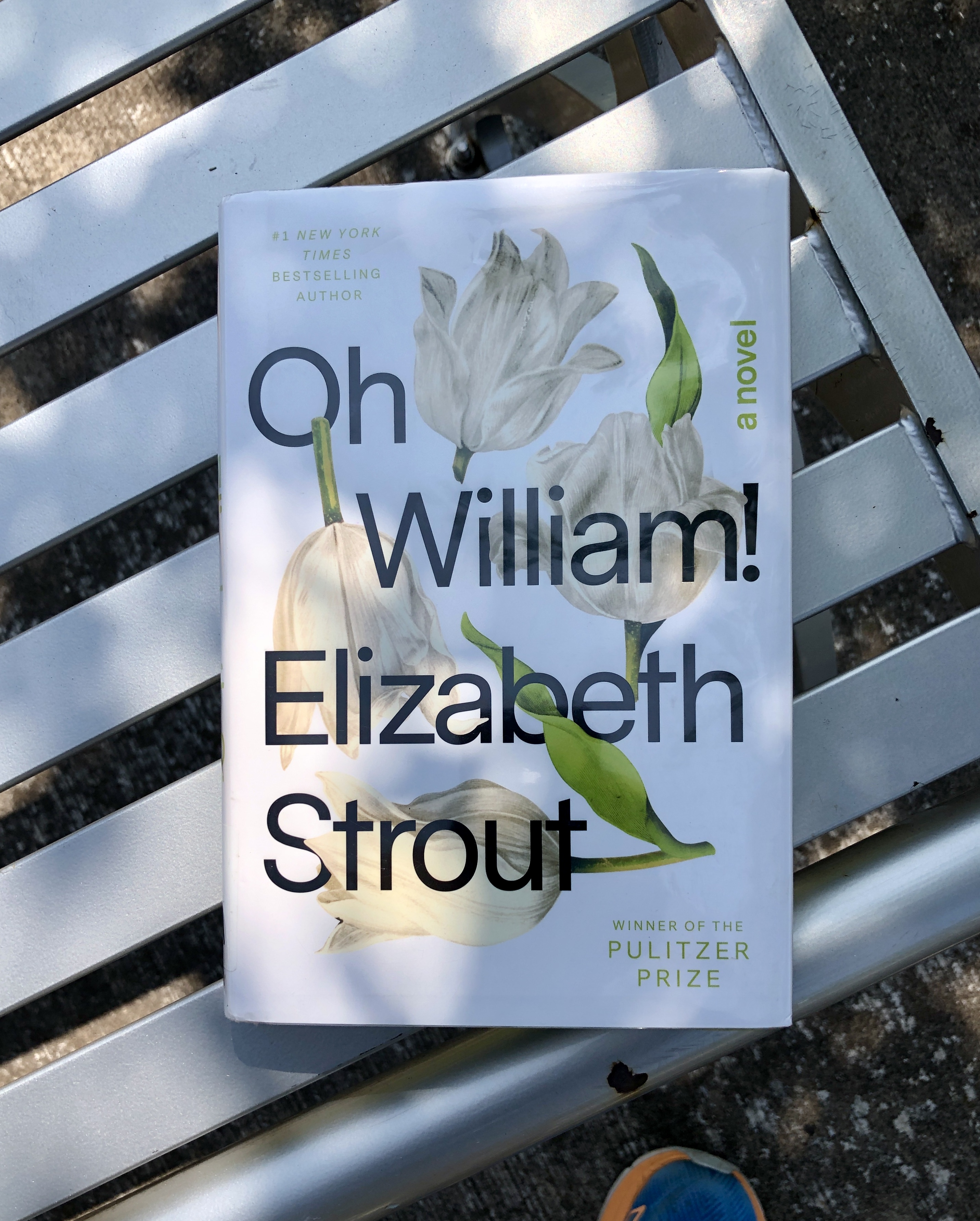
For habitual cheapskates like me, you can’t beat Little Free Library. Today while out on my run/walk, I picked up a perfect condition hardcover copy of Oh William! by Pulitzer Prize-winning author Elizabeth Strout (who is also a Syracuse University College of Law alum). The book had been languishing on my Goodreads “want to read” list for years. But now I’ve become the Fred Sanford of books, stalking the different Little Free Library sites in my surrounding area for literary steals. I do contribute some of my “read” books to the drop-off sites (but nowhere near as many volumes as I claim). Happy Sunday reading everyone.

Oh William! by Elizabeth Strout.

Standard

Where Angels Fear to Tread (1905)

I recently finished reading the novel Where Angels Fear to Tread by E.M. Forster. The work was published in 1905. I won’t give a review or provide a plot summary. You can look that up online or watch the 1991 movie starring Helen Mirren and Helena Bonham Carter.

Here’s an excellent description of the book I found through the Modernism Lab at Yale University.

What I want to share are a couple of excerpts that struck me. The first is from the third-person omniscient point of view (if my high school English reference is correct):

“For a wonderful physical tie binds the parents to the children; and—by some sad, strange irony—it does not bind us children to our parents. For if it did, if we could answer their love not with gratitude but with equal love, life would lose much of its pathos and much of its squalor, and we might be wonderfully happy.”

Angel in Asheville, NC. Photo by Francis DiClemente.

In the second quote, the character Philip Herriton is talking to Miss Abbott:

“Miss Abbott, don’t worry over me. Some people are born not to do things. I’m one of them; I never did anything at school or at the Bar. I came out to stop Lilia’s marriage, and it was too late. I came out intending to get the baby, and I shall return an ‘honourable failure.’ I never expect anything to happen now, and so I am never disappointed. You would be surprised to know what my great events are. Going to the theatre yesterday, talking to you now—I don’t suppose I shall ever meet anything greater. I seem fated to pass through the world without colliding with it or moving it—and I’m sure I can’t tell you whether the fate’s good or evil. I don’t die—I don’t fall in love. And if other people die or fall in love, they always do it when I’m just not there. You are quite right; life to me is just a spectacle, which—thank God, and thank Italy, and thank you—is now more beautiful and heartening than it has ever been before.”

Standard

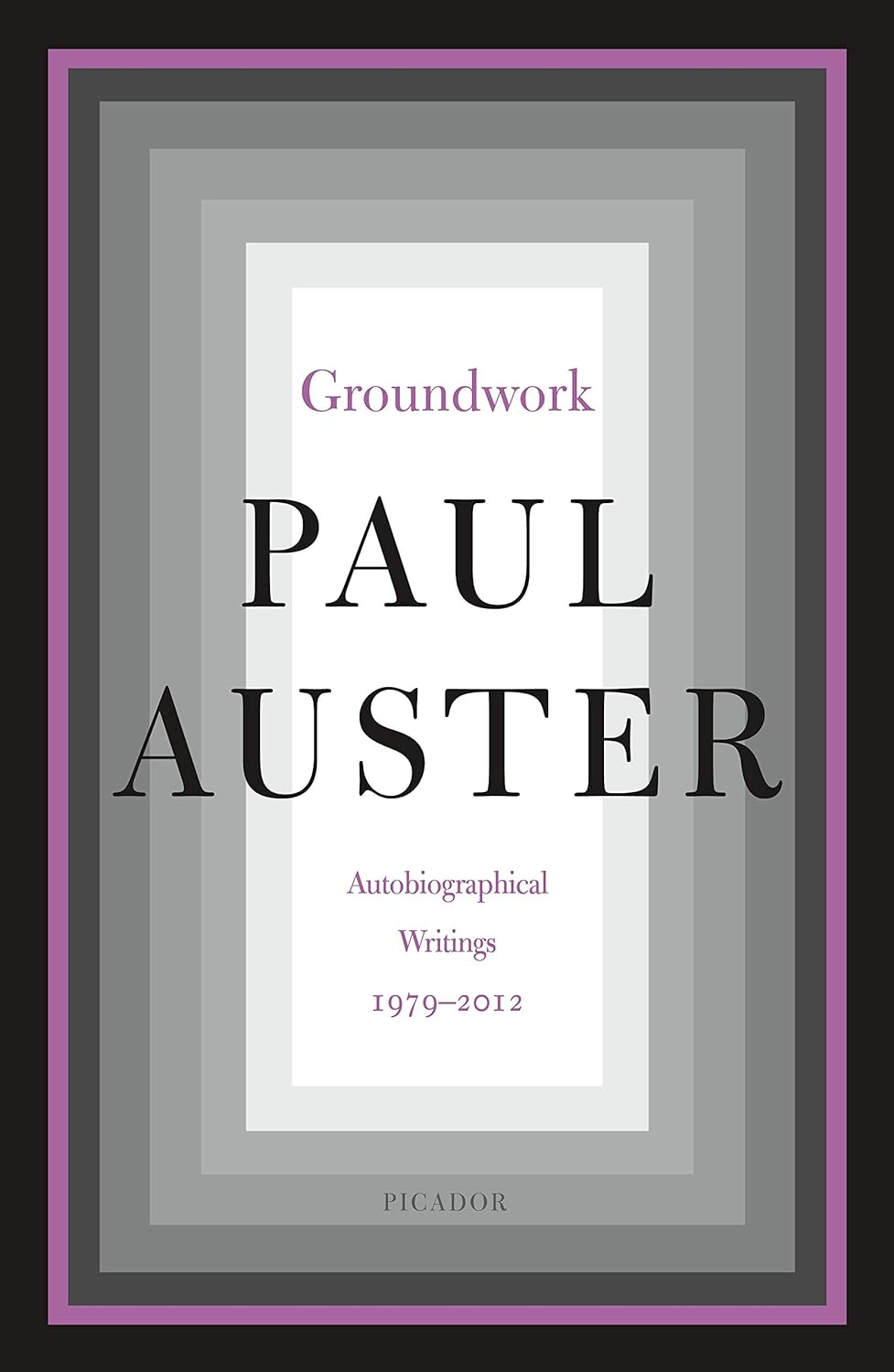
Groundwork by Paul Auster

I’m currently reading a work of collected nonfiction by the late author Paul Auster. Auster is one of my favorite writers, and his book The Invention of Solitude inspired me to work on my memoir project.

The title of the collected volume is Groundwork: Autobiographical Writings, 1979–2012, and it contains Auster’s memoir Hand to Mouth: A Chronicle of Early Failure (1996). Two great paragraphs illuminate the nature of working writers—writers employed in other professions to pay the bills and provide for their families, all while stealing time to scribble and peck away at personal writing projects (some of which may go unpublished).

The late author Paul Auster.

Auster’s words hit home for me because I’m a working writer who rises at 3:30 a.m. on weekdays to write. He inspired me by pointing out that other artists have blazed a similar path.

Excerpt from the book: 

“Becoming a writer is not a “career decision” like becoming a doctor or a policeman. You don’t choose it so much as get chosen, and once you accept the fact that you’re not fit for anything else, you have to be prepared to walk a long, hard road for the rest of your days. Unless you turn out to be a favorite of the gods (and woe to the man who banks on that), your work will never bring in enough to support you, and if you mean to have a roof over your head and not starve to death, you must resign yourself to doing other work to pay the bills. I understood all that, I was prepared for it, I had no complaints. In that respect, I was immensely lucky. I didn’t particularly want anything in the way of material goods, and the prospect of being poor didn’t frighten me. All I wanted was a chance to do the work I felt I had it in me to do.”

Groundwork by Paul Auster.

“Most writers lead double lives. They earn money at legitimate professions and carve out time for their writing as best they can: early in the morning, late at night, weekends, vacations. William Carlos Williams and Louis-Ferdinand Céline were doctors. Wallace Stevens worked for an insurance company. T.S. Eliot was a banker, then a publisher. Among my own acquaintances, the French poet Jacques Dupin is codirector of an art gallery in Paris. William Bronk, the American poet, managed his family’s coal and lumber business in upstate New York for over 40 years. Don DeLillo, Peter Carey, Salman Rushdie, and Elmore Leonard all worked for long stretches in advertising. Other writers teach. … Who can blame them? The salaries may not be big, but the work is steady and the hours good.”

Paul Auster. Groundwork: Autobiographical Writings, 1979–2012. Picador (2020).

Standard

Library Discovery

I discovered this anomaly while exploring a Central New York library.

Blonde by Joyce Carol Oates.

In this case, one little e makes a big difference, as this should be Oates, like Joyce Carol Oates or Hockey Hall of Famer Adam Oates. Not like Quaker Oats. But the little misspelling doesn’t diminish the quality of the book. Once the reader opens it, the person will get lost in the masterful storytelling and prose of JCO.

Standard

Dostoyevsky Doorstop

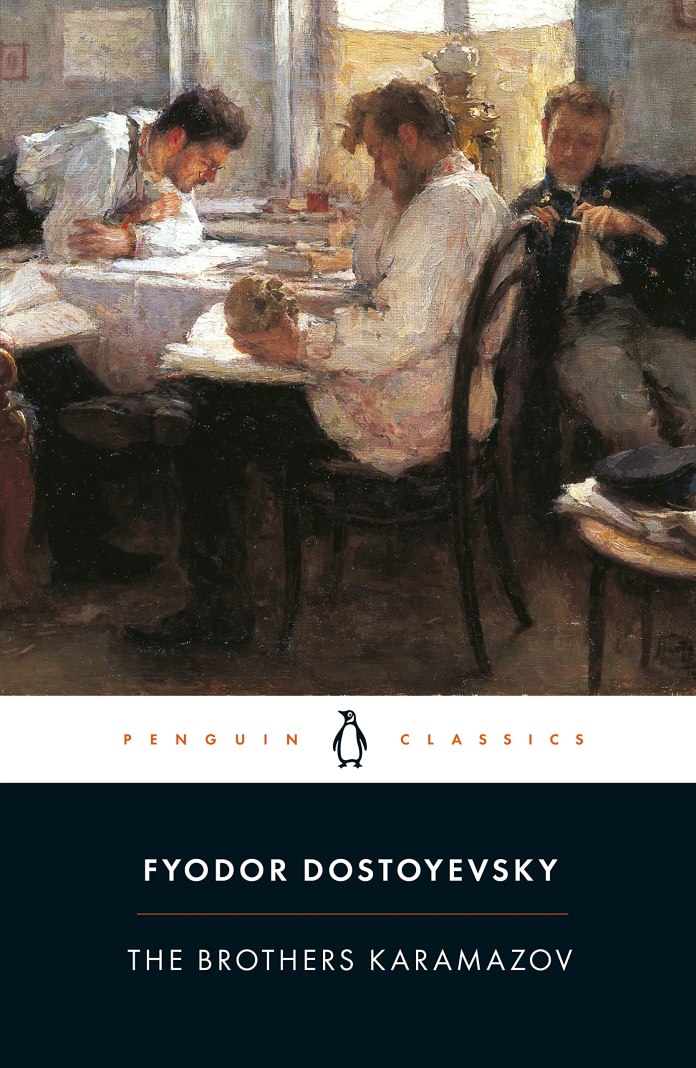
I just finished reading David Copperfield by Charles Dickens. Clocking in at nearly 800 pages, the book remained in my Kindle library for more than a year. Even as I skipped through page after page, the completion rate remained at about 62 percent. I thought I would never finish. Now I am tackling another classic tome of literature—The Brothers Karamazov by Fyodor Dostoyevsky. I’m only 27 pages into it, and I’m already confused by the multiple characters the author has introduced. But I think having a print copy will make the reading easier than Copperfield.

I always struggle with longer novels, but they can also be the most satisfying. Two of my favorite novels are longer works—Look Homeward Angel by Thomas Wolfe and The Town and the City by Jack Kerouac.

I’m approaching Karamazov like I mentally approach a Central New York winter. You can’t see the end of winter in late October. You have to take it one day at a time, one snowstorm at a time. So I can’t anticipate reading the last sentence of page 985 and then closing the book. I just have to plug along, page by page, day by day until I reach the end. My goal is to finish by Christmas.

Standard

Paperback Mysteries

Books are recyclable works of art that have transference of ownership. And I love making discoveries in the pages of used paperbacks—books that have been discarded from public libraries, purchased at garage sales, or pulled from bargain bins.

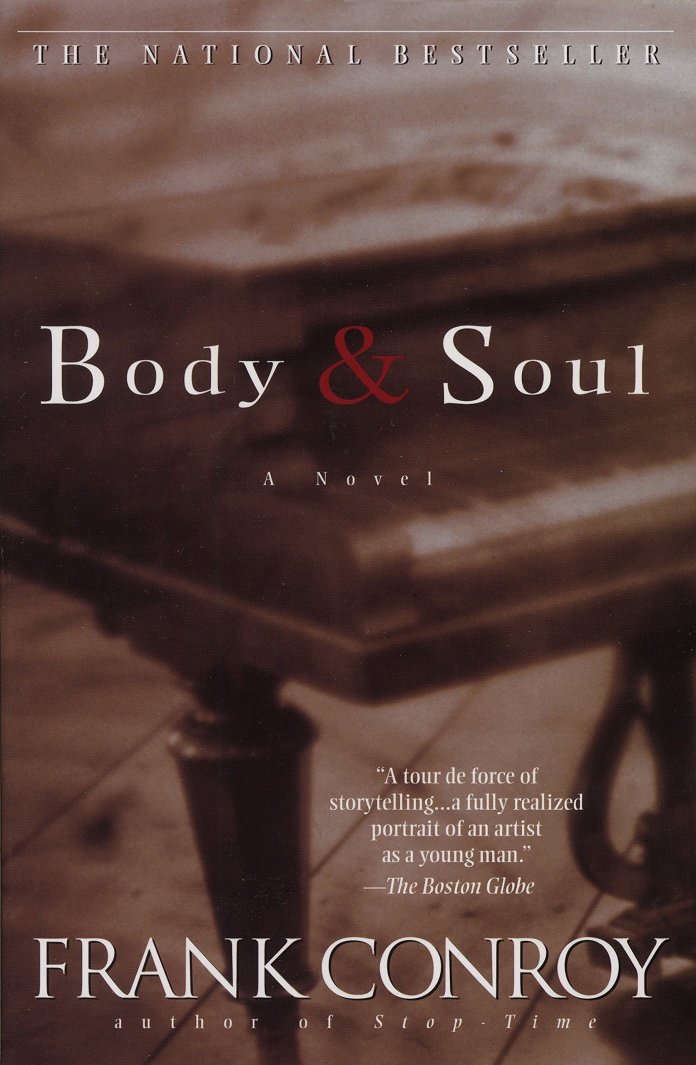
Case in point: my gently used copy of the novel Body and Soul by Frank Conroy. The bildungsroman tells the story of musical wunderkind Claude Rawlings, starting from his childhood in New York City in the 1940s. The late Conroy, who had served as director of the Writers’ Workshop at the University of Iowa, is known for penning the influential memoir Stop-Time.

Body and Soul by Frank Conroy.

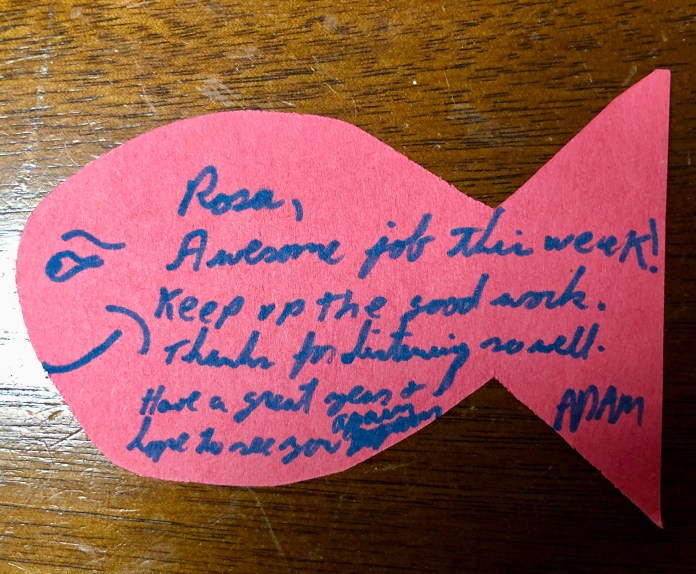
I read Body and Soul several years ago when residing in Phoenix, Arizona. I bought my current copy on Amazon. And stuffed between the pages, I found vestiges left behind by the previous owners—a bookmark and two notes. The first note is dated Oct. 13 (year not included). It’s from CB and addressed to Kristen: “Here’s the book about the piano protege I mentioned in Balto.”

The second note is written on a piece of red paper cut into the shape of a fish. It’s addressed to Rosa from Adam. “Awesome job this week! Keep up the good work. Thanks for listening so well. Have a great year + hope to see you again.”

Multiple scenarios run through my head. I’d like to know more about the people who touched the book I now grasp. I’m curious about the relationships between Kristen and CB and Rosa and Adam. Is Kristen a musician and is “Balto” short for “Baltimore?” Was Adam a teacher and Rosa his student?

I know my questions will go unanswered and the paperback mysteries will remain unsolved. But on the bright side, I still have Conroy’s story to explore.

Standard

Frankenstein, 1931

On Friday night, I watched the 1931 film Frankenstein, starring Colin Clive and Boris Karloff. And Henry Frankenstein’s creature, called The Monster, played by Karloff, elicited my empathy as he jolted to life in a lightning storm with an abnormal brain incapable of functioning in society. I won’t relay the plot summary since the story is very familiar. And the movie version is much different from the novel it was based upon, Mary Shelley’s Frankenstein; or, the Modern Prometheus.

Frankenstein poster

But one scene stood out. In it, Karloff plays a game with a little girl, both of them tossing flowers into a lake. He then picks up the girl and throws her in, and she disappears below the surface of the water. Why? He doesn’t know any better.

Frankenstein movie still.

And the film made me think of my autistic son and about all disabled people. What do we do with humans who don’t live up to perceived standards of normalcy? Where do they go? Are they given a chance to function, to thrive, to pursue happiness, and to find a place in this world? I have no answers—just a desire to express kindness toward every person.

And the movie inspired a short poem.

Halloween Screening:
Frankenstein, 1931

You can’t fault
Frankenstein’s creature
For what he became.

He never had a choice.
He didn’t ask to be born.
He didn’t seek existence.

With an abnormal brain
And cobbled parts,
He can’t be blamed for
The terror he wrought.

He was only acting
According to his nature.
The real monster here
Is the man who
Created the creature.

Standard

Book Selection

Have you ever gone into a store with the intention of buying one thing but end up selecting another? You want a black belt, but you decide the brown leather one looks and feels better encircling your waist? Or you crave pancakes, but when the waitress comes around, you order a Denver omelet with home fries and wheat toast?

This happens to me frequently when I go to the library in search of a particular book. I write down the call number and head off in the direction of its location. But when I roam through the rows of the repository, my attention gets diverted, I discover a different book, and I choose that one instead.

Here’s an example. On a recent Sunday afternoon I climbed the steps of Carnegie Library at Syracuse University, walked through the grand Reading Room, filled with students studying, and went into the upper level stacks in search of a nonfiction book, The Noonday Demon: An Atlas of Depression by Andrew Solomon (with a call number in the range of RC537).

I had scribbled the call number on a scrap of paper, and perhaps serendipity led me in a different direction because I went to the wrong row, as I had transposed the call number in my head. I started scanning the shelves in the area of RC357, and there, amid a plethora of books about amnesia and other medical problems, a title jumped out at me and seized my attention. Its name: Be Glad You’re Neurotic.
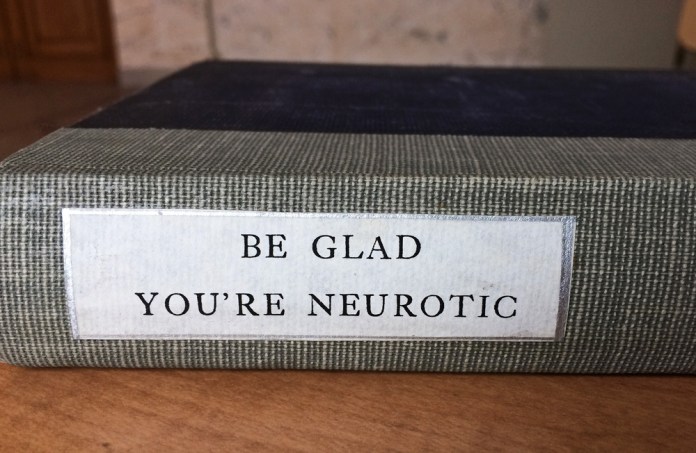
Be Glad You’re Neurotic by Louis E. Bisch, M.D., Ph.D.

Be Glad You’re Neurotic by Louis E. Bisch, M.D., Ph.D.

“Wow, was this battered blue and gray hardcover placed in this exact spot just for my eyes?” I wondered. “Am I the intended audience?”

I grabbed it and flipped through the book, and my cursory glance indicated it offered some self-help advice, which, with all of my odd predilections, proclivities, and obsessive-compulsive tendencies, I am willing to accept.

Be Glad You’re Neurotic was written by Louis E. Bisch, M.D., Ph.D., and published in 1936 by Whittlesey House, a division of the McGraw-Hill Book Company, Inc. Its earliest library check-out date was January 6, 1965; and the last stamp is dated October 7, 1997.

I’m hoping the book will do me some good. A sentence in the preface reads, “Neurotic states are more common than the common cold.”

And some of the chapter headings inspire me and make me feel better about myself. Chapter I: I’m a Neurotic Myself and Delighted. Chapter II: To Be Normal Is Nothing to Brag About. And Chapter IV: Your Neurotic Development Was Inevitable.

I haven’t read any further yet, and that’s because I have a stack of books I am still waiting to tackle; currently I have five books checked out from the library, while also reading two others via Kindle.

Books waiting to be read.

Books waiting to be read.

And this experience at the library made me realize two things. One—how sad it is that I’ll never have the time to read all of the books I want to. Many titles on my “to-read” list will remain unread. I consider it a metaphor for how there are certain things in life you’ll never achieve or get to do. My dream trip to Ireland and Italy—well, keep dreaming.

The second revelation is that I’m fed up with always seeking out the next book instead of thoroughly enjoying the one I’m currently reading. As a voracious reader, this book lust is a real problem for me. All it takes is a New York Times review or an interview with an author on Fresh Air with Terry Gross to set me off in search of the title in question. My Amazon “wish list” has hundreds of books sitting in the queue.

So after I plow through the pile of books sitting on top of my bedroom dresser, I will try to limit myself to reading only one novel and one nonfiction book at a time—a two-book limit. But I am not sure if I will be successful. I don’t know if I can stop myself from going to the library before I finish reading them both. And I still need to check out a copy of The Noonday Demon.
Standard

Thomas Wolfe: You Can’t Go Home Again

I recently finished reading Thomas Wolfe’s paperweight of a book You Can’t Go Home Again.

The autobiographical novel, published in 1940, two years after Wolfe’s death in 1938, gets bogged down with scenes that could have been edited out with no loss of narrative structure.

Photo by Carl Van Vechten; the Carl Van Vechten Photographs Collection at the Library of Congress

Photo of Thomas Wolfe by Carl Van Vechten; the Carl Van Vechten Photographs Collection at the Library of Congress

However, I enjoyed embarking on a journey of self-discovery with the protagonist, a lonely young writer named George Webber, who pens a famous novel about his hometown, Libya Hill (a fictional setting that could be considered a stand-in for Wolfe’s native Asheville, North Carolina), and then is reviled by his friends and neighbors because the book uncovers the dark secrets of the town.

And although I found myself skipping over sections of the book—descriptions and digressions that slowed down the story—Wolfe’s lyrical voice and ability to construct stunning passages of prose can make a reader stop skimming pages and pay attention to each sentence.

Here are some beautiful paragraphs where Wolfe seemed to capture some central truths about life and humanity.

“So, then, to every man his chance—to every man, regardless of his birth, his shining, golden opportunity—to every man the right to live, to work, to be himself, and to become whatever thing his manhood and his vision can combine to make him—this, seeker, is the promise of America.”

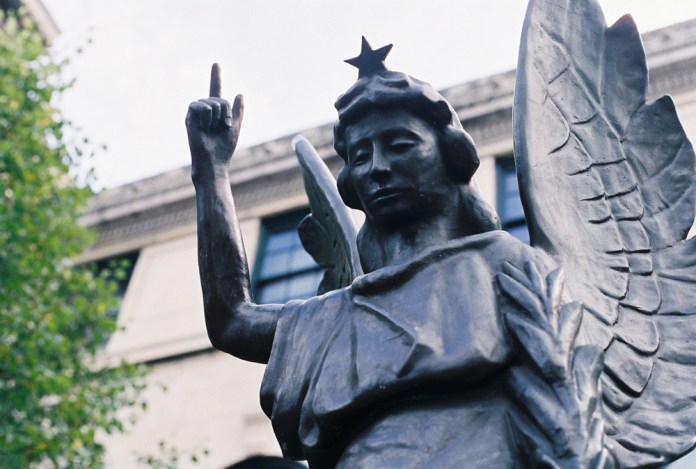
Thomas Wolfe Memorial Angel, Asheville, NC (Photo by Francis DiClemente)

Thomas Wolfe Memorial Angel, Asheville, NC (Photo by Francis DiClemente)

“For four years George Webber lived and wrote in Brooklyn, and during all this time his life was about as solitary as any that a modern man can know. Loneliness, far from being a rare and curious circumstance, is and always has been the central and inevitable experience of every man. Not only has this been true of the greatest poets, as evidenced by the huge unhappiness of their published grief, but now it seemed to George to apply with equal force to all the nameless ciphers who swarmed about him in the streets.”

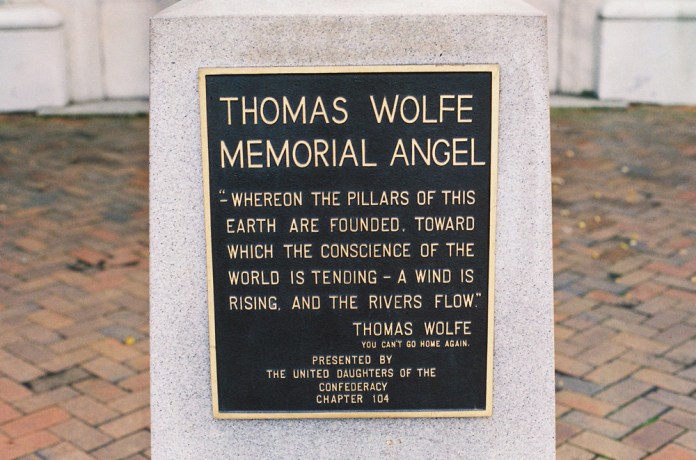
Thomas Wolfe Memorial Angel Quote (Photo by Francis DiClemente)

Thomas Wolfe Memorial Angel Quote (Photo by Francis DiClemente)

“All things belonging to the earth will never change—the leaf, the blade, the flower, the wind that cries and sleeps and wakes again, the trees whose stiff arms clash and tremble in the dark, and the dust of lovers long since buried in the earth … they go back into the earth that lasts forever. Only the earth endures, but it endures forever.”

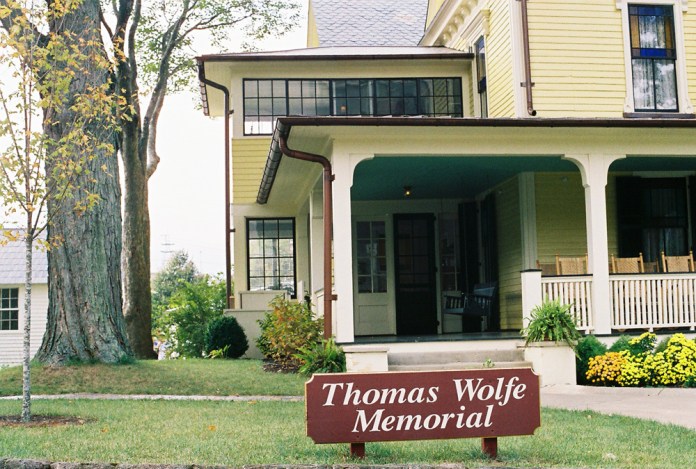
Thomas Wolfe's mother's boardinghouse in Asheville, NC. It's now called the Thomas Wolfe Memorial (Photo by Francis DiClemente)

Thomas Wolfe’s mother’s boardinghouse in Asheville, NC. It’s now called the Thomas Wolfe Memorial. (Photo by Francis DiClemente)

“You can’t go back home to your family, back home to your childhood, back home to romantic love, back home to a young man’s dreams of glory and of fame … back home to the father you have lost and have been looking for, back home to someone who can help you, save you, ease the burden for you, back home to the old forms and systems of things which once seemed everlasting but which are changing all the time—back home to the escapes of Time and Memory.”

Wolfe, Thomas. You Can’t Go Home Again. New York: Scribner (A Division of Simon and Schuster, Inc.), 2011 (first published in 1940). Print.

Standard

Saturday Night with Bukowski

I finished Ham on Rye last night (or more accurately, early this morning), and while I enjoyed reading about the exploits of Charles Bukowski’s fictional alter ego Henry Chinaski, I don’t think I would want to live next to him. Being Henry’s neighbor could put you in peril. He’s loud, rude, gets drunk all the time and brawls with his pals and strangers who cross his path. Say the wrong thing to him and you’re likely to be on the receiving end of a right upper cut.

But in one scene toward the end of the book, we find Henry reflecting on his life as he drinks alone in his room in a Los Angeles rooming house. Bukowski paints the scene with humor, absurdity, loneliness and truth.

Our narrator Henry takes over from here:

It was a Saturday night in December. I was in my room and I drank much more than usual, lighting cigarette after cigarette, thinking of girls and the city and jobs, and of the years ahead … Then I heard the radio in the next room. The guy had it on too loud. It was a sickening love song.

“Hey buddy!” I hollered, “turn that thing down.”

There was no response.

I walked to the wall and pounded on it.

“I SAID, ‘TURN THAT F**KING THING DOWN!'”

The volume remained the same.

I walked outside to his door. I was in my shorts. I raised my leg and jammed my foot into the door. It burst open. There were two people on the cot, an old fat guy and an old fat woman. They were f**king. There was a small candle burning. The old guy was on top. He stopped and turned his head and looked. She looked up from underneath him. The place was very nicely fixed-up with curtains and a little rug.

“Oh, I’m sorry …”

I closed their door and went back to my place. I felt terrible. The poor had a right to f**k their way through their bad dreams. Sex and drink, and maybe love, was all they had.

Bukowski, Charles. Ham on Rye. Santa Barbara, California: Black Sparrow Press, 1982. 275. Print.

A short time later Henry walks back to the other room, knocks on the door and apologizes to the couple; he invites them over to his place for a drink. But the man, described by Bukowski as having a face “hung with great folds of sorrow,” refuses the offer and closes the door on Henry.

And so our Saturday night ends. Henry awakens the next day with what he calls, “one of my worst hangovers.”

Standard