Book Sighting

It’s always a thrill when I see one of my books hanging out in a library. Last week, while working a B-roll shoot at Bird Library at Syracuse University, I found my latest book, Poecabulary, residing in this section. I’m SU staff, not faculty or alumni, but it was exciting to find one of my books in physical form resting on a shelf, waiting to be discovered by a reader (or so one hopes).

Bird Library at Syracuse University.

Poecabulary at Bird Library.

Standard

Fall Book Finds

I made a couple of finds at the Little Free Library on my way home from a jog today. The classic children’s book Charlotte’s Web by E.B. White and Forever by Judy Blume were nestled in the box. I’ve been wanting to read some Judy Blume novels since watching the recent documentary Judy Blume Forever.

But this donated copy was missing the first two pages. I felt like Alvy in Annie Hall, who couldn’t watch a movie in a theater if he missed the opening credits. Fortunately, due to the power of Amazon and its “read sample” button, I scanned the first two pages of Judy’s book.

I didn’t take home the copy of Charlotte’s Web because I read the story within the last couple of years. But a note on the flip side of the front cover made me smile. It seemed like a discovery I should’ve made in late June, after the school year ended in the district, instead of in late October.

Dear Cheyenne,

It’s been a terrific year in 3rd grade.

Heart icon
Mrs. V.

It brought back fond memories of Mrs. Voisine, my third-grade teacher at DeWitt Clinton elementary school in Rome, New York. Later on, I did the math and determined that Cheyenne would have graduated high school in 2015. I wonder what she’s doing now and if Mrs. V. is still teaching.

Standard

Poetic Precision

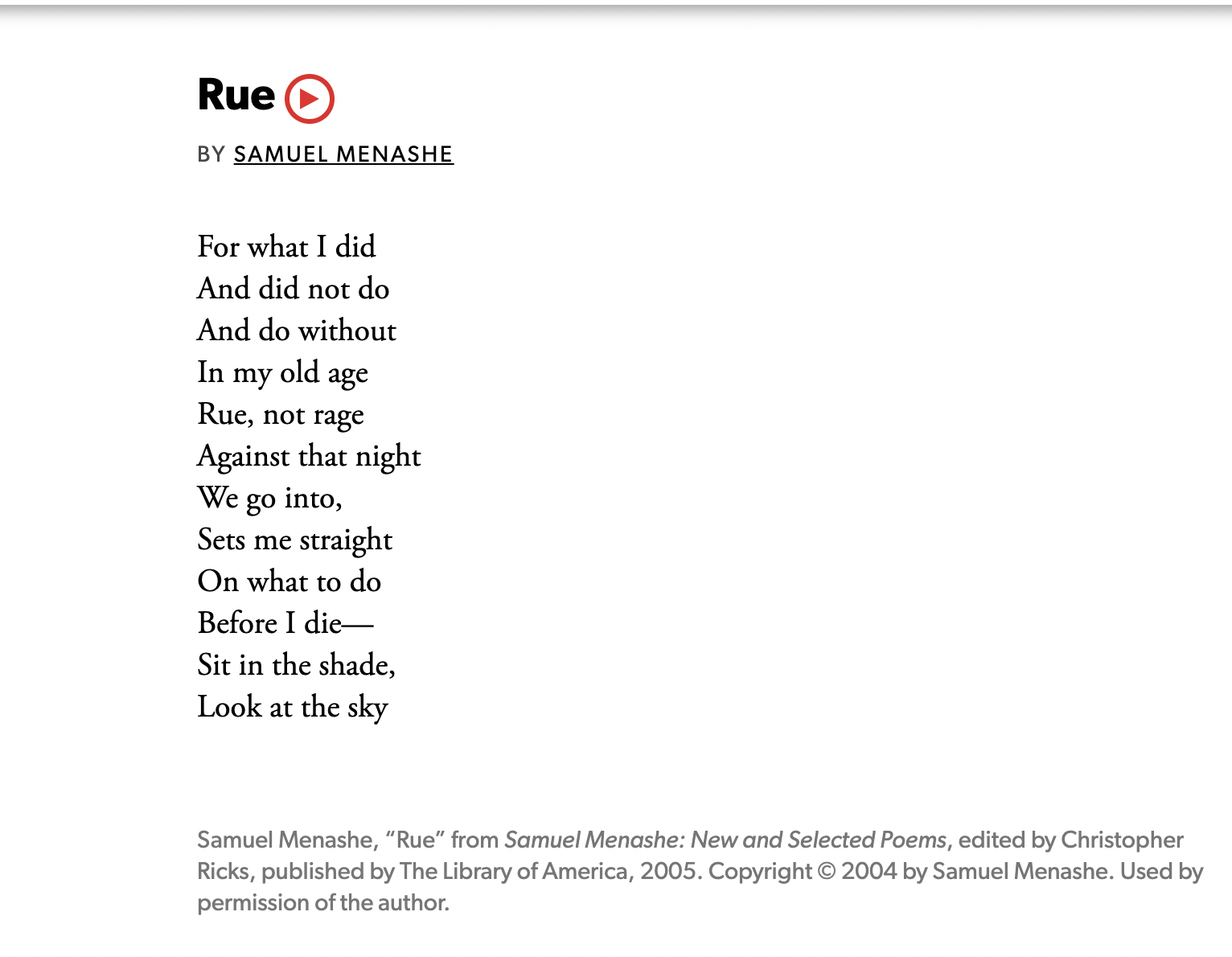
During my staycation this week, I ventured to Bird Library at SU to peruse some novels by Larry McMurtry (author of Lonesome Dove, Terms of Endearment and The Last Picture Show). I took a little literary detour when I got sidetracked in the stacks—flipping through the volume New and Selected Poems by Samuel Menashe. Menashe’s author photo caught my attention because he reminds me of a young Christopher Walken.

New and Selected Poems by Samuel Menashe.

I’m drawn to Menashe’s concise and illuminating poems that tackle the universal themes of life, death and existentialism.

Here are some of my favorite poems.

Autumn

I walk outside the stone wall
Looking into the park at night
As armed trees frisk a windfall
Down paths that lampposts light.

The Dead of Winter

In my coat I sit
At the window sill
Wintering with snow
That did not melt
It fell long ago
At night, by stealth
I was where I am
When the snow began.

The Living End

Before long the end
Of the beginning
Begins to bend
To the beginning
Of the end you live
With some misgivings
About what you did.

Grief

Disbelief
To begin with—
Later, grief
Taking root
Grapples me
Wherever I am
Branches ram
Me in my bed
You are dead.

Voyage

Water opens without end
At the bow of the ship
Rising to descend
Away from it

Days become one
I am who I was.

Passive Resistance by Samuel Menashe.

Downpour

Windowed I observe
The waning snow
As rain unearths
That raw clay—
Adam’s afterbirth—
No one escapes
I lie down, immerse
Myself in sleep
The windows weep.

Samuel Menashe: New and Selected Poems, Bloodaxe Books; revised edition (January 1, 2009).

Standard

Library Discovery

I discovered this anomaly while exploring a Central New York library.

Blonde by Joyce Carol Oates.

In this case, one little e makes a big difference, as this should be Oates, like Joyce Carol Oates or Hockey Hall of Famer Adam Oates. Not like Quaker Oats. But the little misspelling doesn’t diminish the quality of the book. Once the reader opens it, the person will get lost in the masterful storytelling and prose of JCO.

Standard

Summer Reading Inspiration

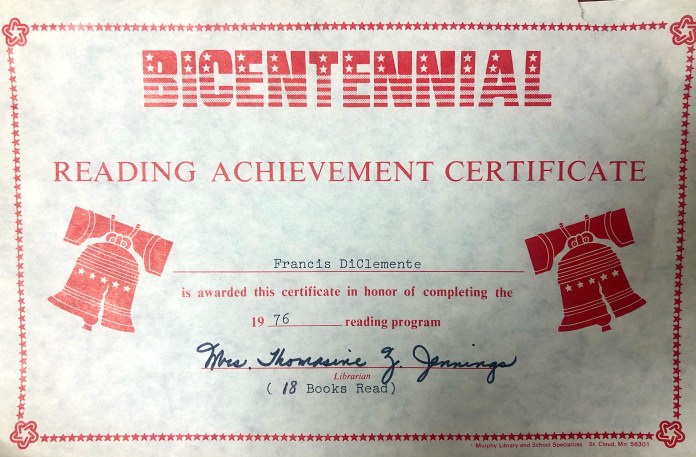
Digging through some totes in my living room, I found this archival evidence of my early obsession with books.

Library reading certificate, 1976.

During America’s Bicentennial year of 1976, my mother had enrolled me in a summer reading program at Jervis Public Library in my hometown of Rome, New York. The librarian had divided the group into two teams—the Cincinnati Reds and the New York Yankees—and we competed against each other for the most books read over the course of the summer. I can’t remember which side I was on, but the librarian was prescient, because Cincinnati would meet New York in the World Series later that year, with the Reds sweeping the Yankees to win the title.

I wish I had a list of the eighteen books I had read during the summer of ’76, as I would like to revisit some of them now.

As for this summer’s reading list, I am starting off with these selections.

The Beauty of Dusk: On Vision Lost and Found, a memoir by Frank Bruni.

Frank Bruni book cover.

Jack Kerouac: Collected Poems, published by Library of America, and The Closers by Michael Connelly.

Jack Kerouac: Collected Poems, published by Library of America.

Standard

Stumbling Upon Sylvia

While perusing for books in the library, I spotted a large volume entitled The Unabridged Journals of Sylvia Plath, 1950-1962. In the few moments I took to scan the 700-plus-page book, I felt like I peered into the troubled soul of the confessional poet and author of the novel The Bell Jar. Plath struggled with depression much of her life and committed suicide in 1963.

The intensity of the language in one of the passages from a section dated 22 November 1955 – 18 April 1956 captivated me, and I thought if you rearranged the sentences in verse form, they would construct a splendid poem. I had no sense of context from where Plath’s agitated emotions sprang, and standing in the library stacks, I felt a great sense of loss about Plath’s life and sadness that she took her unique voice with her to the grave.

Here’s an image of the passage I read:

Plath, Sylvia. The Unabridged Journals of Sylvia Plath, 1950-1962. New York: Anchor Books, 2000.

Standard

Litany of Beauty

Today I roamed through Bird Library at Syracuse University while searching for some summer reading. I took home five books, including Charlotte’s Web by E.B. White and Bag of Bones by Stephen King. And as I am wont to do, I pulled a book off a shelf at random, flipped it open to the middle and began reading the first text I saw.

The 1916 Poets, edited by Desmond Ryan.

The book had a light green cover with the title The 1916 Poets (edited by Desmond Ryan). It contains a selection of poems from Irish authors. My eyes settled on the poem “Litany of Beauty” by Thomas MacDonagh, and I found the words inspiring, particularly the lines:

Beauty of dawn and dew,
Beauty of morning peace
Ever ancient and ever new,
Ever renewed till waking cease …

Ryan, Desmond (Edited By). The 1916 Poets. Westport, Connecticut: Greenwood Press. 1979, c1963.

And here’s a bad iPhone photo of a portion of the poem.

Litany of Beauty by Thomas MacDonagh.

Standard

A Slim Volume of Verse by D.H. Lawrence

D.H. Lawrence. Beinecke Rare Book & Manuscript Library, Yale University.

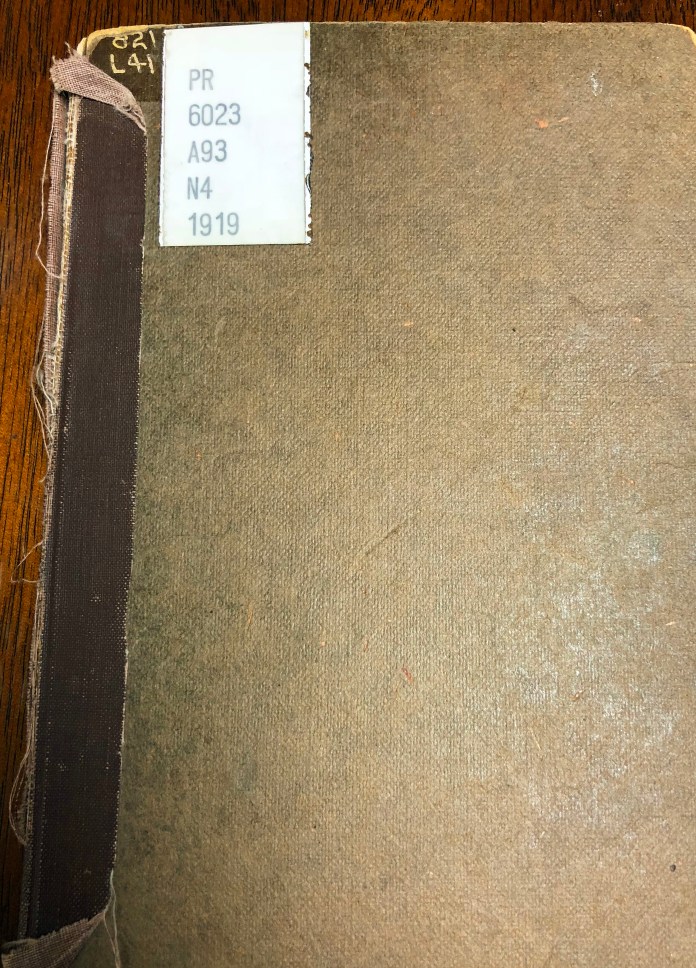
I recently stumbled upon a short collection of poems by D.H. Lawrence when I went to Syracuse University’s Bird Library to borrow his famous novel Lady Chatterley’s Lover. Amid the works penned by Lawrence, I found the slim volume of verse and pulled it off the shelf.

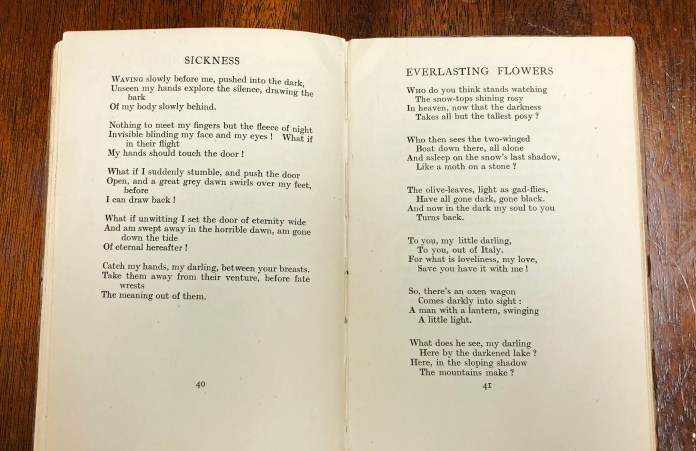
I thought the worn book might disintegrate as I held it in my hands and turned the pages, and with an original copyright of 1918, its title amused me: New Poems by D.H. Lawrence. The last stamp on the checkout slip is dated December of 1999, so it appears no one else has picked up the book in nearly 20 years.

Lawrence’s poems display sophisticated language with an “Old English” quality to them, and as I read the book, I had to stop several times to write down words that I would later look up on Dictionary.com. Many of the poems were short and possessed a timelessness, as they focused on nature and emotions, which cannot be bracketed by date or era.

Here are a few selections I liked:

Gipsy

I, the man with the red scarf,
Will give thee what I have, this last week’s earnings.
Take them, and buy thee a silver ring
And wed me, to ease my yearnings.

For the rest, when thou art wedded
I’ll wet my brow for thee
With sweat, I’ll enter a house for thy sake,
Thou shalt shut doors on me.

Piano

Softly, in the dusk, a woman is singing to me;
Taking me back down the vista of years, till I see
A child sitting under the piano, in the boom of the tingling strings
And pressing the small, poised feet of a mother who smiles as she sings.

In spite of myself, the insidious mastery of song
Betrays me back, till the heart of me weeps to belong
To the old Sunday evenings at home, with winter outside
And hymns in the cosy parlour, the tinkling piano our guide.

So now it is vain for the singer to burst into clamour
With the great black piano appassionato. The glamour
Of childish days is upon me, my manhood is cast
Down in the flood of remembrance, I weep like a child for the past.

D.H. Lawrence

These final two poems are ideal for summer reading, and I needed to look up the definitions of the two “p” words that stand out in the verses—primula and palimpsest. According to Dictionary.com, primula is a primrose, while palimpsest is a noun, meaning “a parchment or the like from which writing has been partially or completely erased to make room for another text.” The reference to twilight as a palimpsest suggests night overtaking day.

New Poems by D.H. Lawrence

Coming Awake

WHEN I woke, the lake-lights were quivering on the wall,
The sunshine swam in a shoal across and across,
And a hairy, big bee hung over the primulas
In the window, his body black fur, and the sound of him cross.

There was something I ought to remember: and yet
I did not remember. Why should I? The running lights
And the airy primulas, oblivious
Of the impending bee—they were fair enough sights.

Palimpsest of Twilight

Darkness comes out of the earth
And swallows dip into the pallor of the west;
From the hay comes the clamour of children’s mirth;
Wanes the old palimpsest.

The night-stock oozes scent,
And a moon-blue moth goes flittering by:
All that the worldly day has meant
Wastes like a lie.

The children have forsaken their play;
A single star in a veil of light
Glimmers: litter of day
Is gone from sight.

Lawrence, D.H. (David Herbert), New Poems. London: Martin Seeker, 1918.

Standard

Book Selection

Have you ever gone into a store with the intention of buying one thing but end up selecting another? You want a black belt, but you decide the brown leather one looks and feels better encircling your waist? Or you crave pancakes, but when the waitress comes around, you order a Denver omelet with home fries and wheat toast?

This happens to me frequently when I go to the library in search of a particular book. I write down the call number and head off in the direction of its location. But when I roam through the rows of the repository, my attention gets diverted, I discover a different book, and I choose that one instead.

Here’s an example. On a recent Sunday afternoon I climbed the steps of Carnegie Library at Syracuse University, walked through the grand Reading Room, filled with students studying, and went into the upper level stacks in search of a nonfiction book, The Noonday Demon: An Atlas of Depression by Andrew Solomon (with a call number in the range of RC537).

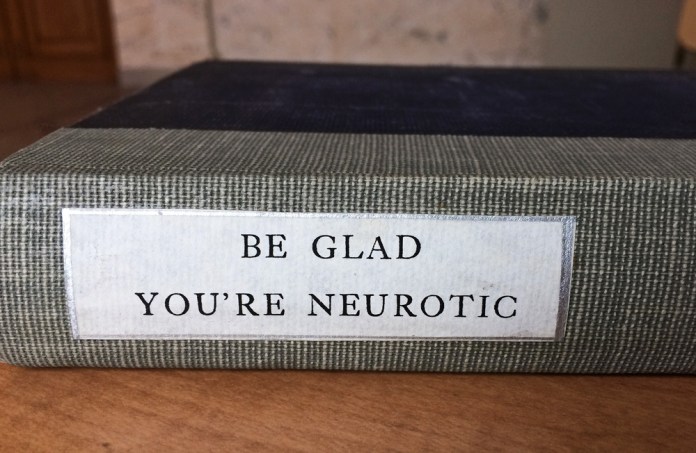
I had scribbled the call number on a scrap of paper, and perhaps serendipity led me in a different direction because I went to the wrong row, as I had transposed the call number in my head. I started scanning the shelves in the area of RC357, and there, amid a plethora of books about amnesia and other medical problems, a title jumped out at me and seized my attention. Its name: Be Glad You’re Neurotic.

Be Glad You’re Neurotic by Louis E. Bisch, M.D., Ph.D.

Be Glad You’re Neurotic by Louis E. Bisch, M.D., Ph.D.

“Wow, was this battered blue and gray hardcover placed in this exact spot just for my eyes?” I wondered. “Am I the intended audience?”

I grabbed it and flipped through the book, and my cursory glance indicated it offered some self-help advice, which, with all of my odd predilections, proclivities, and obsessive-compulsive tendencies, I am willing to accept.

Be Glad You’re Neurotic was written by Louis E. Bisch, M.D., Ph.D., and published in 1936 by Whittlesey House, a division of the McGraw-Hill Book Company, Inc. Its earliest library check-out date was January 6, 1965; and the last stamp is dated October 7, 1997.

I’m hoping the book will do me some good. A sentence in the preface reads, “Neurotic states are more common than the common cold.”

And some of the chapter headings inspire me and make me feel better about myself. Chapter I: I’m a Neurotic Myself and Delighted. Chapter II: To Be Normal Is Nothing to Brag About. And Chapter IV: Your Neurotic Development Was Inevitable.

I haven’t read any further yet, and that’s because I have a stack of books I am still waiting to tackle; currently I have five books checked out from the library, while also reading two others via Kindle.

Books waiting to be read.

Books waiting to be read.

And this experience at the library made me realize two things. One—how sad it is that I’ll never have the time to read all of the books I want to. Many titles on my “to-read” list will remain unread. I consider it a metaphor for how there are certain things in life you’ll never achieve or get to do. My dream trip to Ireland and Italy—well, keep dreaming.

The second revelation is that I’m fed up with always seeking out the next book instead of thoroughly enjoying the one I’m currently reading. As a voracious reader, this book lust is a real problem for me. All it takes is a New York Times review or an interview with an author on Fresh Air with Terry Gross to set me off in search of the title in question. My Amazon “wish list” has hundreds of books sitting in the queue.

So after I plow through the pile of books sitting on top of my bedroom dresser, I will try to limit myself to reading only one novel and one nonfiction book at a time—a two-book limit. But I am not sure if I will be successful. I don’t know if I can stop myself from going to the library before I finish reading them both. And I still need to check out a copy of The Noonday Demon.

Standard

Jumpcuts of Text: Continued

As promised in my last blog post, here are the excerpts from books six through ten that I pulled off the shelves at random recently at Syracuse University’s Bird Library.

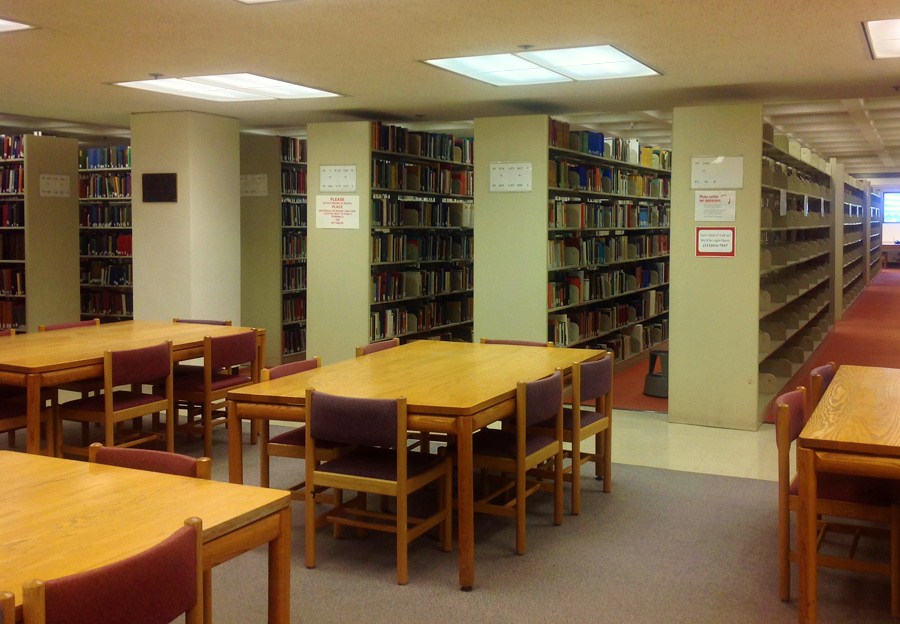
Table in Library

Table in Library

Book 6: Saville by David Storey

“I haven’t said he’ll never do it,” Colin said.

Richard had covered his face in his hands: his head was shaken from side to side; he his shoulders shook, some fresh anguish broke from him as his father touched his back.

“Nay, love,” his father said. “It’s not important.”

“It is,” his brother said, his voice buried by his moans.

Storey, David. Saville. New York: Harper & Row, Publishers, Inc., 1976. Print.

Editor’s note: I forgot to write down the page number and then was unable to find the passage while skimming through the book.

Book 7: Music of the Mill by Luis J. Rodriguez

“Eventually it wasn’t a fantasy. I often walked home from school, which was hard at first since I got so many stares and whistles, especially from the paisas, the Mexicanos, freshly wet from over the Rio Grande. There were run-down motellike apartments on Florence Avenue that I had to pass by every day. Nothing but newly arrived men lived in them. They worked in local construction and factory jobs. By the afternoon, many of them were hanging out, already drinking beer, with the shirts off, wearing Mexican vaquero hats, a type of cowboy hat. They always yelled and whistled at me.”

Rodriguez, Luis J. Music of the Mill. New York: HarperCollins Publishers, 2005. 216. Print.

Book 8: These Are Not Sweet Girls: Poetry by Latin American Women. Edited by Marjorie Agosin.

From the poem Rosa/Fili by Maria Arrillaga:

III.

“He did not leave
You left, Rosa, Rosario, Rosina, Rosaura/Fili
Your name grows
In that new path
Furrows flee your face
Your features are refined
In the contour of precise strokes
Calm you are
The towering heights of the past
Become the happy landscape
Of your big waist
Your hair undulates defying
He who will appreciate your body
You are intelligent, Fili
You have your life
You have yourself
It’s no small thing.”

Agosin, Marjorie. These Are Not Sweet Girls: Poetry by Latin American Women. Fredonia, New York: White Pine Press, 1994. 194. Print.

Book 9: The Tartar Steppe by Dino Buzzati

“One September morning, Giovanni Drogo, being newly commissioned, set out from the city for Fort Bastiani; it was his first posting.

He had himself called while it was still dark and for the first time put on his lieutenant’s uniform. When he had done, he looked at himself in the mirror by the light of an oil lamp but failed to find there the expected joy. There was a great silence in the house but from a neighbouring room low voices could be heard; his mother was rising to bid him farewell.

This was the day he had looked forward to for years—the beginning of his real life.”

Buzzati, Dino. The Tartar Steppe. New York: Carcanet Press, 1987. 1. Print.

Book 10: Strindberg: A Life by Sue Prideaux

“When they had left for France, Siri was pregnant again. She knew when they reached their destination she could not hope for a career on the French stage. They stood on the platform, smartly dressed as always, with their children, their nanny Eva, their trunks and cases of books and the blue and white pram with its milk-stained top. Siri’s career as an actress, apart from her creation of the role of Miss Julie in Denmark in 1888, was over.”

Prideaux, Sue. Strindberg: A Life. New Haven and London: Yale University Press, 2012. 104. Print.
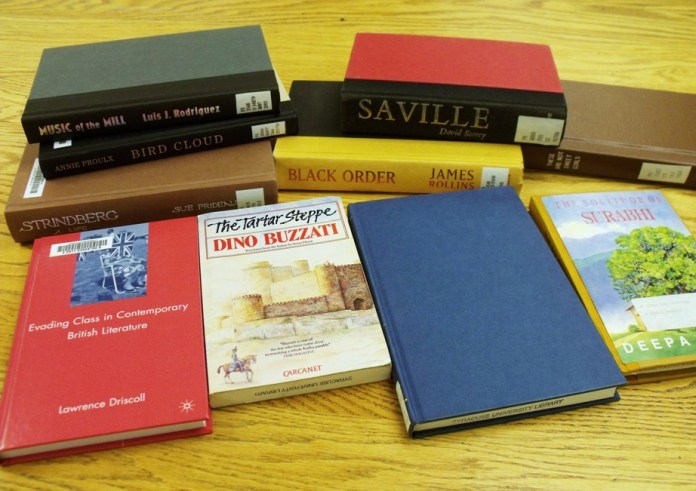
Books on Table

Books on Table

Standard