39 Years Later

I’ve written about this in many entries over the years, but I can’t let the Dec. 12th date pass without mentioning my gratitude for still being here. Today marks my “tumorversary.” Thirty-nine years ago today, on Dec. 12, 1984, surgeons at SUNY Upstate Medical Center in Syracuse, New York (now named Upstate University Hospital), removed a large craniopharyngioma that had engulfed my pituitary gland, leading to stunted growth and delayed puberty in my teenage years, as well as lifelong hypopituitarism.

In my last blog post, I wrote about my follow-up appointment with my neurosurgeon after my summer operation—my sixth brain surgery. But who’s counting?

Standard

Recovery Update

I never post pictures of myself, but I want to share this photo taken by my wife in our backyard. Eight days have passed since my brain surgery. I’m still a little wobbly, but I am getting stronger every day and trying not to strain myself.

Backyard photo. Credit: Pamela DiClemente.

I am also grateful for being able to soak up the sunshine—standing and breathing on my own. And I wish speedy recoveries for other people enduring health crises.

Thank you for your prayers and kind thoughts.

Standard

Tumor Talk

I am undergoing another brain surgery on Monday morning. This marks the fourth time since my craniopharyngioma (benign brain tumor on the pituitary gland) first appeared when I was fifteen years old.

Image by the National Cancer Institute.

My last blast of Gamma Knife radiation in 2020 kept the tumor away, but subsequent regrowth began affecting my vision in the past two years. Another round of radiation could not be performed because the tumor sits only a millimeter away from the optic nerve. My radiation oncologist gave me the grim news that radiation presented a twenty-five percent risk of blindness.

So a neurosurgeon and an ears, nose, and throat surgeon at Upstate will team up for a transsphenoidal approach—meaning they would go through the nose to access the tumor. I had the same surgery in 2011, followed by a rough recovery where I stayed locked in my room for about a month, suffering from excruciating headaches. I have added concerns now because in 2011 I was on my own; now I have my wife and son to think about.

Image by the National Cancer Institute.

Anyway, I want to present a piece of experimental writing inspired by my tumor. I think this falls under the essay category, but it could also be considered fiction.

Tumor Talk: A Conversation with My Craniopharyngioma

“I’m back, baby!”

I heard those words in my head after my radiation oncologist discussed the results of my latest MRI. Dr. L. said my craniopharyngioma—a benign, slow-growth tumor at the base of the brain near the pituitary gland—had grown over the last two years, causing my recent double vision.

Dr. L. said the proximity of the neoplasm to the optic nerve and blood vessels meant radiation was no longer an option. I would need surgery.

“You must be pretty proud of yourself, Fred,” I said to my tumor friend resting inside my head.

“Oh, come on, man, don’t be like that,” Fred said. “You know this was inevitable. Us craniopharyngiomas are like the cockroaches of the tumor world. You know no matter what you do, we always come back. You think that weak-ass radiation was gonna work on me?”

Yes, my tumor has a name. Since he’s been residing inside me for so long, I figured we should at least be on a first-name basis.

And Fred was right. There’s no denying his Terminator instincts for coming back. He’s like Buster Keaton in The General. He keeps barreling down the tracks no matter what you do to him.

Fred first appeared in 1984 as a large tumor engulfing my pituitary gland. His removal led to hypopituitarism and diabetes insipidus (a disease affecting water and sodium balance).

Despite surgeries in 1984, 1988, and 2011, plus two blasts of Gamma Knife radiation, Fred continued to aggregate the tumor vestiges, scooping up the fragments and wrangling them into a well-formed regiment. I gotta give him credit for its spunk and resiliency.

But after leaving the medical office and waiting at the bus stop, I wanted to set some ground rules with Fred, to see if I could talk him down or at least minimize his impact.

“Why are you doing this to me again? Life has been pretty stable with my family. Why do you have to make trouble for us now?”

“Come on, man, get real. Don’t give me those bullshit questions. Why anything? Why do you breathe or drink water? Why does a horse gallop, a deer prance, a cat meow, or a goat bleat? Do I need to go on? I’m a fucking brain tumor.”

“So what if you’re a tumor? Can’t you control yourself? Can’t you stop growing?”

“Now you just sound naïve. I can’t be something other than what I am. And I have a clear objective. As a tumor, my job is to expand and invade. That’s it. That’s why I’m here on this planet.”

What could I say? I couldn’t offer any retort.

“Look, don’t be so glum. You’re in good hands with your doctors, and our history shows we both come out alive.”

“Yeah, but I wish you’d agree to leave.”

“Well if it’s any consolation, I do like where I live. You’re a good host. Don’t get me wrong, I’d prefer to be inside the head of some brilliant mathematician or a swimsuit model reclining on a beach. No offense. Look, you’re not a bad guy. But let’s not get carried away. You’re no fucking Einstein or Dave Chappelle. And frankly, I get a little bored with your prosaic thoughts.”

“Tell me how you really feel.”

“Oh come on, man. I’m just busting your balls a little bit, trying to cheer you up. Which reminds me—I thought of a theme song for our relationship. Come on, sing it with me:

“In your head, in your head,
Zombie, zombie, zombie-ie-ie-ie …”

“Very funny.”

“Come on, man, don’t be like that. We need to learn to live together. Look, I haven’t caused irreparable damage. Your brain functions, memory, and language processing are all intact.”

“I suppose I should thank you for that. But with any luck, the neurosurgeon will go up through the nose and pluck you out.”

“Oh, why so adversarial? We’re just talking here.”

“You have your objective. And I have mine. You’re a squatter. A nuisance tenant who needs to be evicted.”

“Yeah, good luck. I adhere to things. You can’t just kick me out. I stick around. Been doing it for more than thirty-five years.

“Yes, you’re one tough foe.”

“But why do you have to think of me like that?”

“What do you mean?”

“Maybe I’m more friend than foe?”

“I don’t buy it.”

“Just hear me out. You wouldn’t be the man you are today if it weren’t for me.”

“How do you figure?”

“You’re pretty driven, ambitious, and disciplined, right?”

“Yeah, I suppose.”

“Well, if it weren’t for me, you wouldn’t have had to overcome those endocrine challenges—being the shortest guy in your class. I may have stunted your growth, but I gave you determination—a fire in the belly.”

“You know, I have to admit, I think you have a point. From the moment you came along, I felt like you were a ticking time bomb inside my head, and I had to strive to achieve something before you exploded and shattered my skull.”

“But, lucky for you, I’m not a bomb. And I’m not vicious, pernicious fucking glioblastoma. I’m just an aggravating nuisance, a little hangnail or a sliver under the skin. Think of me as a dented fender or a toilet that keeps running.”

“Well, I guess I should say, ‘thank you’ for that.”

“Don’t mention it.”

“Can we at least come to some agreement? Can you just stop growing and stay put for a while, until I have this surgery?”

“I don’t have that kind of control, kid. You give me too much credit. I don’t know where I’m going. I just keep moving.”

“Well listen, after Dr. H. does his transsphenoidal resection work, I’ll let you come back slowly, over the next ten years.”

“I hate to break it to you, but I don’t need your permission to inhabit some space inside your head. And let’s face it—we’re gonna be together for a long, long time. We’ll be two old, shriveled geezers playing shuffleboard in Clearwater. So let’s stay friends.”

I laughed. “I guess you’re right. I don’t know what else to say. See you later, Fred.”

“See you in the operating room, kid.”

Standard

Tumorversary 2022

Today marks the thirty-eighth anniversary of my first brain surgery. As I’ve written about before, on Dec. 12, 1984, surgeons at SUNY Upstate Medical Center (now named Upstate University Hospital) in Syracuse, New York, removed a large craniopharyngioma that had engulfed my pituitary gland, leading to stunted growth and delayed puberty in my teenage years, as well as lifelong hypopituitarism.

The tumor has returned over the years, requiring follow-up surgeries and Gamma Knife radiation. It’s something I’ve learned to live with, and I’m grateful my condition is manageable.

Here’s a poem reminiscent of that initial post-surgical time period:

Craniopharyngioma (Youthful Diary Entry)

Craniopharyngioma gave me
an excuse for being unattractive.
I had a problem inside my head.
It wasn’t my fault
I stood four foot eight inches tall
and looked like I was
twelve years old instead of eighteen—
and then nineteen
instead of twenty-four.
I couldn’t be blamed for
my sans testosterone body
straddling the line
between male and female.

The brain tumor
spurred questions
about my appearance,
aroused ridicule
and provoked sympathy.
I heard voices whispering:
“Guess how old that guy is?”
And, “Is that a dude or a chick?”

And while I waited for my
body to mature, to fall in line
and to achieve normal progression,
I remember wishing the surgeons
had left the scalpel
inside my skull
before they closed me up,
knitting the stitches
from ear to ear.

I prayed the scalpel
would twist and twirl
while I slept at night—
carving my brain
like a jack-o’-lantern—
splitting the left and right
hemispheres,
and effacing the memory
of my existence.

Standard

Featured Poets Blog

I just wanted to share that I have a couple of new poems published on Osamase Ekhator’s Featured Poets blog. You can find out more about Osamase Ekhator on his personal website. And here’s a direct link to the Featured Poets page.

Standard

Jacket with a Past

I came home from grocery shopping on a recent Friday night and changed into black shorts and a black T-shirt to relax for the evening. As a gag, I pulled an olive green, double-breasted blazer from the back of my closet, slipped it on and stepped into the living room; I then waited for my wife—who was seated on the couch with our three-year-old son—to look up and notice me. When she did, she howled with laughter and said, “No, no.”

“What, no good?” I asked.

“It’s so out of style,” she said. The shoulder pads are so over the top.”

Of course, I knew she was right.

And one side note: I believe I am colorblind, so while I think the jacket is olive green, it may actually be beige or light brown.

The 1980s blazer is a cross between something Sonny Crockett would have worn on Miami Vice or one of the suit jackets David Byrne of The Talking Heads could have donned while performing on stage or appearing in an MTV video.

But even though the garment is dated, I thought I looked decent modeling it, since I’m actually leaner now than I was when I bought the jacket in the late 1980s at Sangertown Square mall in New Hartford, New York (if my memory is correct). It came with me to Washington, DC for graduate film school and then to my career stops in journalism—to Venice, Florida; Toledo, Ohio; and Phoenix, Arizona.

After returning to central New York in 2006, I left the jacket in my parents’ home in Rome, until I retrieved it a few years ago and buried it in my bedroom closet in Syracuse. I decided not to discard the blazer because I thought I would find the right occasion to wear it; but I never did, as I knew the jacket’s time had passed, as had mine.

But the story does not end there because the jacket has a history. After breaking it out and seeing it encircling my frame, it reminded me of the way I felt about myself in the late 1980s and early 1990s, when I was riddled with self-hatred over my chubby, underdeveloped and feminine appearance (caused in part by my hypopituitarism). No jacket back then would have made me feel good about myself when looking in the mirror.

I’d like to say I’ve moved past the low self-esteem that hounded me in my youth. But the truth is I still struggle with it daily. Professional success does not resolve it; neither does marriage nor being a decent parent. All of us must live with the non-Instagram versions of ourselves—the real, unvarnished truth we face every day—the wrapping of flesh that houses the spirit pulsating inside. And so the jacket is more than piece of clothing to me. It’s part of my past, a slice of my story I wanted to share.

I donated the blazer to the Salvation Army store, and I hope that despite its out-of-date style, someone else was able to get some use out of it.

Standard

Hitting the 50 Mark

As I celebrate my 50th birthday today, I want to offer some brief reflections on hitting the half-century mark.

Most importantly, I must express gratitude for surviving this long. Since 1984 I have endured four surgeries to remove a craniopharyngioma (pituitary tumor) and its remnants, as well as managing the hypopituitarism that followed. In subsequent years, the diseases of osteoporosis and rheumatoid arthritis have been added to my medical history. But my diminishing health has taught me some important lessons. Here they are:

  1. If not this, it would be something else. Yes, I have some challenges, but I have not been given a stage four cancer diagnosis, and I do not suffer another fatal illness. And for that I am thankful.
  2. I must accept the limitations imposed on me by these diseases, keeping the attitude of always trying to do my best and reevaluating my goals and what I am able to accomplish.
  3. The importance of cultivating an attitude of gratitude. I am thankful for my family, friends and full-time employment status, but I also continually remind myself to be grateful for the things we often take for granted. For me these are: standing upright, breathing normally, having brain function (although somewhat impaired at times), having five working senses and working limbs.

So there’s only one more thought on turning 50: I don’t know how many more years I have left on this planet, but I will try to make each day memorable, not in achievement but in the ways I connect with others, spread compassion and leave a positive impact wherever I tread.


Standard

Memories of Summer Stock Theater

Act I:

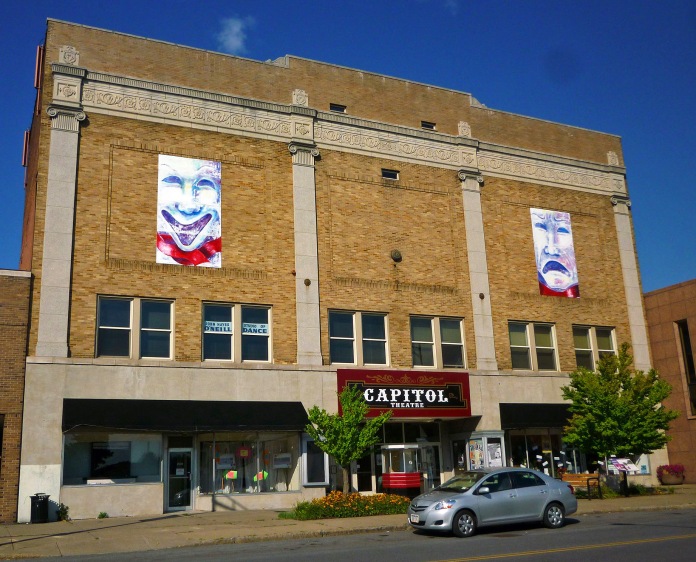
I loathed musical theater when I was growing up. My first exposure to the genre came during my college years in the late 1980s and early ’90s when I attended SummerStage performances at the Capitol Theatre in my hometown of Rome, New York. The productions featured college students from across the region who were majoring in drama or theater studies, and I remember seeing many shows, including Guys and Dolls and South Pacific.

Capitol Theatre, Rome, New York.

My mother, Carmella, and my stepfather, Bill, would buy me tickets, and in a failed attempt to impress the many young women who attended the performances, I would “dress up” in a black blazer that I had purchased at the Salvation Army store in Rome; yet my appearance and fashion sense drew no positive feedback from the females in the audience.

And while I wanted to go to the Capitol shows because they were summer social events, I was afraid that if I actually liked them, and expressed this appreciation, I would get laughed at or be regarded as effeminate by my friends in our sports-obsessed city.

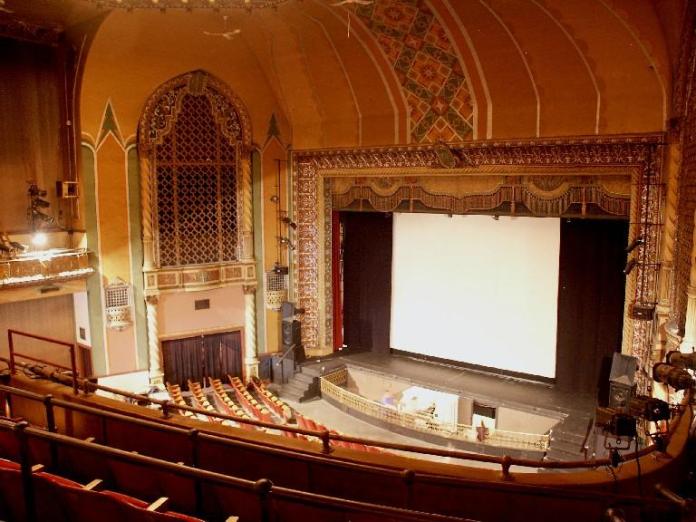
Once the lights went down and the curtain opened for a show, I would snicker when the actors would break into song in the middle of a conversation. I wanted to stand up and scream, “This is absurd. Why am I the only one laughing here?”

Capitol Theatre Interior.

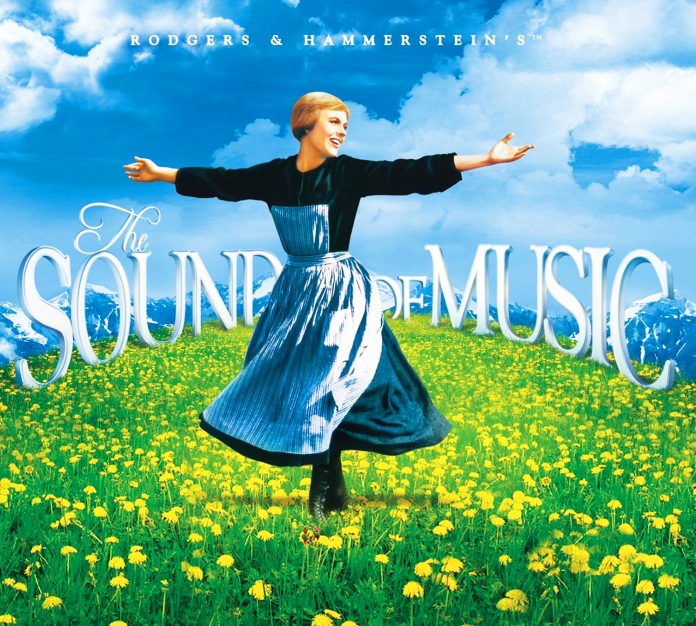
Live musical theater seemed even more preposterous than its cinematic equivalent, which I had been introduced to as a kid while watching my mother’s obsession—the 1965 film The Sound of Music, starring Julie Andrews and Christopher Plummer. And just like with TSOM, I could not suspend my disbelief and accept the characters speaking dialogue one moment and singing the next. Yet I seemed to be the only one dismayed by the experience because the packed houses at the Capitol responded to the final scenes with thunderous applause and standing ovations for the performers.

The Sound of Music.

As we would leave the theater, Mom or Bill would often ask me what I thought about the production. I would say something like, “I thought it was stupid. I just hate how they just start singing.” And my mother would shake her head and say, “Oh you never like anything. I don’t know why we even bother to bring you.”

What I didn’t share with my mom is that at the time, seeing the musicals on the Capitol stage tapped into the dark experience of my maturation from a boy to a man.

I had been diagnosed with a pituitary tumor when I was fifteen. In 1984 neurosurgeons performed a craniotomy to remove the tumor and then swept up the remnants in a follow-up surgery in 1988, after my freshman year at St. John Fisher College in Rochester, New York. Endocrinologists also treated me for panhypopituitarism, as I lacked all of the hormones the pituitary gland normally produces. I was prescribed synthetic human growth hormone and testosterone shots during this period.

So even though I was in college when I attended the SummerStage performances, I still looked like a fourteen-year-old boy who had not passed through puberty. Lacking secondary male characteristics like facial hair, an enlarged Adam’s apple, and a deeper voice, I was sometimes mistaken for a girl, both in person and when talking with strangers or customer service professionals over the phone.

The women at my college were not interested in me romantically, and my low self-esteem grew into rabid self-hatred. I despised my youthful appearance and feminine features, and I became angry over my body’s inability to “catch up” to my chronological age.

So when I went to the theater with Mom and Bill, I resented the easy solutions to problems as presented by the actors. For example, a couple would be on stage bathed in bright amber or violet lights, and they would converse about some family dilemma or obstacle to their romance. Circumstances would appear bleak; and then they would start singing and dancing, and their fate would change and their drama would be resolved.

I couldn’t accept this. Life wasn’t like that. I could not alter my situation or “become normal” through song and dance. My problems stayed with me after I walked out of the theater. And so I hated musicals because they represented an unrealistic portrait of the world.

Of course I was only seeing things through the narrow prism of my personal experience. I wasn’t able to look out, beyond myself, in order to enjoy the artistry of the action on stage.

Act II:

Years later I underwent a reversal and evolved to love musicals, especially the films featuring Judy Garland, Doris Day, Frank Sinatra, and Gene Kelly. My all-time favorites are The Wizard of Oz (a given), Young at Heart, and Singin’ in the Rain.

I also attended many live musical theater performances. So what changed? How did I come to appreciate the genre I had hated so much in my youth? For one thing I grew up and matured.

But I also had a more practical reason for liking musicals. I began working at Syracuse University in 2007 and from time to time would receive staff discounts for tickets to performances at Syracuse Stage, Central New York’s professional theater. I took advantage of the deals and soon attended many of the plays produced by Syracuse Stage, including the musicals Fiddler on the Roof, Little Women, Godspell, Oklahoma!, and Rent.

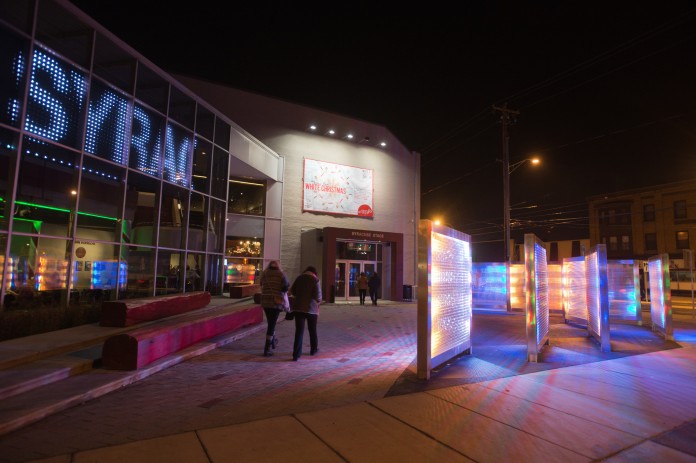
Syracuse Stage Exterior. Photo by Steve Sartori.

I would buy a single ticket, usually close to the stage, orchestra left or right (one of the cheapest seats in the house). And because I paid for the tickets, I convinced myself I would enjoy the shows no matter what, so I wouldn’t feel like I had wasted my money.

Also, even though I was single at the time I started going to the shows, I tried not to focus my thoughts on my bachelor status or become discouraged because I never brought a date with me to the theater (although sometimes I couldn’t help being envious of couples holding hands as the house lights dimmed).

Instead, I turned my attention to the action in front of me. Unlike when I watched the SummerStage shows in Rome, I was able to get out of my head, to look outward instead of inward.

I also surrendered my desire for logic in the plot lines of the plays. In 2008 I began dating my future wife, Pam, a theater actress from the Philippines, and she helped me to suspend my disbelief. She told me, “Just enjoy it. Let yourself go and don’t worry if it doesn’t make sense.”

And in watching a number of musicals unfold before me, I no longer expected a realistic interpretation of the world; it didn’t bother me anymore that the actors behaved irrationally.

I simply allowed the experience to wash over me and marveled at the production values and collaboration involved in bringing the action to life on stage.

I also viewed the plays with a more critical eye and appreciated how musicals combine elements of multiple disciplines. They encompass the verbal, as represented by the words in the script; the visual through the costumes, lighting, and set design; dance and movement through the choreography; and the aural through the music and sound effects. Musical theater appeals to all senses, even including smell when smoke is used in scenes.

And I discovered what my mother had understood years earlier when watching The Sound of Music—that musicals offer escapist entertainment as the viewer lives vicariously through the characters, relating to their struggles.

I remember rooting for the character of Jo March in Syracuse Stage’s 2009 production of Little Women, hoping she would hold on to her independence as she strove to find her way in the world.

I remember being captivated by the song “Astonishing” and its soaring lyrics: “I may be small, but I’ve got giant plans to shine as brightly as the sun … I will be fearless, surrendering modesty and grace.”

And sitting up close for the performances I saw how hard the actors worked—the sweat pouring off their faces and brows and soaking their costumes as they belted out the songs and danced breathlessly on stage. In the dusty glow of the stage lights I also noticed the smiles on their faces and a flicker of light in their eyes. It was clear they loved what they were doing; and that joy translated to the audience.

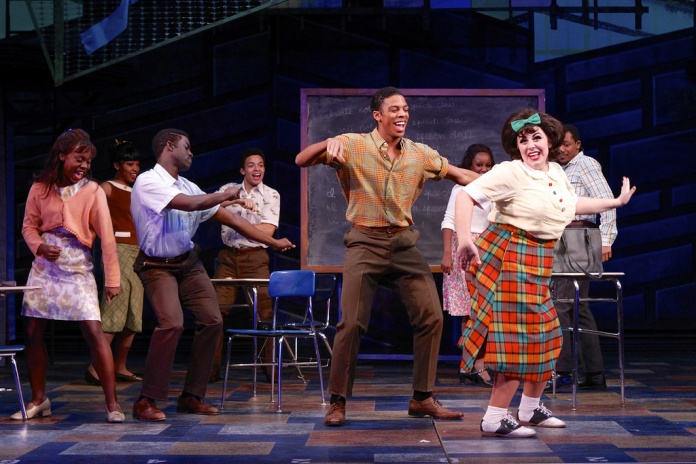
I remember seeing Hairspray with Pam at Syracuse Stage in December 2014, sitting in row B, left orchestra. And during one of the songs—either “Good Morning Baltimore” or “You Can’t Stop the Beat”—I turned my head around in the same way Audrey Tautou’s character did when she visited the movie theater in the French film Amelie. In the darkness I scanned the crowd seated behind me, gazing at the mixed audience comprised of older couples, young professionals, and college students. And their smiling faces matched the expressions of the actors on stage; the emotional connection was palpable.

Hairspray Scene. Photo by Michael Davis.

And I joined in on the fun. I turned my head around and nodded my head and tapped my foot as I listened to the music and let the show carry me away. I also thought that if my mother were still alive, she would have loved the performance too.

Standard

Diagnosis: An Essay

I just wanted to share that I have a short patient essay published on the website of The Pituitary Foundation. It’s part of a coming-of-age memoir in progress. You can read the piece here. Thanks for taking a look. I am still working to shape the messy memoir into a very bad first draft.

Standard

Anniversary Day

Gratitude fills me on this day, Dec. 12, as I recall an important moment from my life.

Thirty-two years ago this morning, on Dec. 12, 1984, surgeons at SUNY Upstate Medical Center in Syracuse (now named Upstate University Hospital) pried open my skull and pulled out a large tumor that had swallowed my pituitary gland, stunting my growth and delaying my maturation during my teenage years.

Upstate University Hospital (Photo by Francis DiClemente)

Upstate University Hospital (Photo by Francis DiClemente)

Although it was benign, the position of the tumor, a craniopharyngioma located near the optic nerve, meant it could have caused a loss of vision if left untreated. But the surgeons plucked out most of the tumor in a successful eight-hour operation.

The damage to the pituitary gland left me with two lifelong diseases—panhypopituitarism (a deficiency of all of the hormones the pituitary gland produces) and central diabetes insipidus (a condition caused by a lack of the hormone vasopressin, producing the symptoms of excessive urination and extreme thirst).

Still, despite the need for heavy doses of prescription drugs and constant management and monitoring of my health, more than three decades later I am happy to report my last MRI showed I am tumor free. My vision remains intact, with the exception of reaching the age where I require progressive lenses and reading glasses.

Doctors had to perform two follow-up, through-the-nose surgeries, along with a round of Gamma Knife radiosurgery, in order to achieve the positive results. And I know the slow-growth tumor could make a return appearance a few years from now.

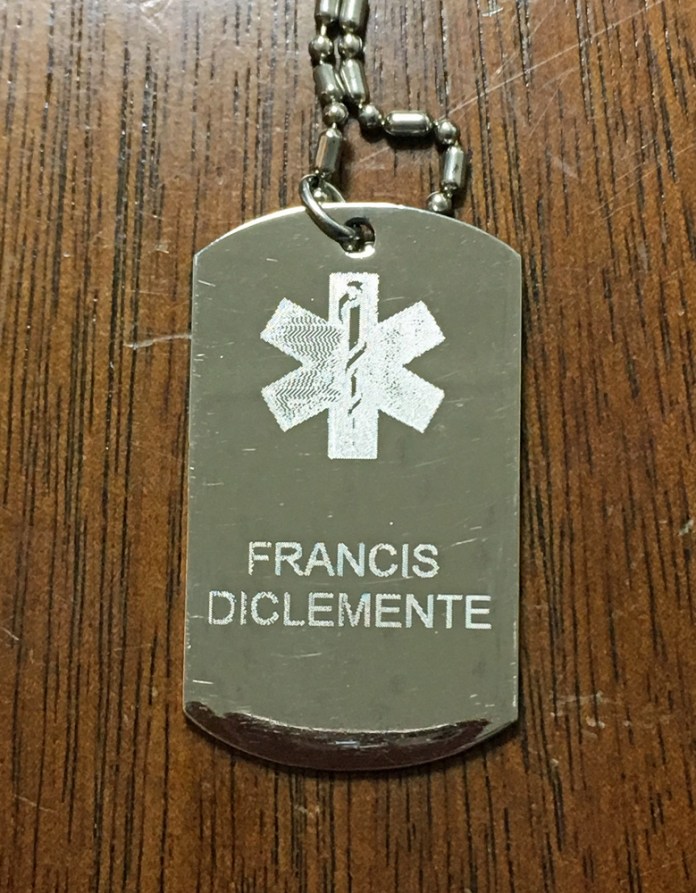
My medical ID necklace

My medical ID necklace

But for today I am free of its tentacles.

Today I am thankful for being alive, knowing things could have turned out differently. One error from a surgeon 32 years ago could have meant diminished mental capacity or motor function, or even worse, blindness. Any number of factors could have changed the outcome.

Instead I am nearly 50 now and married to a wonderful woman. And we have a beautiful young son, a nine-month-old tyrant named Colin Joe.

I believe the prayers my family hurled at heaven on Dec. 12, 1984, had something to do with helping me survive the delicate operation. On this feast day of Our Lady of Guadalupe, I can’t help thinking that the petitions my aunt, Sister Carmella DeCosty, made to the Blessed Mother that day were answered. And in this season of blessings and gratitude, I will take a moment to say my own prayer of thanksgiving.

Our Lady of Guadalupe

Our Lady of Guadalupe

Standard