Black Box experimental film

For a recent film festival, I had to submit my project through an unlisted YouTube account. Now I’d like you use that account to upload some past projects.

The first is Black Box, a 2013 experimental short film that uses the power of music and dance to explore emotions. In the strictest sense, it is a dance film; however, it serves as a conceptual video art piece as opposed to a straight performance work.

The dancer in the piece clutches a black box representing the human heart as a repository of life’s emotions. It is a metaphor for the turmoil and pain we carry inside. Through a series of movements, the character becomes free from the heavy burden of the black box, and he can leave it behind and thus arrive at a state of inner peace.

The idea for this video originated with the music, the second movement of Franz Schubert’s Death and the Maiden. I had always loved this melancholy and stirring piece and thought it could serve as the foundation for an artwork if the song was married to powerful visuals.

Once I developed the concept and treatment for Black Box, I turned to choreographer and dancer Brandon Ellis. Ellis interpreted the concept and developed and executed the dance routine.

For the production I collaborated with Michael Barletta and Courtney Rile, founders of the Syracuse, New York-based production company Daylight Blue Media.

Credits:

Choreography by Brandon Ellis
Cinematography by Michael Barletta and Courtney Rile
Edited by Courtney Rile
Produced and Directed by Francis DiClemente

Official Selection, 2014 Athens International Film and Video Festival (Athens, Ohio)
NewFilmmakers New York screening series (2013)


Standard

Ice Cream Poem

I saw a melting ice cream cone on the sidewalk while out for my Sunday run today. Luckily, I brought along a pen and a scrap of paper. I jotted down some notes, which became the sweaty, messy first draft of this poem.

Melting Cone

A Drumstick ice cream cone
lying in the middle of the sidewalk
on a blistering July Sunday—
the vanilla ice cream liquified,
while ants scale the surface of
the dented waffle cone.

Did the child cry
when the cone hit the ground?
And did Mom let the girl
run back inside to
grab another from the freezer?
But maybe a kid didn’t drop it—
because in reality,
ice cream misfortune
could befall anyone.

The forecast calls for storms.
Soon heavy rain will scatter the ants
and cleanse the sidewalk,
erasing the evidence of this calamity,
as one more taste of summer fades away.

Standard

Some Poems Celebrating Summer

Stanwix Street

A vanilla ice cream cone
covered with sprinkles of dirt,
a handful tossed by small, grimy hands
across a chain-link fence.
A blond child’s whine—
flat, constant and eerily melodic.
The girl then turning away,
screaming upstairs to her mother,
sound asleep in the mid-August heat,
the lime-green curtains fluttering in the
second-story window of the adjacent brick building.
The child just standing there, scraping off the grit
and licking the melting residue
trickling down her forearm.

Streetlight Paradise

Chalk marks on sidewalks,
fireflies stalking the night,
creaky porch steps,
chain-link nets and
the crack of the bat.

Sour-puss lips break a smile,
then sneak a kiss.
It’s cool to hold hands with
the girl of your dreams,
the one who says she’ll
love you forever.

But forever is too far away.
Our time is now—a passing moment
when our parents look the other way.

Summer fun in the springtime
of our lives, sucking it all in
under this streetlight paradise.

The Mystery of the Wolf

A summer evening in upstate New York—
a backyard sprinkler hisses
while the smell of fresh-cut grass
is pungent and delicious.
Crickets chirp and a coffee-colored mare
snorts from across the barbed-wire fence.

I am alone, kicking a soccer ball,
when a gray wolf emerges from
the high weeds lining the fence.
I try to run, but my legs lock up,
and I tumble to the ground.

The wolf circles me,
then sweeps in on my limp frame.
I can hear its stomach growling
as it hovers over me.
The tongue is extended
and drool splashes my face.
The wolf takes my neck in its mouth,
but does not bite down.

And I wake up in my bed,
thankful that the encounter is just a dream.
I am safe, and no wolf invades my room.
Yet I remain troubled,
afraid of closing my eyes,
drifting back to sleep
and ending up at the mercy
of another predator.

Minors

Toledo in July—a Mud Hens game:
Big league dreamers with names like Bubba, Fausto and Tyler
toil away in the minors,
hustling for the scouts perched behind home plate,
diving for line drives and sliding head first,
with egos in check and mouths full of dirt.

Pillars of artificial light frame the setting sun,
and from beyond the azure sky,
the ghosts of washed-up utility infielders
and middle relief pitchers
pull for these hard luck Triple-A players.
They want to scream, “Take heed, savor it now,
for this is the best you will ever be.”
But they’re under orders to keep their mouths shut,
and can only blow a home run foul every once in a while.

The steel girder stands are filled with a crowd
that still believes in this clockless game.
They listen intently for the crack of the bat,
and sing with all their might during the seventh-inning stretch.

Little kids with hot pink shorts and noisy flip-flops
smear their faces with mustard and hug Muddy the mascot.
They scatter peanut shells and scamper after foul balls,
and for them the score is merely an afterthought.

The summer night comes to a close
with a game-ending double play and a fireworks barrage.
The fans file out and load into their cars,
going back to real life with memories of Mud Hens
now stitched in the seams of their minds.

(All four poems were previously published in Dreaming of Lemon Trees: Selected Poems, Finishing Line Press, 2019).

Standard

Artwork by Kiddo

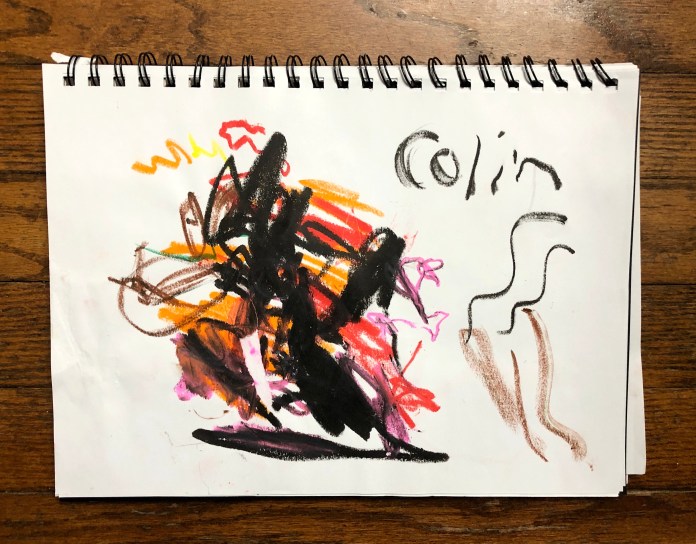
Here is an original artwork by my nine-year-old son, Colin (with minimal photo editing). It made me think that sometimes the chaos wrought by autism can render beauty. I like the use of white space and the Jackson Pollock feel.

Untitled by Colin DiClemente.

But the sundry objects and paper cutouts scattered in his bedroom and on our dining room table might indicate his preferred medium will be collage.

Dining room scene.

Often, when Colin is doing his repetitive tasks, such as lining up blocks or wooden letters of the alphabet, I’ll ask him questions, like, “What job do you want to do when you grow up?” If you could only be one, would it be a police officer, a firefighter, a doctor, a teacher, an artist, or a cook? And I’ll name a whole bunch of other occupations. But nearly every time, Colin’s answer will either be Artist or Cook (he loves mixing the batter for pancakes and muffins).

I joke with my wife, Pam, that we should encourage him to pursue a career as an accountant because earning a living will be easier than working as an artist or chef. I also tell her we should let Colin pursue his artistic endeavors so that he can 1) Explore and develop his creative expression 2) Maybe sell a few paintings one day that will pay off the mortgage and perhaps fund some experimental or documentary film projects.

I also realize that the parents of an autistic child have to let go of any desire for a neat and orderly home. It’s just not possible, at least in my experience. Pam and I try to laugh about it and embrace the futility of those moments when Colin takes up too much real estate in our house with his strewn objects or refuses to pick up his mess.

Standard

Poecabulary Book Released

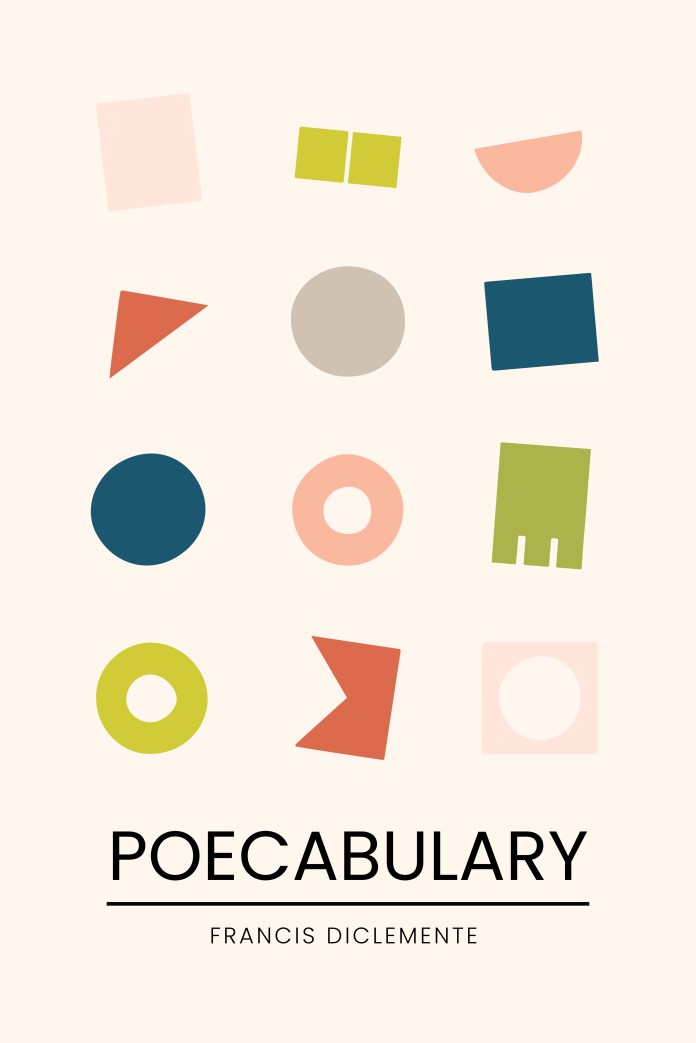
I am excited to announce the publication of my new book, a minimalistic, experimental poetry collection entitled Poecabulary.

Here is the description:

Poecabulary is a minimalist poetry collection that blurs the line between vocabulary and verse. Words appear in unexpected pairings, creating connections that surprise, challenge, and invite reflection. Each combination is a deliberate act of linguistic play, where alliteration, sound, appearance, randomness, rhyme, and meaning collide.

The author explores how similar or opposing words interact, encouraging readers to discover their interpretations and associations. Both a playful exercise and a meditation on language, Poecabulary celebrates the power and flexibility of words.

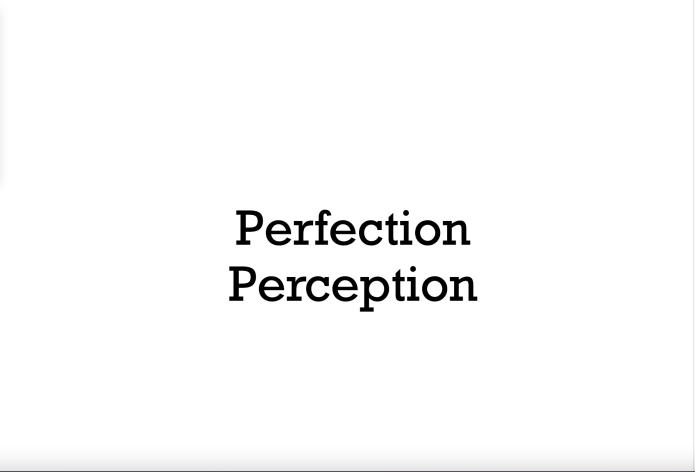
This collection will resonate with language lovers, poetry enthusiasts, and anyone curious about how words shape meaning. Sample pairings include Autistic/Artistic, Diffident/Different, Lonely/Lovely, Perfection/Perception, and Reject/Respect.

Poecabulary front cover.

The book began with my obsession with vocabulary and discovering connections between word pairings.

As part of my compulsive, lexical behavior, I check four different online dictionaries daily for their “Word of the Day” features:

TheFreeDictionary.com
Dictionary.com
Merriam-Webster.com
WordGenius.com

This project is an example of how the crazy ideas that percolate and fester in my brain are the ones I need to chase, since they are the ones that elevate my creativity and spur risk taking.

Here is the author’s note from the front of the book:

Obsessed with vocabulary, I created this work as wordplay—an exercise to incite imagination and elicit connections in the reader’s mind. I consider the word pairings a hybrid of vocabulary and poetry—which could be labeled as “Poecabulary” or “Voetry.”

Quite honestly, I don’t even know if you can call Poecabulary a book, but I do believe some “word nerd” readers may enjoy it. And it’s a quick read. Although it’s 190 pages long, the word count is less than 650.

I would also love to collaborate with a visual artist who could make large-scale paintings featuring select word pairings from the collection. I could see the text-based works hanging in a gallery space.

Here are a few of my favorite word combinations:

Autistic/Artistic

Diffident/Different

Lonely/Lovely

Perfection/Perception

Reject/Respect

Standard

Nerve Conduction Study Conversation

I received a nerve conduction study last week related to symptoms of my rheumatoid arthritis. The bearded electromyography (EMG) technician, Mark, had dark hair and an athletic build, and he wore glasses. We made small talk while he placed electrodes on me, stimulated the nerves with mild electrical shocks, and measured the results on a computer.

When I asked him where he was from, he said he grew up in Syracuse and went to a local high school. “It was a really good school,” he said, noting its academic and athletic excellence. “But I didn’t appreciate it at the time. I was kind of a screw up.”

He also explained that his mother was a custodian at Syracuse University and how he could have gone to college there for free, but didn’t take advantage of the opportunity. “I blew it,” he said. “But I had to find my own way.”

And then he said a jewel of a statement regarding regret. “If you focus too much on regrets, you don’t appreciate the life you currently have.” Or he may have said, “If you focus too much on regrets, you don’t live the life you currently have.”

Regret is a recurring theme in my poetry. I think it’s something all adults at a certain age wrestle with—this idea of ambitions versus reality.

Camera Angle

What would I choose
if I were given a chance
to lead a different life?

What mistakes
would I correct?
What new road
would I take?

But you can’t splice
the scenes of your life
to edit the past.
You can only point
the camera forward
and zoom into the future.

(The Truth I Must Invent, Poets Choice, 2023)

Formula for Success

Life can
be tolerable
when you
relinquish
aspiration
and settle for
acceptable.

(Outward Arrangements: Poems, independently published, 2021)

Shift in Thought

At some point
you have to
deal with the
Who You Are
instead of the
Who You Want To Become.

By now the
form is fixed.
You are
complete as is.
Don’t expect
anything else.
Don’t hope
for anything more.

(Outward Arrangements: Poems, independently published, 2021)


Standard

A Mother’s Day Poem

This poem is dedicated to all mothers, for what moms do every day of the year. It appears in my 2019 full-length collection, Dreaming of Lemon Trees: Selected Poems, published by Finishing Line Press.

Here’s me kissing my mom, Carmella, sometime in the late 1970s or early 1980s.

Mother at a School Bus Stop

A middle-aged woman with a white canvas coat
stands with her two young children
at a school bus stop on a misty gray morning.
The boy and girl are bundled up
and jabbering as they bounce around—
unaware that Mondays should be devoid of glee.

When the bus pulls up, the mother hugs the children.
The kids separate from her breast,
scurry up the steps and claim an empty seat up front.
The mother waves goodbye to the little faces
pressed against the window and watches
as the bus pushes away from the curb,
ejecting a thin cloud of exhaust.

The woman turns around,
waits for the traffic light to change
and then crosses the street,
marching up the block to return home.
Once there, dirty dishes, unmade beds and
cigarette butts heaped in black plastic ashtrays
demand her attention until mid-morning,
when the woman leaves the house and rushes to work.

She then counts down the hours
until the school bus returns to the curb
and her two kids hop off and leap into her arms,
almost in unison.

Standard

The Happy Couple Exhibit

This essay was originally published in the 2014 edition of Words & Images literary magazine, a student-run publication at the University of Southern Maine.

##

I heard the woman first before I saw her or her partner inside the museum of the Onondaga Historical Association in Syracuse, New York. She said in loud voice, “Rick, where are you, hon?” The OHA had a few exhibitions running simultaneously on this Saturday in early January 2013, and so it was possible to lose sight of your friend or partner as you made your way through the different gallery spaces and inspected the various works. “Hon, come here, look at this,” she added.

Onondaga Historical Association

At the time I was examining the exhibit Manifest Destiny and The American West by artist Robert Hirsch. Hirsch presented nearly one-thousand images in a three-dimensional display—with the pictures placed inside jars and serving as a commentary on how the geographic progression across North America shaped U.S. culture.

After I finished looking at the Manifest Destiny jars, I started walking toward where the couple was standing. They were planted in front of some panels of an exhibit highlighting historic stereoscopic photographs.

Rick was probably in his sixties. He was tall, broad-shouldered and bald except for a tuft of grayish-white hair at the back of his head. He had a bushy mustache that curled downward and matched his hair color and he was wearing a tan jacket.

The woman, whom I will call Ruth, was small and also appeared to be in her sixties. She was wearing a black fur coat, tall black boots, and bronze earrings that looked like costume jewelry. She had short black hair, a birthmark on the right side of her face, and she had applied a little too much burgundy lipstick to her mouth.

But it was her dialogue that made her memorable. I am not a casting director, but I believe you could pick Ruth up and place her in a Woody Allen film and without even reviewing the script, she would fit in with no problem. In fact, I bet she would steal scenes away from Scarlett Johansson or Penélope Cruz.

I heard her tell her husband, as I assumed they were married, “See, I should have lived in the 1920s. I’d be dead now but look at all the stuff I would have remembered.”

Something else about Ruth struck me on a personal level; she reminded me a lot of my late mother. To my knowledge, my mother had never attended an art exhibit in her life and was not loquacious like this museum visitor, but the two women shared some physical features. Both were short and had short black hair.

Carmella DeCosty Ruane, 1945-2011

And just like Ruth, my mother would often smear too much of the same shade of burgundy lipstick on her mouth. My mom also had the habit of applying a little too much rouge to her cheeks. If she was getting ready to leave the house to attend the Saturday vigil mass at St. Peter’s Church in Rome, New York, where she lived, I would tell her, “Mom, you need to blot your cheeks. The rouge is caked on.” Her standard reply would be, “Oh shut up. Can’t you ever say anything nice?”

Ruth, Rick, and I were gathered inside a small gallery space where Carl Lee’s multi-channel video Last House, which documents the destruction of a house in Buffalo, was being screened.

In the piece, on what looks like a bright spring or summer day, a backhoe starts demolishing the house and three separate camera angles capture the action simultaneously. Viewers watch as the scoop of the backhoe starts eating away the roof and walls of the structure, while a man stands near the rubble and uses a power hose to spray water on the scoop and house so no sparks jump to life.

As arresting as Lee’s video was, his exhibit became trumped by a living breathing work of art—the older couple that had seized my attention. And as I stood near the back wall of the room, my focus shifted from the images on the screen in front of me to Rick and Ruth seated on a black bench nearby.

“You see that, it’s three angles of the same thing,” Rick said.

“Yes, I know,” Ruth replied. She paused and then added, “You must think I’m a real idiot.”

I almost burst out laughing because her delivery was a spot-on impersonation of my mother, using the same words my mother had said to me on numerous occasions. But I managed to suppress the laughter swelling inside of me, keeping it contained in my throat.

A short time later, Rick said to Ruth, “Hon, are tired?” Ruth rubbed her thighs and said, “A little, but I’m OK.”

“Well, it’s 2:30,” Rick said.

“No, it’s later.” She checked her watch and said, “It’s 2:40.”

“Your watch is fast,” he said.

“No, it’s not. I set it by the stove, and it’s always slow.”

They stopped chatting and watched in silence as the house was being ripped apart in the video. Then, a little while later, amid the grating sounds of the backhoe and the walls tumbling down, Rick turned his head toward Ruth and said, “Are you sure you’re not too tired?”

“No, I’m fine,” she said.

And that’s how I left them. The couple was still sitting there, watching the video when I stepped out of the exhibition space and exited the OHA.

I think what intrigued me most about the couple was their ease of interaction and level of comfort with one another. And I was thankful for having witnessed this slice of life from their apparent happy marriage, a snapshot of two older people behaving in an unguarded fashion in a public museum on an ordinary Saturday afternoon.

I did not assume they lived a perfect life without worry or conflict. But it appeared Rick and Ruth understood and accepted one other unconditionally. In spending a few moments in their presence, it seemed like neither partner had any illusions about the other person. There appeared to be no mysteries in their relationship still waiting to be uncovered. They had likely revealed all their flaws and weaknesses a long time ago, and yet, they still enjoyed spending time together and remained happily married and devoted to one another. Or at least that’s the impression they gave to outsiders.

I often get a rush of creative energy after visiting an art museum, attending a play or concert, or seeing a great film. And while I was walking home, my rumination about the couple sparked an idea. I decided they would make a compelling subject for a modern art exhibit.

So here’s my proposal:

A museum would build a large installation showcasing Rick and Ruth as one of the last surviving happy couples in America. It would be a spectacle like something 19th Century showman P.T. Barnum could have curated and promoted.

Rick and Ruth would be placed inside a large kitchen space encased in glass like the diner scene in Edward Hopper’s iconic painting Nighthawks.

Nighthawks by Edward Hopper, 1942

We would observe them sitting in their kitchen—drinking coffee, talking, cooking, and eating breakfast, lunch, or dinner, reading the newspaper, playing Scrabble, baking cookies, celebrating their birthdays, and washing and drying dishes.

The display would offer viewers an unfiltered window into the life of the couple, and the images, sounds, and conversations would document Rick and Ruth’s ease of interaction. The goal would be to reveal the secrets of this happy marriage.

As a result, the exhibit would aim to answer these central questions: What makes this couple different from others? What is the key to their bliss? And what advice or insights do they have for other couples in terms of making a relationship last?

From a technical standpoint, Rick and Ruth would need to be well-lit and microphones would need to be placed on or near them to pick up clean sound; the museum would also have to mount speakers or headphones near the display so the viewer could listen as the couple communicates.

As this idea spun wildly inside my brain, I felt a sense of joy bubbling within, and I smiled when I imagined Rick and Ruth hanging out in their hermetically sealed museum kitchen.

I could almost hear him saying something like, “You know, we’re gonna have to eat a little later because the chicken still needs to defrost before we put it in the oven.”

Ruth would then shoot Rick a dirty look, smack her lips or maybe place a hand on her hip. “Do you think so?” she would say. “God, you must think I’m a real idiot.”

Moments later, Ruth would be standing at the counter making a salad and Rick setting the table, and Ruth might turn to him and ask, “Hon, what do you feel like for dessert?”

“Oh, I don’t care,” he would say, his eyes lifting from the cutlery on the table. “Anything.”

“Well, we have that Entenmann’s crumb cake in the freezer. You want me to take it out?”

“Sure.”

“Yeah, that sounds good, doesn’t it hon?”

“You bet, Ruth. It does.”

Then, as the museum would get ready to close for the day, the lights to the kitchen display would be dimmed and Rick and Ruth would depart the exhibition space. And we wouldn’t be allowed to tag along with them when they walk outside the walls of the museum, get into their car, and head home for the night.

But I suspect not much would change between them, and I find this reassuring because I wouldn’t want to miss anything.

Standard

My Coffee Ritual

Originally published in the Bookends Review in August 2023.

I have an unhealthy obsession with the act of brewing coffee in my Mr. Coffee electric drip coffee machine. Why do I prefer this method to a single-serving Keurig or buying coffee at Dunkin’ Donuts or Starbucks on the way to work?

For one, nostalgia tugs at me, as I remember my deceased parents and how they taught me how to make coffee in the 1970s. When I was young, my dad worked as a salesman at the local Sears store, while my mom started her banking career on the teller line. They were low-income earners, but they never scrimped on the staple of coffee. There was always a canister of coffee and an electric drip coffee maker sitting on the Formica countertop in our kitchen (and in their separate residences after they divorced).

I remember my mother wearing a worried expression on her face every morning as she sat at the kitchen table, her fingers pressed to her forehead as she smoked Salem Light cigarettes and drank coffee from a light blue ceramic mug. She needed coffee to start the day, as if sipping the hot liquid prepared her to endure the responsibilities and financial burdens she confronted.

And while tastes vary, my parents instructed me on how to make a decent blend in the coffee pot. The rules were rigid; if you flouted them, the coffee came out too weak or too strong, and you would need to dump it in the sink and start all over again. And we couldn’t waste coffee in my house. The measurements were three scoops of coffee for every six cups of water, four scoops for eight cups of water—and, if we had company—the ratio went to five and ten or six and twelve.

As an adult, I’ve adjusted this formula to make a stronger blend, but I still relish the quotidian ritual of standing in my kitchen and preparing the coffee maker at night so it’s ready to go when I wake up in the morning.

I love measuring the water, tucking a paper filter in the filter basket, scooping out ground coffee—either Folgers or Maxwell House—smelling the aroma, noting the sound of the metal scoop digging in the plastic canister, dumping the coffee in the filter, and closing the lid.

And my Mr. Coffee coffee maker offers a no-frills, analog, tactile coffee-making experience. There’s no clock, no built-in alarm, no digital displays, no voice activation. The process requires exactness and following an ordered progression. The steps are simple: add water, add coffee, plug in, and turn on.

But this coffee-making ritual has a deeper significance, as you must wait for the coffee to brew. It’s not instantaneous, and the process reminds me of sex. There’s a buildup and a finish as the coffee maker hisses and spits and completes its cycle with a flourish of guttural sounds.

But I also draw a connection between coffee and death. Every time I scoop the coffee and drop it in the filter basket, I am reminded of my mortality. My mind reflects on burial scenes in movies, where family members toss shovelfuls of dirt on top of a coffin containing the body of a loved one. I think, “How many more pots of coffee will I make before I die? When will I take the last sip of coffee brewed in my kitchen?”

Standard