Some Days
Some days I love my life.
Some days I hate my life.
But I’m thankful for every day
I receive the gift of having
A life to complain about.
Some Days
Some days I love my life.
Some days I hate my life.
But I’m thankful for every day
I receive the gift of having
A life to complain about.
My experimental documentary short Glimpses of Existence (2021) is now available for viewing on YouTube. I consider it a companion piece to Fragments of the Living (2015).
Glimpses of Existence is a zero-budget film in the form of video collage. Using scenes captured with an old iPhone—mostly during the pandemic—it attempts to find meaning in the mundane moments of our lives, seeking the extraordinary amid the ordinary.
The central focus of the film is my son, Colin, who is autistic. He’s nine years old now, but he was about five when this was made. Despite his condition, Colin finds joy in everyday activities, and through his eyes we recognize the importance of treasuring the tiny segments of life we are granted—minutes, seconds, hours—while being reminded about the transitory nature of existence.
![]()
Produced, Directed and Edited by Francis DiClemente.
Distributed by OTV – Open Television
Film Festivals:
2023: Official Selection in the Festival of Arts and Cinema, London
2022: Official Selection, Life is Short Film Festival, Los Angeles
2021: Honorable Mention, Global Shorts Film Festival, Los Angeles
2021: Official Selection, NewFilmmakers NY Short Films Program, New York
2021: Semifinalist, Official Selection, Blow-Up International Arthouse Filmfest, Chicago
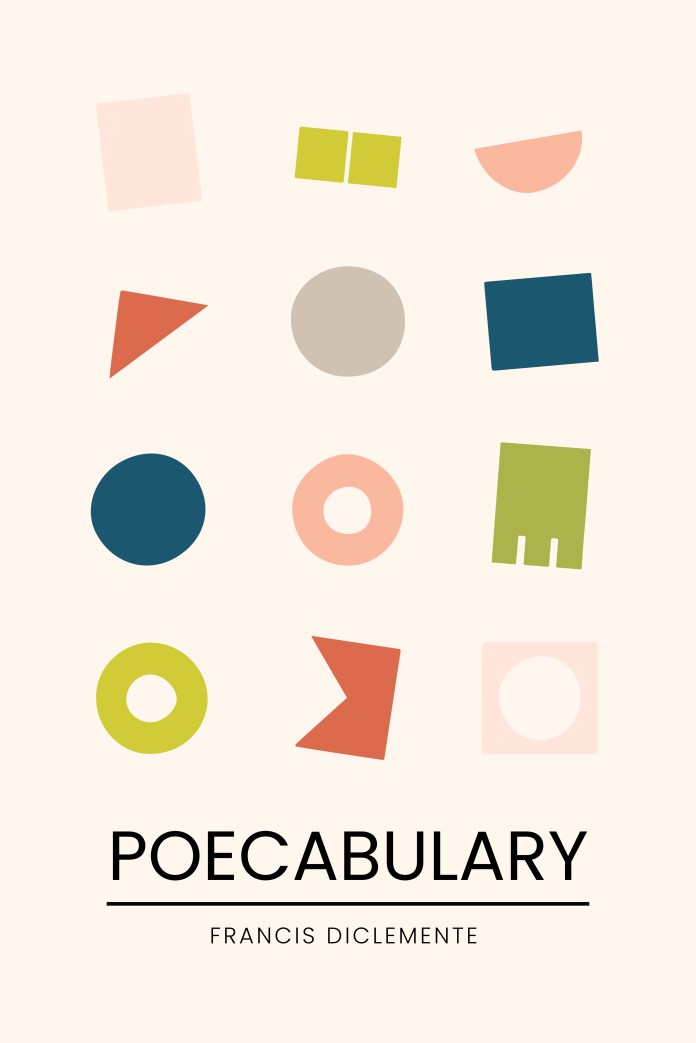
I’m not a fan of the promotional aspect of writing, but I want to share this positive review of Poecabulary because the Reedsy Discovery reviewer, Stephen Dudas, summarized exactly what I was trying to achieve with my wacky experimental book project. Nearly all of the time, I’m tossing words in the dark, hoping they find their way to readers. So it’s nice, and rare, when my stray verbal arrows hit the mark.

Poecabulary front cover.
Some of my favorite pull quotes:.
“Francis DiClemente’s Poecabulary is a stunning example of that now all-too-rare book in our contemporary poetry landscape: a genuine, focused experiment with specific elements of the English language.
“… Poecabulary is fully intended as a collaborative experience (all reading is, of course, but collaboration is at the forefront of this particular collection). To read the collection is to be brought into a creative and intellectual game. What is similar? What is different? What does one word mean to the other? What arguments, stories, commentaries, dreams, songs, etc. might spin out from where these words meet?
“Poecabulary does what any good poetry collection should—it offers itself up as the site of interactive play between a poet’s invitation and a reader’s interpretation.”
—Reviewed by Stephen Dudas, Reedsy Discovery
I have a terse poem published in the Summer 2025 issue of The Soliloquist Journal. A paperback version is also for sale with a 15-percent discount code: RE5RQ6G15.

“The Point of Regret” appears in my unpublished philosophical poetry collection entitled Embrace the Futility. It’s similar in theme to another short poem, “Resolution of Existence,” which appears in my 2021 book Outward Arrangements: Poems.
Resolution of Existence
You must
Live the life
You have
And not
The one
You want.
My experimental documentary short Fragments of the Living is now available for viewing on YouTube. The film is composed of public domain home movie clips. It is a celebration of the American family, a nostalgic salute to the past and a meditation on the fleeting nature of life. It was screened at the NewFilmmakers New York Screening Series (2016), Athens International Film Festival (Athens, OH; 2016), and Syracuse International Film Festival, SpringFest in 2016.
Two years ago today, I underwent my sixth brain surgery at Upstate Medical University Hospital for a recurring benign tumor on my pituitary gland. A neurosurgery and ENT team removed the stubborn craniopharyngioma in a four-hour surgery on July 24, 2023.

Upstate Medical University Hospital (Photo by Francis DiClemente)
I wrote a poem based on the postoperative medical report uploaded to the MyChart portal. I consider this a “reverse redacted poem.” Instead of blacking out words from my source text, I pulled words and phrases from the summary.
Neurosurgery Report
Date of Procedure: July 24, 2023
Endonasal endoscopic
transsphenoidal resection
of tumor
with nasal septal flap.
Preoperative diagnosis:
Recurrent craniopharyngioma
Postoperative: Same
Patient is a 53-year-old male
with a long history
of known craniopharyngioma.
Recurrence of craniopharyngioma
abutting the optic chiasm.
Not a great candidate
for repeat radiosurgery—
not enough margin
between the tumor
and the optic chiasm.
Counseled on the risks
and benefits of endonasal
transsphenoidal resection.
Elected to proceed
despite the risks.
Patient was intubated
by anesthesia.
Positioned supine
with the bed turned 90 degrees.
Endonasal approach
to the sphenoid sinus.
Once the sella was exposed
and the bone drilled down,
we began our resection.
A long handled arachnoid knife
was used to incise the dura.
The tumor was located
mainly on the right side.
We then encountered
thick scar tissue,
which was also incised
in cruciate fashion.
Once both layers of dura
had been opened,
there was immediate egress
of thin viscous brown fluid.
With the endoscope
we could see a
calcified appearing tumor
just in front of our field.
At this point, there was a brisk
CSF (cerebrospinal fluid) leak
from the chiasmatic cistern most likely.
Once we had attempted
to scrape along the floor
of the sella posteriorly and laterally
along the cavernous sinus,
we then turned our attention
to the tumor hanging in front of us.
We used laryngeal biopsy forceps
to coax the tumor out.
At this point, the tumor
seemed fairly stuck and plastered
to the arachnoid superiorly,
and thus we resected the
remaining tumor in front of us
in piecemeal fashion.
Given the brisk CFS leak,
our ENT colleagues then turned to
the right-sided nasal septal flap.
The ENT repaired the CSF leak.
Packing Surgical and NasoPore dressing
placed by the ENT surgeons.
This concluded our procedure.
The drapes were then removed.
The patient was returned to the stretcher.
He was successfully extubated
by anesthesia and transported
to PACU (Post Anesthesia Care Unit)
in stable condition.
Now, two years later, I am still living with a brain tumor. My last MRI in December 2024 revealed:
“The lesion measures 14 mm x 13 mm (TV by AP; Transverse by Anteroposterior), unchanged compared to prior scan dated 5/17/2024, allowing difference in technique and slice selection. The superior aspect of the mass abuts supraclinoid ICA, which remains patent. The right prechiasmatic optic nerve demonstrates mild atrophy but remains unchanged.”

My next MRI is scheduled for September. I suffer some mild headaches and have double vision when looking at a computer screen without my prism prescription glasses or gazing to the extreme right. But otherwise, the tumor is not affecting my health.
And I know what Dr. H. will say when he reads the MRI report in September. He’ll say, “Your scan looks good. It hasn’t grown. Let’s leave it alone and get another MRI in six months.”
This wait-and-see approach works well for me. But at the same time, I can never get the tumor out of my head—literally and figuratively.
And although Dr. H. is the surgeon and I respect his medical advice, his Pollyanna outlook ruffles me.
That’s because Dr. H. isn’t troubled by a repetition of sneezes that I fear could dislodge the tumor from its nook and cause it to invade healthy brain tissue. Dr. H. doesn’t worry that eating an entrée of fish and chips will add protein and fat to the tumor cells and make the mass larger. He’s not worried that the tumor will expand and start pressing against the optic nerve.

Craniopharyngiomas consistently grow back; that’s their nature. Having this dormant beast taking up real estate inside my skull feels like having Godzilla asleep in your cellar. You know he’ll wake up eventually. And then what? So how can you sit at the kitchen table and blithely enjoy a quiet dinner when you know the predator lurks beneath your feet?
At the same time, life and death could trade places on any given day. I’ve lost two cousins younger than sixty years old in the past six months (Derek DeCosty and Damon DeCosty), and I know tomorrow is not guaranteed. I am also very fortunate not to have a malignant tumor or a fatal disease.
And since I have no alternative, I live with the tumor as best as I can and try to forget it’s still there. Meanwhile, the tumor remains in the act of waiting—waiting to decide what it will become, waiting to find its path, waiting to strike. The neoplasm’s presence inside my head troubles me if I allow the image of the fluid-wrapped mass to provoke my worst fears. But for now, I try not to disturb the sleeping beast.
My younger cousin Damon DeCosty died of a heart attack in Jacksonville, Florida, on May 25. He was 53 years old. A celebration of his life is planned for July 22 (his birthday) in Jacksonville.

Damon’s high school yearbook photo.
Damon’s death was a huge blow to our family because his older brother, Derek DeCosty, passed away from pneumonia in January 2025.
My high school years overlapped with all three DeCosty brothers—Fiore (nicknamed “Fee”) being the oldest, followed by Derek, and then Damon, who was two years younger than me.

My cousin Fee (right), Damon (center) and I celebrate my sister Lisa’s birthday in 1980.
His obituary notes that he was born in Rome, New York, and was a member of the 1987-1988 undefeated Rome Free Academy hockey team, which won the state title. He played hockey and studied art at the State University of New York at Fredonia. He later worked in construction in Key West before beginning a career in agronomy at TPC Sawgrass Golf Course near Jacksonville.

The 1987-88 state champion RFA hockey team. Damon is the last player standing in the second row, next to Coach Dick Meiss.
But those facts don’t resonate with me on an emotional level. And in processing this loss and trying to write about it, no coherent narrative emerged. There’s no Hero’s Journey or three-act structure to guide you in mourning a loved one.
Instead, I recall images and voices—murky memories and episodic scenes that, when juxtaposed, add up to the human being known as Damon DeCosty and what he meant to his family and friends.
The things I remember about Damon:
His bronze skin, dark eyes, and black hair. He was of Italian American descent on his father’s side and Native American, with Caddo Nation heritage, on his mother’s side.
His artistic talent. I remember his hand moving across a sketch pad and seeing his artwork hanging in his room.
His placid, reserved, and affable personality. Although Damon possessed a James Dean coolness, he wasn’t aloof. Instead, you felt a sense of calmness in his presence, and people gravitated to him because of his kindness.

Damon with his dad, my Uncle Fiore DeCosty.
Damon had heart surgery at Crouse Hospital in Syracuse when he was about five years old in 1976. While my Uncle Fiore (Fee) and Aunt Pat stayed with Damon at the hospital, Fee and Derek spent the night at my parents’ house on Stanwix Street in Rome, near the Oneida County Courthouse on North James Street. I think it was a school night, and my mom packed my cousins’ lunches in their twin metal lunch boxes featuring Brazilian soccer legend Pelé.

When Damon recovered from surgery, he insisted on a sleepover at our house because he missed out on the fun, and I remember stretching out on the floor next to him as we slept.
I recall Damon and I spending a summer afternoon at our grandparents’ house on Crossgates Road. No one else was around, and we ran around in our bare feet on the patio, our feet turning black, and frolicked on the lawn, leaping over a sprinkler (a poor kid’s substitute for a swimming pool), our denim jean shorts getting soaked as we inhaled the scent of fresh-cut grass.
My cousins lived in a housing development on Seville Drive in north Rome. It seemed like a subdivision had been dropped in the middle of cleared farmland. Damon’s mom, my Aunt Pat, was a dietitian. And while the growing boys always had enough to eat, she didn’t buy them junk food. Their cereal choices were healthy, whole-grain products, such as Wheaties and Cheerios.

Damon (seated) and Derek with their mom, my Aunt Pat (sometime around 1980).
But on at least one occasion, while spending the weekend with my cousins, I remember my Aunt Pat went out shopping, and Derek and Fee sprang into action. They raced around the house, collecting small bills and coins, and gave the money to Damon with instructions to run across a cornfield and buy a box of sugary cereal at a nearby convenience store. Damon returned with a box of Frosted Flakes, Cocoa Pebbles, Trix, or Lucky Charms (I can’t remember the exact brand). But we all sat at the kitchen table, passing around the milk and wolfing down bowls of cereal, then discarding the box and hiding the evidence before Aunt Pat returned home.

In remembering Damon, I also find myself thinking about my late father, Francis DiClemente Sr., and reflecting on how divorce complicates family relationships, especially for children. When families fracture, the boundaries between relatives blur.
My mother and Damon’s father were siblings. Does that mean when my parents divorced, my dad stopped being an uncle to the DeCosty boys? Or after Damon’s parents divorced, did his mom (who was also my godmother) cease being my aunt?
Does divorce sever relations with non-blood relatives? Do you erase the bonds of love and family just because a couple separates? That’s a topic for a whole separate essay.
I bring this up because many years after my parents split, my dad would ask about Fee, Derek, and Damon. He really cared about them. And if they visited the Sears store in Rome where he worked, they would seek him out and say “hello.”
And it’s not politically correct, but whenever my father asked about Damon, he would say, “Hey, how’s the Little Chief doing? What’s up with the Little Chief? Tell the Little Chief I said ‘hello.’”
I must also admit that when I heard Damon had died, one of the first thoughts that popped into my head was that Fiore is now The Last of the Mohicans (also not politically correct).
Damon and I bonded over our mutual love of music. Our shared tastes included U2, The Cure, Grateful Dead, Genesis, The Replacements, R.E.M., Jane’s Addiction, The Cult, The Smiths, and many other artists.

Damon and I were part of a contingent of Romans that went to the Metallica concert in Weedsport, NY on July 16, 1989. We were more eager to see the opening act, The Cult. Damon is wearing the backwards baseball cap.
Fee shared a couple of Damon’s YouTube music playlists with me. One is titled Essential Dead, and includes tracks from the Grateful Dead and other jam bands. The other is titled simply Work.
I enjoy shuffling through the Work playlist and imagining Damon mowing a fairway, adjusting a pin placement at TPC Sawgrass, doing some odd carpentry work, or putting the final touches on a large-scale oil painting. The playlist contains more than 300 tracks—over seven hours of music—and it consoles me knowing I’m listening to songs curated by Damon, tracks that held special meaning for him.
For a recent film festival, I had to submit my project through an unlisted YouTube account. Now I’d like you use that account to upload some past projects.
The first is Black Box, a 2013 experimental short film that uses the power of music and dance to explore emotions. In the strictest sense, it is a dance film; however, it serves as a conceptual video art piece as opposed to a straight performance work.
The dancer in the piece clutches a black box representing the human heart as a repository of life’s emotions. It is a metaphor for the turmoil and pain we carry inside. Through a series of movements, the character becomes free from the heavy burden of the black box, and he can leave it behind and thus arrive at a state of inner peace.
The idea for this video originated with the music, the second movement of Franz Schubert’s Death and the Maiden. I had always loved this melancholy and stirring piece and thought it could serve as the foundation for an artwork if the song was married to powerful visuals.
Once I developed the concept and treatment for Black Box, I turned to choreographer and dancer Brandon Ellis. Ellis interpreted the concept and developed and executed the dance routine.
For the production I collaborated with Michael Barletta and Courtney Rile, founders of the Syracuse, New York-based production company Daylight Blue Media.
Credits:
Choreography by Brandon Ellis
Cinematography by Michael Barletta and Courtney Rile
Edited by Courtney Rile
Produced and Directed by Francis DiClemente
Official Selection, 2014 Athens International Film and Video Festival (Athens, Ohio)
NewFilmmakers New York screening series (2013)
I saw a melting ice cream cone on the sidewalk while out for my Sunday run today. Luckily, I brought along a pen and a scrap of paper. I jotted down some notes, which became the sweaty, messy first draft of this poem.
Melting Cone
A Drumstick ice cream cone
lying in the middle of the sidewalk
on a blistering July Sunday—
the vanilla ice cream liquified,
while ants scale the surface of
the dented waffle cone.
Did the child cry
when the cone hit the ground?
And did Mom let the girl
run back inside to
grab another from the freezer?
But maybe a kid didn’t drop it—
because in reality,
ice cream misfortune
could befall anyone.
The forecast calls for storms.
Soon heavy rain will scatter the ants
and cleanse the sidewalk,
erasing the evidence of this calamity,
as one more taste of summer fades away.
Stanwix Street
A vanilla ice cream cone
covered with sprinkles of dirt,
a handful tossed by small, grimy hands
across a chain-link fence.
A blond child’s whine—
flat, constant and eerily melodic.
The girl then turning away,
screaming upstairs to her mother,
sound asleep in the mid-August heat,
the lime-green curtains fluttering in the
second-story window of the adjacent brick building.
The child just standing there, scraping off the grit
and licking the melting residue
trickling down her forearm.
Streetlight Paradise
Chalk marks on sidewalks,
fireflies stalking the night,
creaky porch steps,
chain-link nets and
the crack of the bat.
Sour-puss lips break a smile,
then sneak a kiss.
It’s cool to hold hands with
the girl of your dreams,
the one who says she’ll
love you forever.
But forever is too far away.
Our time is now—a passing moment
when our parents look the other way.
Summer fun in the springtime
of our lives, sucking it all in
under this streetlight paradise.
The Mystery of the Wolf
A summer evening in upstate New York—
a backyard sprinkler hisses
while the smell of fresh-cut grass
is pungent and delicious.
Crickets chirp and a coffee-colored mare
snorts from across the barbed-wire fence.
I am alone, kicking a soccer ball,
when a gray wolf emerges from
the high weeds lining the fence.
I try to run, but my legs lock up,
and I tumble to the ground.
The wolf circles me,
then sweeps in on my limp frame.
I can hear its stomach growling
as it hovers over me.
The tongue is extended
and drool splashes my face.
The wolf takes my neck in its mouth,
but does not bite down.
And I wake up in my bed,
thankful that the encounter is just a dream.
I am safe, and no wolf invades my room.
Yet I remain troubled,
afraid of closing my eyes,
drifting back to sleep
and ending up at the mercy
of another predator.
Minors
Toledo in July—a Mud Hens game:
Big league dreamers with names like Bubba, Fausto and Tyler
toil away in the minors,
hustling for the scouts perched behind home plate,
diving for line drives and sliding head first,
with egos in check and mouths full of dirt.
Pillars of artificial light frame the setting sun,
and from beyond the azure sky,
the ghosts of washed-up utility infielders
and middle relief pitchers
pull for these hard luck Triple-A players.
They want to scream, “Take heed, savor it now,
for this is the best you will ever be.”
But they’re under orders to keep their mouths shut,
and can only blow a home run foul every once in a while.
The steel girder stands are filled with a crowd
that still believes in this clockless game.
They listen intently for the crack of the bat,
and sing with all their might during the seventh-inning stretch.
Little kids with hot pink shorts and noisy flip-flops
smear their faces with mustard and hug Muddy the mascot.
They scatter peanut shells and scamper after foul balls,
and for them the score is merely an afterthought.
The summer night comes to a close
with a game-ending double play and a fireworks barrage.
The fans file out and load into their cars,
going back to real life with memories of Mud Hens
now stitched in the seams of their minds.
(All four poems were previously published in Dreaming of Lemon Trees: Selected Poems, Finishing Line Press, 2019).