Kerouac Poetry

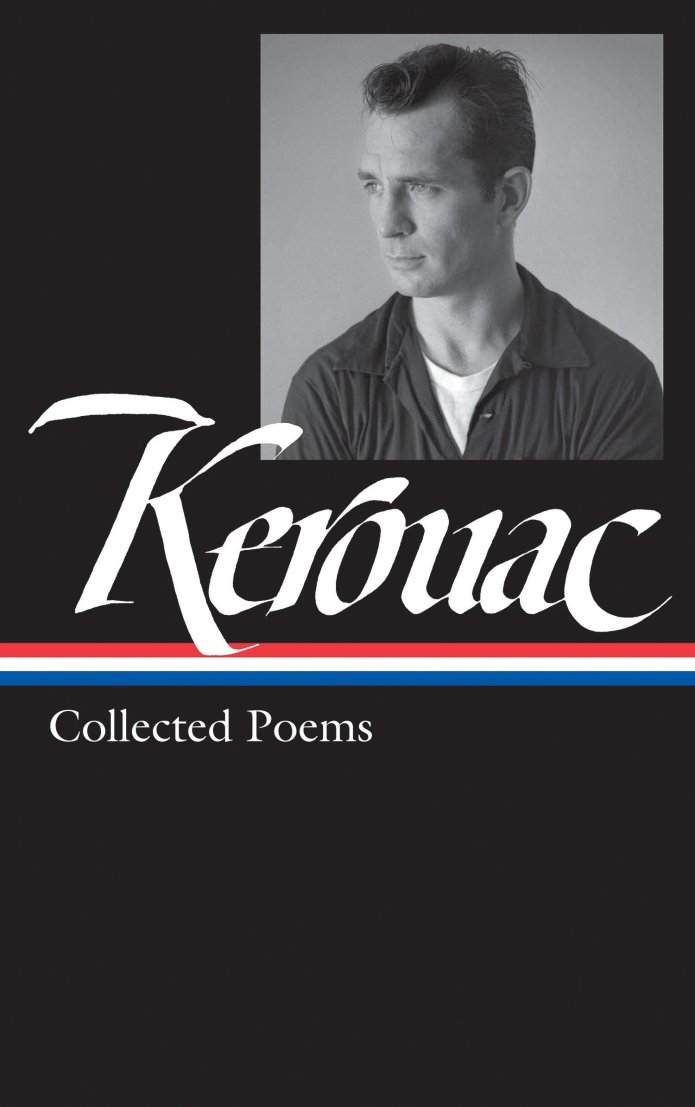
I’ve been reading Jack Kerouac: Collected Poems, which includes the works Mexico City Blues, San Francisco Blues, The Scripture of the Golden Eternity and Book of Haikus. The Beat Generation novelist and author of On the Road inspired my writing of poetry many years ago. Kerouac, Langston Hughes and Charles Bukowski taught me that you didn’t need an MFA to write poetry, as their art sprang from life experiences. They showed me the power of raw and real voices and stories expressed in the form of free verse.

Kerouac’s collection has more than 600 pages of poetry, but I found much of it gibberish—stream-of-consciousness thoughts, rantings and Buddhist and Catholic references. Yet Kerouac also delivers heart-crushing beauty within the pages of this doorstop.

The poem “Hymn” appears in a section entitled Pomes All Sizes.

“Hymn”

And when you showed me the Brooklyn Bridge
in the morning,
Ah God,

And the people slipping on ice in the street,
twice,
twice,
two different people
came over, goin to work,
so earnest and tryful,
clutching their pitiful
morning Daily News
slip on the ice & fall
both inside 5 minutes
and I cried I cried

That’s when you taught me tears, Ah
God in the morning,
Ah Thee

And me leaning on the lamppost wiping
eyes,
eyes,
nobody’s know I’d cried
or woulda cared anyway
but O I saw my father
and my grandfather’s mother
and the long lines of chairs
and the tear-sitters and dead,
Ah me, I knew God You
had better plans than that

So whatever plan you have for me
Splitter of majesty
Make it short
brief
Make it snappy
Bring me home to the Eternal Mother
Today

At your service anyway,
(and until)

I also enjoyed many of the pieces in the section Book of Haikus. I believe Kerouac’s haikus do not follow the strict Japanese pattern of three lines of five, seven and five syllables.

Here are some autumn-related selections:

Late moon rising
—Frost
On the grass

Waiting for the leaves
to fall;—
There goes one!

First frost dropped
All leaves
Last night—leafsmoke

Crisp cold October morning
—the cats fighting
In the weeds

A yellow witch chewing
A cigarette,
Those Autumn leaves

Kerouac, Jack. Jack Kerouac: Collected Poems. New York: Library of America, 2012.

The book also served another purpose for me. Late last night I found a nail sticking out of the cheap wood paneling in the bedroom of my apartment. I was worried my son would catch himself on it, but I didn’t feel like going to the closet to grab my hammer. So I used the book to bang the nail back into place. Thanks Jack!

Standard

Birthday Poems

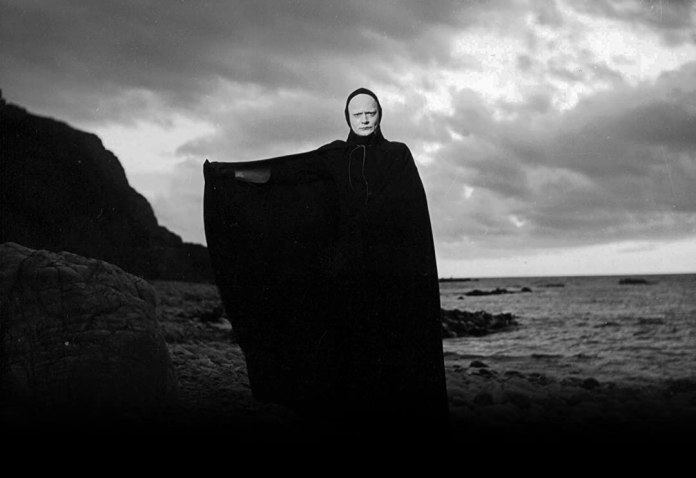
I am celebrating my 52nd birthday today. And with each passing year, I feel the weight of mortality and the footsteps of death encroaching. It’s a presence I can’t escape, like Bergman’s grim reaper in The Seventh Seal.

In reality, though, you don’t need a birthday to be struck by that feeling. An impending sense of finality hits me every morning I awaken. But I also feel overwhelming gratitude when I am granted another morning, another day, another opportunity to create and share time and space and precious moments with loved ones.

A poem by the late poet Mark Strand seems fitting for this birthday and for this moment in time under COVID. To me it expresses the fleeting nature of existence.

Mark Strand, 1934-2014

The Coming of Light

Even this late it happens:
the coming of love, the coming of light.
You wake and the candles are lit as if by themselves,
stars gather, dreams pour into your pillows,
sending up warm bouquets of air.
Even this late the bones of the body shine
and tomorrow’s dust flares into breath.

To Mr. Strand’s words, I add a few poems of my own, all focused on the unavoidable outcome of existence. They remind me to accept the inevitable while still trying to extract meaning out of a life that must cease one day.

Interment

I imagine the coffin lid closing,
the pine box being lowered into the pit,
shovels of dirt hitting the top,
and no one hearing me scream,
“Let me out. Let me out,”
as I realize I’ve run out of time
to make my life count.

What You Get

There is nothing you can do
to avoid becoming dust.
You can try to elongate your life,
but you will expire one day.

And whether cremated
or buried in the earth,
your body will not
survive this world.
Maybe your soul will
travel somewhere else,
but really, who knows for sure?

In this existence,
you are granted only two things:
Right Here. Right Now.
That’s all you get.
So make the most of it.

Awareness

How many people are dying
in emergency rooms
at this exact moment?
Right now, how many people are
exhaling their last breaths?
How many loved ones
arrive too late to say goodbye?

Each day ushers in death—
and while we sleep,
smashed brains, shattered bones,
plugged arteries, faulty hearts,
cancer and other diseases
claim their victims.

We try not to notice.
We try to avoid the truth.
We rush about our lives,
never knowing when
our time will come—
until one day it does.

I can’t live like that.
I can’t avoid the obvious.
I need to face death daily,
to recognize it lurking, prowling,
ready to pounce on me.
This knowledge of death
creeping nearby forces me
to examine my existence
and ascertain if I am useful—
wise with my time or wasteful.

I accept the finite offering
of a limited lifespan—
what little measure
of time God has granted.
It’s up to me to make it count.

Outward Arrangements: Poems by Francis DiClemente (2021).


Standard

Poetry Podcast Guest Appearance

I was the guest this week on the podcast Quintessential Listening: Poetry Online Radio hosted by Dr. Michael Anthony Ingram, a poet and retired university professor. You can find the audio here.

Standard

Insomnia Poem

A bout of insomnia last night produced a short poem. At 3 a.m., my five-year-old son Colin and I were both wide awake. While he squirmed and rolled around in bed, I covered up to prevent getting struck by his flailing elbows and knees. And in the early morning darkness, these words came to me:

Manifesto for Dejected Artists

To create is to make something
that did not exist before—
something no one requested
and something the world
does not want or need.

And yet, you decided
to make it anyway.
So now it’s here for others
to accept or reject.
Either way, your job is done.

And I have realized from experience that if some lines, words, thoughts, characters or plots float in my head when I’m in bed, that I must jot down the ideas immediately or I will forget them upon awakening.

And on a totally unrelated note, here is a photo of Colin holding his pre-K diploma, which he received on the last day of school on Thursday.

Standard

A Camus Quote

I am currently reading Albert Camus’s Notebooks 1935-1942, and I found this little piece of wisdom from the section May 1935 to September 1937. I thought it was worth sharing, and I hope you find some value in the words.

“One must not cut oneself off from the world. No one who lives in the sunlight makes a failure of his life. My whole effort, whatever the situation, misfortune or disillusion, must be to make contact again. But even within this sadness I feel a great leap of joy and a great desire to love simply at the sight of a hill against the evening sky.”

Camus, Albert. Notebooks 1935-1942. Paris: Editions Gallimard, 1962. Ivan R. Dee, Translation, Reprint Edition, 2010.

Standard

Man Inside Nighthawks: A Flash Fiction Story

Here’s a flash fiction story inspired by the Edward Hopper painting Nighthawks.

I assume I was nothing before I found myself sitting here, staring straight ahead. But I don’t know for sure.

This is what I do know: I can’t move my head. I can’t smoke the cigarette pressed between the fingers of my right hand or drink the cup of coffee resting on top of the counter. I can’t touch the woman seated next to me or talk to the other two men.

This is my life. Suspended in warm, yellow light. Unable to move, locked in a soundless existence—no water running, fan whirring or grill sizzling. No sirens or street sounds beyond the glass.

Time drags on with no discernible shift—no transition to morning. Here night never ends.

Yet my mind still works. In fact, it never stops; I’m cursed with thoughts that run continuously.

I wonder: Why am I here? And where exactly is here? What purpose do I serve? Why put me next to these people and not give me an opportunity to interact with them?

Do I have a past? Did I exist before I became frozen in this moment—captured and imprisoned for eternity?

As you can see, I have nothing but questions that yield no answers. If only I could talk to the other people. If only I could pry open my lips and make a sound. Then maybe we could communicate. Maybe we could figure out our reason for being here. Then I could scream for help. But who would hear my voice and who would come to our aid?

If only I could stand up and walk around, stretch my legs and peek outside the window.

But then I would upset the balance of the composition. And so I will stay in place. Funny, right? I don’t have a choice. I can’t move even if I wanted to. So I’ll be here any time you feel like looking at me.

Standard

Been Away Too Long

I’ve been so tied up with work, family and long-range creative projects that I have neglected this blog for far too long. I haven’t posted anything since January—not that anyone is missing my content.

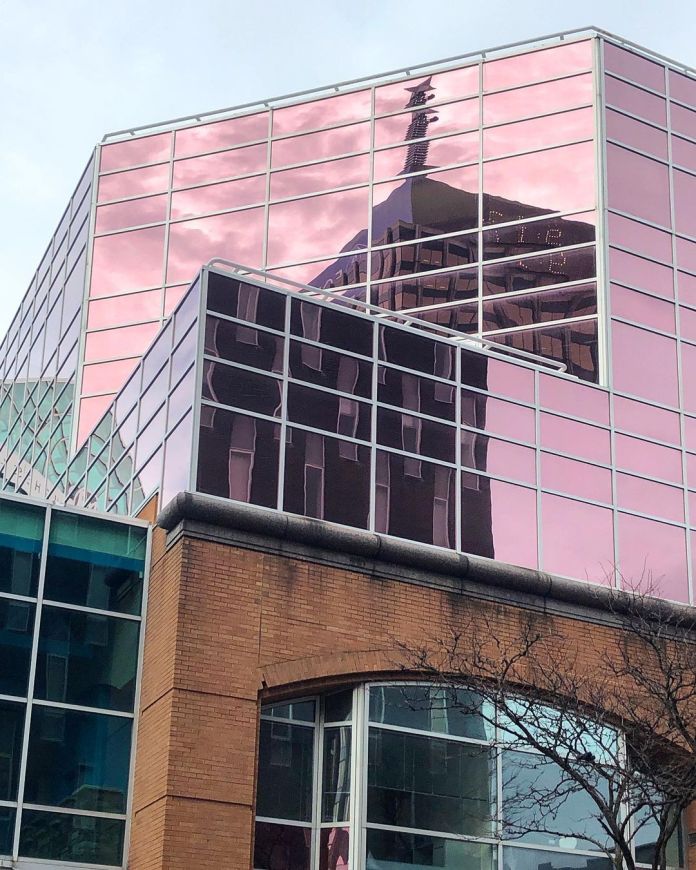
But during my Saturday morning jog/walk in downtown Syracuse, I snapped a photo and composed a short poem. To me both represent the ephemeral nature of life. If I had not stopped running on the sidewalk to take the picture or pull out my mini notebook and jot down the poem, the image and words would have been lost.

The sun would have shifted or shadows would have altered the light hitting the buildings and the words would have escaped my mind. A good reason to always carry a smartphone, a pen and a notebook. You never know when inspiration will strike.

Morning reflection. A George Costanza pinkish hue. Photo by Francis DiClemente.

Giving Up Admission

I can’t keep
it together.

I don’t have
the strength
to carry on.

Can I let go
and fall into
your arms?

Standard

Dreaming of Lemon Trees Review

Fellow poet Louis Cecile has posted a review of Dreaming of Lemon Trees: Selected Poems on his blog. Louis is the author of multiple collections of poetry, and his blog offers poetry and fiction book reviews.

Dreaming of Lemon Trees Book Review

Standard

Kathleen Kramer: Everything Matters

I’d like to offer a book suggestion that would be a good read anytime but seems ideal for a pandemic—during an unprecedented time in human history when we are all contemplating our existence on this planet.

The book is a collection of poems inspired by a series of photographs captured by the author, Kathleen Kramer. I must state at the outset that I am biased; Kathleen is a friend and we have supported each other over the years through many writing projects.
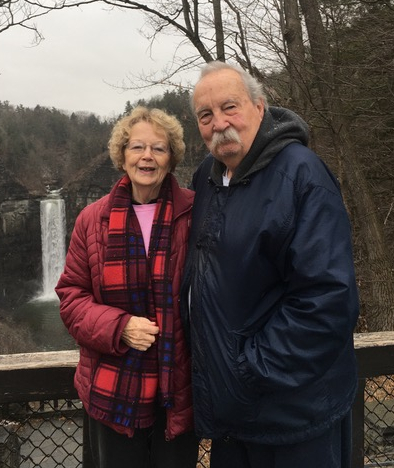
The author with her husband, Jack.

I also wrote one of the blurbs on the back of the book, which is entitled Everything Matters (Yesteryear Publishing, 2020). But that’s not why I’m recommending this collection. I’m recommending it because of the quality of the writing, its universal message and the transcendent feeling the book delivers to the reader.

Everything Matters by Kathleen Kramer.

To better explain the book, I turn it over to Kathleen, who has agreed to answer some questions about the work. I highlighted some phrases that caught my attention.

Can you give a brief description of the book? What do you hope people will take away from it?

The book, Everything Matters, is a collection of poems and the photographs which inspired them. (So, I guess if I could be bold enough to call my simple photos art, this is a collection of ekphrastic poetry.) I’ve found that if I pay attention, there is often something about an object or a scene I may see that “catches” me. I’m guessing many others have found this, as well. Maybe as we mail a letter and are struck by the pattern of shadows on the steps of the Post Office. Or, at the bookstore, we catch sight of a book we used to read to our children 50 years ago. Or we see a little boy contemplating his first big snowfall. There’s something that has connected on a level deeper than the simply visual. So these photos and these poems were not planned nor conceived together, but arose later, paired, and out of a place within and, perhaps, a place “beyond” myself.
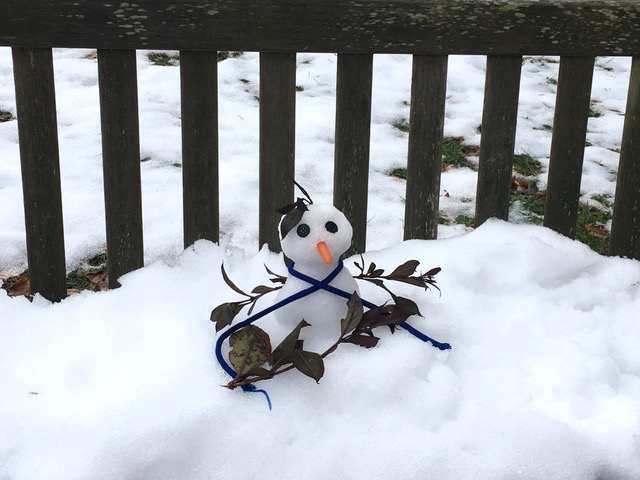
“Small Things” by Kathleen Kramer.

It’s my belief that creativity, whatever form it may take, is a gift from something greater than ourselves. We are enlarged by creating something beautiful, authentic, honest. And I think our hope is that those who read or see or hear our work will be enlarged, too, and feel a personal connection that is important to them.

My observation: I love Kathleen’s statement that “we are enlarged by creating something beautiful, authentic, honest.” It’s the sense that art is a shared connection between the creator and the reader or audience, and both sides are required for a satisfying experience.

Can you describe how your work celebrates or gives heightened meaning to the ordinary moments of existence?

 Almost 30 years ago, when I first began writing seriously—both plays and poetry—it was the “ordinary” life or the “ordinary” event that called to me. There always seemed, to me, to be something bigger that lived in that life or event. For lack of a better way to explain it, I believe there is a holiness at the heart of most ordinary things. Or, quoting Gerard Manley Hopkins, “There lives the dearest freshness deep down things.”

Lines by Kathleen Kramer.

So I guess what I wish for is that by calling attention to the seemingly-simple—a moth on the window or a chocolate sprinkle fallen from an ice cream cone—the reader or listener to these poems will be led to see a holiness in their own lives and the lives of those around them.

What was the most challenging part of the process for you—writing the poems, taking the photographs or piecing the words and images together?

 Truthfully, in most cases, the process seemed organic. Something in me responded to something I saw. I didn’t stop to think about it, I just took the photo. Then I waited for whatever “spoke” to me in that image to come to the surface. Sometimes it came within minutes, but usually it was hours, or even days or weeks, or months. Again, it seemed organic in that it happened in its own time, maybe like a baby robin hatching or a peony opening from its tight bud. So to answer your question, neither part—taking the photos or writing the poems—was particularly difficult—except for getting myself out of the way enough for the authentic to come forth.

Not So Long Ago by Kathleen Kramer.

Then, of course, there’s the re-writing, when it’s not always easy to let go of a phrase or a line that takes away from the integrity of the poem, regardless of how much I loved that particular phrase or line.

My observation: Her responses, “I didn’t stop to think about it” and “getting myself out of the way,” inspire me. The goal is simple—just create and don’t worry about the result. Trust the process and have faith that it will yield results.

How can reading poetry help people during a pandemic?

Perhaps the greatest benefits to reading poetry at this very challenging time is that poetry can take us out of ourselves into a larger consciousness while, at the same time, leading us deeper into that part of ourselves that is tender and receptive, hopefully affirming a wholeness that exists, regardless of the conditions around us.

Do you have any advice for aspiring writers, no matter what genre they are writing?

 I think writers come to write for many reasons. Some have to. By that, I mean that they don’t feel complete unless they write to explore life and to articulate, first for themselves, and then, hopefully, to share what they’ve written as a way to affirm their lives and to connect with the lives of others.

I guess there are some who write in the hope of recognition or fame. This isn’t an easy motive for me to relate to. Mostly because we all know how unlikely it is that many writers will achieve it. But also because to write with “the market” in mind, feels shallow, contrived, and unrewarding to the writer. But that’s me speaking from a place where this motivation never held much importance.

What I’m getting to, I think, is that an aspiring writer needs to be fearless, in a way, and bold in reaching for the heart of what he or she is moved to write. Be authentic. Strive to write what is true for you. At the same time, be gentle with yourself. Allow yourself to write bad sentences, bad poems. You can delete them! Or rewrite them! And, as a beloved writing teacher used to say, “Get the censor off your shoulder.” I would add, “trust yourself, trust the process, and trust that something larger than yourself is at work.”
Standard

Inspired by Vincent

I am continuing to work my way through the book The Letters of Vincent Van Gogh. I am reading it from beginning to end, but I haven’t been consistent with reading it on a daily basis.

The Letters of Vincent Van Gogh, Penguin Classics.

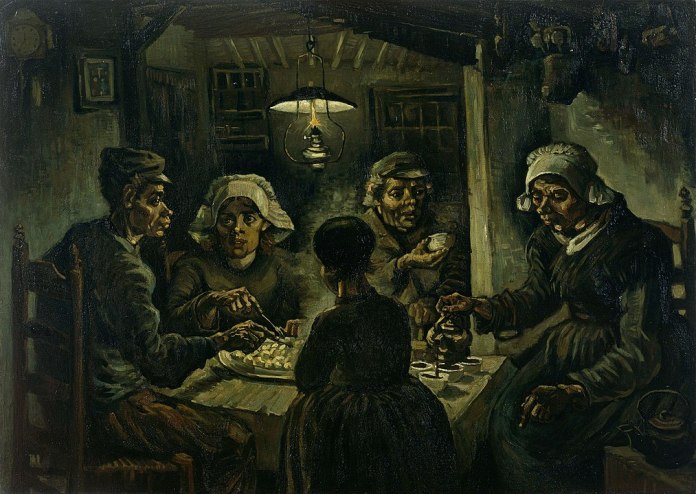
Yesterday I came across a passage worth sharing. To set it up: the time is July 1885, a few months after Vincent painted his master work depicting peasant life—The Potato Eaters (April 1885).

The Potato Eaters by Vincent van Gogh (1885).

However, Vincent is still having trouble selling his work and his financial situation appears bleak. He writes to his brother Theo:

“I find myself faced with the necessity of being that most disagreeable of people, in other words of having to ask for money. And since I don’t think that sales will pick up in the next few days, the situation seems rather dire. But I put it to you, isn’t it better for both of us, après tout (after all), to work hard, no matter what problems that may entail, than to sit around philosophizing at a time like this?

I can’t foretell the future, Theo—but I do know the eternal law that all things change. Think back 10 years, and things were different, the circumstances, the mood of the people, in short everything. And 10 years hence much is bound to have changed again. But what one does remains—and one does not easily regret having done it. The more active one is, the better, and I would sooner have a failure than sit idle and do nothing.”

Gogh, Vincent van, and Ronald. Leeuw. The Letters of Vincent Van Gogh. London: Allen Lane, Penguin Press, 1996. Print.

What inspires me about this passage is Vincent’s willingness to press on with his art, undeterred by his lack of success. The fire in him to create burns too intensely for him to abandon his avocation.

Standard