Forty Years Later

I am celebrating an important milestone today—the 40th anniversary of my first brain surgery to remove a benign tumor engulfing my pituitary gland. I have written about this ordeal many times in the past, including in this long 2014 post.

On this day, four decades ago, surgeons cracked open my skull and extracted the craniopharyngioma that had stunted my growth and delayed my transition from boy to man.

In this essay, I reflect on my experience as a teenager in 1984 while a patient at SUNY Upstate Medical Center (renamed Upstate University Hospital) in Syracuse, New York. I am limiting the narrative period to the day of surgery and my immediate recovery.
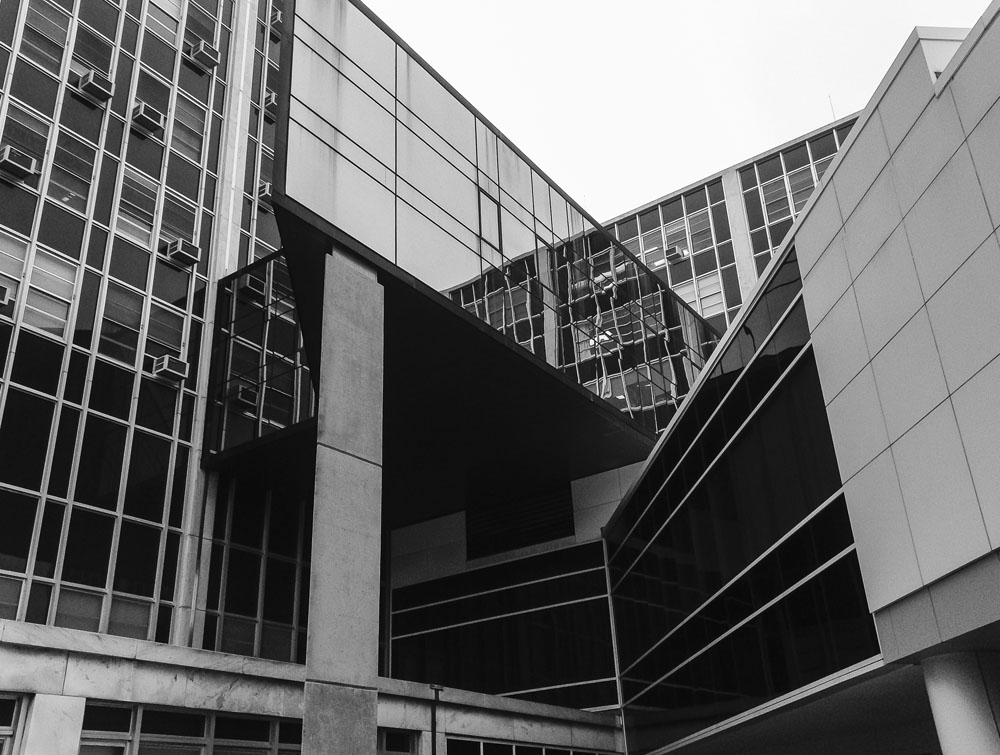
Upstate University Hospital

Surgery Day: An Essay

1.

Early morning. Blackness. I can smell the breakfast trays delivered on the hospital floor—watery eggs, ham and bacon, soggy oatmeal, and weak tea and coffee. The noise outside my room grows as patients awaken and nurses draw blood and administer medicine.

My appointment with the medical intervention team has arrived. I am fifteen years old and ready for surgery day, prepared for the trauma that awaits me on the table. My head will be shaved, and my skull sawed open. The tumor growing in my head—wrapped around my pituitary gland and stifling my maturation—will be plucked free, yanked out like an infected molar and then examined under a microscope to determine its classification. We must name our enemies to defeat them.

Once removed, the lesion will relinquish dominion over my body. I will be cut loose from its tentacles. The surgery will disrupt my endocrine system, leading to a permanent condition known as hypopituitarism and propelling me on a long road toward “catch-up” growth and development.

A photo of my father and me two months before the operation in 1984.

2.

A nurse enters my room and hands me a small plastic cup filled with a few pills. “This will just relax you,” she says as I swallow the pre-surgery drugs. About a half-hour later, she returns and says, “It’s time for you to go down now.” A softness squishes against the edges of my mind; I am drifting from consciousness.

An orderly comes to take me away—filling nearly the entire space inside the door frame. A hulking figure with thick, black hair, a black beard, and muscular forearms, he reminds me of Bluto from the Popeye the Sailor cartoons. But for some reason, I call him Hugo.

“OK, Hugo,” I say, “I’m ready now.” Hugo helps me slide over from my bed to a stretcher as the nurse covers me with a sheet and a blanket.

My family gathers around me, bending down to kiss me and wish me “good luck.” What does “good luck” mean on the operating table? I wonder.

Tears stream down my mother’s cheeks, which are red and wind-burned and feel cold against my skin as she kisses my face and forehead; she squeezes my hand and then releases her grip and steps away.

Hugo unlocks the wheels of the gurney and steers it out of the room and into the hallway. Even though I am sleepy, I stay awake for the ride, keeping my eyes open and watching the panels of fluorescent lights pass overhead as we make our way through the hospital corridors and into an elevator. We take a silent ride down to the surgical wing.

The temperature drops when we enter the frigid, sterile operating room. A chill runs over my body; my lips tremble as gooseflesh buds on my arms.

The surgical team members buzz around the operating room, each doctor or nurse carrying out a specific task. They transfer me from the stretcher to the operating table. An overhead light shines into my eyes while I lay splayed on the table.

A nurse covers me with an extra blanket and stretches tight, white stockings over my calves. She says the stockings will help to prevent blood clots after surgery.

One of the doctors sits down near the table and says he will shave my head. When he asks me if I want my whole head sheared or just the front, I make the mistake of telling him to clip only the front. As a result, weeks after the surgery, my hair remains uneven—bald in front and growing long in the back—similar to the long hair sticking out the back of helmets worn by hockey players with mullets.

After they jab an IV in my arm, I grow drowsy, my eyelids shutting; but before I drift off, I tell one of the nurses that I need to pee. The woman chuckles and says, “Oh, you don’t have to worry about that now. We’ve already put in a catheter.”

And then I leave the world—falling under the power of general anesthesia for about eight-and-a-half hours while the surgeons perform their work.
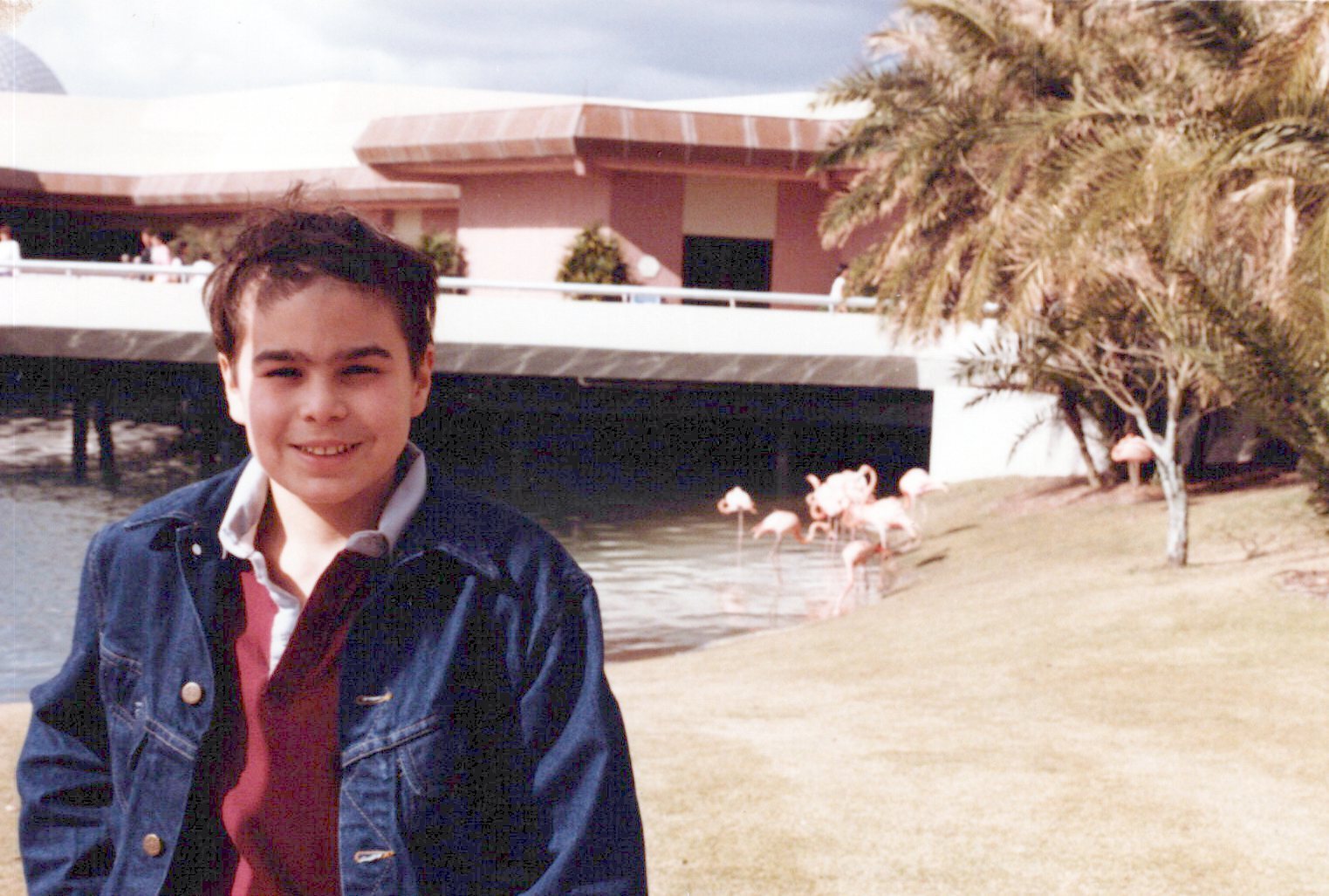
At Walt Disney World in February 1985.

3.

I have often wondered where I traveled to during that gap of time. What realms or landscapes did I explore in my mind while my skull lay open and I remained unconscious on the operating table?

Here is me stepping out of the story momentarily to travel back in time and investigate the scene. It’s a fantasy of the man I hoped I would become once the surgeons extracted the tumor. It’s the future I had envisioned for myself—marked by maturation and normalcy, playing the role of a fully formed male accompanied by a female partner.

A green canopy of trees. A trilling stream. Sunlight filtering through leaves overhanging a hiking path. Birds chirp, and tree limbs sway in the wind.

Boots touch the soft, muddy earth. A man emerges from a wooded path. He is dressed in a red checkered flannel shirt, tan khakis, and hiking boots, and he carries a knapsack on his shoulders. He is about five feet six inches tall, lean and muscular, and has a slight beard.

A twig snaps, and we see a woman walking out of a clearing. She’s wearing a fleece sweatshirt, jeans, hiking boots, and a backpack. The two figures stride toward one another, share a kiss, and then grasp hands. Sunlight bathes them as they leave the clearing and start walking on a path leading over a ridge. They climb the slight incline and disappear as they walk down the other side, their bodies concealed by the curve of the Earth.
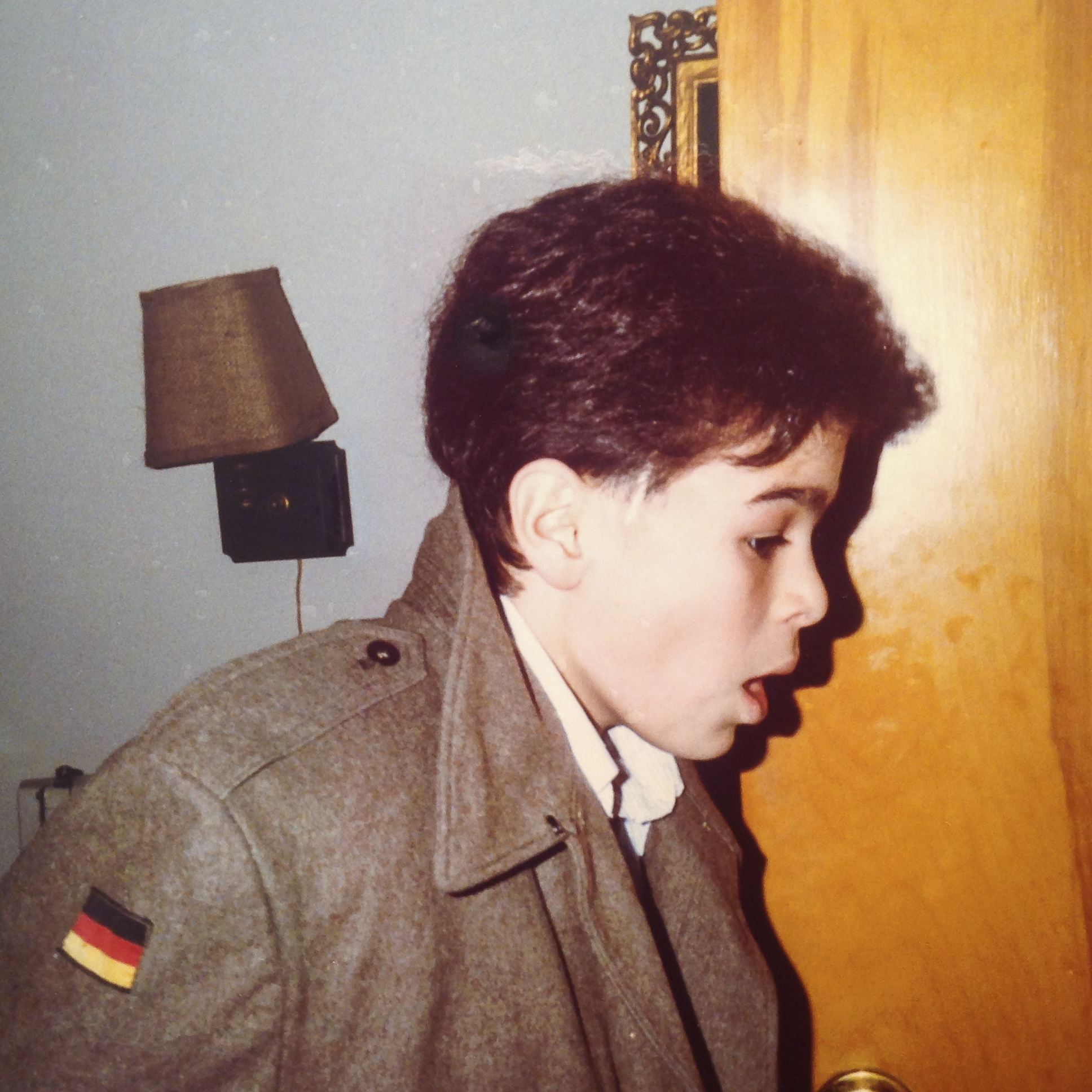
Late high school or early college years.

4.

I wake up in a bed tucked in a corner of the surgical intensive care unit. I feel dizzy, and a dull, continuous ache presses against my head as if my skull is being squeezed in a vice. Nurses inject the opioid Demerol into my thighs over several hours to alleviate the pain, and I keep drifting in and out of sleep. I hear machines beeping and the sound of a respirator somewhere on the floor. The gentle sound of the ventilator puts me at ease as I listen to it—in and out, in and out, in and out.

EKG stickers are pressed to my chest, and machines monitor my heart rate and blood pressure. Vaseline has been smeared on my eyelids and eyelashes, clouding my vision, and I feel like I am straining to see from under the cover of a heavy, wet blanket. The white stockings the surgical team had given me are pulled up to my knees and constrict the circulation in my lower limbs.

I feel small—shriveled up in the bed like a green-gray alien being prodded by U.S. government doctors and scientists on an operating table in Roswell or Los Alamos, New Mexico. A scar runs the entire length of my head, from the tip of my right ear to the tip of my left ear. I tap a slight dent in my skull (produced by a right frontal craniotomy during surgery), about the width of two fingers, just above my forehead on the right side.

The stitches itch, and I reach up to feel the thick, black threads. I wonder if I resemble a twisted version of the Mr. Met mascot.

5.

But I feel relieved because I have awakened from the operation, and my brain function remains intact. Some doctors lean over my bed and ask me a series of questions: Do I know my name, the current year, the president of the U.S., and the name of the city I am in? I answer the questions correctly, and when instructed, I squeeze their fingers, wiggle my toes, puff my cheeks, stick out my tongue, and follow a penlight with my eyes.

My senses function properly, as I can see, hear, speak, and smell. I can form thoughts, and the trauma of the surgery has not altered my mental ability or effaced my memory.

My mother, father, sister, and Aunt Teresa huddle around my bed, their faces beaming like those of Dorothy’s relatives in the scene when she wakes up from the dream at the end of The Wizard of Oz.

“Hey, buddy,” my dad says.

My mom leans over the bed rail, kisses my face and eyelids, and says, “You did great, honey, just great.”

“Yeah, Dr. B. said he got most of it,” Dad says.

“Was it big?” I ask.

My mom holds up her right thumb, indicating the size of the tumor. “It was about the size of a thumb,” she says. She caresses my face and adds, “Dr. B. said there’s a little bit left over, but we don’t need to worry about that now.”

“OK,” I say, closing my eyes and returning to sleep.

High school graduation in 1987.

6.

I wake up on the first night with a raging thirst in my parched throat. I feel like I have been deprived of water for days. But because the doctors are concerned about swelling in the brain, they load me with corticosteroids and restrict my fluid intake. My face is swollen, and I feel bloated from the steroids; I am not allowed to drink water, but I am permitted to suck on ice chips.

However, late in the evening, with the lights dimmed on the floor after visiting hours have ended, I turn my head, look around, and notice a sink in the corner, only a few feet away from my bed.

Somehow, despite being woozy, I lower the bed rail, swing my legs out to the side, and climb out of bed. I try to be quiet as I wheel my IV stand toward the small, stainless-steel sink. I turn on the foot pedal faucet, cup my hands, and gulp the water like it’s rushing in an icy mountain river.

The cold liquid pours down my throat and gives me immediate relief. I want to stay here and drink more water, but a man—a male nurse or an orderly—races toward me and pulls me away from the sink.

“What are you doing?” he yells. “You just had brain surgery.”

He then escorts me back to bed, swings my legs over, covers me with the blankets, and lifts the bed rail.

“Now, don’t get up again,” he says. “What do you wanna do, crack your head open and screw up the work those surgeons did?”

And now tucked back into bed, I resume sleeping, drifting off until the next wave of pain hits, and I press the call button to request another dose of Demerol.

##

Recalling these past forty years, I run a tally of my surgeries at Upstate. The number stands at six—counting the initial surgery in 1984 and the subsequent operations to remove tumor regrowth in 1988, 2011, 2012 (Gamma Knife), 2020 (Gamma Knife), and 2023.

I have some double vision when looking at things up close and to my extreme right (right sixth nerve palsy), and I must be hyper-vigilant in the management of my care to treat my hypopituitarism. But except for my corticosteroid-induced osteoporosis and rheumatoid arthritis (unrelated to the tumor), I am a healthy, middle-aged man.

My next MRI is scheduled for Dec. 18. And with the stubborn resilience of craniopharyngiomas, I know more surgeries (or radiation treatments) loom in the future. But I face each day with gratitude, recognizing how lucky I am to have survived the scalpel on multiple occasions. I also don’t look beyond each six-month window of time between MRIs. Once my current neurosurgeon orders the next MRI, I go about my life without thinking about the tumor still lurking in my head.

Late high school or early college years.

##

And because of the significance of the number 40 on this anniversary date, I’ll leave you with U2 playing “40” live at Red Rocks Amphitheatre in Colorado in 1983.


Standard

The Casualties of Autumn

It’s the season of beautiful colors, exquisite light and streaming A Charlie Brown Christmas by the Vince Guaraldi Trio. While returning home from a recent jog, the piles of leaves in my neighborhood incited an idea for a poem. Fortunately, I had a pen and some paper to capture the idea before it slipped away.

The Casualties of Autumn

Every leaf strewn in a pile
collected at the curb
had a life before it
separated from the tree
and twirled to the earth.
Is there a home reserved
for the departed souls of leaves—
a place of repose
for the casualties of autumn?


Standard

Falling Back

To mark the end of Daylight Saving Time, I present a poem inspired by autumn scenery. I drafted this poem more than 25 years ago while living with my sister in Toledo, Ohio. I have revised it multiple times over the years, never satisfied with the final result. While this version may not be perfect, I think it’s about the best I can do, and so I release it here.

Falling Back (2024)

Alone on an empty school playground in Toledo, Ohio,
my worn-out sneakers shuffle on asphalt
as I practice left-handed hook shots
on a bent basketball rim with a rusted chain-link net.
The sound of the bouncing ball reverberates
off the school’s red brick façade,
as my reflection jumps out at me in the first-floor windows
adorned with orange paper jack-o’-lanterns.

A towering oak tree with branches like octopus tentacles
observes me as I heave an air ball from three-point land.
It studies my movements while a sharp wind
strips away its cloak of golden-brown leaves.

The cold sticks to my fingertips as I lick them
to get a better grip on the Spalding rubber ball.
And with my nose running incessantly and my chest heaving,
I swallow the chill in the air, trapping it deep inside my lungs.

I pick up my dribble—then stop, smell, look and listen.
Streetlights flicker on in the suburban neighborhood,
and across the road, a pumpkin is perched
on the porch of a modest white house.
The scent of burning leaves wafts in the air.
Charcoal-gray clouds brood in the sky,
and on the western horizon, near a row of pine trees,
there’s a feathering of soft pink light.

At the nearby park, soccer goals stand naked and netless,
and on the gravel softball field,
silence reigns on the base paths and outfield grass.
In the schoolyard, monkey bars are free of tiny, groping hands,
and empty swings sway in the stiff breeze—
calling out for the children to return.

But summer delight has long since passed,
and now Daylight Saving Time concludes again,
with me falling back to the days of my youth in Rome, New York.
I remember two-hand-touch football at Franklyn’s Field,
Friday nights watching the Rome Free Academy Black Knights
trounce visiting opponents under bright stadium lights,
blades of grass and windshields glazed with morning frost,
and autumn’s first taste of a juicy Macintosh.
There is magic and harmony in nature’s ever-spinning cycle.
I need only to look around,
and I find myself back in upstate New York—
my body planted in Ohio, but my mind
transported home to my native land.

Now, since autumn is on my mind with another page of the calendar being ripped, October giving way to November, I want to share some family photos from Halloween.

Colin Joe walking in his school parade.

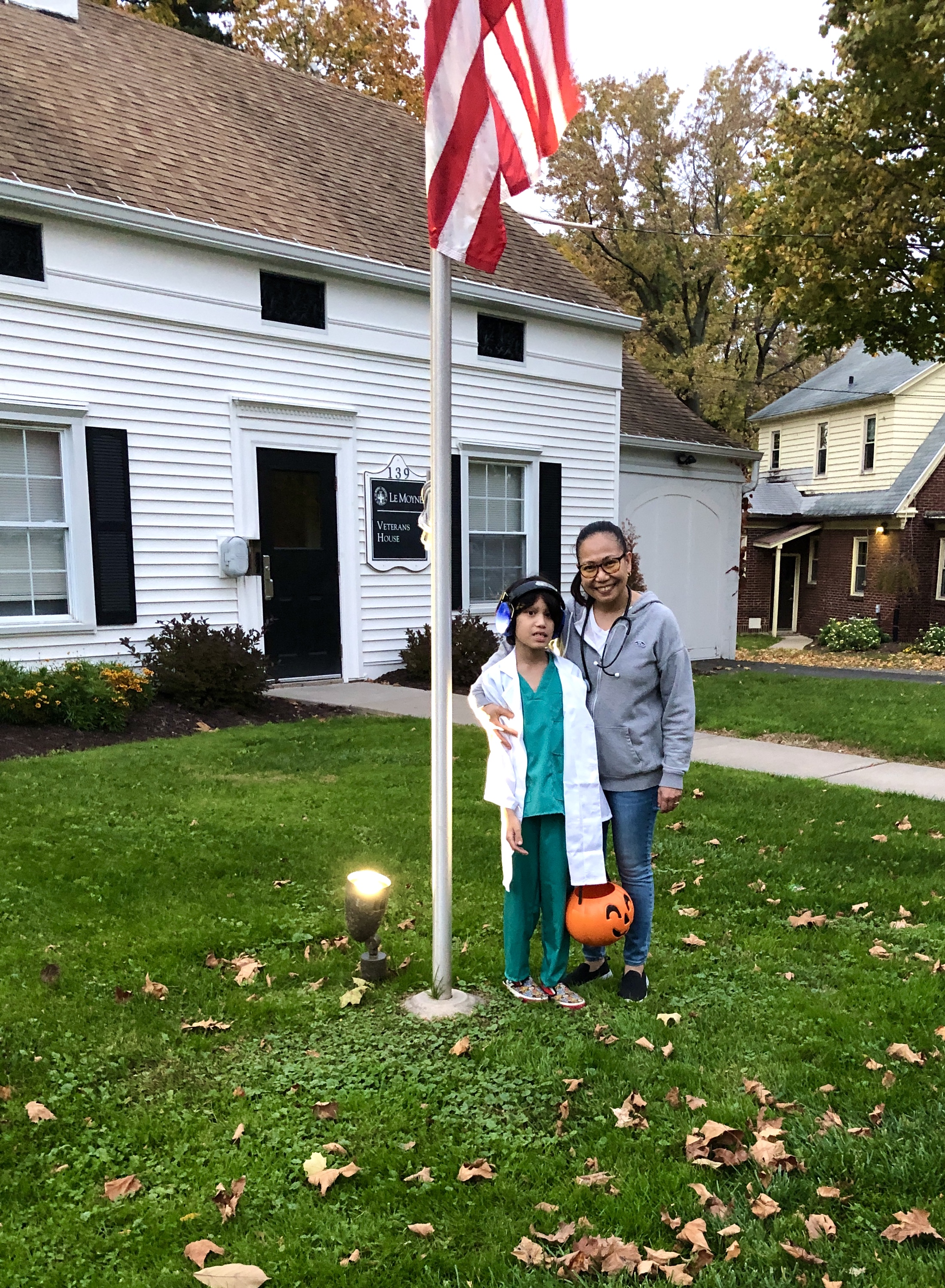
It was a special day for our family since our eight-year-old autistic son, Colin, participated in a parade at his elementary school and was excited and eager to go trick-or-treating in our neighborhood.

Colin Joe dressed as a doctor for Halloween.

In other years, we had to drag him out of the house. This year, dressed in his doctor’s costume, he slipped on his sneakers and gripped his pumpkin candy bucket, leading Mom and Dad in search of treats.

Pam and Colin, Halloween 2024.

Standard

In Honor of Abby

While walking on the campus of Le Moyne College last Sunday, I saw this bronze plaque with a poem in honor of a deceased student. The wording captured my interest.

Abby Bohnert ’19

Everyone’s friend.

Red lipstick and thick socks.
Giggles so loud they echo down the hall.
“She is Heaven and Hell’s love child.
Hold her. Name her poem.”

February 5, 1997 – August 8, 2016

A quick Google search shows that Abby died suddenly in 2016. And her mother passed away days later, making the story even more tragic.

I don’t have any wise words to share, except that Abby must have been a very special woman to be remembered with such a beautiful tribute on campus.

Standard

Poetic Precision

During my staycation this week, I ventured to Bird Library at SU to peruse some novels by Larry McMurtry (author of Lonesome Dove, Terms of Endearment and The Last Picture Show). I took a little literary detour when I got sidetracked in the stacks—flipping through the volume New and Selected Poems by Samuel Menashe. Menashe’s author photo caught my attention because he reminds me of a young Christopher Walken.

New and Selected Poems by Samuel Menashe.

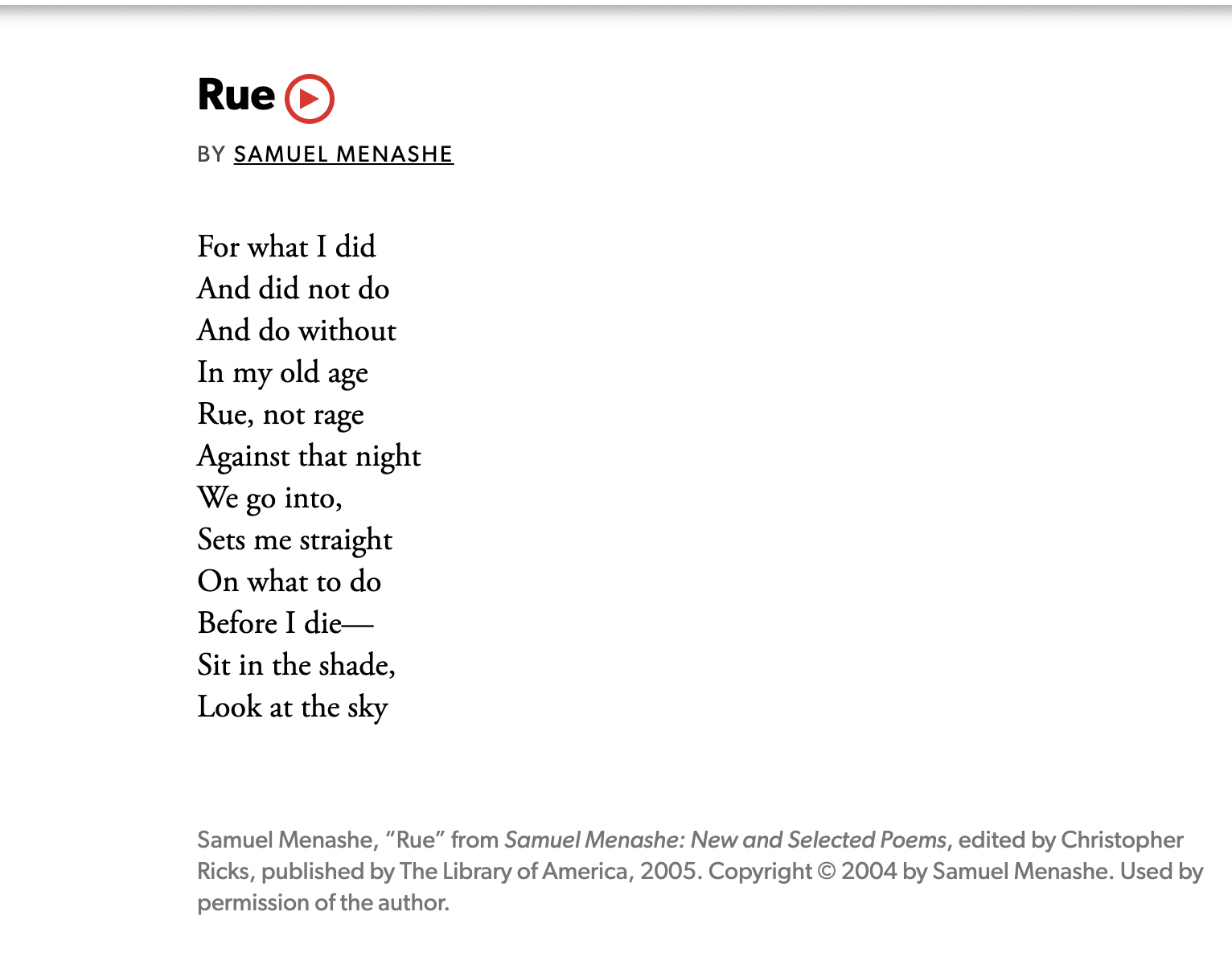
I’m drawn to Menashe’s concise and illuminating poems that tackle the universal themes of life, death and existentialism.

Here are some of my favorite poems.

Autumn

I walk outside the stone wall
Looking into the park at night
As armed trees frisk a windfall
Down paths that lampposts light.

The Dead of Winter

In my coat I sit
At the window sill
Wintering with snow
That did not melt
It fell long ago
At night, by stealth
I was where I am
When the snow began.

The Living End

Before long the end
Of the beginning
Begins to bend
To the beginning
Of the end you live
With some misgivings
About what you did.

Grief

Disbelief
To begin with—
Later, grief
Taking root
Grapples me
Wherever I am
Branches ram
Me in my bed
You are dead.

Voyage

Water opens without end
At the bow of the ship
Rising to descend
Away from it

Days become one
I am who I was.

Passive Resistance by Samuel Menashe.

Downpour

Windowed I observe
The waning snow
As rain unearths
That raw clay—
Adam’s afterbirth—
No one escapes
I lie down, immerse
Myself in sleep
The windows weep.

Samuel Menashe: New and Selected Poems, Bloodaxe Books; revised edition (January 1, 2009).

Standard

Excerpts: Poems for Lorca

Today, I present two poems from the chapbook Poems for Lorca, written by the late Syracuse journalist Walt Shepperd. I discovered the collection in the small gift shop in ArtRage Gallery.

I mistakenly thought the title referenced Spanish poet Federico García Lorca. But in the dedication page, Walt wrote: “For my daughter Lorca.”

Poems for Lorca by Walt Shepperd.

I’ve read this first poem multiple times, and I still don’t understand its meaning. But the ambiguous nature makes me appreciate the work even more. The words first hit me when I flipped through the book while walking along Crouse Avenue after leaving ArtRage on a sunny spring day. I think the poem has a timeless, universal quality.

An Easement for the Highway in Your Mind

The tinder has dried
and bridges
roots
and the canvas
in the windowframes
of someone else’s yesterdays
smolder
from sparks
carried
on an imperceptible breeze
down a road
between
trees
and tents
and tenements
over timbers
charred beyond support
of tomorrow’s weight.

They say
you can’t go home again
and they are mostly wrong
but your return
must be guided
by bulldozer tracks
and burial mounds
and streams filled in
with silt
of ruins crumbling
from your backward glance.

##

The second poem also has a great title and a sense of mystery.

I Dreamt I Took a Two Week Vacation
in an Audrey Hepburn Movie

I never wanted birthdays
and Christmas
and mother’s day
to be what now
it seems
they must become,
excuses for remembering
that time is now a luxury.

We build new worlds
and gather things
that patch the strands
that chafe our shells
that brace our memories
into barricades
that must stand by themselves
for time is now a luxury.

The things we gather
gather dust
the barricades
won’t stand a charge
the boxes burn
the seeds grow mold
the papers crumble in the new light,
and love becomes the luxury.

Shepperd, Walt. Poems for Lorca. W.D. Hoffstadt & Sons, 2012.

I intend to place the book in a Little Free Library in my neighborhood so another reader can appreciate Walt’s words.

Standard

Nine Months Later

Today marks nine months since my surgery to remove a benign brain tumor on my pituitary gland. Although it’s not a major milestone, it’s tied to a once-in-a-lifetime event—seeing Bruce Springsteen in concert on April 18 in the JMA Wireless Dome in Syracuse.

The concert was originally scheduled for September 7, 2023, and I would have been in no condition during my recovery to climb the concrete steps to the upper rafters of the Dome in Section 336, Row Y. I transferred my ticket to a co-worker, but then the tour was sidelined due to Bruce’s peptic ulcer disease. I’d like to think some heavenly intervention permitted me to attend the rescheduled event in April in a fully restored state.

I went to the concert with my wife, Pam—a rare night out for us and a break for her as she completed her first full year in her occupational therapy assistant program at Bryant and Stratton College. We hired a babysitter and took a Lyft to the show, arriving before the gates opened.

The Dome’s muddy sound system threw me off as the concert began. Bruce’s opening number was “Lonesome Day,” but I couldn’t figure out the tune. I felt like an outfielder in baseball who can’t pick up the ball off the bat. The first song I recognized was “No Surrender,” and the sound quality seemed to improve as the concert wore on.

Bruce and the E Street Band played the anthemic classics, which I have been reliving through the miracle of YouTube: “Badlands,” “Backstreets,” “The Promised Land,” “Thunder Road,” and “Born to Run.”

Up in the nosebleeds, an exuberant middle-aged woman with long, dark hair kept bumping me as she swayed, stomped her feet, clapped her hands, and pumped her fists. She kept apologizing, but I didn’t care about the incidental physical contact. I appreciated the pure joy she displayed, and we formed a bond through our mutual love of the music.

After “Born to Run” finished with a flourish, we shared a two-word conversation—screamed into each other’s ears.

I turned to her and said, “Amazing.”

“Right!” she said.

I hardly go to concerts, and I can’t remember the last stadium concert I attended. It may have been when I saw Bruce in Phoenix in 2002 during The Rising Tour. I went alone to America West Arena during the sweltering heat of August.

A Syracuse woman posted on Facebook that she didn’t enjoy the show because of the behavior of the people around her. And I know a debate persists about proper concert etiquette. As for me, I love it when fans dance and shout the lyrics at the top of their lungs. I mean, if you can’t let loose at a rock concert, where can you? They’re not serving tea and finger sandwiches. I think your ticket should come with a warning like “buyer beware … this isn’t your living room,” and I sang many songs, my voice growing hoarse as the night continued.

Music provides bookmarks for people’s lives. Fans connect songs to significant moments in their lives. Bruce’s music sustained me during my darkest days when I was consumed by loneliness, shame, and self-hatred.

So when Bruce belted out the words to “The Promised Land,” I joined him and thousands of others in screaming:

Blow away the dreams that tear you apart,
Blow away the dreams that break your heart,
Blow away the lies that leave you nothing
But lost and brokenhearted …

And I didn’t care that my voice was way off-key.

Standard

When Words Fail

While walking in my neighborhood yesterday, I visited the memorial site for five-year-old Nefertiti “Neffy” Harris, who was allegedly beaten to death by her mother in January. The girl’s remains were discovered last month in a field behind an apartment building off Salt Springs Road in Syracuse. People have left balloons, stuffed animals, signs and religious candles at the spot.

Memorial site for Neffy Harris.

On this spring day, birds chirped and pinwheels spun in the breeze. And the bright sunlight, blue sky and peaceful sounds gave me a feeling of tranquility while I reflected on the horrific circumstances of Neffy’s death.

Yet words seem futile when trying to process the murder of a young child whose voice is now silent. There’s nothing you can say to make this situation less tragic. My only hope is that Neffy is in a better place. As I walked away, I also considered the mother’s situation, and the thought that popped into my head was, “Everyone is redeemable.”

Standard

Ralph Rotella: The Sole of Syracuse

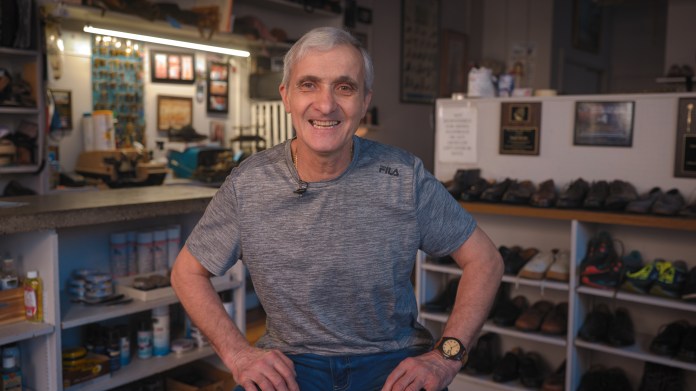
I’m happy to announce that my indie documentary short Ralph Rotella: The Sole of Syracuse, co-directed by my talented Syracuse University colleague Shane Johnson, will premiere at the Redhouse on Friday afternoon as an official entry of the Syracuse International Film Festival.

As many people in Central New York already know, Ralph is an amazing character with a generous heart, and it was a blast learning more about him.

After walking past his shop almost every day for the past few years, I felt compelled to go inside and talk to him. Inspired by Studs Terkel’s book Working, I wanted to do a mini doc to answer two questions: 1) Do people still get their shoes repaired in the 21st century 2) Can this man actually earn a living through shoe repair alone (taking into account the high cost of a downtown office building lease)? Or does he need an alternate income to survive?

Ralph Rotella hammering a heel. Photo Credit: Shane Johnson.

Ralph was a tough interview, and it was a challenge stringing together a narrative based on his terse sound bites, quips, and comedic digressions. And the film I thought I was making turned into something slightly different. But that’s the beauty of documentary filmmaking; if you take the time to pay attention to your subject, the story will reveal itself to you.

Photo Credit: Shane Johnson.

And through Shane’s fine cinematography—as we observed a “day in the life” of the shop, cinema verité style—we captured authentic personal moments that illustrate the bond Ralph shares with his customers on a daily basis.

This is Ralph’s work bench. It’s my favorite frame from the film. Photo Credit: Shane Johnson.

And here’s a little teaser we prepared in anticipation of the premiere.

Standard

Urban Exploration

I had a morning eye doctor’s appointment earlier this week. And I had some time to kill before the dilation drops rendered my eyes useless for the rest of the day. After getting off the bus at Washington Street near City Hall, I cut across Montgomery Street while making my way to Presidential Plaza.

St. Paul’s Church. Photo by Francis DiClemente.

Brick wall with ivy. Photo by Francis DiClemente.

Along the way, I snapped a few photos with my antiquated, battery-challenged iPhone 8, jotted down a quick poem about some feathered denizens of the Salt City, and captured a moment of tranquility on a sunny morning downtown.

I felt grateful for the opportunity to capture a myriad of sights and sounds the universe sent my way. It was another reminder to always pay attention to my surroundings and be on the lookout for creative inspiration. Here’s the poem I wrote. It required significant revision as it made the transition from my pocket notebook to my computer.

Bird Chatter

Three pigeons
perched on a wire.

What are they
talking about
on this bright,
sunny morning?

But their conversation
is restricted—not for
human interpretation.

And the chatter ends
when the birds
lift from the wire,
taking off in formation,

flapping their wings,
and sending feathers
twirling to the ground.


Standard