Jumpcuts of Text: A Research Experiment

Several years ago I worked as an editor at a national broadcast news wire service in Arizona. My roommate Dave and I worked the same 10 p.m. to 6 a.m. shift, and we would commute together, one of us taking turns driving each week. Often in the morning, after our shift ended, we would go grocery shopping, eat breakfast at a Denny’s or a Village Inn or search for some other activity to do to help us wind down before heading home, closing the Venetian blinds and trying to fall asleep in the Arizona sunlight. Such is the dilemma of night shift workers, struggling to sleep in daylight in opposition to your body’s circadian rhythm.

One morning Dave and I went to a bookstore near Indian School Road in Phoenix. The place offered a hodgepodge of entertainment-related merchandise: books, CDs (this was around 2001), board games, video games and porn (both magazines and video).

I remember buying used copies of Jack Kerouac’s The Town and the City and Frank Conroe’s Body and Soul. Both remain two of my all-time favorite books.

Dave and I wandered through the store and then we decided to play a game. We each went into a row in the used paperback section. Dave would pull out a book and a read a paragraph aloud. And then it was my turn and I would do the same thing. As the game progressed, I recall Dave stretching out on the floor of his row, surrounded by a stack of books.

Our selected passages included excerpts from spy thrillers, Dick Francis mysteries and Harlequin romance novels emblazoned with cover art images of men with bulging biceps and ripped pectorals.

Something about the incongruity, the verbal juxtaposition of the different passages, struck me as satisfying. These were books I never would have opened if I was browsing in the bookstore alone. The random act of pulling any volume and reading it aloud was like walking into a movie theater and knowing only the title of a film or buying a CD based solely on the artist’s name or the cover art.

I thought it would be fun to try to duplicate the exhilarating feeling of making a literary discovery. I decided to create an adapted research experiment by going to the fifth floor of Syracuse University’s Bird Library on a recent Saturday afternoon and pulling ten books off the shelves at random.

Table in Library

Table in Library

I spread the books on a table and for each book, I wrote down the author, title and publisher. I then opened the book to any page and read the first passage or paragraph that my eyes traveled to.

At first I wanted to replicate the work of a collage artist by compiling the sentences to form a textual conglomerate—to see the various passages edited into one composition. However, after I transcribed the paragraphs from the ten books, I realized they should each stand alone as a completed work of art. To me each book signifies a surprise that is worth exploring.

And, as a result, my “to-do” reading list has grown by ten titles.

I also wanted to make this a two-part blog post. So here are the selections from the first five books I grabbed off the shelves. I will add books six through ten later in the week.

Random Library Books

Random Library Books

Book 1: Evading Class in Contemporary British Literature by Lawrence Driscoll; an excerpt from The Book of Dave by Will Self.

“Dave keeps walking and soon we have the kitchen-sink drama moment when the protagonist looks back at his home town, as Dave looks down on London from the height of Essex:

Towards evening Dave found himself mounting up a hill. Up he went…Dave turned back to see the city he had lost   spreading to the far hills of the south in  brick peak after tarmac trough…In the mid distance a river streaked silver and beside it a mighty wheel revolved so slowly.”

Driscoll, Lawrence. Evading Class in Contemporary British Literature. New York: Palmgrave Macmillan, 2009. 89-90. Print.

Book 2: Blake, Kierkegaard, and the Spectre of the Dialectic by Lorraine Clark

“Kierkegaard’s attack on the spectre of negation that dissolves the ethical contraries once again focuses on the “phantom” of the Hegelian negative:

Leaving logic to go on to ethics, one encounters here again the negative, which is indefatigably active in the whole Hegelian philosophy. Here too a man discovers to his amazement that the negative is the evil. Now the confusion is in full swing; there is no bound to brilliancy.”

Clark, Lorraine. Blake, Kierkegaard, and the Spectre of the Dialectic. New York: Cambridge University Press, 1991. 134. Print.

Book 3: The Solitude of Surabhi by Deepa Shah

“Twelve-year-old Nimish looked sullenly out of the open window behind his father. Why was Papa so nervous of life and if it was a matter of assuming a role he could become a pilot, a soldier, an actor—well anything, Nimish thought. And then he noticed with surprise the fuzz on the tree outside which had softened the starkness of the branches of a fortnight ago.”

Shah, Deepa. The Solitude of Surabhi. New Delhi: Penguin Books India, 1997. 106. Print.
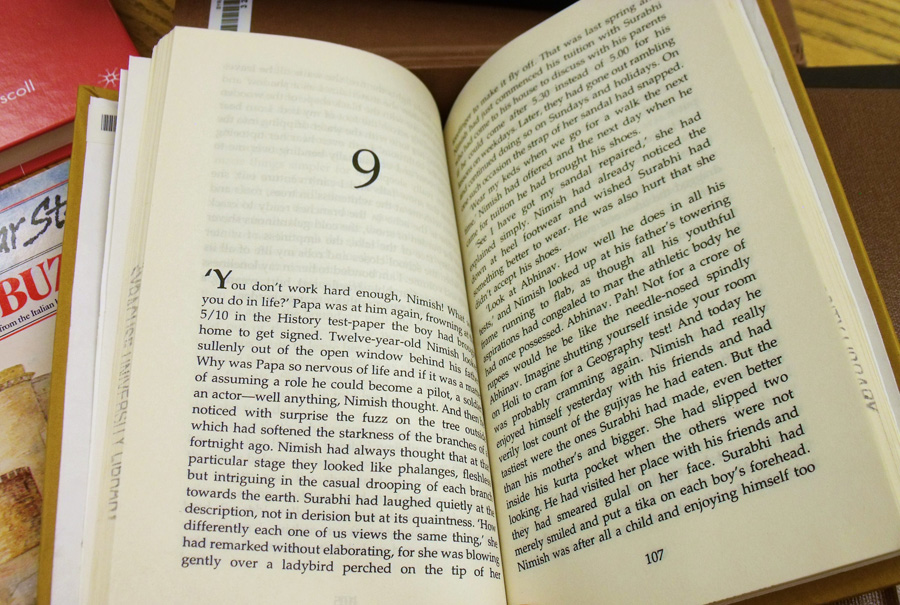
The Solitude of Surabhi

The Solitude of Surabhi

Book 4: Black Order by James Rollins

“Keep a historical perspective, Mr. Crowe. The Nazis were convinced that they would give rise to the next superrace. And here was a tool to do it in a generation. Morality held no benefit. There was a larger imperative.”

“To create a master race. To rule the world.”

Rollins, James. Black Order. New York: William Morrow, an imprint of HarperCollins Publishers, 2006. 190. Print.

Book 5: Bird Cloud by Annie Proulx

“I had to go to Germany and while I was gone the James Gang and the tile setter handled the enormous job of moving all the furniture and the full bookcases, of closing off and filling in the unwanted floor outlets, of measuring, cutting and laying the tile. The floor was almost the floor of my dreams, clean, smooth, elegant and a ravishing color. I swore always to have tiled floors wherever I lived. The bookcases were perfectly in place. How had they done all this in two weeks? I will never know.”

Proulx, Annie. Bird Cloud. New York: Scribner, a division of Simon & Schuster, Inc., 2011. 137. Print.

Standard

Out of the Past: Phone Booths in the Library

Until recently, three telephone booths—with wooden frames, glass doors and their electronic “guts” removed—stood idle on the fifth floor of E.S. Bird Library at Syracuse University, appearing like obsolete artifacts from the past.

Phone booths at Bird Library. Photo by Francis DiClemente.

Phone booths at Bird Library. Photo by Francis DiClemente.

I spotted them a few years ago when I first started taking out books at Bird Library, after being hired as a staff member at SU. It’s one of the best perks, along with being able to work out for free at the university’s fitness centers.

I had noticed identical phone booths on other floors of the building, and they seemed out of place amid the countless volumes of books in a 21st Century university library. According to library officials, the phone booths were part of the original construction and were in place when the building opened in 1972. One booth on each floor was a campus phone and the others were pay phones.

Phone booths at Bird Library. Photo by Francis DiClemente

Phone booths at Bird Library. Photo by Francis DiClemente.

Close up of phone booth at Bird Library. Photo by Francis DiClemente.

Close up of phone booth at Bird Library. Photo by Francis DiClemente.

But although they were installed in the early 1970s, the pay phones made me think of an earlier time period in cinema—from the 1940s to the 1960s.

The image of Cary Grant’s character (Roger Thornhill) using a pay phone in Grand Central Station to call his mother in Alfred Hitchcock’s North by Northwest (1959) jumped into my mind. Here’s the scene, courtesy of YouTube.

I also thought about scenes in film noir movies where a reporter would use a pay phone to call his editor to offer an update on a trial or a murder investigation.

One of the most dramatic phone booth scenes from the time period involves Burt Lancaster and Barbara Stanwyck in the 1948 movie Sorry, Wrong Number.

I’ve never seen the film, but it’s about a woman, Leona Stevenson (played by Stanwyck), who overhears a murder plot. Her husband, Henry, played by Lancaster, is talking to her on the phone, and the drama intensifies as the conversation unfolds. Here’s the scene.

Of course there are several other memorable cinematic phone booth scenes. I’m sure you’ll think of some. The obvious one is Clark Kent using a phone booth to “change into Superman.” Another is the gas station sequence in Hitchcock’s The Birds from 1963, with Tippi Hedren’s character seeking shelter in a glass phone booth as violent gulls attack.

But back to reality . . .

A facilities coordinator for Syracuse University Libraries says all of the phone booths at Bird have now been dismantled and will be replaced by recycling stations.

Close up of phone booth at Bird Library. Photo by Francis DiClemente.

Close up of phone booth at Bird Library. Photo by Francis DiClemente.

Phone booths removed from Bird Library. Photo by Francis DiClemente

Phone booths removed from Bird Library. Photo by Francis DiClemente.

I’m a little disappointed that I will no longer see them when I visit Bird. I think it would have been fun to try to re-create a film noir-style scene using the library’s phone booths. I could imagine a cool “DOLLY IN” move to one of the booths as our protagonist slides the glass door shut, scrambles to find a coin and hurries to make a call—a call that could save his or her life.

I did, however, preserve my memory of the library phone booths, through a short poem I wrote that appeared in my 2010 poetry chapbook, Outskirts of Intimacy, published by Flutter Press.

Here it is:

Disconnected Landlines

Three phone booths stand
Idle and unnoticed on the fifth floor
Of Syracuse University’s Bird Library.
And in this repository of knowledge,
They present themselves
With sliding glass doors ajar
And phone units ripped out—
Relics from the pre-digital age,
No longer able to make or receive calls.

Standard

Saroyan Shopping List

My latest stumbled-upon literary discovery at Syracuse University’s Bird Library revealed a clue to a mystery I will never solve. But I was thrilled to find it pressed between the pages of William Saroyan’s The Assyrian and Other Stories.

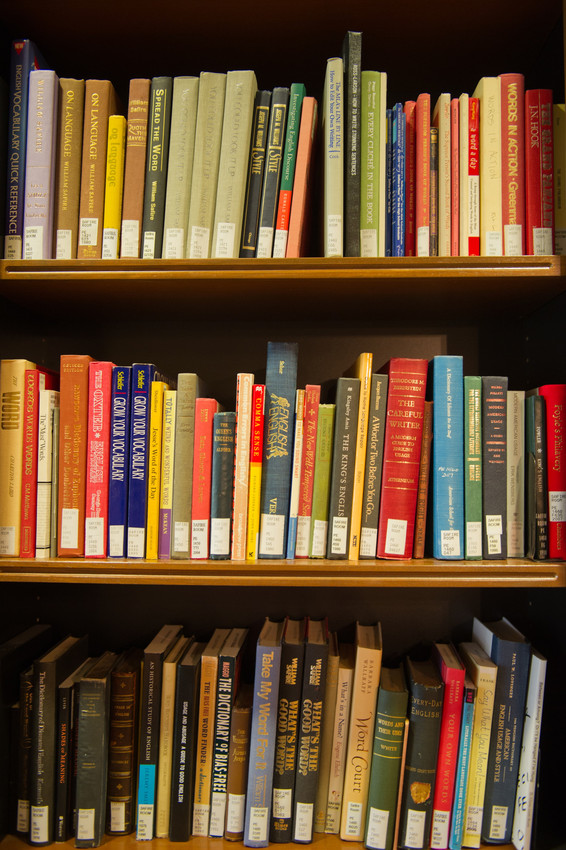
Books on shelves at Syracuse University's Bird Library. Photo by Steve Sartori.

Books on shelves at Bird Library. Photo by Steve Sartori.

I was searching through the stacks on the fifth floor one morning last week, before heading to work. I wanted to pick up ‘Tis by Frank McCourt and The Human Comedy by Saroyan. After I grabbed The Human Comedy I decided to peruse the large selection of other Saroyan books resting on the shelves nearby.

I flipped through The Assyrian and decided to check it out as well because the book contains an essay written by W.S. called The Writer on the Writing. In it he talks about his writing philosophy and the prolific short story work he produced in the mid to late 1930s.

I found his words to be inspiring.

He writes: “Anxiety at work is what tires a writer most. Writing without anxiety is certain to do the writer himself good; which takes me back to what it was I had hoped to achieve for myself when I wrote so many short stories in 1934-1939. I felt that it was right to just write them and turn them loose and not take myself or the stories too seriously. I had hoped to achieve an easier way for a man to write: that is, a more natural way.”

(Saroyan, William. The Assyrian and Other Stories. New York: Harcourt, Brace and Company, 1949. Print.)

He goes on to say the writer should have “implicit faith in himself, in his character, and in what he is apt to write. He must believe that it is possible for him to achieve writing as good as he might ever achieve by writing easily, swiftly and with gladness.”

However, the sage advice from Saroyan was not the only thing the book divulged.

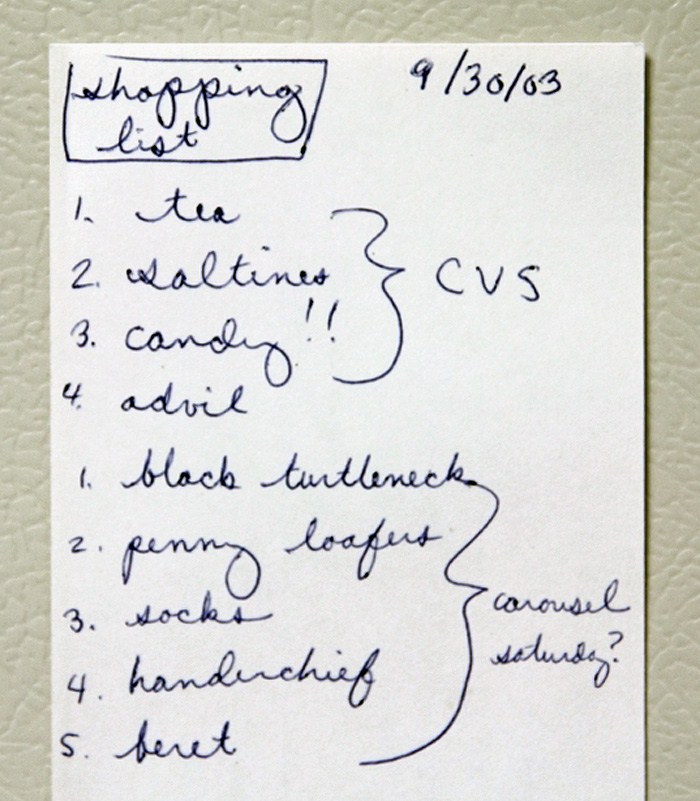
Inside I found a 3×5 index card dated 9/30/03. A shopping list was written vertically in blue ballpoint ink on the unlined side of the card. The list was divided into two areas; one section had the word “CVS” next to it and listed the following items numerically:

1. tea
2. Saltines
3. candy!! (double exclamation points)
4. Advil

The second section mentioned “Carousel Saturday?”—pointing to a possible trip to the mall. Carousel Center was the former name of the Destiny USA mall in Syracuse. For this part the list read:

1. black turtleneck
2. penny loafers
3. socks
4. handerchief (misspelled for handkerchief).
5. beret

A shopping list written on a 3x5 index card, found in the book The Assyrian and Other Stories by William Saroyan.

A shopping list written on a 3×5 index card, found in the book The Assyrian and Other Stories by William Saroyan.

I tried to imagine the person who made out this list. Was it a man or a woman? I narrowed my hunches to either a young professor or a graduate student (both male) picking up some needed supplies and clothes at the beginning of a fall semester. Maybe this student was pursuing his MFA in creative writing. I pictured him with brown hair, a tall, thin frame and wearing his black turtleneck, beret and penny loafers while reciting a manuscript at a cafe poetry reading.

Finding the list made me think that in another life I would have made a good library detective, sort of like Mr. Bookman (Philip Baker Hall) in that popular Seinfeld episode.

I’m not sure why these little discoveries inside books amuse me so much, but they do. Maybe my life is so boring I need to live vicariously through other people. Or maybe it’s just the element of surprise that excites me. It’s fun to uncover something that has been hidden in between the pages of a book for many years.

The only due-date stamp for The Assyrian and Other Stories is Oct. 24, 2003, so I wondered if I was the only person to open this book since then.

I also consider the index card a timeline marker for its owner. It proves he was here; this was a snapshot of his life on Sept. 30, 2003. He existed in a fixed place at a set time. He bought candy and tea and Advil and probably looked stylish in his black turtleneck, beret and penny loafers. He was alive and had dreams.

Our shopping list author is not the same person today. He is older and may have a wife and kids. Perhaps he applied the advice of Saroyan in his own creative work. Maybe he completed his MFA and now teaches creative writing at SU. Maybe he published his own short story collection or a couple of novels. Maybe I will find his books in circulation in this same library.

Unfortunately, maybe is as far as my investigation will take me. I’m left with only suppositions, as answers to the mystery of the index card and its owner elude me.

Standard

Three more gems from Broken Lights

I finished the 1920 poetry book Broken Lights: A Book of Verse by Glenn Hughes, which I mentioned in my last post.

In spending some time with the book, I inspected the library checkout card and was amazed to discover it  was first taken out of Syracuse University Library on September 2, 1926. I find it exciting to think that more than 85 years ago someone else was flipping through the same pages and reading the same poems. The last date stamped on the card is June 7, 1932. And another stamp on the first inside page reads, “STORAGE 28 JUL ’65 J F.”

There are several beautiful poems in the collection, but three short works that appear on consecutive pages (56-58), a literary triptych if you will, struck me the most. The first two seem dark at first but both end on a positive note. They also employ an alternating rhyming pattern. Here are the three poems:

RETROSPECT

God knows what dreary stretches lie
In the vast regions of my heart—
Bleak places where all flowers die,
And birds flee from wind’s keen smart.

But this I know: though desolate
Such of my heart’s dark spaces be,
Fair fields there are, inviolate,
Glowing and warm with love of thee.

REPLY

“Life—what is life?” I asked the world,
The world did not reply;
Its bitter lip with scorn was curled,
And mocking was its eye.

But then you came, and now I stand
From the grim world apart;
For life was in the soft white hand
You laid upon my heart.

SONG OF SORROW

The songs I made for you are dead,
For the aching of my heart has drowned their melody,
It is the winter of our love,
And the rose leaves that were scattered in the summer
Lie black and scentless on forgotten paths.

Ah, desolate, desolate with nameless yearning
In my heart that was so light in other days,
And somewhere in a garden,
Where a bird is singing in the sunshine
I can see you sitting, weeping,
With your gold hair all about you,
And a beautiful, deep sorrow in your eyes.

(Hughes, Glenn. Broken Lights: A Book of Verse. Seattle: Department of Printing, University of Washington, 1920. Print.)


Standard

A Jewel in the Stacks

I went to Syracuse University’s Bird Library to pick up two novels I hope to read over the summer: Shirley Jackson’s The Haunting of Hill House and The Killing Man by Mickey Spillane. But as is often the case when I am roaming through the aisles on the fifth floor of the library, another book caught my attention. It’s a slim volume of poetry titled Broken Lights: A Book of Verse by Glenn Hughes, published in 1920. I pulled the rust-colored book off the shelf and flipped it open randomly, stopping on page 68, where I found the poem Dakota Night. As I read the poem, the words stirred my imagination, making me feel like I was standing in a knee-high field of grass surrounded by a bowl of stars.

DAKOTA NIGHT

Was ever such a night for stars
Above this silent prairie land,
Where lonely years have left their scars
In rocky buttes that darkly stand
Against the liquid film of night
So richly flecked with golden light!

There is a peace here, native, strong,
That lies upon this rolling waste
As though the gods had labored long
And, wearying, had turned to taste
The joy of dreamless sleep.  No breath
Is heard.  It is a peace like death.

Yet hark!  A murmur on the hill!
The wind among the grasses wakes;
A cricket strums and then is still.
How sweet the music that night makes!
Starlight and quiet once again
On lonely butte and barren plain.

(Hughes, Glenn. Broken Lights: A Book of Verse. Seattle: Department of Printing, University of Washington, 1920. Print.)

I found an online story about Glenn Hughes, or at least I believe it’s the same Glenn Hughes who penned Broken Lights.

And this incident proves why books on paper will always possess more allure to me than e-books. Bound volumes hold tactile power; the way they look, feel and smell invite the reader to explore the space sandwiched between the front and back covers. My literary find also makes me wonder how many other interesting books are just waiting to be discovered on the library stacks.

You can read Broken Lights online for free.

Standard

Collage Postscript

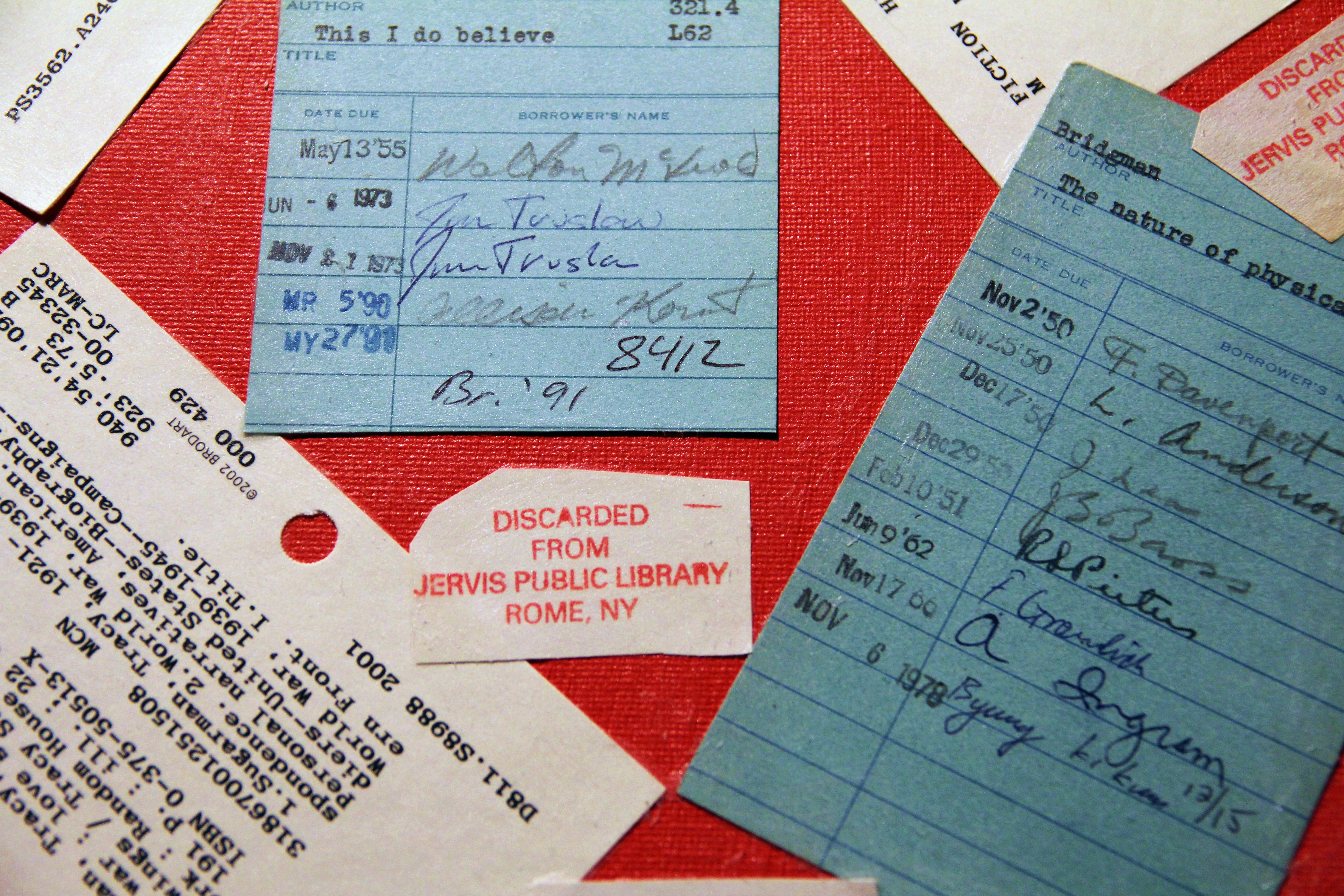
Since I made the first collage piece in 2009, I have tried my hand a few more times, with varying results. I made two library-themed collage works called Archive and Checkout, seen here.

Digital image of mixed media work, 2011.

Digital image of collage, 2011.

The idea for the pieces came to me because over the years my mother had purchased several used books from Jervis Public Library in Rome; most sold for one dollar or less. Flipping through some of the books, I noticed they were all stamped with the phrase “Discarded From Jervis Public Library” in red ink on one of the inside covers or pages.

Many of the books were in good condition, and some of the titles came from popular authors like James Patterson, Scott Turow, Anne Rice and Dick Francis. Even so, whether a title was a Harlequin romance or a prize-winning literary novel, I felt sadness because books that seemed to be still readable were being pulled from the stacks and deposited on cluttered shelves in a dark hallway of the library near the men’s and women’s bathrooms. I’m sure there’s a good reason why the books needed to be moved out of circulation, but on a visceral level I felt empathy for the discarded inanimate works.  

As a result, I went to the library, bought several of the used books and cut out the stamped pages. I then gathered the pages and some old library cards that I found for sale online and pasted them together on two painted canvases.

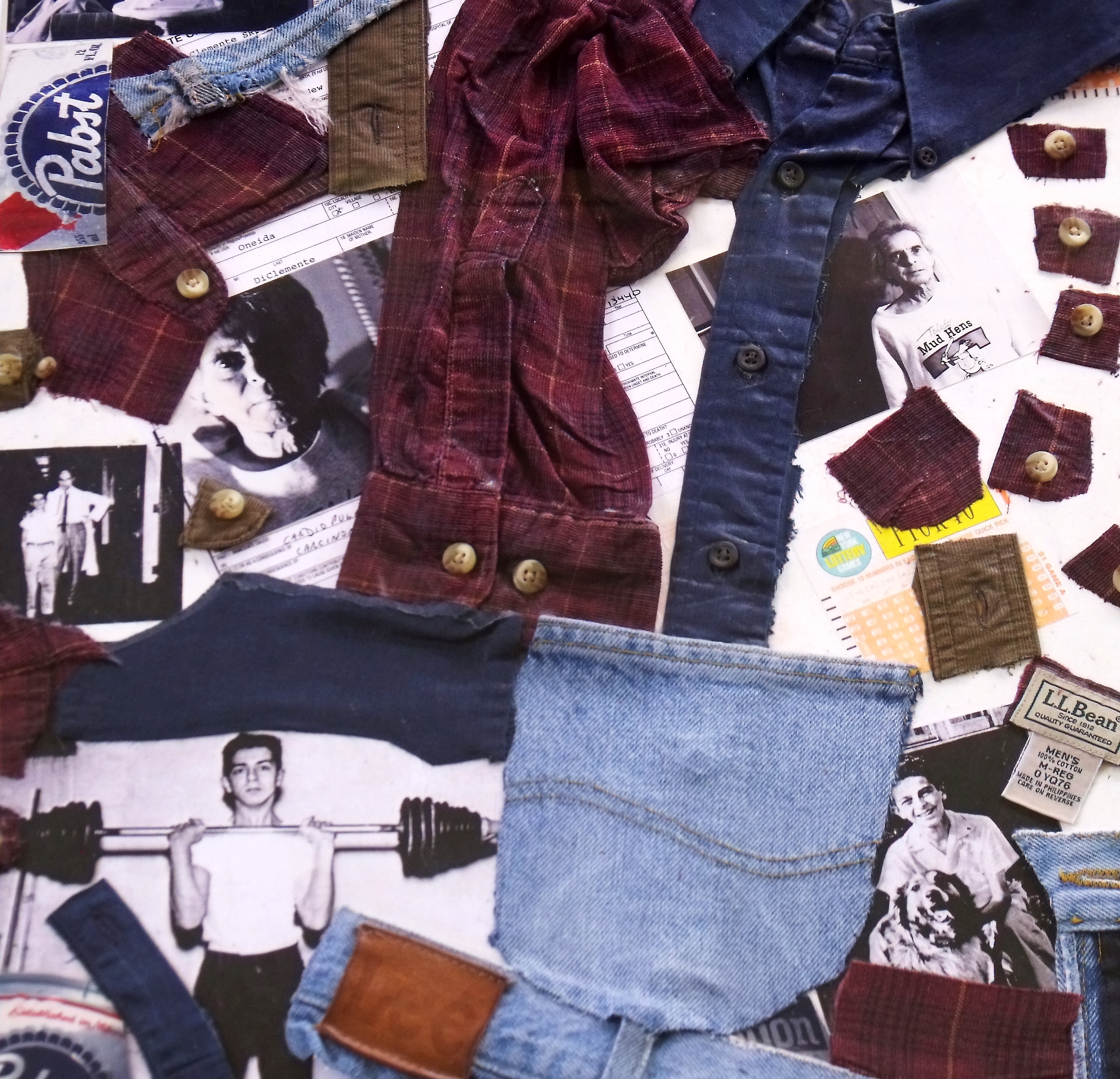
This fun project in the summer of 2011 led to another unrelated work. My father had passed away in 2007 and I still had some of his old clothes and other personal items. So I thought I would try to make a collage tribute to him using materials left over from his life. Here is the finished product.

Digital image of mixed media work, 2011.

In hindsight, I should have painted the surface before I added the collage materials to give it some color. I also think I should have limited the number of buttons from my dad’s shirts.

Still, what I like most about these three collage works is I had no expectations when I started working on them. As stated in my last post, I am a collage novice, but an idea came to me and I said to myself, “OK, give it a try.”

And I think it’s a good lesson for me to learn, as artistic experimentation is vital to keeping work fresh. It helps to shake up the juices and allow new paths of creation to flow. This philosophy of taking risks and following your instincts applies to practitioners of all art forms and is also relevant in other areas of life, such as learning, career, dating, cooking and social experiences.

On a personal note, the three collages hold special meaning for me because they pay tribute to my late parents. I mentioned my father’s collage, but the two library-themed pictures also honor my mother, even if that was not the intention when I made them. My mom, who died last November after a long battle with cancer, was a bibliophile who researched and compiled detailed biographies and booklists for her favorite authors, including Danielle Steel and Nora Roberts. When I would mock her for taking a hobby to such a fanatical level, she would just say, “I’m very organized.”

She also gave me permission to rip out all of the “Discarded From Jervis Public Library” stamps from the used books she had finished reading. She piled the books in a wicker basket placed near the fireplace in the living room, with yellow Post-it notes on the covers indicating they had been “read.”

And I’m glad she had a chance to see the finished library collages since she contributed to the making of them. Right now all three collages are wrapped in brown paper and tucked under the bed in one of the spare bedrooms in my stepfather’s house in Rome. But if a day comes when I have some wall space in a future apartment—not the furnished studio I currently rent—I’ll hang up the collages and look upon the images with satisfaction, knowing a little bit of my parents’ spirit lives on underneath the glass frames.

Digital photograph of collage, 2011.

Digital photograph of mixed media piece, 2011.


Standard