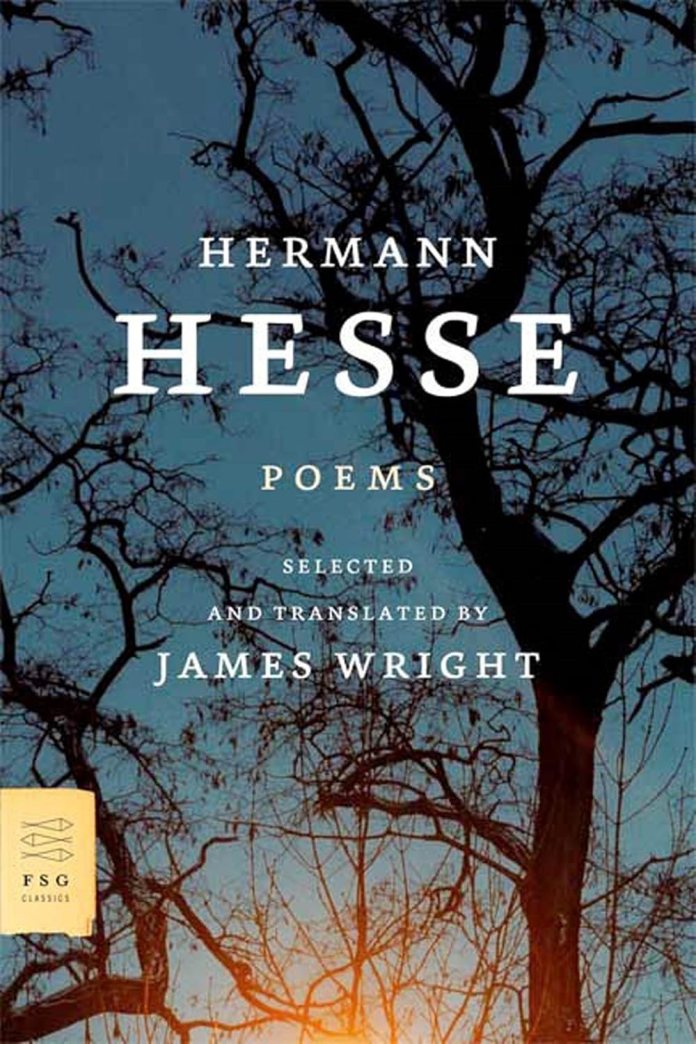
Poems by Hermann Hesse

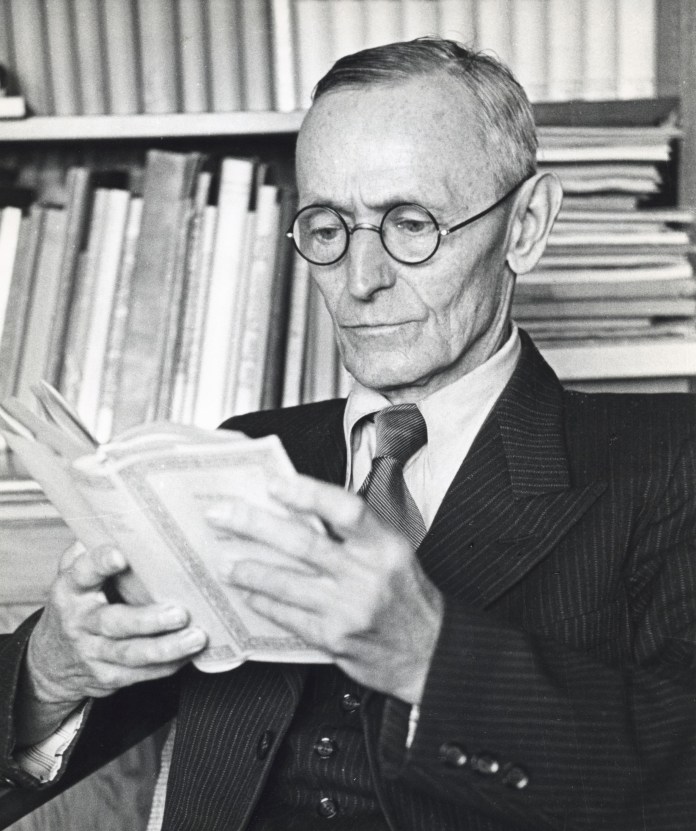
I am re-reading Siddhartha by Hermann Hesse. And in doing a little Wiki research on the German novelist, I discovered he also wrote poetry. I bought a collection of his verses entitled Poems by Hermann Hesse: Selected and Translated By James Wright (Farrar, Straus and Giroux, 1970). Most of the poems are short (which I love), and he explores such themes as youth, nature, identity, longing, and loneliness.
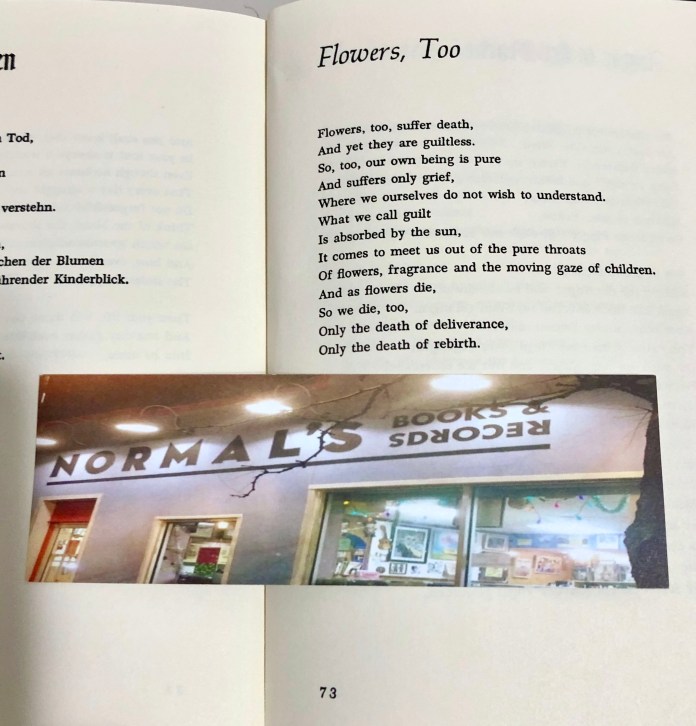
An added bonus—the used book arrived with a nice bookmark from Normals Books & Records in Baltimore, which looks like a really cool store.
Here are a few selections from the book that I wanted to share:

Mountains at Night

The lake has died down,
The reed, black in its sleep,
Whispers in a dream.
Expanding immensely into the countryside,
The mountains loom, outspread.
They are not resting.
They breathe deeply, and hold themselves,
Pressed tightly, to one another.
Deeply breathing,
Laden with mute forces,
Caught in a wasting passion.

On a Journey

Don’t be downcast, soon the night will come,
When we can see the cool moon laughing in secret
Over the faint countryside,
And we rest, hand in hand.

Don’t be downcast, the time will soon come
When we can have rest. Our small crosses will stand
On the bright edge of the road together,
And rain fall, and snow fall,
And the winds come and go.

Night

I like the dark night well enough;
But sometimes, when it turns bleak
And peaked, as my suffering laughs at me,
Its dreadful kingdom horrifies me,

And I wish to God I could take one look at the sunlight
And the blue of heaven brought back to light by its clouds,
And I want to lie down warm in the wide spaces of the day.
Then I can dream of the night.
Destiny

In our fury and muddle,
We act like children, cut off,
Fled from ourselves,
Bound by silly shame.

The years clump past
In their agony, waiting.
Not a single path leads back
To the garden of our youth.

How Heavy The Days . . . 

How heavy the days are.
There’s not a fire that can warm me,
Not a sun to laugh with me,
Everything bare,
Everything cold and merciless,
And even the beloved, clear
Stars look desolately down,
Since I learned in my heart that
Love can die.

And here are a few spring-themed poems:

The First Flowers

Beside the brook
Toward the willows,
During these days
So many yellow flowers have opened
Their eyes into gold.
I have long since lost my innocence, yet a memory
Touches my depth, the golden hours of morning, and gazes
Brilliantly upon me out of the eyes of flowers.
I was going to pick flowers;
Now I leave them all standing
And walk home, an old man.

Spring Day

Wind in bushes and bird piping
And high in the highest fresh blue
A haughty cloud ship, becalmed . . .
I dream of a blond woman,
I dream of my youth,
The high heaven blue and outspread
Is the cradle of my longing
Where I choose to lie calm
And blessedly warm
With the soft humming,
Just like a child held
On his mother’s arm.

Flowers, Too

Flowers, too, suffer death,
And yet they are guiltless.
So, too, our own being is pure
And suffers only grief,
Where we ourselves do not wish to understand.
What we call guilt
Is absorbed by the sun,
It comes to meet us out of the pure throats
Of flowers, fragrance and the moving gaze of children.
And as flowers die,
So we die, too,
Only the death of deliverance,
Only the death of rebirth.

Standard

Books for Sale Locally

Two of my books, Dreaming of Lemon Trees: Selected Poems and Outward Arrangements: Poems are available in the Local Authors section in Parthenon Books, the new bookstore located on Salina Street in Syracuse. I stopped by Sunday morning and was excited to see the books lining the shelf, in company with works by other Central New York writers.

Books on display.


Standard

Jumpcuts of Text: A Research Experiment

Several years ago I worked as an editor at a national broadcast news wire service in Arizona. My roommate Dave and I worked the same 10 p.m. to 6 a.m. shift, and we would commute together, one of us taking turns driving each week. Often in the morning, after our shift ended, we would go grocery shopping, eat breakfast at a Denny’s or a Village Inn or search for some other activity to do to help us wind down before heading home, closing the Venetian blinds and trying to fall asleep in the Arizona sunlight. Such is the dilemma of night shift workers, struggling to sleep in daylight in opposition to your body’s circadian rhythm.

One morning Dave and I went to a bookstore near Indian School Road in Phoenix. The place offered a hodgepodge of entertainment-related merchandise: books, CDs (this was around 2001), board games, video games and porn (both magazines and video).

I remember buying used copies of Jack Kerouac’s The Town and the City and Frank Conroe’s Body and Soul. Both remain two of my all-time favorite books.

Dave and I wandered through the store and then we decided to play a game. We each went into a row in the used paperback section. Dave would pull out a book and a read a paragraph aloud. And then it was my turn and I would do the same thing. As the game progressed, I recall Dave stretching out on the floor of his row, surrounded by a stack of books.

Our selected passages included excerpts from spy thrillers, Dick Francis mysteries and Harlequin romance novels emblazoned with cover art images of men with bulging biceps and ripped pectorals.

Something about the incongruity, the verbal juxtaposition of the different passages, struck me as satisfying. These were books I never would have opened if I was browsing in the bookstore alone. The random act of pulling any volume and reading it aloud was like walking into a movie theater and knowing only the title of a film or buying a CD based solely on the artist’s name or the cover art.

I thought it would be fun to try to duplicate the exhilarating feeling of making a literary discovery. I decided to create an adapted research experiment by going to the fifth floor of Syracuse University’s Bird Library on a recent Saturday afternoon and pulling ten books off the shelves at random.

Table in Library

Table in Library

I spread the books on a table and for each book, I wrote down the author, title and publisher. I then opened the book to any page and read the first passage or paragraph that my eyes traveled to.

At first I wanted to replicate the work of a collage artist by compiling the sentences to form a textual conglomerate—to see the various passages edited into one composition. However, after I transcribed the paragraphs from the ten books, I realized they should each stand alone as a completed work of art. To me each book signifies a surprise that is worth exploring.

And, as a result, my “to-do” reading list has grown by ten titles.

I also wanted to make this a two-part blog post. So here are the selections from the first five books I grabbed off the shelves. I will add books six through ten later in the week.

Random Library Books

Random Library Books

Book 1: Evading Class in Contemporary British Literature by Lawrence Driscoll; an excerpt from The Book of Dave by Will Self.

“Dave keeps walking and soon we have the kitchen-sink drama moment when the protagonist looks back at his home town, as Dave looks down on London from the height of Essex:

Towards evening Dave found himself mounting up a hill. Up he went…Dave turned back to see the city he had lost   spreading to the far hills of the south in  brick peak after tarmac trough…In the mid distance a river streaked silver and beside it a mighty wheel revolved so slowly.”

Driscoll, Lawrence. Evading Class in Contemporary British Literature. New York: Palmgrave Macmillan, 2009. 89-90. Print.

Book 2: Blake, Kierkegaard, and the Spectre of the Dialectic by Lorraine Clark

“Kierkegaard’s attack on the spectre of negation that dissolves the ethical contraries once again focuses on the “phantom” of the Hegelian negative:

Leaving logic to go on to ethics, one encounters here again the negative, which is indefatigably active in the whole Hegelian philosophy. Here too a man discovers to his amazement that the negative is the evil. Now the confusion is in full swing; there is no bound to brilliancy.”

Clark, Lorraine. Blake, Kierkegaard, and the Spectre of the Dialectic. New York: Cambridge University Press, 1991. 134. Print.

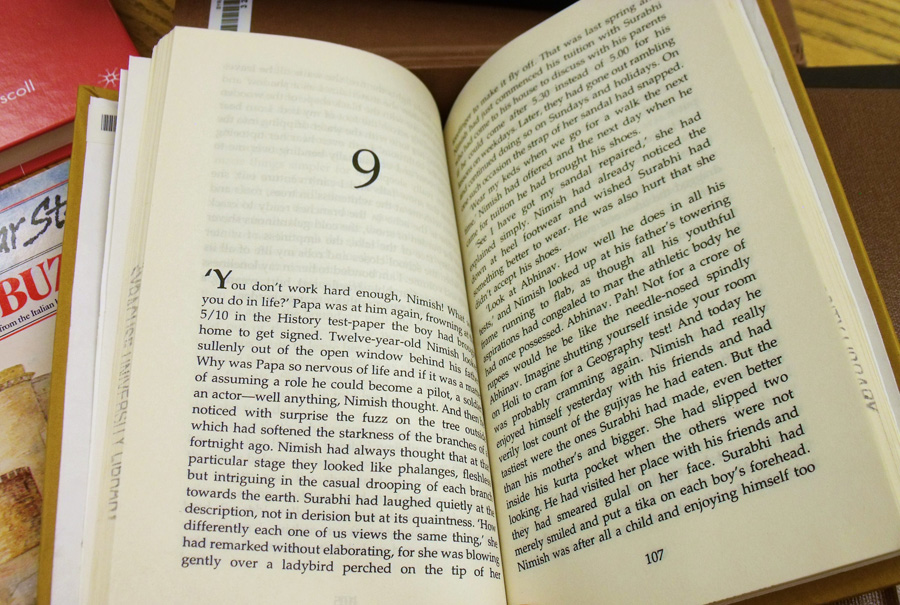
Book 3: The Solitude of Surabhi by Deepa Shah

“Twelve-year-old Nimish looked sullenly out of the open window behind his father. Why was Papa so nervous of life and if it was a matter of assuming a role he could become a pilot, a soldier, an actor—well anything, Nimish thought. And then he noticed with surprise the fuzz on the tree outside which had softened the starkness of the branches of a fortnight ago.”

Shah, Deepa. The Solitude of Surabhi. New Delhi: Penguin Books India, 1997. 106. Print.

The Solitude of Surabhi

The Solitude of Surabhi

Book 4: Black Order by James Rollins

“Keep a historical perspective, Mr. Crowe. The Nazis were convinced that they would give rise to the next superrace. And here was a tool to do it in a generation. Morality held no benefit. There was a larger imperative.”

“To create a master race. To rule the world.”

Rollins, James. Black Order. New York: William Morrow, an imprint of HarperCollins Publishers, 2006. 190. Print.

Book 5: Bird Cloud by Annie Proulx

“I had to go to Germany and while I was gone the James Gang and the tile setter handled the enormous job of moving all the furniture and the full bookcases, of closing off and filling in the unwanted floor outlets, of measuring, cutting and laying the tile. The floor was almost the floor of my dreams, clean, smooth, elegant and a ravishing color. I swore always to have tiled floors wherever I lived. The bookcases were perfectly in place. How had they done all this in two weeks? I will never know.”

Proulx, Annie. Bird Cloud. New York: Scribner, a division of Simon & Schuster, Inc., 2011. 137. Print.

Standard