The Schoolyard Chase

This essay first appeared in the Spring/Summer 2015 issue of South 85 Journal, an online literary magazine.

##

I once used the N-word as a weapon to achieve a goal.

It happened when I was in fifth or sixth grade at DeWitt Clinton elementary school in my hometown of Rome, New York. During recess on a cool, sunny day in early spring, I started playing a game called “Catch the Fly” with my friend Mike. The shouts of kids congregating on the school grounds mingled to form a cacophony. Weeds, broken bottles, and scattered bubble gum and Now and Later candy wrappers lined a chain-link fence that separated the schoolyard from an alley.

In the game, two players took turns throwing a tennis ball or a squishy pink ball against the brick facade of the school building. The person throwing the ball acted as a hitter in baseball. The goal was for the fielder to make three outs and retire the side, while the thrower tried to get the ball past the fielder and thus move imaginary runners around the imaginary bases.

I was playing the field, and Mike tossed the ball against the building. I can’t remember if it was a pop fly or a grounder, but as I raced to catch the ball, Cassie Donaldson (name changed), a tall, Black girl, stole it from me. She either snagged the ball in midair or retrieved it after it skirted by me toward the chain-link fence.

School building. Photo by Francis DiClemente.

“Hey, give it back,” I yelled to Cassie. No recess monitors or adults were stationed outside to enforce fair play. Cassie looked at me while standing a few feet away. She flashed a smile, almost begging me to give chase. And so, I did.

I took off and rushed after her as she bolted, cutting through a crowd of kids gathered in the middle of the schoolyard. Her long legs pumped with fluid motion, and she outran me easily.

It’s worth mentioning that she was one of the fastest and most athletic students in our class. She beat most of the boys in the 50 and 100-yard dashes timed in gym class, and she was often one of the first players chosen by captains when dividing teams for kickball or soccer games.

As the chase continued, Cassie circled the building, running on the sidewalk along Ann Street. She opened a wide gap as I pursued her. We were then alone near the front of the school. She was galloping away, and the futility of the chase became obvious. My short legs failed me; I grew tired and gave up.

After I stopped running, my eyes focused on her back, and her figure appeared smaller with every passing second. I recall she was wearing a long-sleeve green shirt. I caught my breath and screamed, “Give it back, you N-word.”

She broke stride, pulling up instantly. She did not turn around; instead, she hurled the ball over her shoulder and walked away, heading in the same direction she had been running.

The ball bounced toward me, and I picked it up. I walked back to the schoolyard with a tightness building in my stomach. By now, Mike had found some other kids to play with, but once he saw I had the ball, we picked up where we left off.
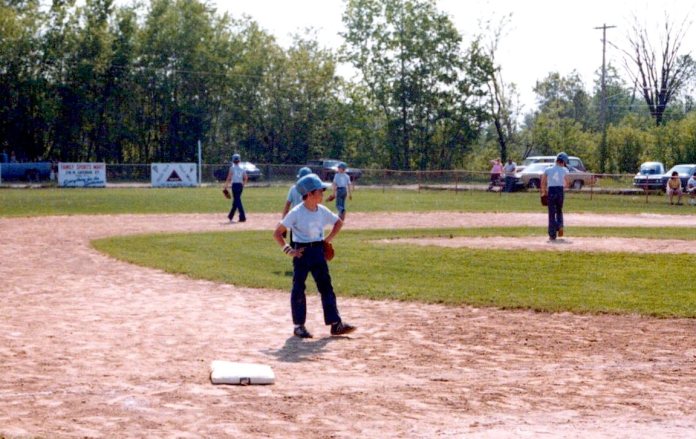
Playing third base in youth league baseball in Rome, New York, in the late 1970s.

But I lost my enthusiasm for the game. And while I felt vindicated because Cassie had taken the ball without provocation, I knew what I said was wrong and had stung her. Yet despite the viciousness of the N-word, its usage had produced the desired result: I had reclaimed possession of my ball.

I had learned the N-word from my father. He used it on occasion when complaining about some of the residents in our city or when watching sports on television.

I know he had a racist disposition. But at times, race seemed to matter little to him. Some of his co-workers at the Sears store where he worked were Black, and I remember he enjoyed chatting and joking with them. He also knew Cassie’s parents, and he would stop to talk to them if we saw them at school or in the grocery store. He also used to give them good discounts on kitchen, electrical, and hardware products at Sears.

So why did he use the N-word? I think it became a habit for him, and I made the mistake of emulating his bad behavior.

Even so, I considered myself colorblind in elementary school. Some of my friends at DeWitt Clinton were Black, and I had grown accustomed to playing sports with Black kids in Rome. Race did not seem like an issue to us.

Yet when I felt humiliated on the school grounds, I had yelled the insult without thinking about who I was targeting.

I must have apologized to Cassie at some point because we remained friends all the way through high school. But I don’t remember what I said to her or the circumstances surrounding the mea culpa. Most likely, I would have apologized to Cassie either before class resumed that day or later on the bus ride home. Or maybe I never told her how sorry I was for what I had done. Maybe we carried our unspoken knowledge of the incident with us as we climbed the grades in school.

And I faced no repercussions. I was not called to the principal’s office to explain my actions, nor was I confronted by my parents after school. And not being punished made me feel even guiltier about my behavior.

It would have been easy for Cassie to squeal on me. We lived on the same street as the Donaldsons on a rural road in South Rome. Her parents could have stopped by our house after work that night and shared the news with my parents.

I often wondered why Cassie never told anyone what I said (or at least I believe she didn’t). Maybe she thought, what good could come from telling her parents one of her classmates had called her a racial slur at recess? What could be gained from it except making her mother and father feel anger and heartache over the treatment of their daughter?

But I had gained something. I learned about the power of words and their impact on others. I discovered how one racial epithet could imbue a girl with shame, altering her body language and stopping her from running freely on a sidewalk.

I can’t say for sure that I never used the N-word again or that it hasn’t popped into my head on occasion. But from that day forward, I don’t remember ever speaking it aloud or directing it at anyone. And I realize racism cannot be cured in one passing swoop. We must struggle every day to reject the baser tendencies of our personalities.

Fortunately, Cassie never held a grudge against me for my childhood misconduct. And I never forgot her or the lesson she taught me in the schoolyard on a spring day in the early 1980s.

Standard

Hallowed Verse

1.

Halloween on Lamphear Road (1970s)

Blackness shrouds the land
between the houses on a
long stretch of rural road
in Rome, New York.

You and your best friend, Billy,
are shining flashlights
as you go trick-or-treating
on a Halloween night.
The smells of cow manure,
burning leaves and ripe apples
permeate the air.

You and Billy walk briskly
along the edge of the road,
chattering about sports,
movies and girls—
trying not to express
the terror you both feel as you
navigate the darkness.

You fear a witch, a ghost
or another malevolent force
will emerge from the adjacent fields,
snatch you and fly away.

You tell yourself to calm down
and keep walking—you are safe
and there’s nothing to be afraid of
on this country road.
And all you have to do is make it
to the next house, the next doorbell,
and the next fun-size Snickers bar.

2. 

Halloween Screening

You can’t fault
Frankenstein’s creature
For what he became.

He never had a choice.
He didn’t ask to be born.
He didn’t seek existence.

With an abnormal brain
And cobbled parts,
He can’t be blamed for
The terror he unleashed.

He was only acting
According to his nature.
The real monster here
Is the man who
Created the creature.

The Truth I Must Invent (Poets Choice, 2023)

3. 

In Need of Houdini

You are wrapped in chains
and stuffed in a metal chest.
The key has been discarded
and the box dumped
into the ocean.

You can’t stretch your legs
or flap your arms,
and you’re stuck in the box—
unable to lift the latch
and swim free.

How long can you
hold your breath?

Outward Arrangements: Poems (independently published, 2021)

4. 

Hike

The trees are haunted with ten-thousand eyes,
hanging in the place where leaves should be—
the remains of those who came this way before,
but did not survive in the forest.

They study me as I hike along the path,
searching for an opening to the other side.
I grow weary and stop to rest.

And then ten-thousand eyes blink in unison.
It seems like a signal.
And as I look around,
buzzards and crows fly at me,
then peck away at the flesh.
I fall to the ground and
the birds snatch pieces of me
as they take off in flight.

Sidewalk Stories (Kelsay Books, 2017)

Standard

Seasonal Verse

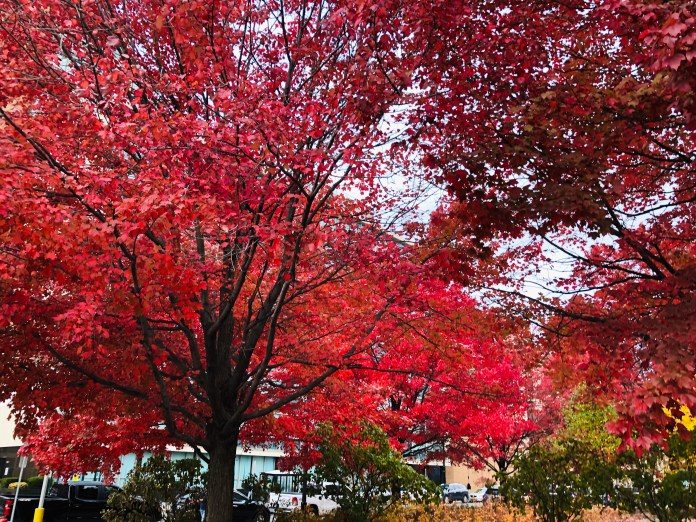
Fall in upstate New York is a season of heightened senses as nature produces its splendid display of vibrant colors. For me, autumn is a time of reflection, often inspiring me to write poetry.

Einhorn Family Walk at Syracuse University. Photo by Francis DiClemente.

Here are some fall-themed selections.

Stadium Nights

Friday nights in Central New York,
crumpling leaves of bursting gold
and breathing in the October cold
as a pigskin spirals tight
and shadows collide under stadium lights.

Small town pride surges like an offensive line,
bursting open a gaping hole,
springing the halfback
en route to the chalk-lined goal.
And fathers perched in the stands
holler until hoarse and reminisce
about the glory days, when they wore the jerseys—
bloodied and mud-caked—
and walked with shoulders back,
receiving cheers as Friday night gladiators.

Under the bleachers, first-time kisses
are punctuated with quivers and giggles
in between swigs of peppermint schnapps.
Holding hands means everything,
and halftime comes far too quick.
The curfew looms as the scoreboard clock winds down.
Just five more minutes you say,
then head home grudgingly.

Dreaming of Lemon Trees: Selected Poems by Francis DiClemente (Finishing Line Press, 2019)

Autumn Acknowledgment

On this glorious autumn day—
with bright sunshine, blue skies
and refulgent orange, red and golden leaves
shimmering on the trees—
I am not thinking about
freezing temperatures and lake effect snow.
I know winter will come.
I know we cannot stave off
the inevitable despair that accompanies
the turn of the seasons.

But winter is not here yet.
So I will enjoy this fall weather
while I still have the chance—
while the green grass remains uncovered
and while the warm sunshine lasts,
at least for another day.

Falling Leaf

The golden maple leaf
fell to the ground
in front of my feet,
making a slapping sound.
It greeted me
on this frosty November morning,
reminding me that one day
I too will lie on the ground,
and others will pass by
without stopping
or looking down.

Sidewalk Stories by Francis DiClemente (Kelsay Books, 2017).

The Last Leaf

The last maple leaf
did not want to leave the tree,
even though his mother
told him it was time to go,
time to break free from the limb
and fall to the ground.

The little leaf said,
“Why, why must I leave
when I can still cling to this tree?”

“Because,” his mother replied,
“it’s part of life, the cycle of nature—
we drop to the ground during fall
and return in the spring.
So come on, let go.”

“I will not. I will not,” the little leaf said.

But a stiff wind stirred and the leaf
lost his grip and twirled to the earth,
falling into his mother’s grasp.

“See, that’s not so bad, is it?” his mother said.
“No Mom,” the little leaf said.
But then he asked, “Mom, am I still a leaf
if I’m no longer connected to the tree?”

Outward Arrangements: Poems by Francis DiClemente (independently published, 2021).

And I’ll wrap up with a poem by Rainer Maria Rilke.

October Day

Oh Lord, it is time, it’s time. It was a great summer.
Lay your shadow on the sundials,
and on the open fields let the winds go!

Give the tardy fruits the hint to fill;
give them two more Mediterranean days,
drive them on into their greatness, and press
the final sweetness into the heavy wine.

Whoever has no house by now will not build.
Whoever is alone now will remain alone,
will wait up, read, write long letters,
and walk along sidewalks under large tress,
not going home, as the leaves fall and blow away.

Selected Poems of Rainer Maria Rilke. Translated and with commentary by Robert Bly. New York: Harper Perennial, 1981.


Standard

Hospital Artwork

I had an appointment at the Upstate Cancer Center last week for a CT simulation to “map” my left hand so I can receive low-dose radiation treatment. It’s a new program offered by the radiation oncology department to treat arthritis. In my case, the radiation will target my left middle finger, which bulges like the knuckles of an NFL center after several seasons in the league. (I imagine the hands of #52 Mike Webster of the Pittsburgh Steelers.)

I arrived early for my appointment and wandered through the hallways and waiting rooms, observing the artwork hanging on the walls. I always look around when I visit hotel lobbies or medical offices so I can spot artwork. I appreciate the accessibility of this art and how it grants viewers quiet moments of reflection and meditation—which is especially beneficial for patients waiting for treatment in clinical settings. It’s there for anyone to discover; you just have to put away the iPhone and glance around.

Here are some pieces I noticed:

Sacred Completion by Alexandra DeLaCruz.

Road Home by Wendy Harris.

Magenta Meadowbrook by Wendy Harris.

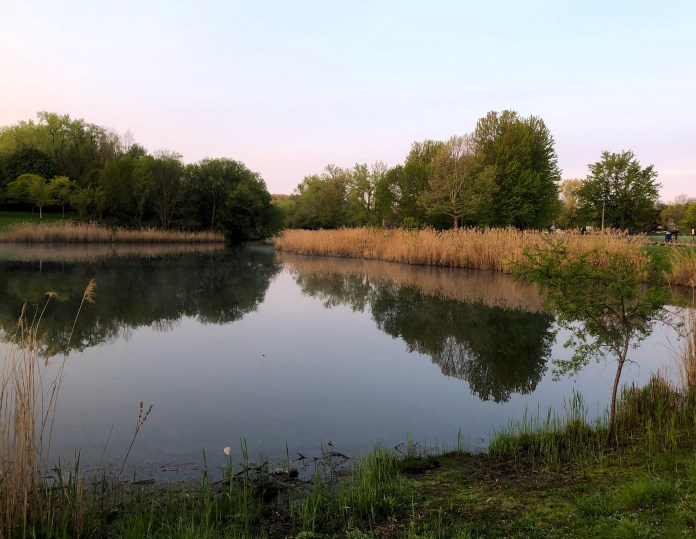
A few years ago, I took an iPhone photo of a pond near Barry Park, and I wonder if the same setting served as the inspiration for Wendy’s pastel landscape painting. Here’s my picture.

Pond near Barry Park by Francis DiClemente.

Distant Land (artist unknown).

Standard

Poecabulary Add Ons

For people in the Syracuse area, I’ll be doing a poetry reading and film screening this Saturday, Oct. 4., at 5 p.m. at Parthenon Books on Salina Street.

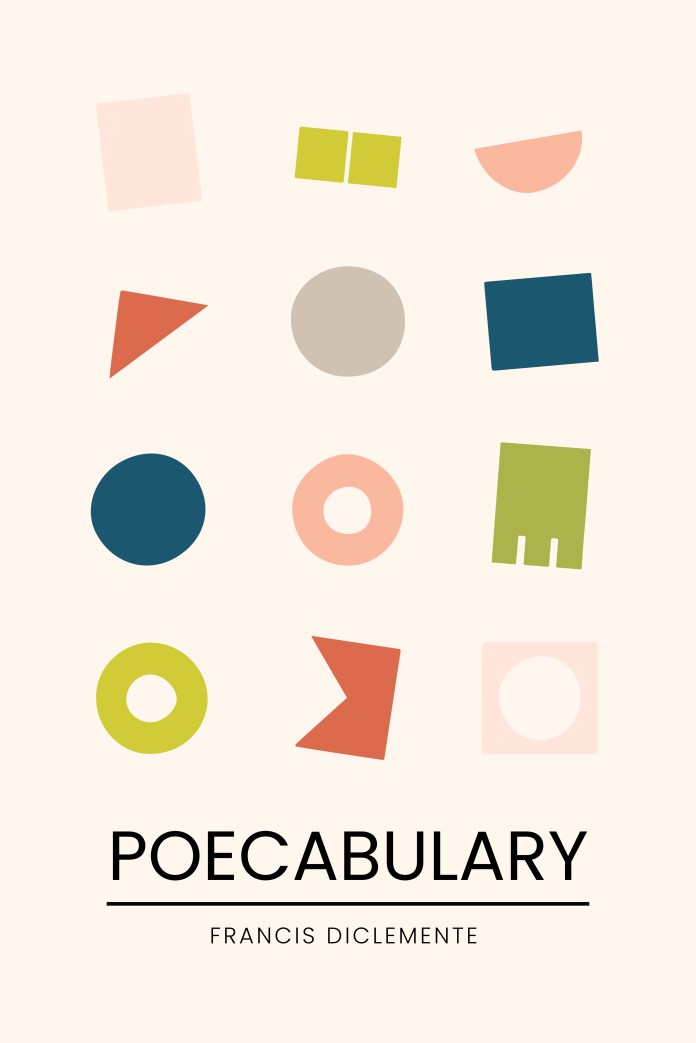
Poecabulary front cover.

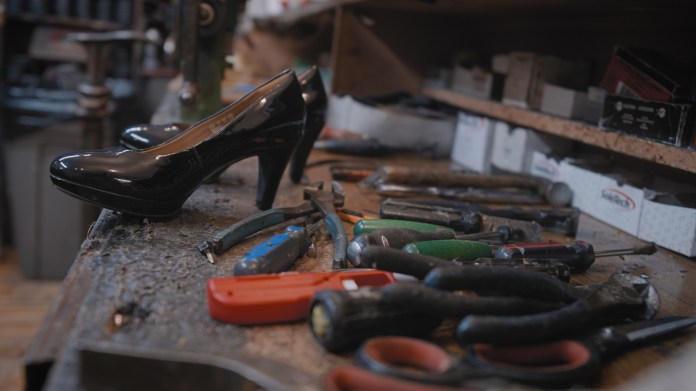
I’ll talk about the genesis and evolution of my minimalistic book project Poecabulary and then screen the documentary short Ralph Rotella: The Sole of Syracuse, co-directed by my former Syracuse University colleague Shane Johnson.

Ralph’s work bench. Photo Credit: Shane Johnson.

And speaking about Poecabulary, the book was released about three months ago. In preparing for the upcoming talk, I thought about a couple of questions I would like audience members (and you as well) to ponder: Do two words on a page constitute poetry? And can Poecabulary be considered an actual book, a real poetry collection?

And even though I succeeded in spitting these vocabulary words out of my system, I can’t stop writing down other word pairings. It’s a ceaseless literary project and an incurable disease.

So here are some other combinations that have emerged since the book’s publication in June.

Alfresco
Alfredo

Adversary
Anniversary

Ample
Amble

Below
Bowel

Cancel
Cancer

Death
Dearth

Density
Destiny

Erotic
Erratic

Fruitful
Futile

Garret
Garrote

Harass
Harness

Honor
Horror

Impotent
Important

Inventive
Invective

Manic
Magic

Monetary
Monitory

Parish
Perish

Passivity
Positivity

Revel
Revile

Share
Shame

Soap
Soup

Spared
Speared

Tragedy
Trajectory

Uncoupled
Uncounted

Vitreous
Virtuous

Wallet
Walleye

Widow
Window

Standard

Rilke on Autumn

Two poems for fall by Rainer Maria Rilke.

Autumn

The leaves fall, fall as from far,
Like distant gardens withered in the heavens;
They fall with slow and lingering descent.

And in the nights the heavy Earth, too, falls
From out the stars into the Solitude.

Thus all doth fall. This hand of mine must fall
And lo! the other one:—it is the law.
But there is One who holds this falling
Infinitely softly in His hands.

Rainer Maria Rilke.

Day in Autumn

After the summer’s yield, Lord, it is time
to let your shadow lengthen on the sundials
and in the pastures let the rough winds fly.

As for the final fruits, coax them to roundness.
Direct on them two days of warmer light
to hale them golden toward their term, and harry
the last few drops of sweetness through the wine.

Whoever’s homeless now, will build no shelter;
who lives alone will live indefinitely so,
waking up to read a little, draft long letters,
and, along the city’s avenues,
fitfully wander, when the wild leaves loosen.

Standard

For the First Day of Fall

Thought While Jogging

Can you hear the cries
of the leaves
carried on the wind
as they disengage
from the maple tree—
falling to the ground
and perishing in a pile?

This poem feels like a partner to “The Casualties of Autumn,” from November 2024, which you can find here.


Standard

Glimpses of Existence (2021)

My experimental documentary short Glimpses of Existence (2021) is now available for viewing on YouTube. I consider it a companion piece to Fragments of the Living (2015).

Glimpses of Existence is a zero-budget film in the form of video collage. Using scenes captured with an old iPhone—mostly during the pandemic—it attempts to find meaning in the mundane moments of our lives, seeking the extraordinary amid the ordinary.

The central focus of the film is my son, Colin, who is autistic. He’s nine years old now, but he was about five when this was made. Despite his condition, Colin finds joy in everyday activities, and through his eyes we recognize the importance of treasuring the tiny segments of life we are granted—minutes, seconds, hours—while being reminded about the transitory nature of existence.

Produced, Directed and Edited by Francis DiClemente.

Distributed by OTV – Open Television

Film Festivals:

2023: Official Selection in the Festival of Arts and Cinema, London
2022: Official Selection, Life is Short Film Festival, Los Angeles
2021: Honorable Mention, Global Shorts Film Festival, Los Angeles
2021: Official Selection, NewFilmmakers NY Short Films Program, New York
2021: Semifinalist, Official Selection, Blow-Up International Arthouse Filmfest, Chicago

Standard

Praise for Poecabulary

I’m not a fan of the promotional aspect of writing, but I want to share this positive review of Poecabulary because the Reedsy Discovery reviewer, Stephen Dudas, summarized exactly what I was trying to achieve with my wacky experimental book project. Nearly all of the time, I’m tossing words in the dark, hoping they find their way to readers. So it’s nice, and rare, when my stray verbal arrows hit the mark.

Poecabulary front cover.

Some of my favorite pull quotes:.

“Francis DiClemente’s Poecabulary is a stunning example of that now all-too-rare book in our contemporary poetry landscape: a genuine, focused experiment with specific elements of the English language.

“… Poecabulary is fully intended as a collaborative experience (all reading is, of course, but collaboration is at the forefront of this particular collection). To read the collection is to be brought into a creative and intellectual game. What is similar? What is different? What does one word mean to the other? What arguments, stories, commentaries, dreams, songs, etc. might spin out from where these words meet?

Poecabulary does what any good poetry collection should—it offers itself up as the site of interactive play between a poet’s invitation and a reader’s interpretation.”

—Reviewed by Stephen Dudas, Reedsy Discovery


Standard