In celebration of National Poetry Month, I am running a free Kindle promotion for my poetry book Outward Arrangements. It starts today and ends on April 6. Here is the direct link.
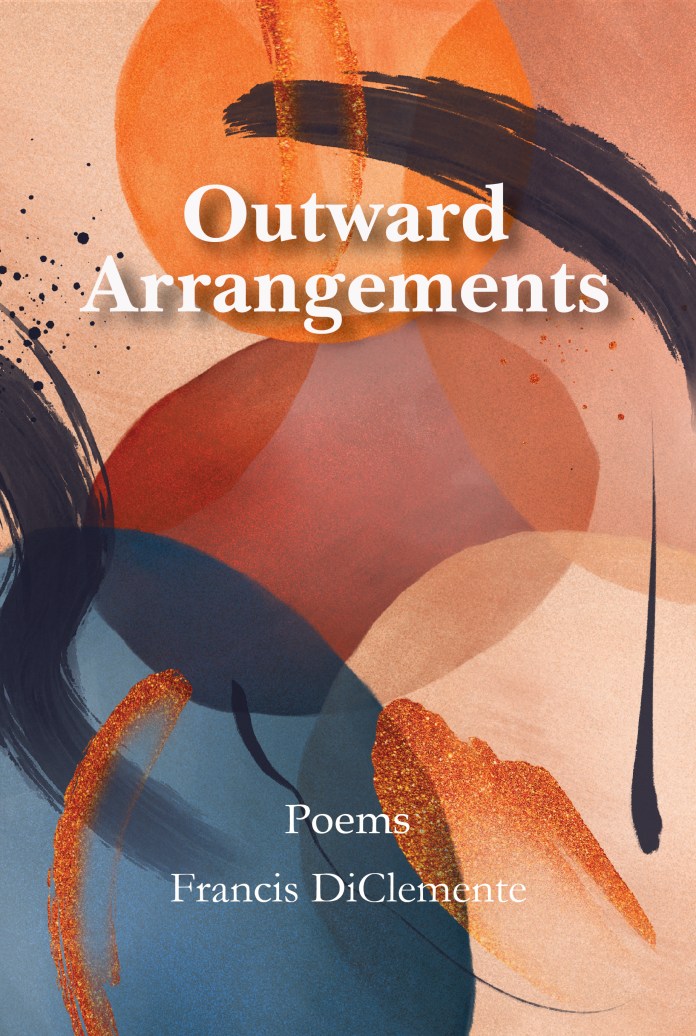
Outward Arrangements Cover
In celebration of National Poetry Month, I am running a free Kindle promotion for my poetry book Outward Arrangements. It starts today and ends on April 6. Here is the direct link.
Outward Arrangements Cover
It’s been too long since my last entry. I’ve been busy with work, family, creative side projects and a recent bout with a stomach flu (now resolved).
Winter has given way to spring-like weather in Central New York, although I’m not hauling my winter coat to the dry cleaner just yet.
And I wanted to return to the blog because today I made some interesting visual discoveries that I wanted to share. I left my cubicle at the office this afternoon to join one of my colleagues on a B-roll video shoot at Shaffer Art Building on the campus of Syracuse University. Some College of Visual and Performing Arts’ students were working on a professional film shoot for a project written and directed by a VPA professor.
While I stood in the hallway, I took notice of my surroundings and captured these images.
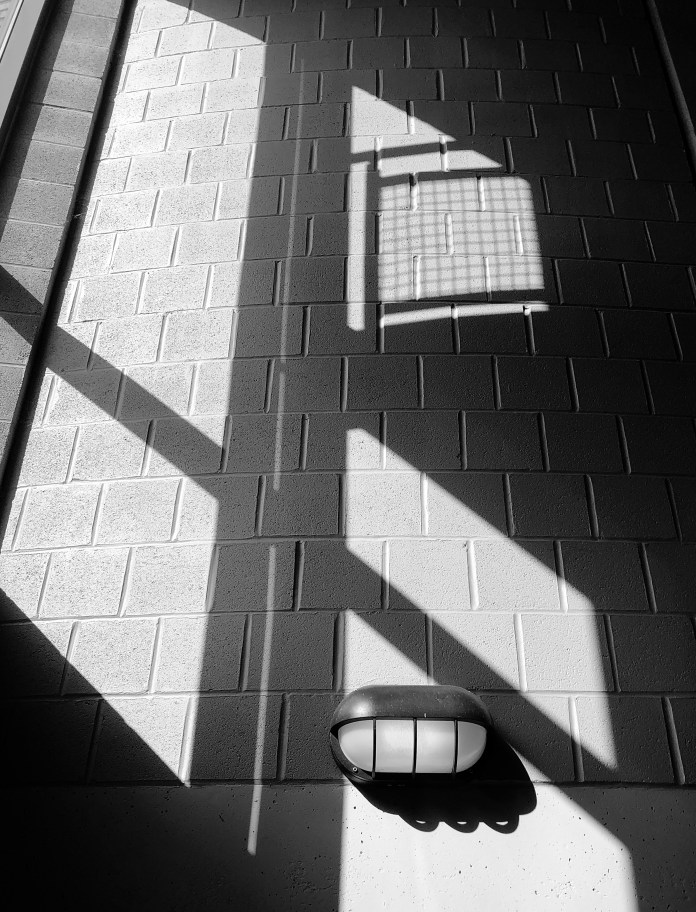
Light hitting wall. Photo by Francis DiClemente.
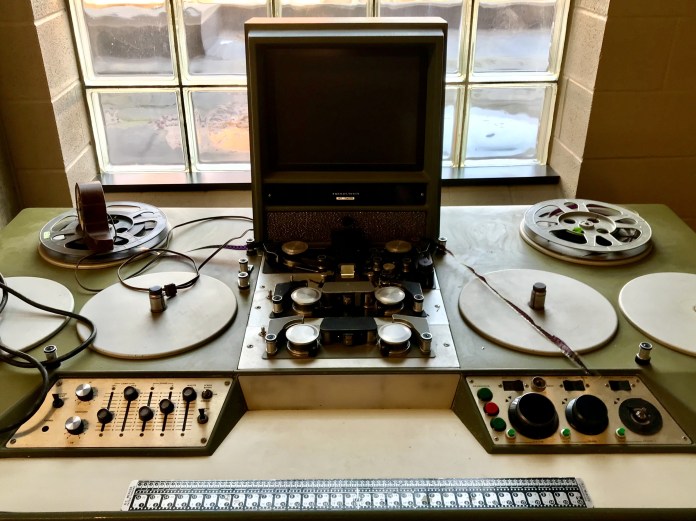
Steenbeck. Photo by Francis DiClemente.
I was so excited to see this Steenbeck editing machine. It made me think of Martin Scorsese’s longtime editor, Thelma Schoonmaker. I’m sure she edited some projects on a Steenbeck. I actually used one when I was a graduate film student at American University in the early 1990s. The machinery is now a dinosaur in a non-linear, Adobe Premiere/Avid/Final Cut world.
The next two images were terse, profound statements that I consider poetry. The words made me stop, pay attention and ponder their meaning. I wish I had the author’s name to give proper credit and supreme praise.

Selfishness and Loneliness. Photo by Francis DiClemente.
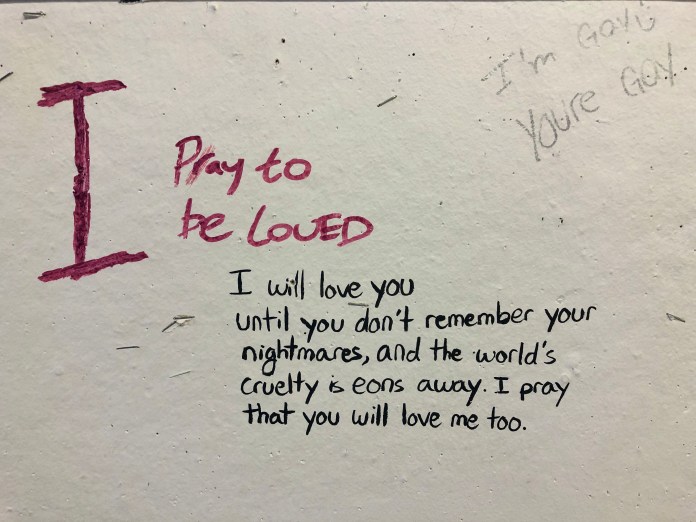
Pray to be Loved. Photo by Francis DiClemente.
I went out for my first real walk since testing positive for COVID, after completing the required isolation.

Branches, sky and building. Photo by Francis DiClemente.
I’m still not at 100 percent, but on this Sunday I was grateful for the combination of sun, sky, snow, air in lungs and limbs moving freely. I’m also thankful I didn’t slip and fall on the sidewalks packed down with ice and snow, resembling a Lake Placid luge track. I’m not taking any days or moments for granted.
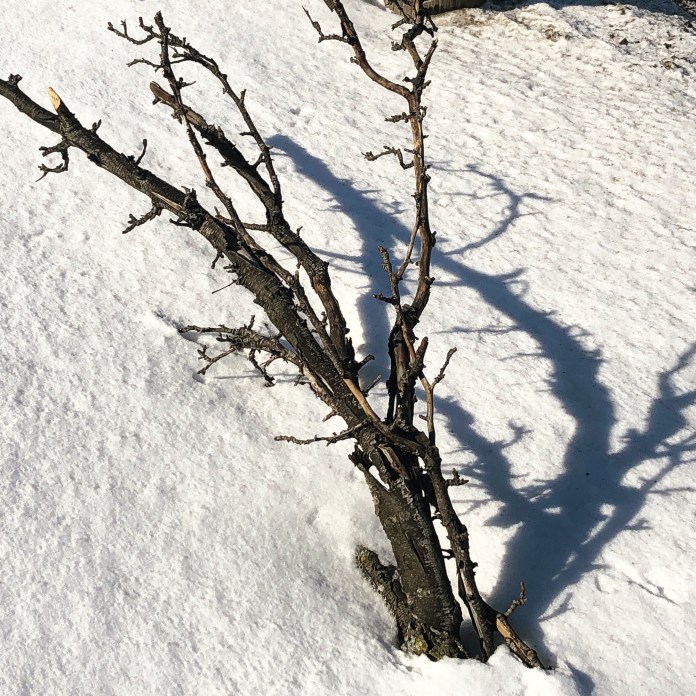
A stick in the snow. Photo by Francis DiClemente.
I thought the large-scale photo of Bruce Springsteen hanging in front of me was a good omen when I stepped in a “spit stall” in the Carrier Dome on Friday to conduct my PCR saliva test.
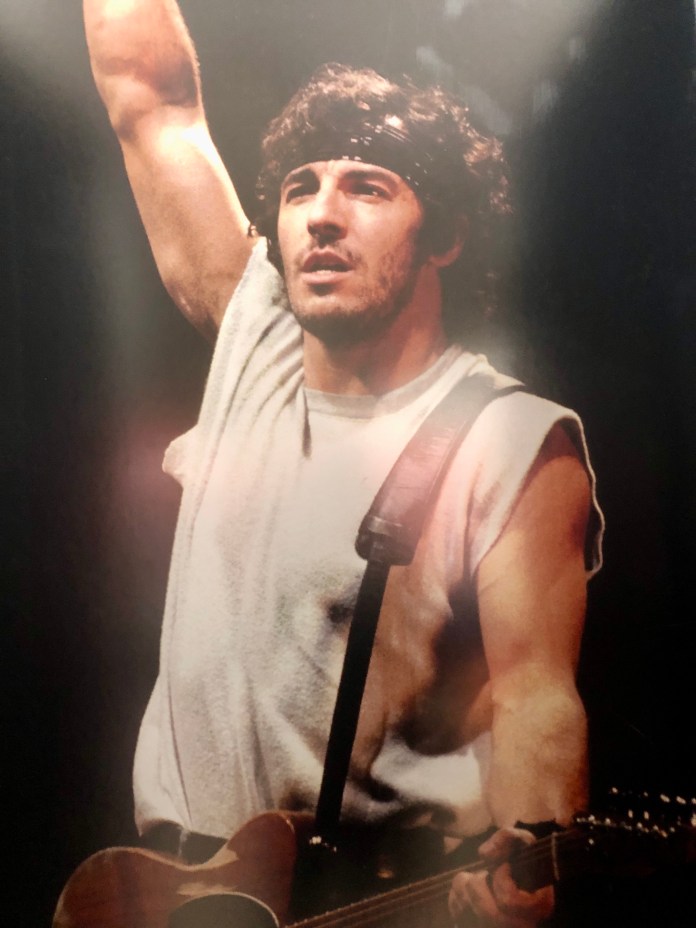
Photo of Bruce Springsteen from a past concert in the Carrier Dome (likely 1985).
Images of rock legends like Bono, Phil Collins, and Mick Jagger—action photos from past concerts—hang on the walls in the concourses in the Dome. So being a huge Springsteen fan, I thought the Boss would bring me some good luck, resulting in a negative COVID-19 result.
For the saliva test, one of the workers gives you a plastic tube marked with a black Sharpie line—the point you need to reach with your spittle for the test to be accurate. I’ve taken the test about a half-dozen times now, and I have developed a routine for generating the copious amount of saliva required.
I rock on the balls of my feet, pretending I am former Yankees slugger Reggie Jackson getting settled in the batter’s box, and then I spit between my teeth as Reggie used to do after fouling back a pitch. And if I’m really having trouble with dry mouth, I imagine I am sucking on a lemon with the seeds squirting into mouth, or else eating a huge, juicy piece of watermelon at a Fourth of July picnic.

Reggie Jackson batting at Yankee Stadium. Photo by Jim Accordino via Wikipedia.
But forgive my banal digression. The important news: unfortunately, I received a university email yesterday informing me that I had tested positive for COVID-19. As a result, I have started my isolation according to the guidelines set forth by the Onondaga County Health Department. I may need a longer isolation period because I am considered immunocompromised.
My son Colin had tested positive earlier in the week, and although I had stayed masked around him, our proximity in a one-bedroom apartment made avoidance of infection nearly impossible. As of this blog entry, my wife Pamela remains negative.
On Friday I had felt a little weakness in my legs. Occasional fatigue and muscle weakness are not uncommon for me, since I have hypopituitarism, rheumatoid arthritis, and hyponatremia (low sodium). But I thought I should get tested to rule out COVID.
So far, my symptoms are mild—slight headache, weak legs, and mild nasal and chest congestion. I’m taking Tylenol and have doubled my dosage of hydrocortisone, since my adrenal glands don’t produce the steroid hormone. But with my underlying conditions, I need to be hyper vigilant about any changes in my health, with the most alarming being shortness of breath and elevated heart rate, according to my primary care doctor.
The reality of testing positive has wiped away the lingering fear of the unknown we have all lived with each day since this pandemic began. My questions about avoiding COVID and about the severity of its impact are meaningless. The invasion succeeded; the likely variant of Omicron now squirms inside my body. But now I can deal with the actual manifestation of coronavirus, instead of worrying about the “what-if” scenarios.
I can say one other thing about COVID. It certainly prioritizes your existence, what you value most in your life. I think for most people it’s personal health and the health and safety of family. That sometimes gets lost amid the daily pressures of work.
And there is one benefit of testing positive—now I don’t need to avoid kissing and hugging Colin.
So my Emmy statuette arrived yesterday. My Real Bedford Falls documentary co-producer/director Stu Lisson was kind enough to drop it off at my apartment. He wanted to take a picture of me unboxing it, but I refused to give in to his request. I was masked and stayed on the other side of the glass in the lobby, as my son Colin is currently in isolation after testing positive for COVID for the second time in three months. (Fortunately, his symptoms are mild—knocking on the wood of my forehead.)
While walking in the hallway, carrying the rectangular box, hugging it close to my torso, I had a flash; the package reminded me of a cremation urn, similar in size and shape. It gave me pause. The object marks one of the best moments in my career, but it also foreshadows a fate I can’t escape. Dark thought, I know.
Once inside my apartment, I opened the box and took a quick glance, making sure the text at the base was correct and my name wasn’t misspelled. I then tucked it in the back of my bedroom closet, behind extra belts, pairs of long underwear, summer shirts, and miscellaneous computer cables.
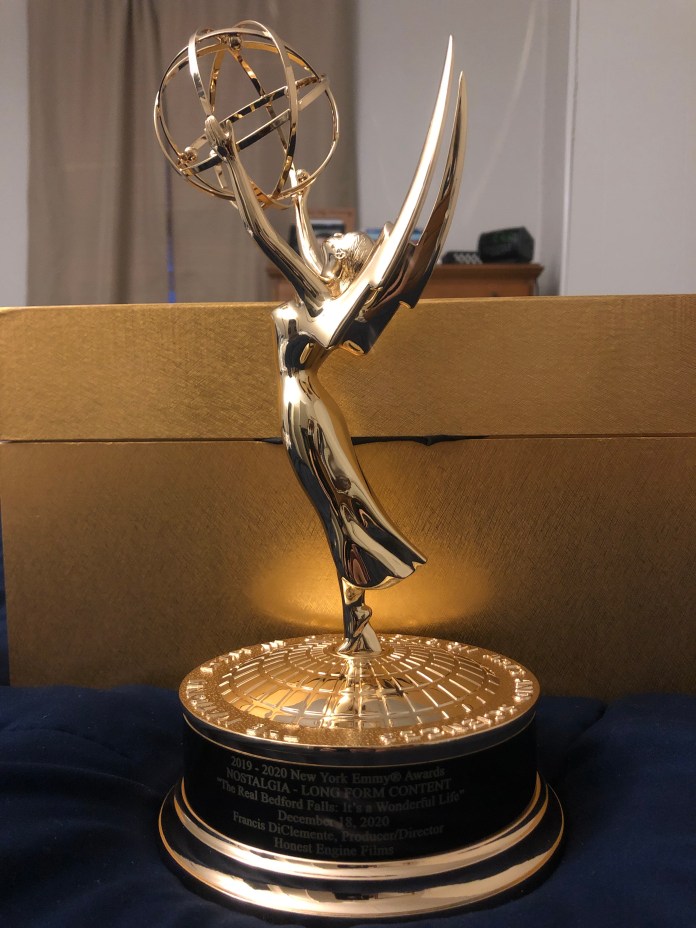
Emmy statuette. Photo by Pamela DiClemente.
I didn’t even take a picture of it. And I usually do not post accolades like this on social media. The images you see here were taken by my wife Pamela, who said something like, “It’s worth celebrating. It’s a beautiful memento and you might not win another one in the future.”
I thought the same thing. I don’t want to be covetous, but the goal is to collect a couple more Emmy awards during the remainder of my career. However, I also know one regional Emmy for an indie documentary short could be it for me—marking the highest honor I will ever achieve.

Emmy statuette base. Photo by Pamela DiClemente.
And if that’s the case, I want to acknowledge the moment, let it seep in, and be grateful for it. And then get busy working on the next thing.
I’m also storing the Emmy in the closet to keep it away from Colin. If know if the hardware was left out in the open, he would grab it and line it up next to his other figures. And in a matter of time, the poor gilded woman would be wingless.

Colin’s play area. Photo by Francis DiClemente.
It’s been a while since I’ve blogged. The holidays were very sad, as my stepfather, William Ruane, passed away on Christmas Day at Upstate University Hospital. He had broken his femur and then had a stroke after surgery. I’m still processing the loss.
I never called Bill “Dad,” but I considered him a second father instead of a stepfather. He played an instrumental role in my adult formation. I could write a lot more about this, but I don’t think I’d find the right words now to express how much Bill meant to me.
So I thought I’d repost an essay from 2013 that was published in Star 82 Review. I remember Bill posing for some pictures while sitting at the kitchen table, and I think this essay captures a little of his spirit.

Bill smoking. Photo by Francis DiClemente.
Man in the Chair
It is late in the afternoon on a fall or winter day, and I am visiting my mother and stepfather at their home in Rome, New York. They are sitting in their family room watching TV; if I had to guess, I’d say the show is Judge Judy, Criminal Minds or NCIS.
My stepfather Bill, who owns his own contracting business, is reclining in his favorite chair, wearing a work-stained hoodie and sipping a cup of coffee. I walk into the room and sidle up to him. I put my hand on the bald crown of his head, which has a fringe of brownish-gray hair on the sides, and I feel the warmth emanating from his skull. Often when I do this, Bill will say, “God, your hand is freezing.” But he does not say anything, and I leave my hand on top of his head and take a glance at the television screen while darkness gathers outside the windows.
A sick realization makes me shudder. I pull my hand away because I recognize in the moment that the head of this man I love could, in a matter of seconds, be crushed with a baseball bat or cracked open with an ax blade. Blood could splatter against the walls, and he would slump over in the chair, inert.
And I think this not because I am homicidal or possess a desire to kill my stepfather. Quite the opposite. Fear sets in because I realize the man sitting in the chair, with a beating heart, functioning brain and sense of humor, could be gone in an instant. He could be animated in one moment and his breath snuffed out in the next.

Bill getting a haircut from George, a barber in Rome, New York. Photo by Francis DiClemente.
Most likely my stepfather will not be killed by a blow to the head or a tree crashing through the house. A heart attack, stroke or cancer will probably get him in the end. And while I already know this, I pause and allow this knowledge to sink in, so I will appreciate him better.
A year or two after this dark afternoon, my mother would lose her battle with cancer. And her death would remind me that we do not live life all at once. It’s not one big project we need to complete by a deadline or a trip to Europe you have planned for years.
Instead, we experience life in small doses, tiny beads of time on a string. And it helps to recognize them, to acknowledge you are present and alive even in the most mundane circumstances—while you are talking with co-workers in the parking lot before heading home for the day, running errands, doing laundry, baking a chocolate cake, tossing a football with friends, reading to your kids at bedtime. These are subplots that drive our stories forward. They are not exciting. They are not memorable. But they are part of our existence, and we must value them before they and we are gone.
So, after I pull my hand away from Bill’s head, I decide to sit on the couch next to my mother. She hates when people talk during a program because it distracts her, so I look at the screen even though I am not interested in the show, and I do not say a word. But during a commercial break, she mutes the sound with the remote control, and Bill and I converse about something. And I can’t remember the topic we discussed, and it doesn’t really matter.
What I remember is three family members spending an evening together.
Our independent documentary, The Real Bedford Falls: It’s a Wonderful Life, will be screened tomorrow, Dec. 11, in Seneca Falls, New York, as part of the It’s a Wonderful Life Festival. It will be shown at 1:30 p.m. at Trinity Church.

Drone photo by Chase Guttman.
Our film asks the question: Was one of the world’s most beloved motion pictures influenced by a small upstate New York town? The Real Bedford Falls: It’s a Wonderful Life is an Emmy Award-winning, half-hour documentary that explores the connections between Seneca Falls and Bedford Falls, the setting of the movie It’s a Wonderful Life.

Frank Capra, the movie’s Academy Award-winning director, was reportedly visiting relatives in Auburn, New York, when he stopped in nearby Seneca Falls to get a haircut. The barber who styled his hair recalled Capra asking many questions about the town, including, “What’s the story with that bridge?”
Fast forward to when actress Karolyn Grimes, who played Zuzu Bailey in It’s a Wonderful Life, saw Seneca Falls for the first time. With snow falling and holiday lights glittering, she exclaimed, “I’m in Bedford Falls!”
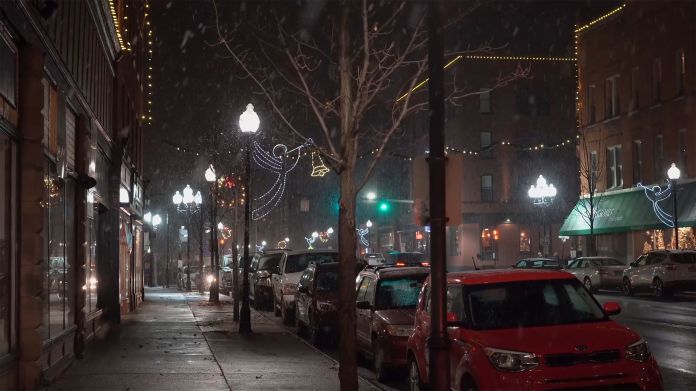
Photo by Stu Lisson.
These and many other striking relates are touched upon in The Real Bedford Falls: It’s a Wonderful Life. The documentary also examines small-town life in Seneca Falls, captures the excitement of the annual It’s a Wonderful Life Festival, and celebrates the enduring themes of the Frank Capra classic.
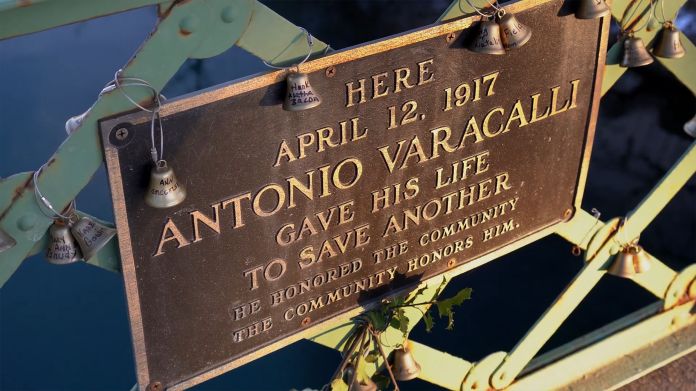
The Real Bedford Falls: It’s a Wonderful Life features interviews with Karolyn Grimes, Jimmy Hawkins (who played Tommy Bailey), Monica Capra Hodges, granddaughter of Frank Capra, film critic Leonard Maltin and Syracuse University professor of pop culture Robert Thompson. Former NBC Today show correspondent Bob Dotson provides the narration.
The film was produced by Honest Engine Films and distributed by Virgil Films & Entertainment. It’s available here. The cost is $2.99 on both Amazon Prime and Apple TV.
On this Thanksgiving Day, I’m thankful for not always getting what I want. I know, it’s such a corny, trite statement, and you can probably hear a Keith Richards guitar line in the back of your mind, along with Mick Jagger starting to sing, “I saw her today at the reception …”
But it’s true. In this case—I’m thankful for a little bonsai tree I bought for my wife for Mother’s Day. I ordered a pink azalea bonsai from an online florist, only to have the tree arrive with no pink azaleas. It looked like a dull green house plant devoid of color, and it presented no surprise when my wife pulled it out of the box. An online chat failed to resolve the matter, meaning no replacement or refund, and I had to live with the bonsai.
But then a strange thing happened. I began to care for it—setting it on top of a windowsill, exposing its branches to sunlight, using a measuring cup every morning to pour a generous amount of water on the soil and splashing droplets of water on its leaves with my fingers.
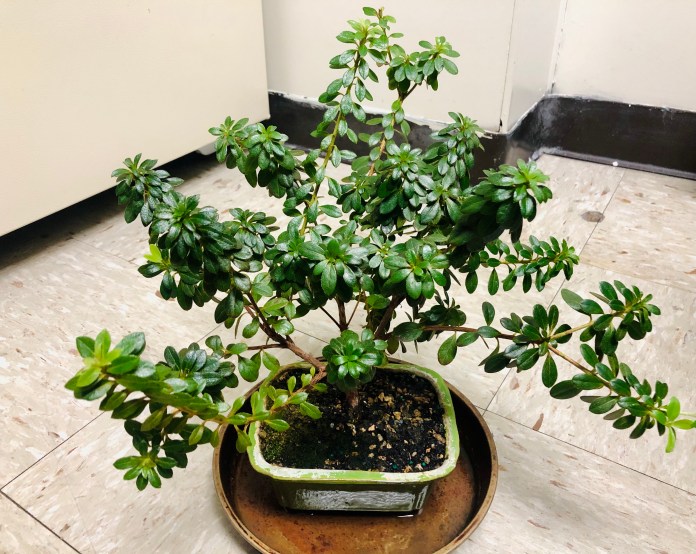
My bonsai tree. Photo by Francis DiClemente.
I gave the plant daily positive reinforcement before placing it back in its spot—saying things like, “You’re doing good. We’re proud of you. We love you. You’re a member of the family.” I also breathed on it, hoping my exhalation of carbon dioxide would help sustain the plant.
And the tree remains alive today. This is quite a feat, considering I’m no plant person. I have no green thumb. I don’t spend my summers tending to a garden of tomatoes, beans and corn in a vast plot of land in my backyard. I’m an urban apartment dweller.
But I am proud that six months after Mother’s Day, the little bonsai is still going strong. I’m grateful that it adds a little life to my drab existence. And I do believe if the bonsai had come with blooming pink azaleas, it would have been tossed out in the trash a long time ago.
I just want to share the news that our independent documentary The Real Bedford Falls: It’s a Wonderful Life is now available on DVD and digital HD. The film was produced by Honest Engine Films and distributed by Virgil Films and Entertainment. It recently won a New York Emmy Award in the category of Nostalgia-Long Form Content.

Here is the synopsis:
Was one of the world’s most beloved motion pictures influenced by a small upstate New York town? The Real Bedford Falls: It’s a Wonderful Life is an Emmy Award-winning, half-hour documentary that explores the connections between Seneca Falls, New York, and Bedford Falls, the setting of the movie It’s a Wonderful Life.

Aerial image by Chase Guttman.
The documentary examines small-town life in Seneca Falls, captures the excitement of the annual It’s a Wonderful Life Festival, and celebrates the enduring themes of the Frank Capra classic. The film features interviews with Karolyn Grimes (who played Zuzu Bailey in It’s a Wonderful Life), Jimmy Hawkins (who played Tommy Bailey), Monica Capra Hodges, granddaughter of Frank Capra, and film critic Leonard Maltin. Former NBC Today show correspondent Bob Dotson provides the narration.
The release of the documentary comes at the right time, as this year marks the 75th anniversary of the release of It’s a Wonderful Life.
On Friday night, I watched the 1931 film Frankenstein, starring Colin Clive and Boris Karloff. And Henry Frankenstein’s creature, called The Monster, played by Karloff, elicited my empathy as he jolted to life in a lightning storm with an abnormal brain incapable of functioning in society. I won’t relay the plot summary since the story is very familiar. And the movie version is much different from the novel it was based upon, Mary Shelley’s Frankenstein; or, the Modern Prometheus.

Frankenstein poster
But one scene stood out. In it, Karloff plays a game with a little girl, both of them tossing flowers into a lake. He then picks up the girl and throws her in, and she disappears below the surface of the water. Why? He doesn’t know any better.

Frankenstein movie still.
And the film made me think of my autistic son and about all disabled people. What do we do with humans who don’t live up to perceived standards of normalcy? Where do they go? Are they given a chance to function, to thrive, to pursue happiness, and to find a place in this world? I have no answers—just a desire to express kindness toward every person.
And the movie inspired a short poem.
Halloween Screening:
Frankenstein, 1931
You can’t fault
Frankenstein’s creature
For what he became.
He never had a choice.
He didn’t ask to be born.
He didn’t seek existence.
With an abnormal brain
And cobbled parts,
He can’t be blamed for
The terror he wrought.
He was only acting
According to his nature.
The real monster here
Is the man who
Created the creature.

 Francis DiClemente