Come On In! by Charles Bukowski

Over the weekend I finished reading Come On In!: New Poems by Charles Bukowski, and I felt a twinge of sadness when I returned the book to the library. I had enjoyed spending some evenings at home with old Buk.

Come On In by Charles Bukowski

Come On In by Charles Bukowski

Bukowski died in 1994 and the collection was published posthumously in 2006. Here we find the author facing old age, illness and death and never flinching. He presents several gems in the book—accessible poems packed with emotion. The tender, humane side of Bukowski is exposed, as if the onion skin had been peeled.

Charles Bukowski (Richard Robinson/Black Sparrow Press)

Here are four of my favorite works from the volume. I think they contain lessons for the living, as Bukowski seems to offer instructions as we face our own demise.

moving toward the dark

if we can’t find the courage to go on,
what will we do?
what should we do?
what would you do?
if we can’t find the courage to go on,
then
what day
what minute
in what year
did we go
wrong?
or was it an accumulation of all the years?

I have some answers.
to die, yes.
to go mad, maybe.

or perhaps to
gamble everything away?

if we can’t find the courage to go on,
what should we do?
what did all the others
do?

they went on
living their lives,
badly.
we’ll do the same,
probably.

living too long
takes more than
time.

###

no leaders please

invent yourself and then reinvent yourself,
don’t swim in the same slough.
invent yourself and then reinvent yourself
and
stay out of the clutches of mediocrity.

invent yourself and then reinvent yourself,
change your tone and shape so often that they can
never
categorize you.

reinvigorate yourself and
accept what is
but only on the terms that you have invented
and reinvented.

be self-taught.

and reinvent your life because you must;
it is your life and
its history
and the present
belong only to
you.

###
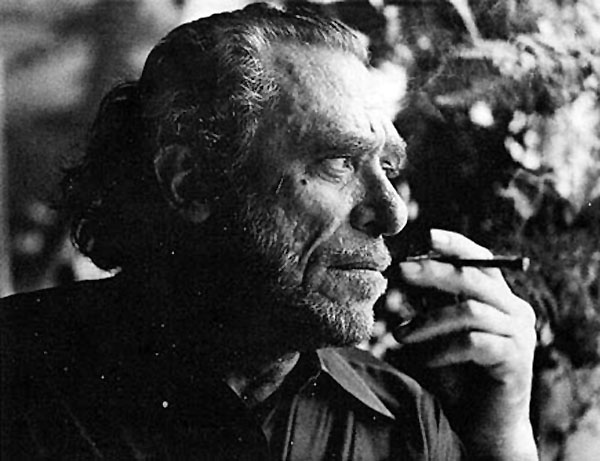
Charles Bukowski

Charles Bukowski

my song

ample
consternation,
plentiful
pain.

restless days
and
sleepless nights

always fighting
with all your
heart and soul
so as not
to fail at living

who could ask
for anything
more?

###

mind and heart

unaccountably we are alone
forever alone
and it was meant to be
that way,
it was never meant
to be any other way–
and when the death struggle
begins
the last thing I wish to see
is
a ring of human faces
hovering over me–
better just my old friends,
the walls of my self,
let only them be there.

I have been alone but seldom
lonely.
I have satisfied my thirst
at the well
of my self
and that wine was good,
the best I ever had,
and tonight
sitting
staring into the dark
I now finally understand
the dark and the
light and everything
in between.

peace of mind and heart
arrives
when we accept what
is:
having been
born into this
strange life
we must accept
the wasted gamble of our
days
and take some satisfaction in
the pleasure of
leaving it all
behind.

cry not for me.

grieve not for me.

read
what I’ve written
then
forget it
all.

drink from the well
of your self
and begin
again.

Bukowski, Charles. Come On In!: New Poems. New York: Ecco (An imprint of HarperCollins Publishers), 2006.

Standard

Poetry Pals

I can’t seem to get enough of writer Charles Bukowski these days.

Charles Bukowski

Charles Bukowski

I recently finished reading his novel Hollywood, a fictionalized account about Bukowski’s experience writing the screenplay for the movie Barfly.

I then ran out to the library and checked out two poetry books by Bukowski—The Flash of Lightning Behind the Mountain: New Poems and Come On In!: New Poems.

I don’t even read much poetry but I felt I needed more Bukowski books in the house, like I wanted to keep my friend around for a while. Bukowski seems less like a deceased author and more like a buddy spending his vacation with me. When I’m engrossed in a Bukowski work, I often picture him sitting in my living room and reading aloud from his book while taking sips of beer from a can of Pabst Blue Ribbon or Miller High Life.

Anyway, that’s just a fleeting image. The writing speaks for itself. And I’ve only read up to page 57 in The Flash of Lightning, but here’s a poem I found worthy of sharing. I hope you enjoy it too.

Born Again

this special place of ourselves
sometimes explodes in our
faces.
I got a flat on the freeway yesterday,
changed the right rear wheel on the
shoulder,
the big rigs storming by,
slamming the sky
against my head and
body.
it felt like I was clinging to the
edge of the earth,
30 minutes late for the first
post.

but strangely, something
about the experience
was very much like emerging reluctantly
a second time
from my
mother’s womb.

Bukowski, Charles. The Flash of Lightning Behind the Mountain: New Poems. New York: Ecco (An imprint of HarperCollins Publishers), 2004.

I also ran across an old interview with Bukowski in the New York Times in which he discusses his style of writing and being a lucky late bloomer.

Standard

nobody but you

Over the weekend I finished reading Sifting Through the Madness for the Word, the Line, the Way, a book of poems by Charles Bukowski.

One of the last poems in the book, nobody but you, serves as a punctuation mark and a pep talk from the late author to all human beings.

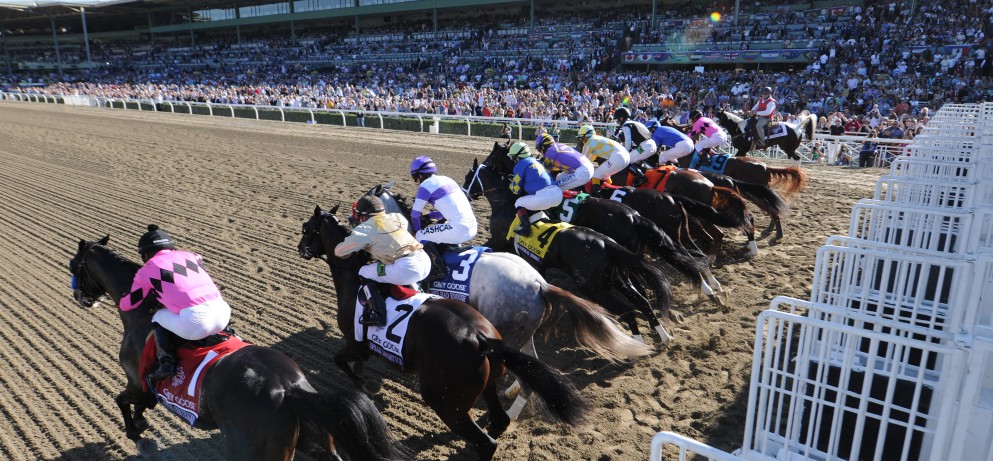
After reading it, I imagined Bukowski, an avid horse racing bettor, standing up in the grandstand at Santa Anita Park in Arcadia, California.

Santa Anita Park in Arcadia, California.

Santa Anita Park in Arcadia, California.

I pictured him holding a microphone and shouting the words of the poem to the people around him and the crowd below.

He would say: “OK listen up, this is what I have to say. I’m only gonna say it once.”

And in a rough voice he would recite his poem:

nobody but you

nobody can save you but
yourself.
you will be put again and again
into nearly impossible
situations.
they will attempt again and again
through subterfuge, guise and
force
to make you submit, quit and/or die quietly
inside.

nobody can save you but
yourself
and it will be easy enough to fail
so very easily
but don’t, don’t, don’t.
just watch them.
listen to them.
do you want to be like that?
a faceless, mindless, heartless
being?
do you want to experience
death before death?

nobody can save you but
yourself
and you’re worth saving.
it’s a war not easily won
but if anything is worth winning then
this is it.

think about it.
think about saving your self.

your spiritual self.
your gut self.
your singing magical self and
your beautiful self.
save it.
don’t join the dead-in-spirit.

maintain your self
with humor and grace
and finally
if necessary
wager your life as you struggle,
damn the odds, damn
the price.

only you can save your
self.

do it! do it!

then you’ll know exactly what
I am talking about.

Bukowski, Charles. Sifting Through the Madness for the Word, the Line, the Way. New York: Ecco (An imprint of HarperCollins Publishers), 2003.

After receiving thunderous applause, Bukowski would say, “That’s it. Enough poetry for today. I need to go make an exacta bet—six and four in the fifth.”

He would drop the microphone and head toward the betting windows, getting lost in the crowd of other patrons. It’s a fitting image since the man is gone but his words remain with us.

Standard

Sandburg Serendipity

While roaming through the stacks on the fifth floor of E.S. Bird Library at Syracuse University—in search of J.D. Salinger’s Franny and Zooey—I came across a green, hardcover volume of Chicago Poems by Carl Sandburg.

Chicago Poems by Carl Sandburg.

Chicago Poems by Carl Sandburg.

I pulled the book off the shelf and cracked it open, turning randomly to page 116. There I found the poem Under the Harvest Moon. Sandburg’s words seem fitting as classes at SU resume and summer gives way to fall.

My favorite part of the poem is the phrase, “flagrant crimson lurks in the dusk of the wild red leaves.”

I thought I would share the text of the poem with you, and I hope you find the words as meaningful as I did.

Under the Harvest Moon

UNDER the harvest moon,
When the soft silver
Drips shimmering
Over the garden nights,
Death, the gray mocker,
Comes and whispers to you
As a beautiful friend
Who remembers.

Under the summer roses
When the flagrant crimson
Lurks in the dusk
Of the wild red leaves,
Love, with little hands,
Comes and touches you
With a thousand memories,
And asks you
Beautiful, unanswerable questions.

Sandburg, Carl. Chicago Poems. New York: Henry Holt and Company, 1916.

Standard

HWA Poetry Showcase

One of my poems, Exorcism, appears in the Horror Writers Association’s Poetry Showcase Volume I.

HWA Showcase Book Cover

HWA Showcase Book Cover

The anthology is now available on Amazon as a Kindle e-book.

And here is the poem:

Exorcism

At 4:31 a.m. a dream startles you.
They were sucking the air
out of your chest cavity.
Sister Theresa always said to watch out
for the demons lurking around you.

Sweat drenches your forehead.
You get up and move toward the kitchen.
A bullet hole of light pierces the living room.
You look through the eyepiece in your apartment door.
No one is there on the doorstep ready to break in.
But this knowledge does not reassure you.

You open the refrigerator door
and take a gulp of orange juice straight from the carton.
No demons are hiding inside the fridge,
just restaurant leftovers in a Styrofoam take-home box.

You collapse briefly on the couch,
staring at the color bars on the television set.
And then you suspect the demons have arrived
via the electronic hearth.

After washing your face with cold water,
you look in the mirror.
A shadow moves quickly behind your reflection.
You turn around, but it has already vanished.
The demons are closing in now.

You leave the overhead light on while curling up in bed.
You are still afraid to close your eyes.
You stare at the ceiling and then at the crucifix
hanging on a nail above your bed.
Then you hear Sister Theresa’s voice.
It is frail, barely a whisper,
but you understand what she says:
“Sleep now child, for you must fight later.”

“But what about the demons?” you ask.
“It’s too late,” she says.
“They’ve already built their nest
in the catacombs deep inside you.”

Standard

Three more gems from Broken Lights

I finished the 1920 poetry book Broken Lights: A Book of Verse by Glenn Hughes, which I mentioned in my last post.

In spending some time with the book, I inspected the library checkout card and was amazed to discover it  was first taken out of Syracuse University Library on September 2, 1926. I find it exciting to think that more than 85 years ago someone else was flipping through the same pages and reading the same poems. The last date stamped on the card is June 7, 1932. And another stamp on the first inside page reads, “STORAGE 28 JUL ’65 J F.”

There are several beautiful poems in the collection, but three short works that appear on consecutive pages (56-58), a literary triptych if you will, struck me the most. The first two seem dark at first but both end on a positive note. They also employ an alternating rhyming pattern. Here are the three poems:

RETROSPECT

God knows what dreary stretches lie
In the vast regions of my heart—
Bleak places where all flowers die,
And birds flee from wind’s keen smart.

But this I know: though desolate
Such of my heart’s dark spaces be,
Fair fields there are, inviolate,
Glowing and warm with love of thee.

REPLY

“Life—what is life?” I asked the world,
The world did not reply;
Its bitter lip with scorn was curled,
And mocking was its eye.

But then you came, and now I stand
From the grim world apart;
For life was in the soft white hand
You laid upon my heart.

SONG OF SORROW

The songs I made for you are dead,
For the aching of my heart has drowned their melody,
It is the winter of our love,
And the rose leaves that were scattered in the summer
Lie black and scentless on forgotten paths.

Ah, desolate, desolate with nameless yearning
In my heart that was so light in other days,
And somewhere in a garden,
Where a bird is singing in the sunshine
I can see you sitting, weeping,
With your gold hair all about you,
And a beautiful, deep sorrow in your eyes.

(Hughes, Glenn. Broken Lights: A Book of Verse. Seattle: Department of Printing, University of Washington, 1920. Print.)


Standard

A Jewel in the Stacks

I went to Syracuse University’s Bird Library to pick up two novels I hope to read over the summer: Shirley Jackson’s The Haunting of Hill House and The Killing Man by Mickey Spillane. But as is often the case when I am roaming through the aisles on the fifth floor of the library, another book caught my attention. It’s a slim volume of poetry titled Broken Lights: A Book of Verse by Glenn Hughes, published in 1920. I pulled the rust-colored book off the shelf and flipped it open randomly, stopping on page 68, where I found the poem Dakota Night. As I read the poem, the words stirred my imagination, making me feel like I was standing in a knee-high field of grass surrounded by a bowl of stars.

DAKOTA NIGHT

Was ever such a night for stars
Above this silent prairie land,
Where lonely years have left their scars
In rocky buttes that darkly stand
Against the liquid film of night
So richly flecked with golden light!

There is a peace here, native, strong,
That lies upon this rolling waste
As though the gods had labored long
And, wearying, had turned to taste
The joy of dreamless sleep.  No breath
Is heard.  It is a peace like death.

Yet hark!  A murmur on the hill!
The wind among the grasses wakes;
A cricket strums and then is still.
How sweet the music that night makes!
Starlight and quiet once again
On lonely butte and barren plain.

(Hughes, Glenn. Broken Lights: A Book of Verse. Seattle: Department of Printing, University of Washington, 1920. Print.)

I found an online story about Glenn Hughes, or at least I believe it’s the same Glenn Hughes who penned Broken Lights.

And this incident proves why books on paper will always possess more allure to me than e-books. Bound volumes hold tactile power; the way they look, feel and smell invite the reader to explore the space sandwiched between the front and back covers. My literary find also makes me wonder how many other interesting books are just waiting to be discovered on the library stacks.

You can read Broken Lights online for free.

Standard

In Pursuit of Infinity Chapbook Forthcoming

Two of my poetry collections are now available. The first, entitled Vestiges, was released in November by Alabaster Leaves Publishing. And advance sales for the second book, In Pursuit of Infinity, by Finishing Line Press, are underway and will continue until Dec. 28. The release date for the book is scheduled for Feb. 22, 2013. Pre-publication sales will determine the press run, and so if anyone is interested, you can order the chapbook online. Thanks for taking the time to read this. I appreciate it. Below you’ll find some excerpts from Infinity.

Dreaming of Lemon Trees

I dream of words
I strive to recapture
When I awaken in the morning.
I dream of stories with endings unknown,
Vibrant scenes imagined in my sleep—
A Degas ballerina alone in her dressing room,
A wagon train backlit on the horizon,
A hummingbird dancing on the windowsill,
And a lemon tree in the church courtyard in mid-afternoon.
Wherever I go in my dreams,
The air is balmy and sunlight abundant.
Trees sway and the scent of evergreen finds its way to my nose.
I dream because when this tired body hits the mattress,
It relaxes, then releases and gives up its earthly weight.
My eyes close and I sink to the deep recesses of my mind,
Setting the subconscious free.

Morning Coffee

My mother sits
in the kitchen chair
after she recites
her morning prayers.
Sunlight streams through
the lace curtains
and cigarette smoke
is suspended in the air.
She bows her small head
and presses her fingers
to the bridge of her nose,
as she contemplates
the chores for the day,
while her milky coffee cools
in a blue ceramic mug,
resting within reach
on the laminate counter.

The Shed

Independence Day, 1979 (Rome, New York)

Whipped-cream clouds smear a powder blue sky,
while Grandpa nurses a carafe of Chianti
and dreams of waltzing down Bourbon Street.
The DeCosty family gathers on the patio,
with Uncle Fee roasting sausage and peppers
and Nana dribbling olive oil over fresh tomatoes,
then adding alternating pinches of basil and parsley.

Inside the backyard bordered by overgrown hedges,
the rambunctious cousins wham Wiffle balls
with a thin banana-colored plastic bat,
evoking the hollers of Grandpa . . .
who watches out for his mint-green aluminum shed,
situated perfectly in left-center field—serving as our own Green Monster.

And when we get ahold of that little white ball,
it smacks up against the aluminum obstacle,
clashing like two marching band cymbals in a halftime show.
And with sweat coursing down his neck,
Grandpa barks out his familiar line under the patio awning:
“Son of a bitch . . . keep that goddamn ball away from my shed.”
But Nana is always on our side,
and cancels out his power and keeps him in check.
“Fiore, you let those kids play and mind your mouth,” she says.

Grandpa abandons his no-win cause,
turns up the volume on the Yankee game
and pours himself another glass of red wine.
He watches quietly as the shed stands erect in the late afternoon sun,
sacrificing its facade for our slew of ground-rule doubles.

The Bridesmaid

The most adorable pregnant bridesmaid ever
Waddles down the church’s center aisle,
Unable to hide her protruding belly.
And with her feet swollen,
Her lower back sore and forehead warm,
She endures the ceremony standing
On the altar beside the joyous couple.
But she nearly passes out while
Posing for pictures in the lakefront park.

Inside the reception hall,
She almost vomits at the sight
Of shrimp cocktail and chicken Florentine.
She orders hot tea and lemon from the top-shelf bar,
And dines on rolls and garden salad.
This single-mom-to-be, though not merry,
Offers a smile when others turn to stare,
And bobs her head to the music
As the guests hit the dance floor.

She nibbles on a sliver of white-frosted wedding cake,
And asks for guidance from her parish priest, wise old Father Meyer.
Then the bride overthrows the eager females huddled
Near the dance floor and the bouquet lands
Softly in the expectant mother’s lap.
Her face turns red as everyone looks at her.
So she just grabs the bouquet and throws it back.

Standard

New poetry collection published

It’s been a while since I’ve had time to write, as I was busy working on some video projects for the past couple of months.  But I am now happy to announce that my latest poetry collection, Vestiges, has been published by Alabaster Leaves Publishing.

This 58-page chapbook features both narrative and observational poems. And the book is available for sale on Amazon.com. Please do not feel pressured or obligated to purchase it, but I just wanted to provide the link in case anyone is interested.

And here are a few excerpts from the collection:

Father’s Day Forgotten

Daddy and Christi parted ways at a bus depot
In the early morning hours.
No big scene, just a kiss on the cheek,
Then she turned around and was gone for good—
Hopping aboard the Trailways bus headed westbound for Chicago.
And she never looked back.

Daddy went home to his beer bottle and sofa seat,
And he drew the living room curtains on the rest of the world,
Letting those four eggshell walls close in and swallow him up,
Wasting away in three empty rooms and a bath.

And the memories can’t replace his lost daughter and wife.
So he tries not to remember his mistakes
Or how he drove them away.
Instead he recalls Halloween pumpkins glowing on the front porch,
Training wheels moving along the uneven sidewalk,
Little hands reaching for bigger ones in the park,
And serving Saltine crackers and milk
To chase away the goblins that haunted
Dreams in the middle of the night.

Now Christi has a life of her own,
And she lets the answering machine catch
Daddy’s Sunday afternoon phone call.
She never picks up and rarely calls back.
So Daddy returns to the green couch
Pockmarked with cigarette burns.
He closes his eyes, opens the door to his memory vault
And watches the pictures play in slow-motion.
He rewinds again and again without noticing the film has faded
And the little girl has stepped out of the frame.

Man Versus Ant

an ant races
across the sidewalk,
intent on getting
to the grass
on the other side.
I face a quick decision:
do I step on it
or avoid its path?
better leave the ant alone,
I think to myself.
what if that’s me
in the next life?

Side Dish

A mundane scene of modern living
played out one evening
while I walked along Ninth Street
near East Grovers Avenue in north Phoenix.

I heard the sound of a sliding glass door
opening from behind a retaining wall
running parallel to the sidewalk.

And although I had
no intention of eavesdropping,
I then overheard a woman call out:
“And now the great vegetable debate, green beans or corn?”

The question evoked a few seconds of silence,
followed by a man’s reply:
“Uh . . . both,” he said.

And as I turned the corner,
heading up the next block,
I was tempted to stop and ask the couple,
“Hey, what else is for dinner?”

Perseverance

You can’t expect the world to fall in line for you.
You can’t will happiness or alter your existence by whim.
You have to accept you are not in control.

Work and sleep.
Sleep and work.
Monotony and solitude.
You march on with stubborn persistence.

I believe there are other forms of bravery
Besides firefighters scaling burning buildings
And plucking toddlers from the top floor.
There is courage in accepting your condition,
Realizing you have fallen short,
But not quitting, not becoming bitter,
Not drinking yourself to death,
Or giving up and erasing your place in the world.

There is dignity in continuing to endure an unhappy life.
By making due and moving on,
You shine forth and elevate your humanity—
Even if no one notices or your situation doesn’t change.

Standard