Eight Weeks Later

Today marks two months since my transsphenoidal brain surgery to remove tumor regrowth. I’m happy to report I’m getting stronger every day. I’d say I’m about 80 percent back to normal. I have returned to work and jumped back into the maelstrom of marketing projects, deadlines, and responsibilities.

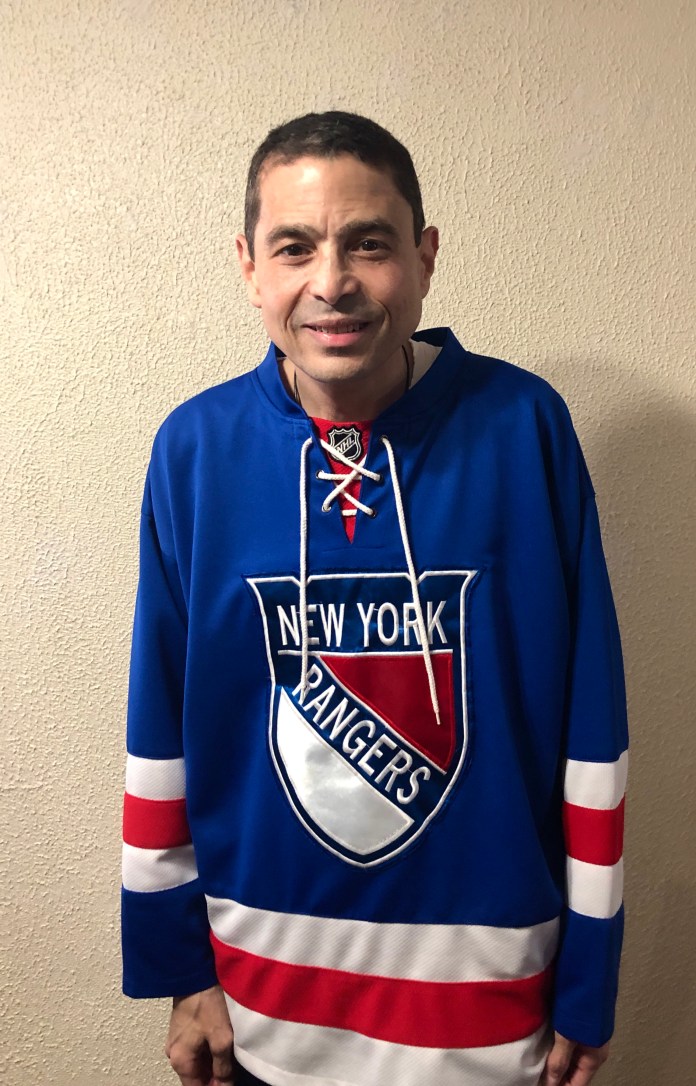
Eight weeks post-surgery.

My nose still throbs, and I needed a round of antibiotics for a recent infection of the cartilage. I had a follow-up appointment with the ENT surgeon; he mentioned it will take about three to six months for me to be fully healed—not surprising considering they rolled part of my septum and used it as a nasoseptal flap to patch where the cerebral spinal fluid leaked during surgery. But the good news—the seal at the back near the opening of the sphenoid sinus is holding.

My nemesis: the twice-daily nasal rinse bottle.

I still need to do twice-daily saline rinses and take Tylenol for the pain. I lifted “weights” yesterday for the first time in eight weeks—don’t laugh at my little five-pound dumbbells. I hope to resume heaving fifteen-pounders in a couple of weeks.

Hitting the “weights.”

Two songs have been repeating in my head during my recovery.

Elton John’s “I’m Still Standing.”

And Steve Winwood’s “Back in the High Life Again.”

And here’s a photo from a Walgreens: the gift of a beautiful sight revealed to me on a mundane Friday night.

Sublime sunset from a parking lot. Photo by Francis DiClemente.

Standard

Post-Surgery Update

I just wanted to give a quick update on my recovery. More than two weeks have passed since my brain surgery.

I had a follow-up appointment with my ENT surgeon yesterday. For the endoscopic debridement with suction, they stick a probe up your nose and suck out the junk, but I’ll spare you the gory, bloody details.

The last time I had this in-office procedure after the same transsphenoidal surgery in 2011, the surgeon maneuvered the probe too close to my brain stem and I suffered the worst headache of my life.

It felt like a gorilla had grabbed my head and shook my skull like a coconut—side to side and front to back—until my brain swished around and undulated on the waves of cerebral spinal fluid. I almost couldn’t drive myself home afterward.

Hence, I was anticipating a similar experience yesterday. But after Dr. A. performed the procedure, I had only a mild headache throughout the day and into the night.

He also saw no signs of a CSF leak, so I feel incredibly grateful. Although my right peripheral vision loss hasn’t improved yet, I am getting stronger every day and anticipate returning to work before the end of the month.

Thank you very much for the kind words and continued prayers—they are helping me!

Standard

Recovery Update

I never post pictures of myself, but I want to share this photo taken by my wife in our backyard. Eight days have passed since my brain surgery. I’m still a little wobbly, but I am getting stronger every day and trying not to strain myself.

Backyard photo. Credit: Pamela DiClemente.

I am also grateful for being able to soak up the sunshine—standing and breathing on my own. And I wish speedy recoveries for other people enduring health crises.

Thank you for your prayers and kind thoughts.

Standard

Post-Op Notes

Here’s a follow-up to my last post. It’s been less than a week since my surgery, so please excuse my scattered and fragmented thoughts.

A neurosurgery and ENT team at Upstate University Hospital removed a stubborn craniopharyngioma in a four-hour surgery earlier this week.

Upstate University Hospital (Photo by Francis DiClemente)

All test results and surgeons’ notes are posted to the MyChart patient portal, and I love the description of my surgery in ALL CAPS. It reads like poetry to me:

ENDONASAL ENDOSCOPIC TRANSSPHENOIDAL RESECTION OF TUMOR WITH NASAL SEPTAL FLAP

Before surgery, George, one of the neurosurgery residents, stepped into the pre-op room to get me to sign some consent forms. He scared the shit out of me when he ran through the complications—cerebral spinal fluid leak (CSF), bleeding, the need for a blood transfusion, stroke, and death. I thought, maybe I should just get out of bed, put on my clothes, leave the hospital, and let the tumor keep growing until it really messes up my vision.

But I overcame my fear and signed the consent forms. Then I met the anesthesia team, a nurse stuck me with a couple of IVs, and I was off to Fairyland.

I woke up in recovery feeling like only seconds had passed. The pain came in waves—going from zero to eight and centered around my forehead, above the bridge of my nose. I was given fentanyl and oxycodone, while a Foley catheter took care of my urine output.

The neuro team quizzed me: What’s your name? Do you know where you are? What year is it? At first, I said 2013, but then I added ten years to arrive at the correct year.

A parade of surgeons, residents, and interns entered my room in the hospital’s Neuroscience Intensive Care Unit, and someone told me they had encountered a CSF leak, but they patched it with cartilage from my nose. Dr. H., my primary neurosurgeon, said they scooped up most of the craniopharyngioma, but some calcium fragments adhered to structures and had to be left behind.

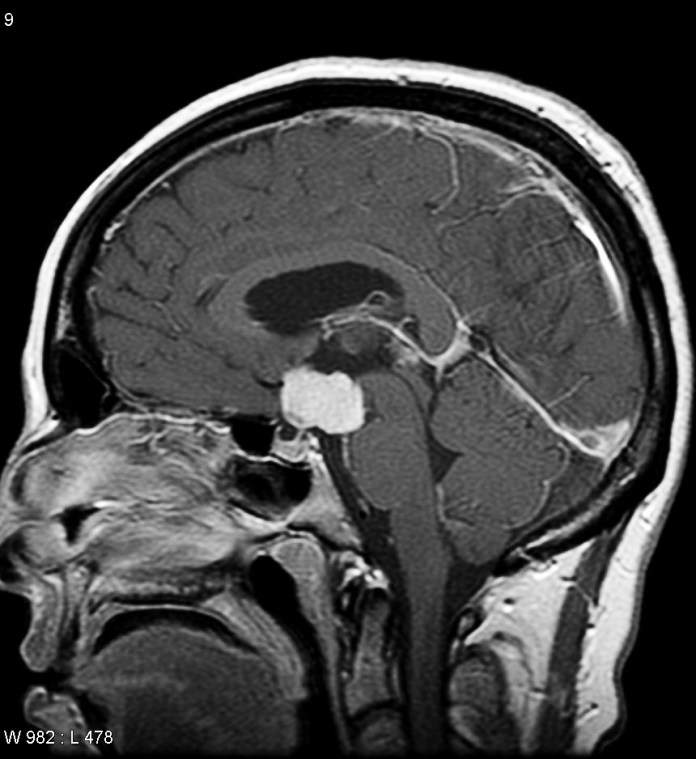
Craniopharyngioma example.

Lying in that hospital bed—humiliated from lack of privacy, with wires twisted around me, with my gown barely covering my naked body, tumid from the high dosage of corticosteroids—I felt like a wounded animal. After the surgical trauma, I now saw my body as simply an object—a machine that either functions or fails.

And I was now at the mercy of the fine nurses who treated me. I enjoyed my conversations with them, and most were serving as traveling nurses doing rotations at Upstate. And one side note: many of the nurses wore Hoka sneakers.

Because of my persistent headaches, I could not read, watch TV, or even look at my phone. With the wall clock ticking incessantly, I closed my eyes, prayed, and reflected on my life.

This was my sixth surgery if you count two Gamma Knife treatments. And since they didn’t get everything, I wondered, how soon will I be back? Will it be two, four, or ten years? How many surgeries will I need before death claims me?

But when I walked the floor on my second day after surgery, I passed other rooms with patients unresponsive and intubated, and deeper thoughts gave me solace. The words that kept coming to me were nothingness, fragility, and gratitude. I saw myself as a minuscule being with absolutely no control over my body or power to alter my existence. Death could come at any point. This is my fate and everyone’s fate. But I remained alive. I was still here.

And late in the afternoon, two days after surgery, I was discharged. While waiting to get a couple of prescriptions filled at the hospital pharmacy, I was wheeled to the Discharge Hospitality Center. Let me tell you, if you need to be in the hospital, that’s the place to go.

A nurse with blond hair, brown plastic-framed glasses, and wearing orange scrubs, greeted my wife Pam and me, asking us if we wanted a cup of coffee. “Sure,” we said. We enjoyed a cup of coffee and some Lorna Doone cookies while we waited, and I told the nurse that her room was a sanctuary.

Then, while waiting at the circular drive for Pam to pick me up, she asked me about my medical history. When I told her this was my sixth surgery, she expressed concern and said she was sorry I had such problems.

I said, “Yeah, but the thing is, you can’t change it, so you just deal with it. And every time I leave Upstate, I feel lucky that I can just walk and breathe.”

“Right, that’s true,” she said. “That’s a good way to look at it.”

At home, Pam told our autistic son Colin that “Daddy is sick and needs rest.” She put a note on our bedroom door—which has a lock—to remind him not to go inside. With his strong physical presence and his habit of jumping into our bed at night, we need to keep him away so he doesn’t whack me accidentally.

The post-op precautions include no nose blowing and drinking from straws. No straining or lifting more than five pounds. Sneeze with your mouth open and keep your head elevated at least thirty degrees. Pretty simple rules to follow.

I’ll keep you posted as my recovery progresses—slow healing, day by day.

Standard

Tumor Talk

I am undergoing another brain surgery on Monday morning. This marks the fourth time since my craniopharyngioma (benign brain tumor on the pituitary gland) first appeared when I was fifteen years old.

Image by the National Cancer Institute.

My last blast of Gamma Knife radiation in 2020 kept the tumor away, but subsequent regrowth began affecting my vision in the past two years. Another round of radiation could not be performed because the tumor sits only a millimeter away from the optic nerve. My radiation oncologist gave me the grim news that radiation presented a twenty-five percent risk of blindness.

So a neurosurgeon and an ears, nose, and throat surgeon at Upstate will team up for a transsphenoidal approach—meaning they would go through the nose to access the tumor. I had the same surgery in 2011, followed by a rough recovery where I stayed locked in my room for about a month, suffering from excruciating headaches. I have added concerns now because in 2011 I was on my own; now I have my wife and son to think about.

Image by the National Cancer Institute.

Anyway, I want to present a piece of experimental writing inspired by my tumor. I think this falls under the essay category, but it could also be considered fiction.

Tumor Talk: A Conversation with My Craniopharyngioma

“I’m back, baby!”

I heard those words in my head after my radiation oncologist discussed the results of my latest MRI. Dr. L. said my craniopharyngioma—a benign, slow-growth tumor at the base of the brain near the pituitary gland—had grown over the last two years, causing my recent double vision.

Dr. L. said the proximity of the neoplasm to the optic nerve and blood vessels meant radiation was no longer an option. I would need surgery.

“You must be pretty proud of yourself, Fred,” I said to my tumor friend resting inside my head.

“Oh, come on, man, don’t be like that,” Fred said. “You know this was inevitable. Us craniopharyngiomas are like the cockroaches of the tumor world. You know no matter what you do, we always come back. You think that weak-ass radiation was gonna work on me?”

Yes, my tumor has a name. Since he’s been residing inside me for so long, I figured we should at least be on a first-name basis.

And Fred was right. There’s no denying his Terminator instincts for coming back. He’s like Buster Keaton in The General. He keeps barreling down the tracks no matter what you do to him.

Fred first appeared in 1984 as a large tumor engulfing my pituitary gland. His removal led to hypopituitarism and diabetes insipidus (a disease affecting water and sodium balance).

Despite surgeries in 1984, 1988, and 2011, plus two blasts of Gamma Knife radiation, Fred continued to aggregate the tumor vestiges, scooping up the fragments and wrangling them into a well-formed regiment. I gotta give him credit for its spunk and resiliency.

But after leaving the medical office and waiting at the bus stop, I wanted to set some ground rules with Fred, to see if I could talk him down or at least minimize his impact.

“Why are you doing this to me again? Life has been pretty stable with my family. Why do you have to make trouble for us now?”

“Come on, man, get real. Don’t give me those bullshit questions. Why anything? Why do you breathe or drink water? Why does a horse gallop, a deer prance, a cat meow, or a goat bleat? Do I need to go on? I’m a fucking brain tumor.”

“So what if you’re a tumor? Can’t you control yourself? Can’t you stop growing?”

“Now you just sound naïve. I can’t be something other than what I am. And I have a clear objective. As a tumor, my job is to expand and invade. That’s it. That’s why I’m here on this planet.”

What could I say? I couldn’t offer any retort.

“Look, don’t be so glum. You’re in good hands with your doctors, and our history shows we both come out alive.”

“Yeah, but I wish you’d agree to leave.”

“Well if it’s any consolation, I do like where I live. You’re a good host. Don’t get me wrong, I’d prefer to be inside the head of some brilliant mathematician or a swimsuit model reclining on a beach. No offense. Look, you’re not a bad guy. But let’s not get carried away. You’re no fucking Einstein or Dave Chappelle. And frankly, I get a little bored with your prosaic thoughts.”

“Tell me how you really feel.”

“Oh come on, man. I’m just busting your balls a little bit, trying to cheer you up. Which reminds me—I thought of a theme song for our relationship. Come on, sing it with me:

“In your head, in your head,
Zombie, zombie, zombie-ie-ie-ie …”

“Very funny.”

“Come on, man, don’t be like that. We need to learn to live together. Look, I haven’t caused irreparable damage. Your brain functions, memory, and language processing are all intact.”

“I suppose I should thank you for that. But with any luck, the neurosurgeon will go up through the nose and pluck you out.”

“Oh, why so adversarial? We’re just talking here.”

“You have your objective. And I have mine. You’re a squatter. A nuisance tenant who needs to be evicted.”

“Yeah, good luck. I adhere to things. You can’t just kick me out. I stick around. Been doing it for more than thirty-five years.

“Yes, you’re one tough foe.”

“But why do you have to think of me like that?”

“What do you mean?”

“Maybe I’m more friend than foe?”

“I don’t buy it.”

“Just hear me out. You wouldn’t be the man you are today if it weren’t for me.”

“How do you figure?”

“You’re pretty driven, ambitious, and disciplined, right?”

“Yeah, I suppose.”

“Well, if it weren’t for me, you wouldn’t have had to overcome those endocrine challenges—being the shortest guy in your class. I may have stunted your growth, but I gave you determination—a fire in the belly.”

“You know, I have to admit, I think you have a point. From the moment you came along, I felt like you were a ticking time bomb inside my head, and I had to strive to achieve something before you exploded and shattered my skull.”

“But, lucky for you, I’m not a bomb. And I’m not vicious, pernicious fucking glioblastoma. I’m just an aggravating nuisance, a little hangnail or a sliver under the skin. Think of me as a dented fender or a toilet that keeps running.”

“Well, I guess I should say, ‘thank you’ for that.”

“Don’t mention it.”

“Can we at least come to some agreement? Can you just stop growing and stay put for a while, until I have this surgery?”

“I don’t have that kind of control, kid. You give me too much credit. I don’t know where I’m going. I just keep moving.”

“Well listen, after Dr. H. does his transsphenoidal resection work, I’ll let you come back slowly, over the next ten years.”

“I hate to break it to you, but I don’t need your permission to inhabit some space inside your head. And let’s face it—we’re gonna be together for a long, long time. We’ll be two old, shriveled geezers playing shuffleboard in Clearwater. So let’s stay friends.”

I laughed. “I guess you’re right. I don’t know what else to say. See you later, Fred.”

“See you in the operating room, kid.”

Standard

Tumorversary 2022

Today marks the thirty-eighth anniversary of my first brain surgery. As I’ve written about before, on Dec. 12, 1984, surgeons at SUNY Upstate Medical Center (now named Upstate University Hospital) in Syracuse, New York, removed a large craniopharyngioma that had engulfed my pituitary gland, leading to stunted growth and delayed puberty in my teenage years, as well as lifelong hypopituitarism.

The tumor has returned over the years, requiring follow-up surgeries and Gamma Knife radiation. It’s something I’ve learned to live with, and I’m grateful my condition is manageable.

Here’s a poem reminiscent of that initial post-surgical time period:

Craniopharyngioma (Youthful Diary Entry)

Craniopharyngioma gave me
an excuse for being unattractive.
I had a problem inside my head.
It wasn’t my fault
I stood four foot eight inches tall
and looked like I was
twelve years old instead of eighteen—
and then nineteen
instead of twenty-four.
I couldn’t be blamed for
my sans testosterone body
straddling the line
between male and female.

The brain tumor
spurred questions
about my appearance,
aroused ridicule
and provoked sympathy.
I heard voices whispering:
“Guess how old that guy is?”
And, “Is that a dude or a chick?”

And while I waited for my
body to mature, to fall in line
and to achieve normal progression,
I remember wishing the surgeons
had left the scalpel
inside my skull
before they closed me up,
knitting the stitches
from ear to ear.

I prayed the scalpel
would twist and twirl
while I slept at night—
carving my brain
like a jack-o’-lantern—
splitting the left and right
hemispheres,
and effacing the memory
of my existence.

Standard

Sidewalk Discoveries

One of the joys of walking to work is making discoveries along the way. People, nature, art, and inanimate objects capture my attention as I stride toward downtown Syracuse.

This morning, I saw a pile of clothes and some plastic trash bags strewn on the sidewalk near the intersection of South Crouse Avenue and East Genesee Street. I walked past the pile, then backed up and snapped a picture. I was filled with pity as I surveyed the situation, and I wondered what happened to the owner of the clothes—likely a female. Obviously, I don’t know the reason why the clothes were dumped on the sidewalk, but there must be a sad story behind it.

Clothes on the sidewalk. Photo by Francis DiClemente.

Later in my foot-powered commute, I found some medical notes and records on the sidewalk near Upstate Health Care Center, close to the intersection of Harrison and Townsend streets.

Being a medical records junkie, I grabbed the papers and stuffed them in my bookbag. Later when I reviewed them, I was intrigued by the doctor’s handwriting and the medical terminology listed. I hope and pray the notes refer to more than one patient, because if one patient has all of these issues, that person is in serious trouble (or could be dead by now). Words that stood out for me: hypokalemia (low potassium), neurosurgery, pancreatic cancer, cerebral aneurysms, craniotomy (opening the skull), renal cause, liver and palliative consult.

Handwritten medical notes.

Along with the handwritten notes, there were a few computer printout pages. They detailed the hospital admission of a 56-year-old man with COPD (chronic obstructive pulmonary disease) and a history of hypoxic hypercarbic respiratory failure “who continues to smoke few cigarettes a day.” The records state “the patient has been losing weight despite good appetite” and has “severe protein calorie malnutrition.”

The patient’s BMI (body mass index) was calculated at 14.4, which would make him very underweight. But the good news—he was discharged with prescriptions for oral steroids and other medications and “will continue on his routine respiratory neb (nebulizer?) treatment regimen w/ Budesonide and DuoNeb (inhaler).”

Medical records.

Both the clothes on the sidewalk and the patient’s records reminded me just how harsh, fleeting and fragile life can be. It doesn’t take much for us to have our shit tossed on the street or end up in the hospital.

I remember my sodium and potassium levels crashing in the past, sending me to the ER, so I can relate to the male patient’s distress. He was probably scared as he underwent a battery of tests and was examined by multiple doctors. I wonder if he’s resting comfortably at home, eating enough food and breathing without difficulty.

Standard

Featured Poets Blog

I just wanted to share that I have a couple of new poems published on Osamase Ekhator’s Featured Poets blog. You can find out more about Osamase Ekhator on his personal website. And here’s a direct link to the Featured Poets page.

Standard

Waiting with Vincent

Instagram Poem #7.  This one seems fitting for today, since I have an MRI scheduled later this morning.

Irises (1889) by Vincent van Gogh.

Waiting with Vincent

A scheduled MRI
of the brain shifts
my thoughts toward
all of the
“what if, worst-case scenarios.”
While waiting for my name
to be called,
I see a print of Irises (1889)
hanging on a wall.

From far across the room,
without my glasses,
the slanted vertical
green leaves
look like snakes
writhing in the dirt.
But the longer
I stare at the image,
the calmer I feel.
Placid is the word
that comes to mind.

And I’m thankful Vincent
spends a few
moments with me
prior to my appointment
with the tube machine.

Because when sitting
in a hospital
waiting room,
artwork by Vincent
never fails to lift the spirits.
A van Gogh painting beats
People magazine
or an iPhone screen
every time.

Standard

Frankenstein for a Day

I am now recuperating from Gamma Knife radiosurgery, which was performed on Tuesday, Jan. 28 at Upstate University Hospital in Syracuse.

I experienced a complication and a greater degree of pain compared to the Gamma Knife procedure I had in 2012 (the goal then being to prevent my pituitary tumor from growing back).

When neurosurgeon Dr. W. and radiation oncologist Dr. M. inserted the four aluminum pins in my head—used to fasten the titanium head frame—they had difficulty at one of the sites, near where I had a portion of bone removed during my initial brain surgery in 1984.

Gamma Knife head frame. Photo by Pamela DiClemente.

The pin placement caused cerebral spinal fluid to leak, and I heard the sound of liquid dripping against the metallic structure, followed by rose-colored fluid splashing on my hands and on the blanket covering me. Nurse B. applied gauze to stanch the flow, but as the droplets fell from my right temple area, I conjured the image of Christ wearing the crown of thorns.

Christ Crowned with Thorns, 1550, by Maarten van Heemskerck (Frans Hals Museum).

After a mapping MRI was performed, Dr. W. and Dr. M. met in a treatment planning room to devise the course of action. The MRI report, which was sent to me electronically the next day, showed the tumor had from grown from my last MRI in December; it now measured 18.6 millimeters by 10.4 mm by 10.6 mm, compared to 13.3 by 8.6 by 9.9.

The terminology in the report amused me, and I imagined a spotlighted Beat poet or a rapper riffing on stage using the following phrases:

Expanded sella
Transaxial
Craniocaudal
Necrotic degeneration
Residual peripheral enhancement
Hypoenhancing mass
Inferior displacement of the optic chiasm
Deviation of infundibulum

After the planning meeting, Nurse B. came back and announced my treatment would last one hour. An older doctor or tech, stocky with salt and pepper hair and a beard, positioned me on the Gamma Knife machine. Then he fastened another head gear to the frame, and I heard cracking sounds and felt pressure in my skull. It made me think a mobster was sticking my head in a vice and turning the lever—to a much lesser degree—or using his meaty hands to squeeze my head like a grapefruit.

My body moved in and out of the tube for about an hour, and then Nurse B. and the tech came back into the room. I felt woozy transferring from the table to the wheelchair, and I feared the CSF leak may cause me to pass out. When I returned to the patient area, Dr. W. removed the frame and placed two small staples near the pin hole that leaked CSF.

A short time later they wrapped me in a head bandage, fed me some toast and discharged me.

My wife Pam took some photos of the ordeal, capturing the gory details. I don’t think I could look more gruesome if a Hollywood makeup artist made me up like Freddy Krueger. However, the more accurate cultural reference is Frankenstein. That’s how I looked and felt.

Take a look at the comparison of these two profile photos: one from the post-op period in 1985 and the other from the recent Gamma Knife day. I retained the shape of my boyhood head in adulthood, but now gray hair is sprinkled throughout.

Florida, 1985.

Gamma Knife, side angle. Photo by Pamela DiClemente.

At home, the cranial pressure seemed elevated and my head ached, especially when moving from one position to another—most notably when leaning my head against the pillow to go to sleep.

I was given instructions to take Tylenol when needed and Dr. W. also prescribed an antibiotic.

I have a series of follow-up appointments scheduled in the next few weeks, and it’s too soon to tell whether the Gamma Knife procedure was successful in restoring normal eyesight (going from double vision back to single).

But while off a couple of days from work, while recovering and lying in bed, I thought about being sick and how when you’re in the moment—whether suffering from the flu or healing from a broken bone—you have the sense you will never be well again. You can’t remember a time when you didn’t feel bad.

Head bandage selfie.

It’s similar to living in a cold climate—like here in upstate New York—enduring harsh winter temperatures and heavy snow and never believing spring will come—until one day it does. And the next thing you know it’s a balmy summer day and the sun is shining, the air warm, ice cubes rattling in glasses of lemonade and lawn mowers buzzing in the neighborhood. And you think, I can’t remember what winter felt like.

Selfie of two small staples puncturing my forehead.

That’s the way I see this health situation. I consider it a short interlude of hardship to endure before I reclaim normalcy. At the same time, judging from my more than 35-year experience with a pernicious craniopharyngioma, I sense this is not the end. More trials will likely come, but my fear is diminished because I already know what to expect, as I can anticipate the movement of a tumor that is stubborn but not swift.

Standard