Thanksgiving Poem

Here is a short poem for Thanksgiving. I found it while transcribing some journals for a work-in-progress memoir project.

November 25, 2004 (Thanksgiving)

I exist.
I endure.
I survive.
I go on, for now,
bathed in the light.
That’s something
to be thankful for.

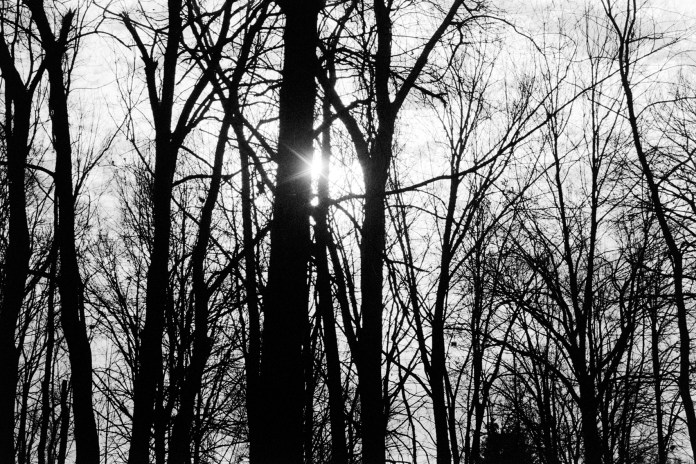
Toledo Trees by Francis DiClemente.


Standard

My New Year’s Resolution

I usually don’t make New Year’s resolutions, but this one came to me amid my battle with a post-Christmas stomach bug (maybe norovirus). In my febrile state, I told myself, “I will stop looking back on the past with regret.”

As someone who writes memoir, I often live in the past—reviewing incidents and conversations that occurred years and decades ago and trying to cull sensory details from those moments to make scenes come alive on the page. So I spend a lot of time on yesterday. My office is overflowing with manuscripts documenting countless yesterdays.

A tree in my neighborhood, observed on Dec. 31, 2024.

But for my 2025 New Year’s resolution, I will attempt to stop that negative line of thought regarding “what could’ve been.” I will instruct myself to stop replaying the poor decisions I made in my progression from boy to man.

And I do have regrets. Many. Most nettlesome are the ones where I let fear stand in the way of opportunity—when I was too frightened to take a risk, either professionally or personally. Some of those decisions still haunt me. In this previous blog post, I wrote about my regret about not moving to California after graduating from college.

But in my sickened state, while I tossed and turned in my son’s twin bed—separated from my wife and son so as not to infect them—I thought, “What have all these regrets done for me?” They certainly don’t make the present more bearable or the future more promising. So why hold on to them?

So in 2025, when I get that tickling of regret inside my brain, I will try to shut it down before it festers.

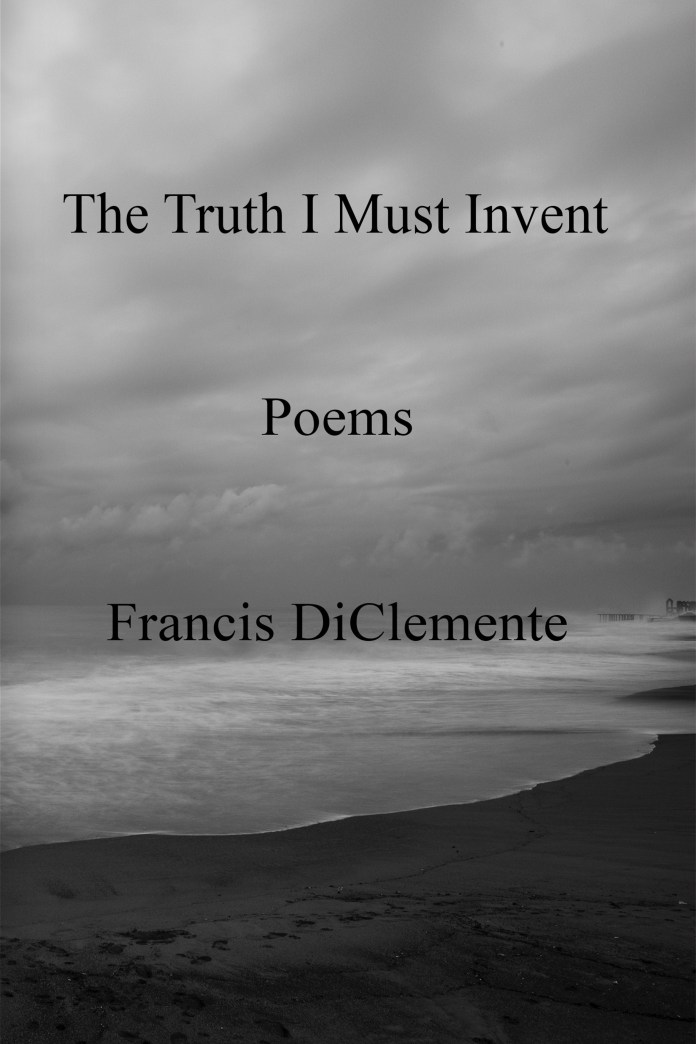
And one of the poems from my collection The Truth I Must Invent seems fitting for me on this New Year’s Eve. I wish everyone a safe and happy New Year. The poem follows. And I apologize for the profanity, but a clean word replacement wouldn’t have the same effect.

The Wanting is the Hardest Part

Tom Petty was wrong.
The waiting isn’t the hardest part.
The wanting is the hardest part.

Wanting fucks everything up—
wanting a better job, a better marriage,
a better house, a better life.
That seed of desire fucks with your head,
makes you think you can be something you’re not.

What if I discarded desire? What if I stopped wanting?
What if I no longer sought a better life?
Can I let go of that fantasy
and accept who I am right now,
without seeking a better version of myself—
the idealized me I hold inside my head?

Standard

A Post-Christmas Poem

December 26

December 26th is
the most dreaded
day of the year.
All the anticipation
of Christmas
has now passed.
The turkey stuffed,
cooked and consumed.
Tins of cookies devoured,
packages ripped apart,
wine bottles drained—
bellies full and
waistlines expanded.

It’s back to work,
with a fat credit card
statement delivered
securely to your inbox.
And yes, you can still say
“Happy Holidays,”
but it doesn’t have
the same ring
on the day
after Christmas.
And New Year’s Day
is a distant cousin
of Christmas—
with January 1st
lacking the allure
and magic of
December 25th.

Standard

Happy Thanksgiving

I want to wish everyone a Happy Thanksgiving. May you and your families be blessed this holiday season. I would also like to share this little poem inspired by a recent trip to the supermarket.

Thanksgiving Dinner

Woman overheard talking on the phone in a grocery store:

“If I’m cookin’ Thanksgiving dinner at my home,
it’s gonna be my mom, my dad, and my kids. That’s it.
I’ll tell her, ‘Look you have a house.
I ain’t cookin’ for you in my little apartment.
Get outta here with that.
Cook your own damn dinner.’”


Standard

Happy Easter

For those who celebrate the holiday, I wish you a Happy Easter. It’s my favorite holiday because it marks the start of spring and offers an invitation for renewal.

Photo by Jos van Ouwerkerk via Pexels.

Here are a few Easter themed poems from the Poetry Foundation website:

Easter by Jill Alexander Essbaum

Easter

is my season
of defeat.

Though all
is green

and death
is done,

I feel alone.
As if the stone

rolled off
from the head

of the tomb
is lodged

in the doorframe
of my room,

and everyone
I’ve ever loved

lives happily
just past

my able reach.
And each time

Jesus rises
I’m reminded

of this marble
fact:

they are not
coming back.

Photo by Francis DiClemente.

I like this following poem, but I need to look up most of the words on Dictionary dot com. The last three lines are the most meaningful to me.

Easter by Peter Fallon 

The first forsythia;
daffodils;
gorse or whins or furze
on hills,

in hedges.
Late winter aconite;
dandelions; primroses
challenging the light

of Easter morning.
The lesser celandine;
a yellow fertilizer
bag define

spring in our steps.
I love my children
and my wife.
Rise all again and again.

And I will add one of my own:

Resurrection Needs Repeating

Sinning doesn’t stop
After Easter Sunday passes.
My transgressions keep
Christ pinned to that cross
365 days a year.

Standard

Gifting Books

I hate writing book promotion posts. But this is just a reminder that books make nice holiday gifts and they’re easy to wrap. My latest poetry collection, The Truth I Must Invent, can be purchased in numerous places. You can find it on Amazon, Barnes & Noble, and Bookshop. It’s also available from the publisher, Poets’ Choice. And a new author profile has been posted on the Poets’ Choice website. Happy holidays everyone.

The Truth I Must Invent book cover.

Standard

A Textual Thanksgiving

I want to wish everyone a Happy Thanksgiving. I have much to be grateful for this year, as Black Friday marks four months since my transsphenoidal (through the nose) brain surgery on July 24.

I have rebounded. I’m back to running and lifting light weights, and I can sneeze and blow my nose without any concern about bleeding or cerebral spinal fluid leaks. I am so thankful my recovery has been steady and unremarkable, with no complications (fingers still crossed).

Interpreting the medical jargon in my latest MRI report—it seems residual tumor matter is still pressing against the optic chiasm and affecting the optic nerve. And my vision has not been fully restored since the tumor grew back a few years ago (and likely never will be). I still have double vision when looking to the far right in my peripheral field, and I need a prism on my reading glasses, which I use when working on the computer. But I can drive because I have no double vision straight on.

I want to share a few  Thanksgiving-themed poems. I am currently reading Poems 1962-2012 by the late poet Louise Glück.

Here are two poems that struck me and are relevant for the season. I must admit I don’t understand the meaning of many of Louise’s poems, but I thoroughly respect and admire her artistry with language. And the works remain open to interpretation by the reader.

Autumnal by Louise Glück

Public sorrow, the acquired
gold of the leaf, the falling off,
the prefigured burning of the yield:
which is accomplished. At the lake’s edge,
the metal pails are full vats of fire.
So waste is elevated
into beauty. And the scattered dead
unite in one consuming vision of order.
In the end, everything is bare.
Above the cold, receptive earth
the trees bend. Beyond,
the lake shines, placid, giving back
the established blue of heaven.

The word
is bear: you give and give, you empty yourself
into a child. And you survive
the automatic loss. Against inhuman landscape,
the tree remains a figure for grief; its form
is forced accommodation. At the grave,
it is the woman, isn’t it, who bends,
the spear useless beside her.

Thanksgiving by Louise Glück

They have come again to graze the orchard,
knowing they will be denied.
The leaves have fallen; on the dry ground
the wind makes piles of them, sorting
all it destroys.

What doesn’t move, the snow will cover.
It will give them away; their hooves
make patterns which the snow remembers.
In the cleared field, they linger
as the summoned prey whose part
is not to forgive. They can afford to die.
They have their place in the dying order.

And in doing some research, I found another “Thanksgiving” poem, this one by Ella Wheeler Wilcox (1850-1919)
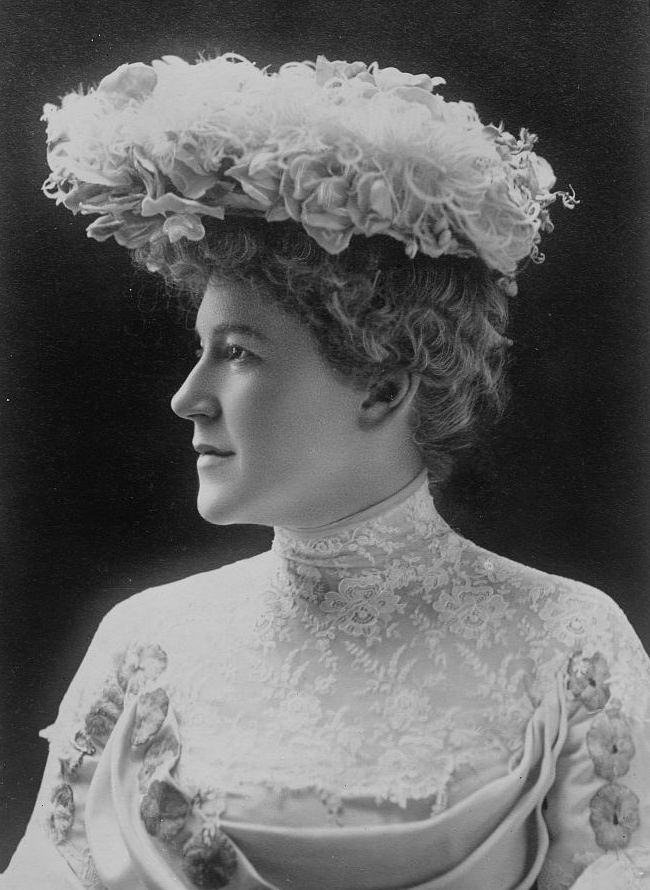
Thanksgiving by Ella Wheeler Wilcox

We walk on starry fields of white
And do not see the daisies;
For blessings common in our sight
We rarely offer praises.
We sigh for some supreme delight
To crown our lives with splendor,
And quite ignore our daily store
Of pleasures sweet and tender.

Our cares are bold and push their way
Upon our thought and feeling.
They hand about us all the day,
Our time from pleasure stealing.
So unobtrusive many a joy
We pass by and forget it,
But worry strives to own our lives,
And conquers if we let it.

There’s not a day in all the year
But holds some hidden pleasure,
And looking back, joys oft appear
To brim the past’s wide measure.
But blessings are like friends, I hold,
Who love and labor near us.
We ought to raise our notes of praise
While living hearts can hear us.

Full many a blessing wears the guise
Of worry or of trouble;
Far-seeing is the soul, and wise,
Who knows the mask is double.
But he who has the faith and strength
To thank his God for sorrow
Has found a joy without alloy
To gladden every morrow.

We ought to make the moments notes
Of happy, glad Thanksgiving;
The hours and days a silent phrase
Of music we are living.
And so the theme should swell and grow
As weeks and months pass o’er us,
And rise sublime at this good time,
A grand Thanksgiving chorus.

Lastly, at a recent appointment at my primary care doctor’s office, I noticed a framed picture of a prose poem entitled “Desiderata” hanging on the wall in an exam room.

The line at the bottom of the page reads, “Found in Old St. Paul’s Church, Baltimore, Dated 1692.” But the piece was actually written in 1927 by Max Ehrman, an Indiana attorney and poet. Some information on the website of Old St. Paul’s Church recounts the story.
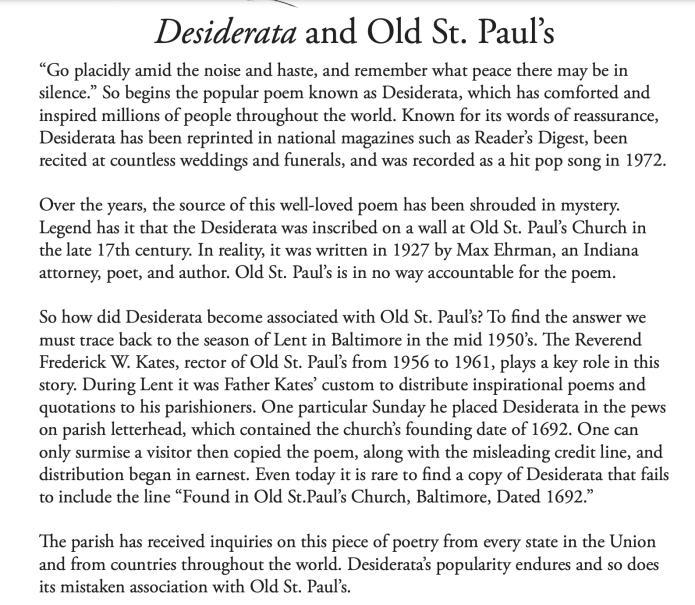
And here is the full text. I highlighted some parts that stood out to me.

Desiderata by Max Ehrmann

Go placidly amid the noise and the haste, and remember what peace there may be in silence. As far as possible, without surrender, be on good terms with all persons.

Speak your truth quietly and clearly; and listen to others, even to the dull and the ignorant; they too have their story.

Avoid loud and aggressive persons; they are vexatious to the spirit. If you compare yourself with others, you may become vain or bitter, for always there will be greater and lesser persons than yourself.

Enjoy your achievements as well as your plans. Keep interested in your own career, however humble; it is a real possession in the changing fortunes of time.

Exercise caution in your business affairs, for the world is full of trickery. But let this not blind you to what virtue there is; many persons strive for high ideals, and everywhere life is full of heroism.

Be yourself. Especially do not feign affection. Neither be cynical about love; for in the face of all aridity and disenchantment, it is as perennial as the grass.

Take kindly the counsel of the years, gracefully surrendering the things of youth.

Nurture strength of spirit to shield you in sudden misfortune. But do not distress yourself with dark imaginings. Many fears are born of fatigue and loneliness.

Beyond a wholesome discipline, be gentle with yourself. You are a child of the universe no less than the trees and the stars; you have a right to be here.

And whether or not it is clear to you, no doubt the universe is unfolding as it should. Therefore be at peace with God, whatever you conceive Him to be. And whatever your labors and aspirations, in the noisy confusion of life, keep peace in your soul. With all its sham, drudgery and broken dreams, it is still a beautiful world. Be cheerful. Strive to be happy.
 

Standard

Unsung Christmas Song

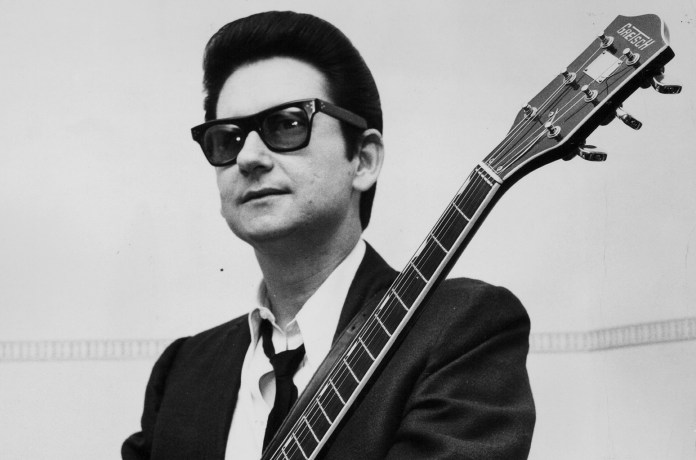
Leave it to legend Roy Orbison to shatter the festive mood of the holiday season.

John Hercock/Central Press/Getty Images

While listening to the “Holiday Favorites” station on Amazon Music, I heard Orbison’s “Pretty Paper” sandwiched somewhere between “Jingle Bell Rock” and Burl Ives’ “Holly Jolly Christmas.”

The song packs a narrative punch in just two minutes and forty-five seconds, as it tells the story of a lonely man on a sidewalk ignored by Christmas shoppers. Sadness prevails in the lyrics and the vulnerability expressed in Orbison’s voice and in the backup vocals draws us into the story, putting the listener on the busy street with the other passersby. I asked myself: Would I pay stop and say “hello” to the man? Would I even bother to notice him?

It’s also worth mentioning that Orbison did not write the lyrics. According to Wikipedia, Willie Nelson wrote “Pretty Paper” in 1963.

Photo by Jeffery Washington, Fort Worth Star-Telegram

The line that devastates me is, “And in the midst of the laughter he cries …”

The full lyrics follow. And I wish everyone a Merry Christmas and Happy New Year.

Pretty Paper
Willie Nelson

Pretty paper, pretty ribbons of blue
Wrap your presents to your darling from you
Pretty pencils to write I love you
Pretty paper, pretty ribbons of blue
Crowded street, busy feet, hustle by him
Downtown shoppers, Christmas is nigh
There he sits all alone on the sidewalk
Hoping that you won’t pass him by
Should you stop? Better not, much too busy
You’re in a hurry, my how time does fly
In the distance the ringing of laughter
And in the midst of the laughter he cries
Pretty paper, pretty ribbons of blue
Wrap your presents to your darling from you
Pretty pencils to write I love you
Pretty paper, pretty ribbons of blue.

Songwriters: Willie Nelson
Pretty Paper lyrics © Roy Orbison Music Company, Sony/ATV Music Publishing LLC, Universal Music Publishing Group, Warner/Chappell Music, Inc.

Standard

An Unexpected Kindness: Parking Garage Christmas Spirit

I received a surprise Monday morning when pulling into the University Avenue Garage at Syracuse University.

University Avenue Garage, Harrison Street Entrance.

University Avenue Garage, Harrison Street Entrance.

I drove in on the Harrison Street side, and after I swiped my card and the arm lever raised, the female parking lot attendant came over to my car and handed me an envelope. After I parked my Focus I opened the envelope and pulled out a Christmas card.

The front of the card had an image of Santa’s sleigh loaded with a small Christmas tree and blue and green-colored wrapped presents.

Dawn's Christmas Card.

Dawn’s Christmas Card.

The greeting inside read:

“Warmest thoughts and best wishes for a wonderful holiday and a very happy new year.”

Underneath the greeting the attendant had scribbled a note that read “Merry Christmas and Happy New Year from Dawn … Parking @ Uag.”

Christmas Card Greeting.

Christmas Card Greeting.

The kind gesture brightened my day. I thought Dawn’s action embodied the Christmas spirit, as she offered me, a passing acquaintance (a stranger really), a gift without expecting anything in return.

I looked up Dawn’s name in the university directory and emailed her later in the day, thanking her for the card. She wrote back that the cards are her “Christmas smiles” and she hands out over 300 of them. She added, “Magic happens when you make someone else smile.”

I agree with that sentiment, and she inspired me to reciprocate the favor. On my way home from work last night I dropped off a Christmas card for Dawn at her UAG booth. She wasn’t working at the time, but I hope she’ll smile when she opens the envelope and feel the same warmth she instilled in me. And I will try to live up to the example of her generosity for the rest of the holiday season.

University Avenue Garage, Adams Street Entrance.

University Avenue Garage, Adams Street Entrance.

Standard