Instagram Poem #10

Office Chair at the Curb. Photo by Francis DiClemente.
Office Chair at the Curb
An office chair
transplanted
to the curb.
I hope the worker
who occupied
the seat
was not
terminated.
Instagram Poem #10
Office Chair at the Curb. Photo by Francis DiClemente.
An office chair
transplanted
to the curb.
I hope the worker
who occupied
the seat
was not
terminated.
Instagram Poem #9

Photo by Francis DiClemente.
A note written on a flyer
posted outside a Dunkin’ Donuts store.
The words read:
“What About the Homeless In CNY??
Does Any One Care??”
The message provokes empathy
and a swelling of guilt,
since my answers to the questions
lack sufficient compassion.
Do I care? Yes I do.
Enough to do something about it?
Well, apparently not.
This is the eighth Instagram poem that I have shared from my work-in-progress poetry collection, entitled Outward Arrangements. I took the photo in December of 2019, when I slipped into the Cathedral of the Immaculate Conception in downtown Syracuse to say a quick prayer. I have not stepped inside a church since the pandemic hit. Wishing you a Merry Christmas and brighter days ahead.
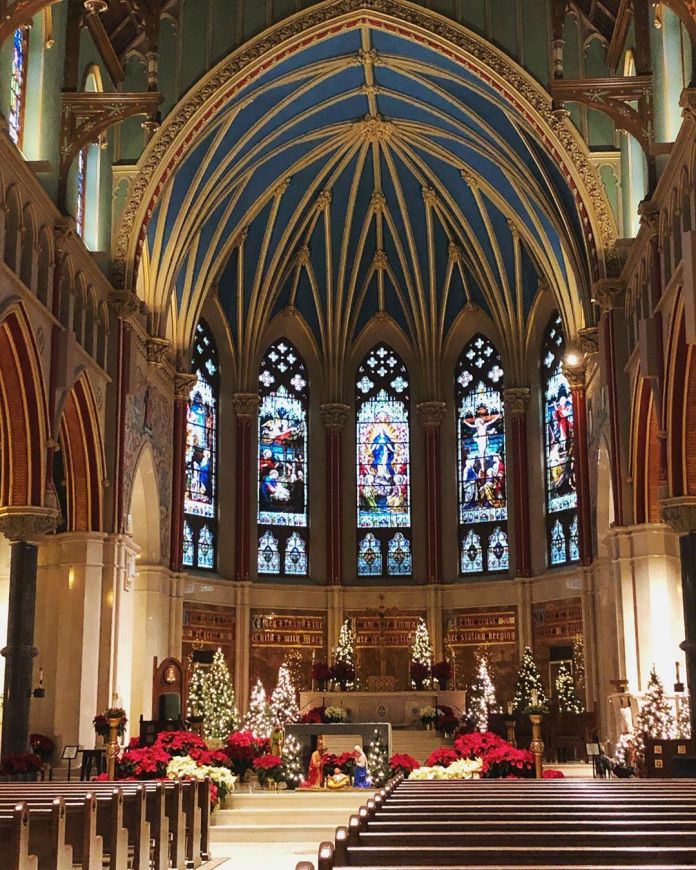
Cathedral of the Immaculate Conception in Syracuse, New York. Photo by Francis DiClemente.
An empty church
instills a feeling of peace,
and a sense of being
part of something
larger than yourself.
It’s a reminder that for me,
life without faith in God
is meaningless.
For people living in the NYC/Tri-State area, I want to pass along this note. The indie documentary short I co-produced/directed with my partner Stu Lisson—The Real Bedford Falls: It’s a Wonderful Life—airs tonight at 10:30 p.m. and again on Christmas Day on Thirteen WNET, the PBS station in New York.
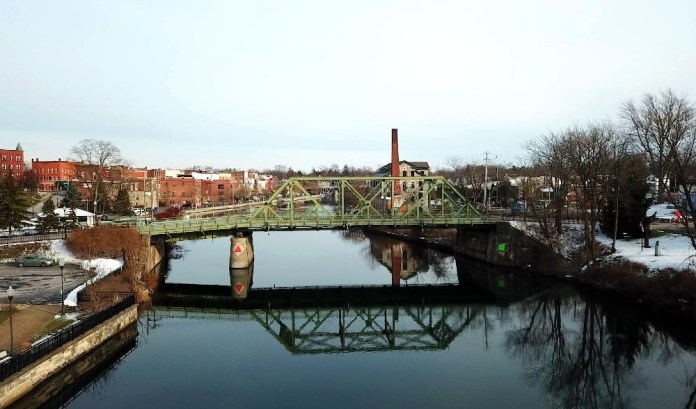
Bridge Street Bridge in Seneca Falls. Aerial image by Chase Guttman.
The film explores the connections between the town of Seneca Falls, New York, and Bedford Falls, the fictional home of George Bailey in the classic movie It’s a Wonderful Life. The documentary features interviews with film critic Leonard Maltin, Karolyn Grimes (Zuzu Bailey), Jimmy Hawkins (Tommy Bailey), Syracuse University professor of popular culture Robert Thompson, film historian Jeanine Basinger and Monica Capra Hodges, granddaughter of director Frank Capra. Former NBC Today show correspondent Bob Dotson lends his mellifluous voice as narrator.
Thanks to everyone who was involved in this indie passion project. Special thanks go to The Seneca Falls It’s a Wonderful Life Museum for access to the story and most of all to Joanne Storkan, Chris Carpenter and the team at Honest Engine Films for making the project a reality. We hope to have a streaming/online viewing option in the near future.
Instagram Poem #7. This one seems fitting for today, since I have an MRI scheduled later this morning.

Irises (1889) by Vincent van Gogh.
A scheduled MRI
of the brain shifts
my thoughts toward
all of the
“what if, worst-case scenarios.”
While waiting for my name
to be called,
I see a print of Irises (1889)
hanging on a wall.
From far across the room,
without my glasses,
the slanted vertical
green leaves
look like snakes
writhing in the dirt.
But the longer
I stare at the image,
the calmer I feel.
Placid is the word
that comes to mind.
And I’m thankful Vincent
spends a few
moments with me
prior to my appointment
with the tube machine.
Because when sitting
in a hospital
waiting room,
artwork by Vincent
never fails to lift the spirits.
A van Gogh painting beats
People magazine
or an iPhone screen
every time.
Today marks the thirty-sixth anniversary of my first brain surgery. As I’ve written about before, on Dec. 12, 1984, surgeons at SUNY Upstate Medical Center (now named Upstate University Hospital) in Syracuse, New York, removed a large craniopharyngioma that had engulfed my pituitary gland, leading to stunted growth and delayed puberty in my early teenage years.

Posing with my parents prior to my surgery in 1984.
Prior to the surgery, in the fall of 1984, a scan of my head had revealed a cloudy mass in the sella region at the base of the skull, and the results of a follow-up CT scan with radiation contrast came a few weeks later.

Craniopharyngioma
I received the news about the brain tumor diagnosis from my father, after he picked me up from wrestling practice on a cold November night. This poem describes that encounter.
Dad put the car in park and let it idle,
and as I slid into the seat and adjusted myself,
he leaned over and kissed me on the cheek,
his tan winter coat brushing against the steering wheel.
I felt a trace of his razor stubble against my skin,
and I could smell a faint odor of Aqua Velva or Brut,
combined with cigarette smoke.
The heater hummed, and he lowered the blast of air
and turned and looked at me.
I wondered why we weren’t moving yet.
He wasn’t crying,
but he appeared on the verge of spilling emotions.
“What’s the matter Dad?” I asked.
“The hospital called your mother today,” he said.
He switched on the overhead light,
reached into his jacket pocket,
and pulled out a torn piece of paper.
“Here,” he said, handing me the slip of paper,
“this is what they think you have.
I wrote it down, but I don’t know if I spelled it right.”
Scribbled in faint blue ink was the word “craniopharyngioma,”
although my father had misspelled it.
His voice cracked a bit as he said, “It’s cranio-phah-reng . . .
something like that . . . I don’t know, it’s some kind of brain tumor.”
I looked at the paper and felt a wave of satisfaction
as my father let out a sigh.
He seemed locked into position in the driver’s seat,
unable to shake off the news and go through the motions
of putting the car in gear and driving away.
I think we may have clutched hands,
and I said, “It’s OK Dad. Don’t worry.
But what do we do now? What’s next?”
“You have to back there for more tests. You may need surgery.”
“All right,” I said.
He switched off the overhead light,
and he drove out of the parking lot.
We grew silent inside the car
as we passed the naked trees lining Pine Street
in our city of Rome, New York.
While my father was crestfallen,
I remember being elated as I sat in the passenger seat.
The CT scan with contrast had given me a medical diagnosis—
a reason for my growth failure at age fifteen.
It explained why my body had not changed,
why I never progressed through puberty,
and why I was so different from the other boys my age.
I still considered myself a physical anomaly,
but the tumor proved it wasn’t my fault.
That knowledge gave me some satisfaction,
and I couldn’t help feeling a stirring of excitement.
I looked down at the piece of paper again
and studied the word—“craniopharyngioma.”
I tried to sound it out in my head while my dad drove on,
and I thought the word
would roll off my tongue like poetry if I said it out loud.
Craniopharyngioma. Cranio-Phar-Ryng-Ee-Oh-Mah . . .
sort of like onomatopoeia.
Instagram Poem #6
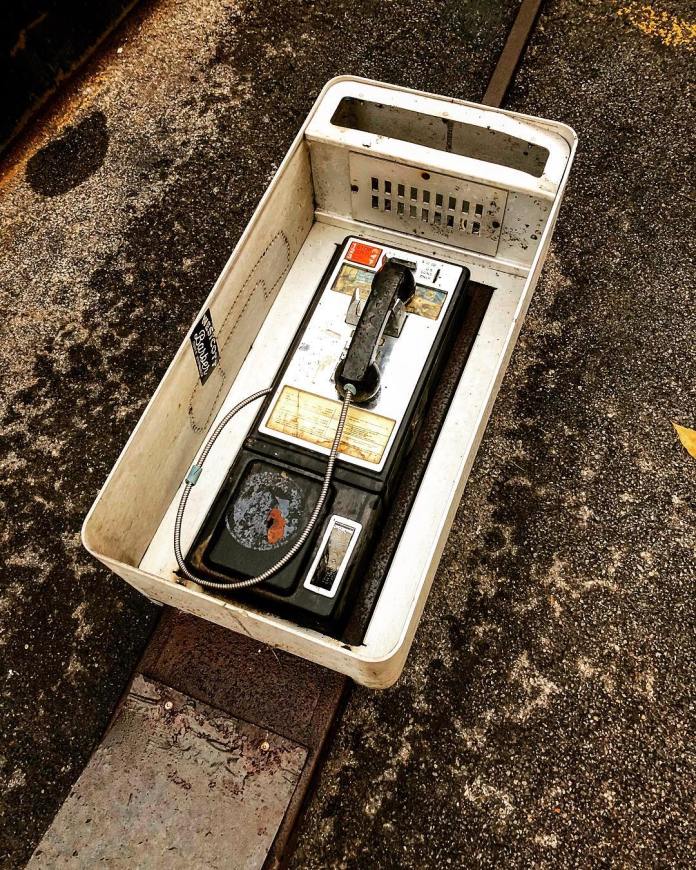
Pay Phone on the Ground. Photo by Francis DiClemente.
A metal pay phone
splayed on the ground
near my apartment
building dumpster,
a relic from the
pre-digital age—
anthropological
evidence of
20th-century
American life.
Model discontinued
and no iOS update
to install.
Instagram Poem #5

While walking to work,
I pass a little park
located next to
Grace Episcopal Church.
It reminds me of the scenery
from the movie The Quiet Man.
And in the early morning stillness,
I half expect
John Wayne and Maureen O’Hara
to come striding toward me
along the path.
It’s yet another example
of how I have to live vicariously
through cinema,
since I am confident
my feet will never touch
Irish soil.

The Quiet Man movie image.
Instagram Poem #4
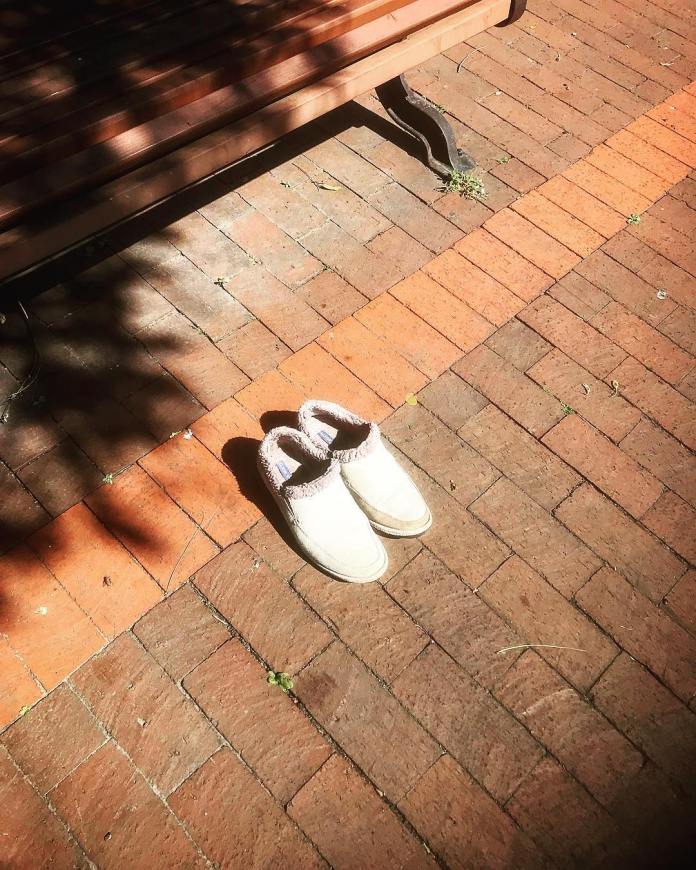
Slippers found near a park bench in downtown Syracuse. Photo by Francis DiClemente.
Sunday morning:
a pair of white slippers
left near a park bench
in downtown Syracuse.
Questions abound:
Who owns the shoes
and where did the person
sleep last night?
No answers to be found,
so instead cue Johnny Cash’s
big, beautiful voice singing
“Sunday Mornin’ Comin’ Down.”

Underwood Typewriter. Photo by Francis DiClemente.
Instagram Poem #3
I see a black metal
Underwood typewriter
in a Salvation Army store.
No apps, software updates
or charging required.
The keys feel good
underneath my fingertips.
 Francis DiClemente