I received a nerve conduction study last week related to symptoms of my rheumatoid arthritis. The bearded electromyography (EMG) technician, Mark, had dark hair and an athletic build, and he wore glasses. We made small talk while he placed electrodes on me, stimulated the nerves with mild electrical shocks, and measured the results on a computer.
When I asked him where he was from, he said he grew up in Syracuse and went to a local high school. “It was a really good school,” he said, noting its academic and athletic excellence. “But I didn’t appreciate it at the time. I was kind of a screw up.”
He also explained that his mother was a custodian at Syracuse University and how he could have gone to college there for free, but didn’t take advantage of the opportunity. “I blew it,” he said. “But I had to find my own way.”
And then he said a jewel of a statement regarding regret. “If you focus too much on regrets, you don’t appreciate the life you currently have.” Or he may have said, “If you focus too much on regrets, you don’t live the life you currently have.”
Regret is a recurring theme in my poetry. I think it’s something all adults at a certain age wrestle with—this idea of ambitions versus reality.
Camera Angle
What would I choose
if I were given a chance
to lead a different life?
What mistakes
would I correct?
What new road
would I take?
But you can’t splice
the scenes of your life
to edit the past.
You can only point
the camera forward
and zoom into the future.
This poem is dedicated to all mothers, for what moms do every day of the year. It appears in my 2019 full-length collection, Dreaming of Lemon Trees: Selected Poems, published by Finishing Line Press.
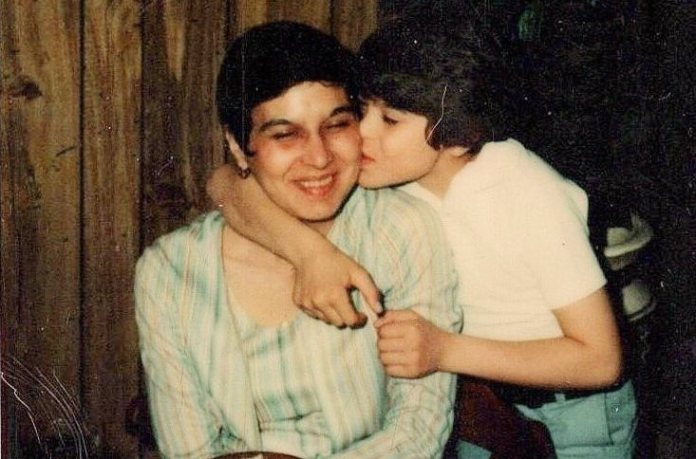
Here’s me kissing my mom, Carmella, sometime in the late 1970s or early 1980s.
Mother at a School Bus Stop
A middle-aged woman with a white canvas coat
stands with her two young children
at a school bus stop on a misty gray morning.
The boy and girl are bundled up
and jabbering as they bounce around—
unaware that Mondays should be devoid of glee.
When the bus pulls up, the mother hugs the children.
The kids separate from her breast,
scurry up the steps and claim an empty seat up front.
The mother waves goodbye to the little faces
pressed against the window and watches
as the bus pushes away from the curb,
ejecting a thin cloud of exhaust.
The woman turns around,
waits for the traffic light to change
and then crosses the street,
marching up the block to return home.
Once there, dirty dishes, unmade beds and
cigarette butts heaped in black plastic ashtrays
demand her attention until mid-morning,
when the woman leaves the house and rushes to work.
She then counts down the hours
until the school bus returns to the curb
and her two kids hop off and leap into her arms,
almost in unison.
This essay was originally published in the 2014 edition of Words & Images literary magazine, a student-run publication at the University of Southern Maine.
##
I heard the woman first before I saw her or her partner inside the museum of the Onondaga Historical Association in Syracuse, New York. She said in loud voice, “Rick, where are you, hon?” The OHA had a few exhibitions running simultaneously on this Saturday in early January 2013, and so it was possible to lose sight of your friend or partner as you made your way through the different gallery spaces and inspected the various works. “Hon, come here, look at this,” she added.
Onondaga Historical Association
At the time I was examining the exhibit Manifest Destiny and The American West by artist Robert Hirsch. Hirsch presented nearly one-thousand images in a three-dimensional display—with the pictures placed inside jars and serving as a commentary on how the geographic progression across North America shaped U.S. culture.
After I finished looking at the Manifest Destiny jars, I started walking toward where the couple was standing. They were planted in front of some panels of an exhibit highlighting historic stereoscopic photographs.
Rick was probably in his sixties. He was tall, broad-shouldered and bald except for a tuft of grayish-white hair at the back of his head. He had a bushy mustache that curled downward and matched his hair color and he was wearing a tan jacket.
The woman, whom I will call Ruth, was small and also appeared to be in her sixties. She was wearing a black fur coat, tall black boots, and bronze earrings that looked like costume jewelry. She had short black hair, a birthmark on the right side of her face, and she had applied a little too much burgundy lipstick to her mouth.
But it was her dialogue that made her memorable. I am not a casting director, but I believe you could pick Ruth up and place her in a Woody Allen film and without even reviewing the script, she would fit in with no problem. In fact, I bet she would steal scenes away from Scarlett Johansson or Penélope Cruz.
I heard her tell her husband, as I assumed they were married, “See, I should have lived in the 1920s. I’d be dead now but look at all the stuff I would have remembered.”
Something else about Ruth struck me on a personal level; she reminded me a lot of my late mother. To my knowledge, my mother had never attended an art exhibit in her life and was not loquacious like this museum visitor, but the two women shared some physical features. Both were short and had short black hair.
Carmella DeCosty Ruane, 1945-2011
And just like Ruth, my mother would often smear too much of the same shade of burgundy lipstick on her mouth. My mom also had the habit of applying a little too much rouge to her cheeks. If she was getting ready to leave the house to attend the Saturday vigil mass at St. Peter’s Church in Rome, New York, where she lived, I would tell her, “Mom, you need to blot your cheeks. The rouge is caked on.” Her standard reply would be, “Oh shut up. Can’t you ever say anything nice?”
Ruth, Rick, and I were gathered inside a small gallery space where Carl Lee’s multi-channel video Last House, which documents the destruction of a house in Buffalo, was being screened.
In the piece, on what looks like a bright spring or summer day, a backhoe starts demolishing the house and three separate camera angles capture the action simultaneously. Viewers watch as the scoop of the backhoe starts eating away the roof and walls of the structure, while a man stands near the rubble and uses a power hose to spray water on the scoop and house so no sparks jump to life.
As arresting as Lee’s video was, his exhibit became trumped by a living breathing work of art—the older couple that had seized my attention. And as I stood near the back wall of the room, my focus shifted from the images on the screen in front of me to Rick and Ruth seated on a black bench nearby.
“You see that, it’s three angles of the same thing,” Rick said.
“Yes, I know,” Ruth replied. She paused and then added, “You must think I’m a real idiot.”
I almost burst out laughing because her delivery was a spot-on impersonation of my mother, using the same words my mother had said to me on numerous occasions. But I managed to suppress the laughter swelling inside of me, keeping it contained in my throat.
A short time later, Rick said to Ruth, “Hon, are tired?” Ruth rubbed her thighs and said, “A little, but I’m OK.”
“Well, it’s 2:30,” Rick said.
“No, it’s later.” She checked her watch and said, “It’s 2:40.”
“Your watch is fast,” he said.
“No, it’s not. I set it by the stove, and it’s always slow.”
They stopped chatting and watched in silence as the house was being ripped apart in the video. Then, a little while later, amid the grating sounds of the backhoe and the walls tumbling down, Rick turned his head toward Ruth and said, “Are you sure you’re not too tired?”
“No, I’m fine,” she said.
And that’s how I left them. The couple was still sitting there, watching the video when I stepped out of the exhibition space and exited the OHA.
I think what intrigued me most about the couple was their ease of interaction and level of comfort with one another. And I was thankful for having witnessed this slice of life from their apparent happy marriage, a snapshot of two older people behaving in an unguarded fashion in a public museum on an ordinary Saturday afternoon.
I did not assume they lived a perfect life without worry or conflict. But it appeared Rick and Ruth understood and accepted one other unconditionally. In spending a few moments in their presence, it seemed like neither partner had any illusions about the other person. There appeared to be no mysteries in their relationship still waiting to be uncovered. They had likely revealed all their flaws and weaknesses a long time ago, and yet, they still enjoyed spending time together and remained happily married and devoted to one another. Or at least that’s the impression they gave to outsiders.
I often get a rush of creative energy after visiting an art museum, attending a play or concert, or seeing a great film. And while I was walking home, my rumination about the couple sparked an idea. I decided they would make a compelling subject for a modern art exhibit.
So here’s my proposal:
A museum would build a large installation showcasing Rick and Ruth as one of the last surviving happy couples in America. It would be a spectacle like something 19th Century showman P.T. Barnum could have curated and promoted.
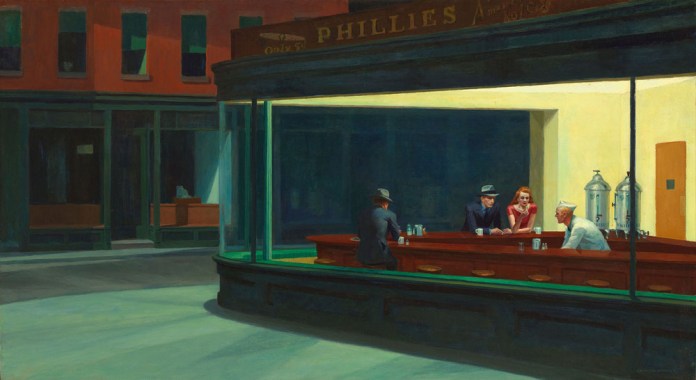
Rick and Ruth would be placed inside a large kitchen space encased in glass like the diner scene in Edward Hopper’s iconic painting Nighthawks.
Nighthawks by Edward Hopper, 1942
We would observe them sitting in their kitchen—drinking coffee, talking, cooking, and eating breakfast, lunch, or dinner, reading the newspaper, playing Scrabble, baking cookies, celebrating their birthdays, and washing and drying dishes.
The display would offer viewers an unfiltered window into the life of the couple, and the images, sounds, and conversations would document Rick and Ruth’s ease of interaction. The goal would be to reveal the secrets of this happy marriage.
As a result, the exhibit would aim to answer these central questions: What makes this couple different from others? What is the key to their bliss? And what advice or insights do they have for other couples in terms of making a relationship last?
From a technical standpoint, Rick and Ruth would need to be well-lit and microphones would need to be placed on or near them to pick up clean sound; the museum would also have to mount speakers or headphones near the display so the viewer could listen as the couple communicates.
As this idea spun wildly inside my brain, I felt a sense of joy bubbling within, and I smiled when I imagined Rick and Ruth hanging out in their hermetically sealed museum kitchen.
I could almost hear him saying something like, “You know, we’re gonna have to eat a little later because the chicken still needs to defrost before we put it in the oven.”
Ruth would then shoot Rick a dirty look, smack her lips or maybe place a hand on her hip. “Do you think so?” she would say. “God, you must think I’m a real idiot.”
Moments later, Ruth would be standing at the counter making a salad and Rick setting the table, and Ruth might turn to him and ask, “Hon, what do you feel like for dessert?”
“Oh, I don’t care,” he would say, his eyes lifting from the cutlery on the table. “Anything.”
“Well, we have that Entenmann’s crumb cake in the freezer. You want me to take it out?”
“Sure.”
“Yeah, that sounds good, doesn’t it hon?”
“You bet, Ruth. It does.”
Then, as the museum would get ready to close for the day, the lights to the kitchen display would be dimmed and Rick and Ruth would depart the exhibition space. And we wouldn’t be allowed to tag along with them when they walk outside the walls of the museum, get into their car, and head home for the night.
But I suspect not much would change between them, and I find this reassuring because I wouldn’t want to miss anything.
I have an unhealthy obsession with the act of brewing coffee in my Mr. Coffee electric drip coffee machine. Why do I prefer this method to a single-serving Keurig or buying coffee at Dunkin’ Donuts or Starbucks on the way to work?
For one, nostalgia tugs at me, as I remember my deceased parents and how they taught me how to make coffee in the 1970s. When I was young, my dad worked as a salesman at the local Sears store, while my mom started her banking career on the teller line. They were low-income earners, but they never scrimped on the staple of coffee. There was always a canister of coffee and an electric drip coffee maker sitting on the Formica countertop in our kitchen (and in their separate residences after they divorced).
I remember my mother wearing a worried expression on her face every morning as she sat at the kitchen table, her fingers pressed to her forehead as she smoked Salem Light cigarettes and drank coffee from a light blue ceramic mug. She needed coffee to start the day, as if sipping the hot liquid prepared her to endure the responsibilities and financial burdens she confronted.
And while tastes vary, my parents instructed me on how to make a decent blend in the coffee pot. The rules were rigid; if you flouted them, the coffee came out too weak or too strong, and you would need to dump it in the sink and start all over again. And we couldn’t waste coffee in my house. The measurements were three scoops of coffee for every six cups of water, four scoops for eight cups of water—and, if we had company—the ratio went to five and ten or six and twelve.
As an adult, I’ve adjusted this formula to make a stronger blend, but I still relish the quotidian ritual of standing in my kitchen and preparing the coffee maker at night so it’s ready to go when I wake up in the morning.
I love measuring the water, tucking a paper filter in the filter basket, scooping out ground coffee—either Folgers or Maxwell House—smelling the aroma, noting the sound of the metal scoop digging in the plastic canister, dumping the coffee in the filter, and closing the lid.
And my Mr. Coffee coffee maker offers a no-frills, analog, tactile coffee-making experience. There’s no clock, no built-in alarm, no digital displays, no voice activation. The process requires exactness and following an ordered progression. The steps are simple: add water, add coffee, plug in, and turn on.
But this coffee-making ritual has a deeper significance, as you must wait for the coffee to brew. It’s not instantaneous, and the process reminds me of sex. There’s a buildup and a finish as the coffee maker hisses and spits and completes its cycle with a flourish of guttural sounds.
But I also draw a connection between coffee and death. Every time I scoop the coffee and drop it in the filter basket, I am reminded of my mortality. My mind reflects on burial scenes in movies, where family members toss shovelfuls of dirt on top of a coffin containing the body of a loved one. I think, “How many more pots of coffee will I make before I die? When will I take the last sip of coffee brewed in my kitchen?”
This week marks two years since my last poetry collection, The Truth I Must Invent, was released. The book is available from the publisher, Poets Choice. You can also find it on Bookshop and a Kindle version on Amazon.
The Truth I Must Invent is a collection of narrative and philosophical poems written in free-verse style. The book explores the themes of self, identity, loneliness, memory, existence, family, parenthood, disability, gratitude, and compassion.
I am giving away three print copies of the book, which I will mail to anyone in the U.S. You can use the contact form or email me directly at the gmail address listed in the form.
The Truth I Must Invent book cover.
Selections from the collection:
Man Inside Nighthawks
I assume I was nothing
before I found myself sitting here,
staring straight ahead.
I can’t move my head.
I can’t smoke the cigarette
pressed between the fingers
of my right hand or drink the cup
of coffee resting on top of the counter.
I can’t touch the woman seated next to me
or talk to the other men in the diner.
This is my life: suspended in warm, yellow light,
trapped in a soundless environment—
no water running, no fan whirring, or grill sizzling.
No sirens or street sounds beyond the glass.
Time drags on with no discernible shift—
no transition to morning.
Here, night never ends.
Yet my mind still works.
In fact, it never stops.
I’m cursed with thoughts that run continuously.
Why am I here?
And where exactly is here?
What purpose do I serve?
Do I have a past? Did I live elsewhere,
before I became frozen in this moment—
captured and imprisoned for eternity?
If only I could talk.
If only I could open my lips and make a sound.
Then I could scream for help.
But who would hear my voice?
If only I could stand up
and walk around,
stretch my legs and
stare outside the window.
But since I can’t move,
the composition will remain unaltered,
as I will stay locked in place
inside this painting,
hanging on a gallery wall.
Looking Through Spindles
I climb out of bed and clutch
the white balusters at the top of the stairs
as harsh words fly behind walls
too thin to hold my parents’ rage.
My sister creeps out of her room,
shrugs her shoulders,
and moves toward me in the hallway,
passing the door to the master bedroom.
She sits down next to me
and whispers, “What happened now?”
“I don’t know,” I say.
And we listen for clues, trying to determine
the cause of the latest fight.
Did Dad come to bed drunk
and make advances on our mother?
Did she recoil or lash out, scratching his eyes?
But we hear no violent action
on the other side of the white door—
only voices laced with acrimony.
And we remain seated on the stairs,
exhausted but unable to fall back asleep.
Zooming out, I see those siblings
in a Polaroid image, sealed under a plastic sheet
in a leather-bound photo album.
And as the adult looking back,
breaking the fourth wall,
I wonder why this memory pricks my brain
when so many others would illuminate my parents’
kindness, decency, and exemplary work ethic.
Why, when I could have chosen from
a myriad of positive scenarios,
does this one seize my attention,
demanding to be chronicled?
My mother and father are both dead
and can’t defend their actions.
And I feel riddled with guilt
for tarnishing their memories.
I also understand that the truth
doesn’t always tell the full story.
My conscience obligates me to explain that
while Mom and Dad weren’t perfect,
they loved us and endured sacrifices
to make our lives a little better.
And while that’s a weak way to end a poem,
the wider perspective allows me to
forgive my mother and father for being human—
for being real people and not just my parents.
Craniopharyngioma (Youthful Diary Entry)
Craniopharyngioma gave me
an excuse for being unattractive.
I had a problem inside my head.
It wasn’t my fault
I stood four foot eight inches tall
and looked like I was
twelve years old instead of eighteen—
and then nineteen
instead of twenty-four.
I couldn’t be blamed for
my sans-testosterone body
straddling the line
between male and female.
The brain tumor
spurred questions
about my appearance,
aroused ridicule,
and provoked sympathy.
I heard voices whispering:
“Guess how old that guy is?”
And, “Is that a dude or a chick?”
And while I waited for my
body to mature, to fall in line,
and to achieve normal progression,
I remember wishing the surgeons
had left the scalpel
inside my skull
before they closed me up,
knitting the stitches
from ear to ear.
I prayed the scalpel
would twist and twirl
while I slept at night—
carving my brain
like a jack-o’-lantern—
splitting the left and right
hemispheres,
and effacing the memory
of my existence.
Mattress Moment
You don’t get to cry
“No Fair”
Mr. Hyman Roth.
This is the life
you have chosen.
You don’t get to pine
for your salad days,
whatever the fuck that means.
You don’t get to
flip over the mattress
on the bed you’ve made.
The Wanting is the Hardest Part
Tom Petty was wrong.
The waiting isn’t the hardest part.
The wanting is the hardest part.
Wanting fucks everything up—
wanting a better job, a better marriage,
a better house, a better life.
That seed of desire fucks with your head,
makes you think you can be something you’re not.
What if I discarded desire? What if stopped wanting?
What if I no longer sought a better life?
Can I let go of that fantasy
and accept who I am right now,
without seeking a better version of myself—
the idealized me I hold inside my head?
Resolution
You must
Live the life
You have
And not
The one
You want.
Witness
I look up as a group of birds
circles buildings in downtown Syracuse.
I resist the urge to pull out my cellphone
and snap a picture for Instagram.
Instead, I hold my gaze skyward,
letting the wind swirl around my face
and the rain patter my forehead,
as the birds duck in unison
behind a limestone structure—
the moment preserved nowhere except in my mind.
No pictures retained or sound recorded.
No trace of the birds in digital form.
And I think that’s the point, that’s life—
a collection of these impromptu glimpses of existence,
built into a collage, a kaleidoscope of images
demanding attention when presented.
Crying at Bedtime
Nothing prepares a parent
for the tantrums of an autistic child.
There’s no well of patience to draw from.
You adapt. You divert. You distract.
You do whatever it takes to calm the child down—
until you earn that blessed moment of peace,
when his eyelids drop and he drifts off to sleep,
his small body folded in the cradle of your arms.
Fingers in Hair
I run my fingers through
my son’s tangled mop of brown hair
as he lies next to me in bed.
It’s 4:30 a.m. and we can’t fall asleep.
He waves his hands in front of his eyes,
making stimming motions,
and I imagine his head slamming
against the windshield,
a spiderweb crack forming
in the sheet of glass and
blood pouring from
an opening in his skull.
I press my hand to his head
to try to stop the bleeding,
but the crimson liquid
slips through my fingers
and stains the carpet
and fabric seat covers.
I am reminded of a
Gospel passage (Luke 12:7 NIV):
“Indeed, the very hairs
of your head are all numbered.”
I hold some of my son’s hairs
in my hand and realize
I cannot prevent a
car accident, fall, gunshot wound,
or disease from killing my son.
I can’t prolong or preserve his life.
I can only love him while he still lives.
His hands whip in front of his face,
and he prattles phrases
only he understands.
I bury my fingers deeper
into the mound of his hair and whisper,
“Come on now, sleepy time, Colin.”
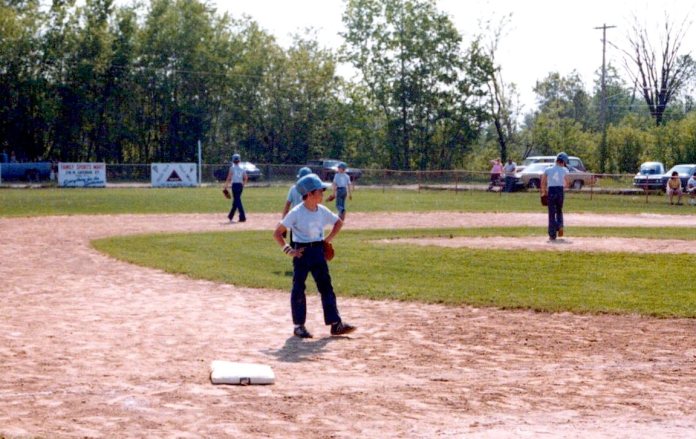
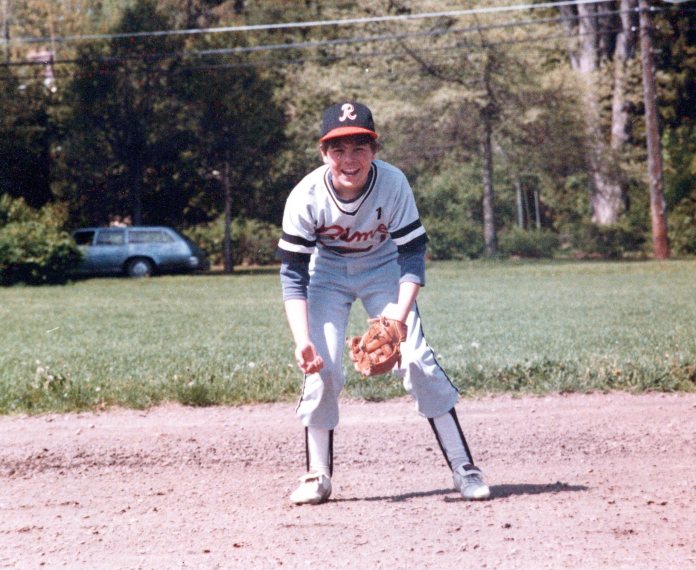
In celebration of opening day in Major League Baseball (Go Yankees!), I am posting two baseball-themed poems. Both appear in my collection Dreaming of Lemon Trees: Selected Poems (Finishing Line Press, 2019).
Playing third base in youth league baseball in Rome, New York, in the late 1970s.
The Shed
Independence Day, Late 1970s (Rome, New York)
Whipped-cream clouds smear a powder blue sky,
while Grandpa nurses a carafe of Chianti
and dreams of waltzing down Bourbon Street.
The DeCosty family gathers on the patio,
with Uncle Fee roasting sausage and peppers
and Nana dribbling olive oil over fresh tomatoes,
then adding alternating pinches of basil and parsley.
Inside the backyard bordered by overgrown hedges,
the rambunctious cousins wham Wiffle balls
with a thin, banana-colored plastic bat,
evoking the hollers of Grandpa …
who watches out for his mint-green aluminum shed,
situated perfectly in left-center field—
serving as our own Green Monster.
And when we get ahold of that little white ball,
it smacks up against the aluminum obstacle,
clashing like two marching band cymbals in a halftime show.
And with sweat coursing down his neck,
Grandpa barks out his familiar line under the patio awning:
“Son of a bitch … keep that goddamn ball away from my shed.”
But Nana is always on our side,
and cancels out his power and keeps him in check.
“Fiore, you let those kids play and mind your mouth,” she says.
Grandpa abandons his no-win cause,
turns up the volume on the Yankee game
and pours himself another glass of red wine.
He watches quietly as the shed stands erect
in the late afternoon sun,
sacrificing its facade for our slew of ground-rule doubles.
Playing freshman baseball in Rome, New York, in 1984.
Minors
Toledo in July—a Mud Hens game:
Big league dreamers with names like Bubba, Fausto and Tyler
toil away in the minors,
hustling for the scouts perched behind home plate,
diving for line drives and sliding head first,
with egos in check and mouths full of dirt.
Pillars of artificial light frame the setting sun,
and from beyond the azure sky,
the ghosts of washed-up utility infielders
and middle relief pitchers
pull for these hard luck Triple-A players.
They want to scream, “Take heed, savor it now,
for this is the best you will ever be.”
But they’re under orders to keep their mouths shut,
and can only blow a home run foul every once in a while.
The steel girder stands are filled with a crowd
that still believes in this clockless game.
They listen intently for the crack of the bat,
and sing with all their might during the seventh-inning stretch.
Little kids with hot pink shorts and noisy flip-flops
smear their faces with mustard and hug Muddy the mascot.
They scatter peanut shells and scamper after foul balls,
and for them the score is merely an afterthought.
The summer night comes to a close
with a game-ending double play and a fireworks barrage.
The fans file out and load into their cars,
going back to real life with memories of Mud Hens
now stitched in the seams of their minds.
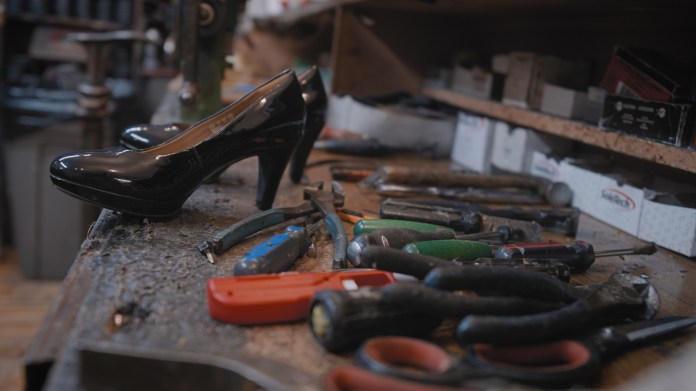
Logline: Ralph Rotella plies the craft of shoe repair while offering kindness and a sense of community to his customers and the residents of Syracuse, New York.
Since emigrating to the U.S. from Italy in the 1970s, Rotella has owned Discount Shoe Repair in downtown Syracuse. Each day he opens the store, fixes shoes, works with his hands using antiquated equipment, and converses with customers. In his daily interactions with people, Rotella reveals himself to be a witty, beatific figure who draws people to himself, building a sense of community with his shoe repair shop as a hive of activity. The film examines the value of work and what constitutes happiness, while also honoring an unsung hero in the Central New York community.
Photo Credit: Shane Johnson
Credits, Awards and Festivals:
Directed by Francis DiClemente and Shane Johnson
Produced by Francis DiClemente
Cinematography and Editing by Shane Johnson
Ralph’s work bench. Photo Credit: Shane Johnson.
Awards:
Winner: Best Director, Short Films
New York Documentary Film Awards (2024)
Gold Remi Award in Film & Video Productions, sub-category Community
57th WorldFest-Houston International Film Festival (2024)
Film Festivals:
New York Documentary Film Awards
NewFilmmakers NY, Spring 2024 Screening Series
57th WorldFest-Houston International Film Festival
Culver City Film Festival
Syracuse International Film Festival
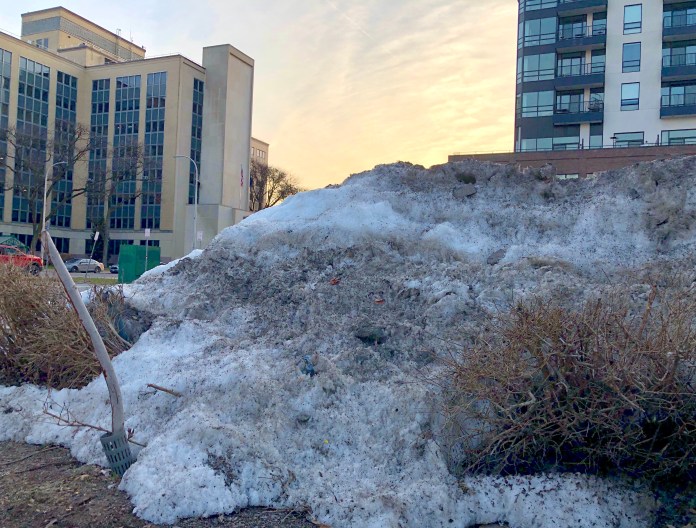
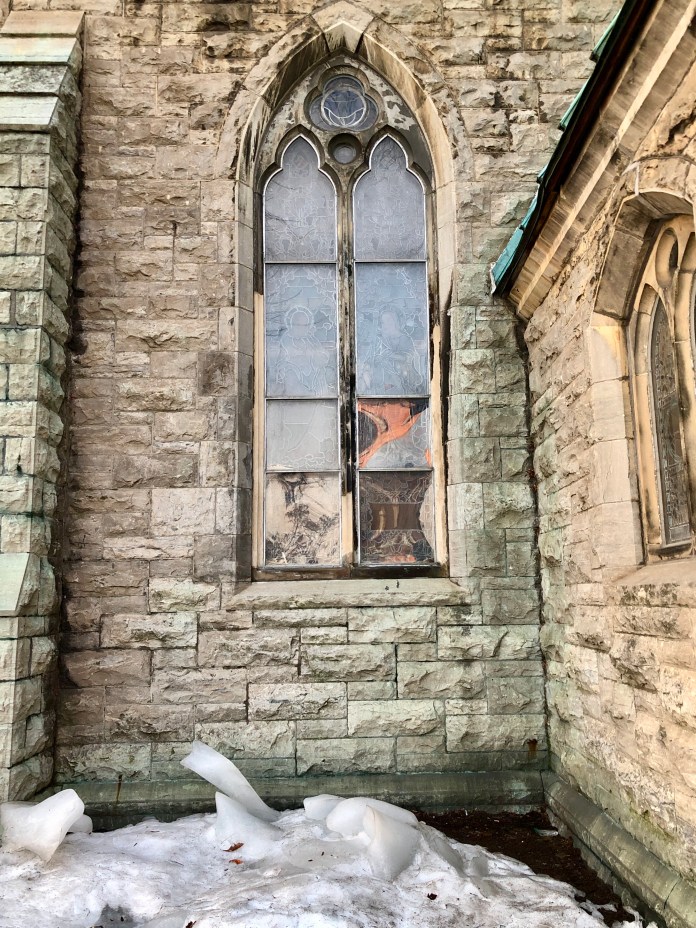
There’s a feeling of spring in Central New York as temperatures have warmed up and snow piles have receded. Here are some recent photos documenting the transitional period.
Snow pile in downtown Syracuse.
This denuded patch of land along Erie Boulevard East reminded me of a plain in Nebraska.
Best Time of the Year
Snow finally
giving way
to grass
in Syracuse.
Cold mornings,
but temps
climbing
above 40.
March Madness,
Lenten fish fries
and the crack
of the bat.
Yippee …
it looks like
we’ve survived
another winter.
But never forget—
in Syracuse
a lake-effect blast
can still chase away
the Easter Bunny
and send the Moms
scurrying to their closets
to retrieve sweaters
on Mother’s Day.
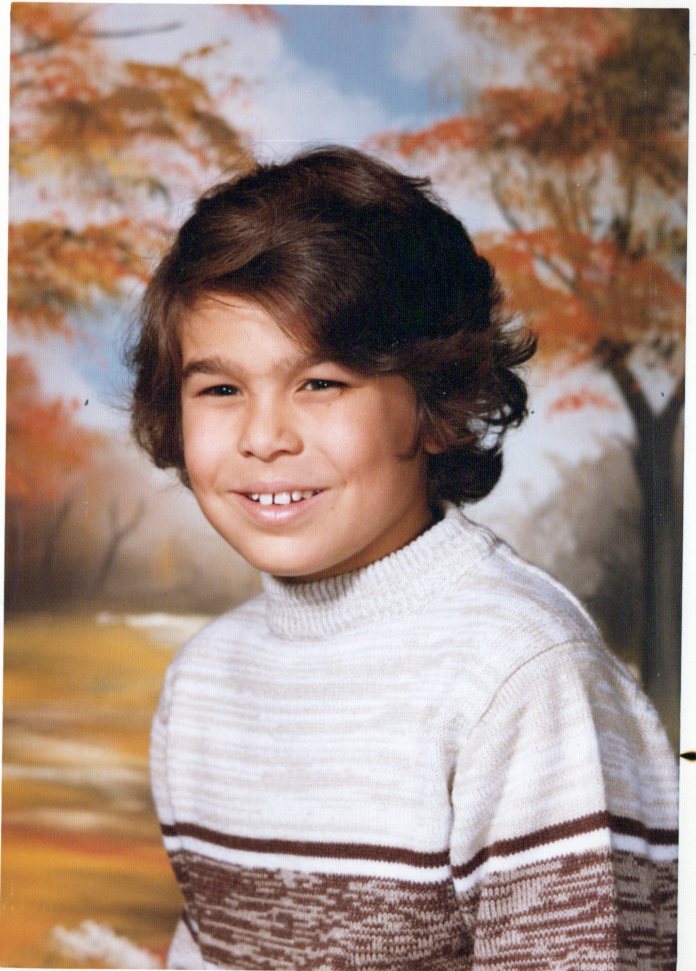
Seeing every person
As a 12-year-old child
Taking a school photo
Eliminates any animosity
You may have for that person.
When you imagine
The awkward kid squinting
At the camera lens—
You discover yourself
Staring back at you.
My cousin Derek DeCosty passed away earlier this year in Jacksonville, Florida. He had been sick around Christmas with a respiratory illness, and we texted on New Year’s Eve. He died on Jan. 3, one day before his 57th birthday. Here’s his obituary.
I’ve spent time processing this loss and bringing the memories of Derek to the surface of my mind—flipping through photo albums, seeing his face, and hearing his ebullient laughter as I recalled moments we shared.
While I felt compelled to write about him, I also dreaded it because this loss is too personal. And what could I say that would make any difference? How could my reflections ease my grief or the sorrow of my relatives? But I hope my words can honor Derek and offer a glimpse into the life of this beautiful soul.
Derek’s father, Fiore (Fee) DeCosty, and his sister Carmella, my mother, were raised in Rome, New York, along with two other siblings, my Aunt Teresa—who goes by her religious name of Sister Carmella—and my Uncle Frank. Derek’s mother, Patricia (my Aunt Pat), is a member of the Caddo Nation of Oklahoma and settled in central New York with Uncle Fee.
A Special Bond
Growing up in Rome, I spent a lot of time with Derek, his older brother, Fiore (Fee), and his younger brother, Damon.
Although I wasn’t a brother to them, I felt something stronger than a typical cousin bond. Derek and I had a special connection because we were only one grade apart in school.
Both of our nuclear families experienced divorce in the early 1980s, and I believe that shared pain also drew us closer.
And being related to the DeCosty boys had its perks.
They were athletes, part of the popular crowd, and because of them, I received party invitations I wouldn’t have gotten otherwise. Pretty girls who swooned over Derek talked to me because they knew I had a direct line to him. And as a short, chubby tenth-grader scurrying through the halls of Rome Free Academy high school for the first time during my sophomore year in 1984, no students teased or bullied me because they knew I was related to the DeCostys.
Cousins gathered at our grandmother’s house. My cousin Chris is in the front row. Second row, from left to right, is Damon, my sister, Lisa, and me; Fee and Derek are in the back row.
Weekends at the DeCosty household were a regular part of my youth. I attended their hockey games (sometimes traveling with my Uncle Fee on road trips) and stretched out on the couch in their cramped ranch house on Seville Drive in north Rome.
If I remember correctly, Damon had a bedroom on the main level, while Derek and Fee slept in the basement in two small, makeshift rooms separated by thin drywall. Three mounds of fetid and sweat-drenched hockey equipment were piled high near the washer and dryer. A boom box blasted music—with The Rolling Stones, The Who, Genesis, The Fixx, and The Police getting frequent play.
The boys practiced their wrist, snap, and slapshots by firing hockey pucks at a white cement wall, festooning the surface with pockmarks and black spots.
Although I was a rabid hockey fan, I had given up playing the sport when I was young because I couldn’t skate. Picture Bambi slipping on the ice. So when Fee, Derek, and Damon were not playing ice hockey, I tried to stir up a game of street hockey or floor hockey. Floor hockey was my favorite, especially on holidays at our Grandma Josephine’s house. We would get on our knees in the living room and use mini sticks and a rolled-up ball of athletic tape as the puck in fierce battles that left us with elbows to the face and rugburns on our knees.
One holiday, Damon, Derek, and I played a football game called “goal-line stance” in Derek’s bedroom. The memory is murky, but this is what I think happened.
With the twin bed pushed against the wall, the front of the mattress was the goal line. Derek was the ball carrier. He was getting annoyed because Damon and I were double-teaming him and standing him up, so he stuffed the football under his arm and leaped over us, Walter Payton style, his body parallel to the ground, until his shoulder slammed into the wall with a loud bang as he landed on the bed.
The collision created a large dent in the drywall, evoking our laughter. “Ah, shit,” Derek said.
My dad, who worked in home improvement (among other areas) at the local Sears store, was at the house for the holiday. I went upstairs, found him in the kitchen, and waved for him to come downstairs.
“What’s up?” he said as we descended the stairs.
“We hit the wall while playing. Can you look at it?”
When my father inspected the damage, he laughed and said, “Oh, you can’t fix that. You boys better hang a poster over it.”
And that’s what Derek and Damon did. I don’t know if my Uncle Fee ever discovered the dent.
Moments in Time
When you lose a loved one, it’s often the small, seemingly insignificant moments that trigger memories. For my deceased father, I picture him sitting in his green easy chair, reading glasses perched on his nose, making his football parlay and Lotto picks (or reviewing the losing tickets).
For my mother, who passed away in 2011, I remember the anxiety that weighed on her—like an oak beam pressing on her shoulders—as she smoked her first cigarette of the morning and drank coffee from a blue ceramic mug, her head bowed, her fingers pressed to her forehead.
For Derek, I remember him chopping ice in Josephine’s driveway and hitting one of his toes, which bled profusely (but did not require medical attention). From then on, if he walked around the house barefoot, I would ask him, “Hey, Derek, can you tell me which one of your toes had difficulty?” To which he would say, “Shut up, man.”
Other things I recall about Derek:
His deep, dark brown eyes; his mixed Italian and Native American heritage; his copper-colored skin in the middle of summer; his large ears that I loved to flick.
From left to right: Fee, Derek, my sister, Lisa, and me. When I posted this photo on Facebook, Derek wrote: “Take it down cuz!!!! Look at the size of me ears!!!!”
The way he would fly on the ice and the joy he exhibited in playing the sport he loved. His big hands, smooth and soft, as he used them to thread a pass or deke a goalie.
And with those hands, he created beautiful artwork. I can imagine him sitting at our grandma’s dining room table, his left hand making a charcoal drawing on a sketch pad.
A pencil sketch Derek made during junior high school.
His love of eating—not just food but the act of eating with family. One of his favorites was Josephine’s pasta beans (pasta fazool), made with cannellini beans and ditalini pasta. “Yeah, pasta beans,” he would say when entering the house on Thursday nights in the winter when Grandma often cooked the dish. He would dunk huge chunks of Ferlo’s Italian bread in the bowl, sopping up the juice, and say, “Ah, Grandma, this is so good. So good.”
His booming voice. He never called me Fran. Whenever I saw or talked to him on the phone, it was always, “Franny D. My man. What’s up?”
His infectious laugh. It started deep in his throat, rolling upward until it was released in waves. Hearing him laugh made you want to join in the fun.
He lit up any room he walked into with his charisma and humility. People were attracted to him because of his inherent goodness and gratitude for whatever you gave him.
And the true beauty of Derek is that he never thought he was better than anyone else. Despite being a star athlete, talented artist, and Honor Society scholar in high school, he was never arrogant or looked down on others.
Fee, Derek, and me in the summer of 1990.
The closest analogy I can make is the scene with Edie McClurg as the secretary Grace in Ferris Bueller’s Day Off, when she’s describing Ferris to Principal Ed Rooney, played by Jeffrey Jones.
Grace: “Oh, he’s very popular, Ed. The sportos, the motorheads, geeks, sluts, bloods, wastoids, dweebies, dickheads—they all adore him. They think he’s a righteous dude.”
That was Derek.
A Cherished Memory
In October 1984, I received the Catholic sacrament of Confirmation at St. John the Baptist Church in Rome.
In this sacrament of initiation, the baptized person is “sealed with the gift of the Holy Spirit. (United States Conference of Catholic Bishops).”
I made the mistake of asking Derek to be my sponsor because I didn’t understand the commitment it entailed.
I thought it meant his only responsibility would be standing up with me in church during the Mass on Confirmation day. That’s it. Instead, he needed to attend preparation workshops, retreats, and church school events over the course of several weeks. He never complained, even though he was the youngest sponsor. Practically everyone else had their mom or dad serving in that role.
We had to choose a Confirmation name after a saint or a figure from the Bible. Although I knew little about the Old Testament prophet Isaiah, I selected the name because I loved Detroit Pistons guard Isiah Thomas (whose first name is spelled differently).
Standing outside St. John’s Church in Rome on the day of my Confirmation in October 1984.
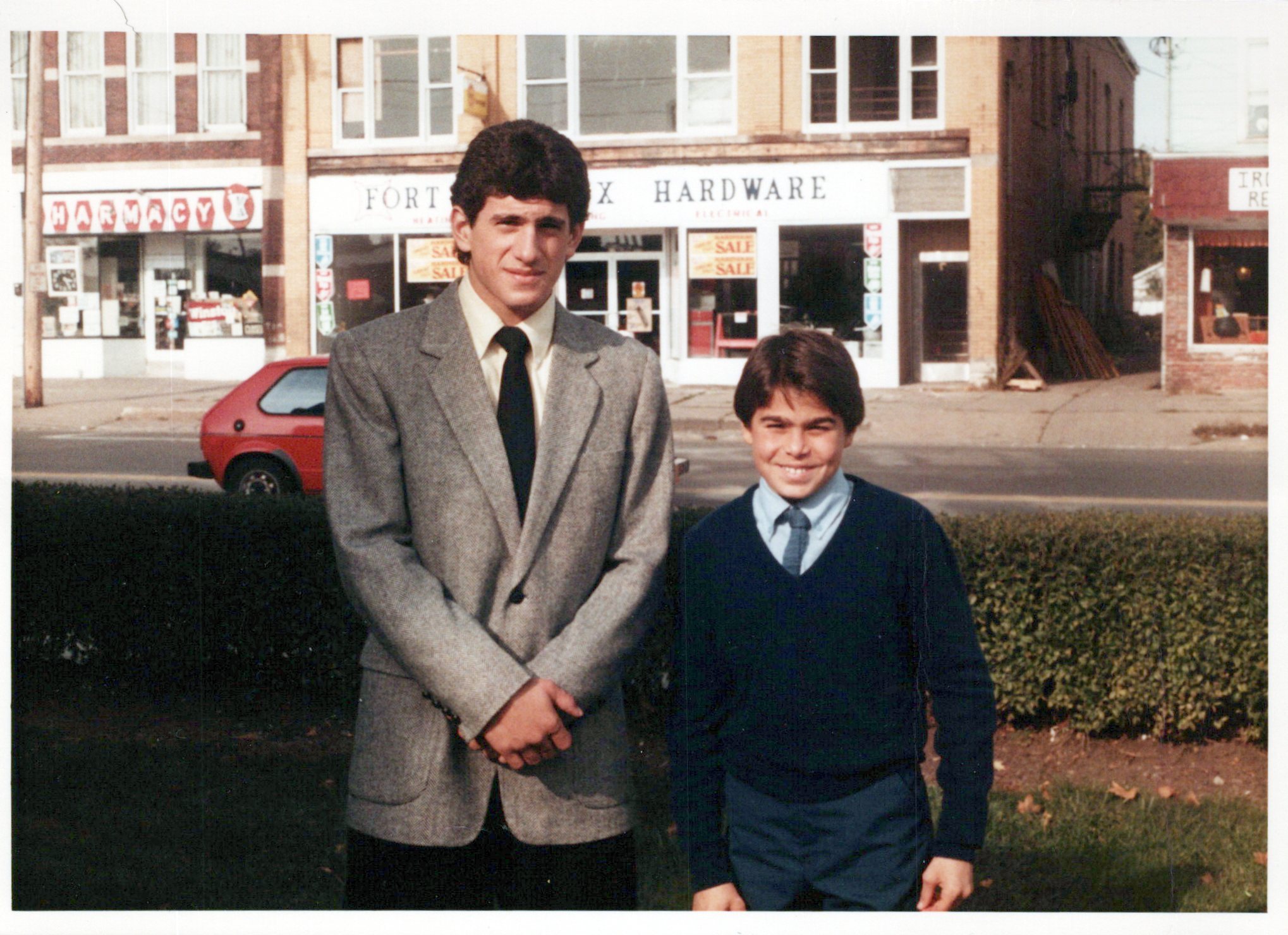
In a photo taken outside the church that day, Derek towers over me, even though he was only about a year-and-a-half older than me. At the time, a benign tumor on my pituitary gland (a craniopharyngioma) was expanding in my brain, stunting my growth and causing delayed puberty. About two months after the photo was taken, surgeons would remove the tumor in an eight-hour operation at SUNY Upstate Medical Center in Syracuse (renamed Upstate University Hospital).
And as I recovered in the surgical intensive care unit, Derek came to visit me, bringing a torn picture of the Sports Illustrated cover featuring an image of Doug Flutie from the “Hail Mary” game against the University of Miami in the Orange Bowl. Derek knew I loved Flutie and was inspired by the quarterback because of his short stature. He pinned the magazine page to my IV stand so I could see it when I looked up from my bed.
Hockey Career: From the Mohawk Valley to Crossing the Atlantic
In 1986, when he was a senior in high school, Derek led Rome Free Academy to its first New York State title in hockey as the Black Knights defeated Skaneateles in Glens Falls. (Damon was a member of the 1988 RFA team that captured the school’s second state championship.)
Derek went on to play Division 1 hockey for the Rensselaer Polytechnic Institute (RPI) Engineers. At the time, Fee was at West Point, playing for the United States Military Academy. In this contest pitting Army against RPI, Fee is chasing Derek and hooking him.
Fee and Derek competing in college hockey.
After I graduated from college and moved away from Rome, I stayed in contact with Derek while his professional hockey career flourished.
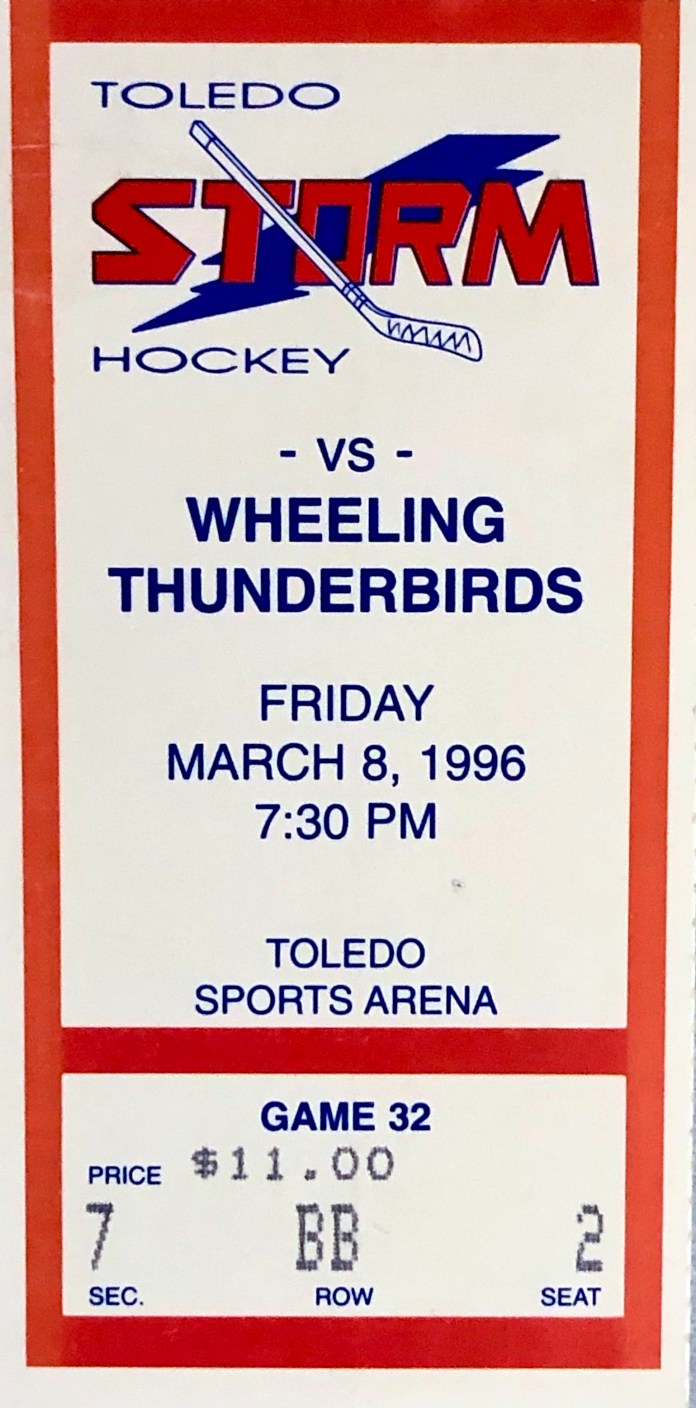
In the mid-1990s, Derek played for the Wheeling Thunderbirds (later renamed Nailers) in the East Coast Hockey League while I was living in Toledo with my sister, Lisa, and working at the news/talk radio station WSPD. Wheeling played the Toledo Storm frequently, and Derek would leave tickets for us at will-call at the Toledo Sports Arena. In exchange for the tickets, we would bring him a case of beer.
I would hang out near the Wheeling locker room and watch the players come out. And then I’d yell, “Hey, DeCosty, you suck.” His head would spin around, and then he’d laugh when he saw me.
After the game, we would grab the beer from the car and talk with Derek for a few minutes near his team bus, the diesel engine roaring and a frigid wind whipping off the Maumee River hitting us in the face.
I took this photo with my Pentax K1000 camera during Derek’s playing days with the Wheeling Thunderbirds.
One night in Toledo, Derek got injured on his first shift of the game. While Derek forechecked with his linemates in the Storm’s zone, a Toledo defenseman whipped the puck along the glass, and it smacked Derek in the face. Blood gushed from his nose, and he went right off the ice and into the locker room. We followed the ambulance as it rushed him to the emergency room. And we spent a few hours talking with Derek in the hospital while the ER doctors treated him.
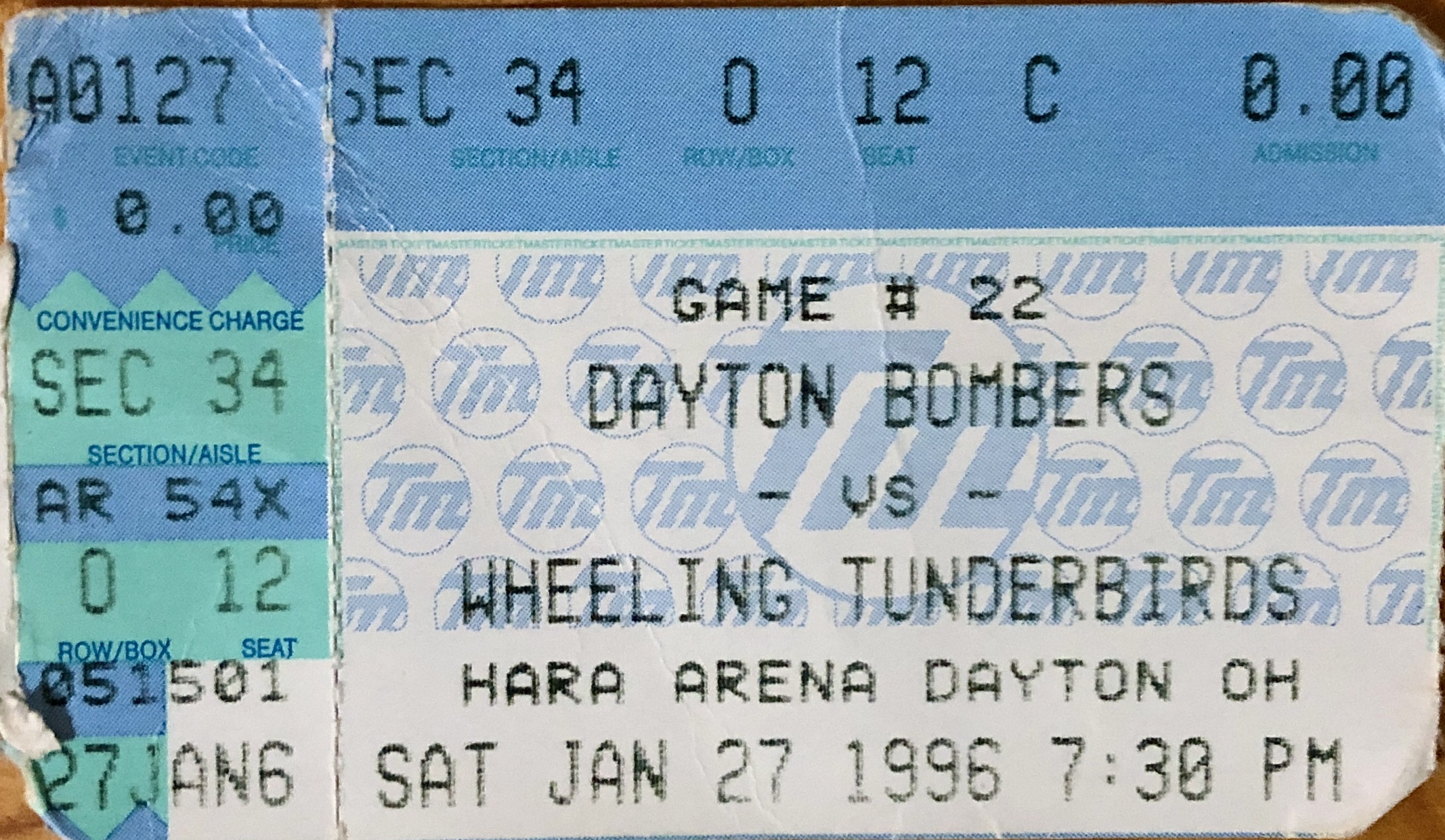
Another time, late on a windy, wintry Saturday afternoon, I found out from my uncle that Derek was playing that night in Dayton, Ohio, about two hours from Toledo. These were the days before cell phones, so I called the arena and left a message for Derek to leave me a ticket at will-call. I was like a hockey groupie.
Strong gusts rocked my Dodge Colt as I filled up at a gas station in Bowling Green, and blowing snow made visibility difficult on I-75. But I made it to the arena, watched Derek play against the Dayton Bombers, talked with him for about twenty minutes, and drove home that night, getting lost on my way out of the city and back onto I-75.
My favorite memory of Derek’s playing days is driving from Toledo to Wheeling one weekend. Derek talked to the coach, who let me ride the team bus for a short road trip from West Virginia to Johnstown, Pennsylvania.
The jocular banter by Derek’s teammates reminded me of scenes from the movie Slap Shot. One player curled up with a blanket in the back of the bus and shouted numerous times: “Hey driver, it’s getting frosty back here. Crank up that heat.”
A hockey card image from his career in Wheeling. Copyright unknown.
But what impressed me most was witnessing how much Derek’s teammates liked and respected him and how his relationship with the friendly people of Wheeling went beyond the surface-level player-fan dynamic. They adored Derek as a valued member of the community, and he returned their affection, making lasting friendships with non-players in the city.
Derek’s professional career later took him abroad as he played for teams in the United Kingdom, including the Guilford Flames and Bracknell Bees.
Relocating to Florida
Derek moved to Florida after his hockey career ended.
And I remember after his father was diagnosed with pancreatic cancer in 2010, Derek drove with Uncle Fee from New York to Jacksonville so he could get treatment at the Mayo Clinic. Derek settled in the Jacksonville area, beginning a career in agronomy at the prestigious TPC Sawgrass Golf Course in Ponte Vedra Beach, home of The Players Championship.
A year later, my wife, Pam, and I spent a few days in Jacksonville, staying with my uncle and his wife, Diane. I remember everyone sitting on the patio on a hot May day while Derek mowed the lawn and trimmed some hedges in the backyard.
Derek was tanned, and he had the most casual, easygoing manner, not complaining that he was doing yard work in the heat while the rest of us were enjoying cool drinks and bantering in the shade. A cigarette dangled from his mouth as he maneuvered around the yard, and he stopped working occasionally to take sips from a bottle of beer.
##
There’s so much more I could say about Derek, so much more I have forgotten and will likely remember later when reminiscing about him.
I took my time drafting this essay. Part of the reason for my slow pace is that I relished roaming around my past accompanied by my beloved cousin.
I feel profound sadness knowing that Derek’s warmth and kind heart are no longer active in the world—that his light, voice, and laughter are no longer accessible to his family, friends, and other people.
But I believe his artwork and the loving impact he made during his short life will endure.
A colorful painting by Derek DeCosty.
With his carefree manner, Derek reminded me a little of Jeff Bridges as the Dude in The Big Lebowski. And I hope Derek’s soul is now at peace and he’s abiding in the cosmos, embarking on celestial wanderings in the afterworld with a sense of curiosity and wonder.
##
I found out about Derek’s death via text when I was at a doctor’s appointment. After I left the medical building, while riding the bus, some words came to me in verse form. I don’t get the heartstrings reference since it’s not a musical instrument, but I guess I conjured the image of an angel playing a harp (like you’d see in old cartoons).
A Poem for Derek
Heartstrings playing in heaven.
Derek is laughing.
But the joke is on us.
He’s gone and won’t be back.
Words that come to me
After the death of my cousin.
No recognition of meaning,
But I must write them anyway—
Words perpetuating memories
To keep my cousin’s spirit alive.
I wish I could hear him laughing,
And ask him what he finds so funny.
Painting by Derek DeCosty.
First-Person Ending
I will end with a few text messages Derek sent me over the past couple of years. I’m sure he wouldn’t mind me sharing them. They reflect his love of life, sense of humor, and compassion for others. I’ve edited them for brevity and clarity.
Note: Because of his family connection to Oklahoma, Derek was a fan of the University of Oklahoma football team (hence the reference to the Sooners). And Colin refers to my son.
The first text is from the summer of 2023, when I needed another brain surgery (my sixth) to remove tumor regrowth. As I awaited my operation, Derek wrote:
June 8, 2023
My beautiful cuz, I understand that you’re going through some shit again regarding those same issues that you’ve conquered in the past and I have no doubt you will again kick ass in our true Bukowski way! I wanted you to know that I have you in my mind, heart, and when I talk to our parents looking down, I’m sure that you have the strength and heart of a buffalo! I love you Fran, don’t ever doubt that you aren’t thought about every day I wake up!
July 24, 2023
My dear cousin, I want you to know that I am thinking about you right now and praying that you are doing well after your surgery. I have you on my mind, in my heart and ask that I take any pain you feel. I love you dearly, more than you know. Stay tough.
October 5, 2024
Good morning my dear cousin!!! This is Derek, this is my new number, new carrier! Just wanted you to have it! Miss and love you all dearly! Saw a really cool tree I have to capture for you. Old crazy oak that I wish you could see! Very photogenic! Anyhow, give Pam and Colin a kiss for me and…..GO YANKS!!!!!
Photo by Derek DeCosty from his Instagram account. He wrote: “Tiny Osprey feather stuck in pro practice green this beautiful morning!”
November 30, 2024
Good afternoon my dear cousin!! Happy Thanksgiving and all that, give my very best to Colin and a big hug for Pam! Hope yall enjoyed the holiday!! Miss and love you dearly!! Crazy day of football today, love it!!! Much love, Go ’Cuse&Boomer Sooner!!
November 30, 2024 (Later)
Sorry Cuz, I had to make a Target run for my mother!
Francis, you’ve always been my Saint, there’s not many people on this earth that understand me in the gracious way you and Damon (sometimes!) get me and the hundred personalities, moods, and craziness that encapsulates all I’m about!! Anyhow, I have to start screaming at the Sooners to get their shit together!!! All my love.
December 31, 2024
My man!!!! Happy New Year to you and all the family! Anyway, straight after Xmas, I caught the flu, of the respiratory type! I’ve been down and out and only going back to work tomorrow!!! Francis, I send my very best to Pam and Colin! Give them a hug for me please! Love and miss you!
Photo by Derek DeCosty from his Instagram account. The text read: “Good morning from the driving range floor, ready for the Players. Happy days!”

















 Francis DiClemente