I want to wish everyone a Happy Thanksgiving. I have much to be grateful for this year, as Black Friday marks four months since my transsphenoidal (through the nose) brain surgery on July 24.
I have rebounded. I’m back to running and lifting light weights, and I can sneeze and blow my nose without any concern about bleeding or cerebral spinal fluid leaks. I am so thankful my recovery has been steady and unremarkable, with no complications (fingers still crossed).
Interpreting the medical jargon in my latest MRI report—it seems residual tumor matter is still pressing against the optic chiasm and affecting the optic nerve. And my vision has not been fully restored since the tumor grew back a few years ago (and likely never will be). I still have double vision when looking to the far right in my peripheral field, and I need a prism on my reading glasses, which I use when working on the computer. But I can drive because I have no double vision straight on.
I want to share a few Thanksgiving-themed poems. I am currently reading Poems 1962-2012 by the late poet Louise Glück.

Here are two poems that struck me and are relevant for the season. I must admit I don’t understand the meaning of many of Louise’s poems, but I thoroughly respect and admire her artistry with language. And the works remain open to interpretation by the reader.
Autumnal by Louise Glück
Public sorrow, the acquired
gold of the leaf, the falling off,
the prefigured burning of the yield:
which is accomplished. At the lake’s edge,
the metal pails are full vats of fire.
So waste is elevated
into beauty. And the scattered dead
unite in one consuming vision of order.
In the end, everything is bare.
Above the cold, receptive earth
the trees bend. Beyond,
the lake shines, placid, giving back
the established blue of heaven.
The word
is bear: you give and give, you empty yourself
into a child. And you survive
the automatic loss. Against inhuman landscape,
the tree remains a figure for grief; its form
is forced accommodation. At the grave,
it is the woman, isn’t it, who bends,
the spear useless beside her.
Thanksgiving by Louise Glück
They have come again to graze the orchard,
knowing they will be denied.
The leaves have fallen; on the dry ground
the wind makes piles of them, sorting
all it destroys.
What doesn’t move, the snow will cover.
It will give them away; their hooves
make patterns which the snow remembers.
In the cleared field, they linger
as the summoned prey whose part
is not to forgive. They can afford to die.
They have their place in the dying order.
And in doing some research, I found another “Thanksgiving” poem, this one by Ella Wheeler Wilcox (1850-1919)
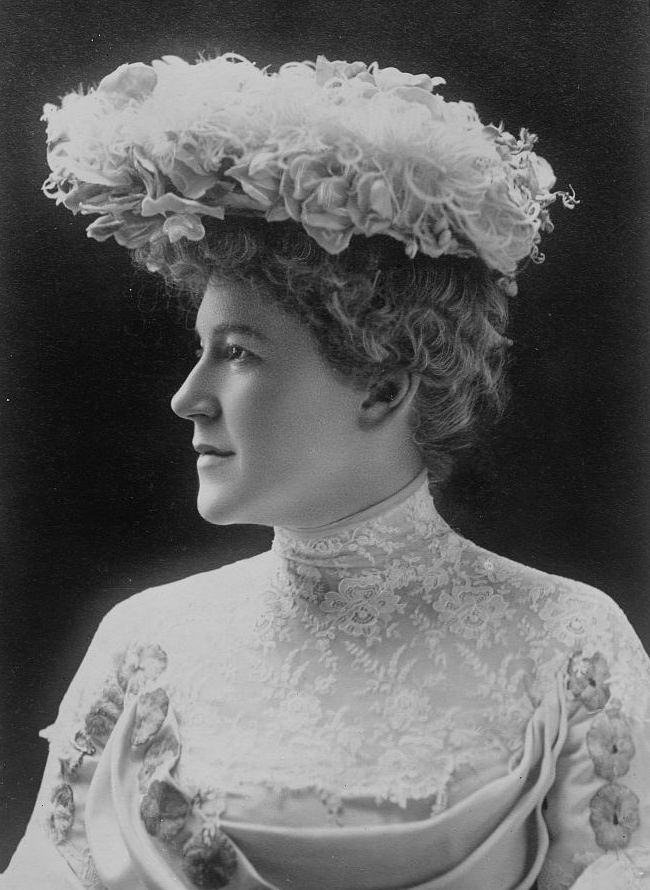
Thanksgiving by Ella Wheeler Wilcox
We walk on starry fields of white
And do not see the daisies;
For blessings common in our sight
We rarely offer praises.
We sigh for some supreme delight
To crown our lives with splendor,
And quite ignore our daily store
Of pleasures sweet and tender.
Our cares are bold and push their way
Upon our thought and feeling.
They hand about us all the day,
Our time from pleasure stealing.
So unobtrusive many a joy
We pass by and forget it,
But worry strives to own our lives,
And conquers if we let it.
There’s not a day in all the year
But holds some hidden pleasure,
And looking back, joys oft appear
To brim the past’s wide measure.
But blessings are like friends, I hold,
Who love and labor near us.
We ought to raise our notes of praise
While living hearts can hear us.
Full many a blessing wears the guise
Of worry or of trouble;
Far-seeing is the soul, and wise,
Who knows the mask is double.
But he who has the faith and strength
To thank his God for sorrow
Has found a joy without alloy
To gladden every morrow.
We ought to make the moments notes
Of happy, glad Thanksgiving;
The hours and days a silent phrase
Of music we are living.
And so the theme should swell and grow
As weeks and months pass o’er us,
And rise sublime at this good time,
A grand Thanksgiving chorus.
Lastly, at a recent appointment at my primary care doctor’s office, I noticed a framed picture of a prose poem entitled “Desiderata” hanging on the wall in an exam room.

The line at the bottom of the page reads, “Found in Old St. Paul’s Church, Baltimore, Dated 1692.” But the piece was actually written in 1927 by Max Ehrman, an Indiana attorney and poet. Some information on the website of Old St. Paul’s Church recounts the story.
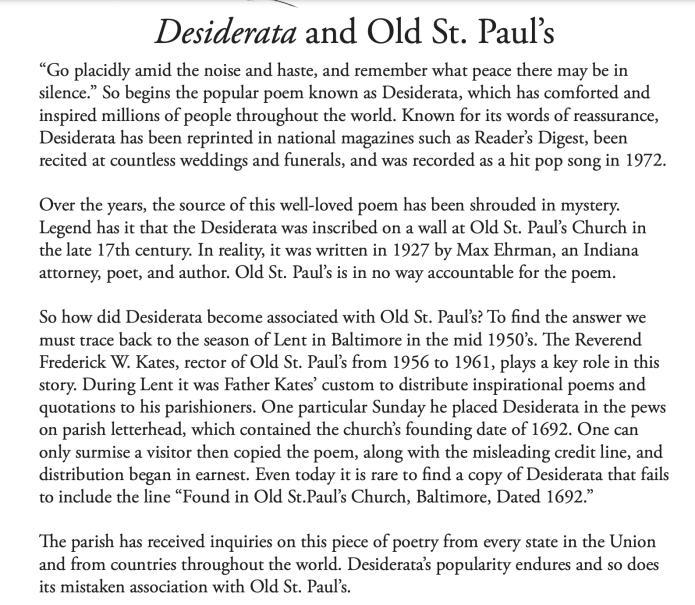
And here is the full text. I highlighted some parts that stood out to me.
Desiderata by Max Ehrmann
Go placidly amid the noise and the haste, and remember what peace there may be in silence. As far as possible, without surrender, be on good terms with all persons.
Speak your truth quietly and clearly; and listen to others, even to the dull and the ignorant; they too have their story.
Avoid loud and aggressive persons; they are vexatious to the spirit. If you compare yourself with others, you may become vain or bitter, for always there will be greater and lesser persons than yourself.
Enjoy your achievements as well as your plans. Keep interested in your own career, however humble; it is a real possession in the changing fortunes of time.
Exercise caution in your business affairs, for the world is full of trickery. But let this not blind you to what virtue there is; many persons strive for high ideals, and everywhere life is full of heroism.
Be yourself. Especially do not feign affection. Neither be cynical about love; for in the face of all aridity and disenchantment, it is as perennial as the grass.
Take kindly the counsel of the years, gracefully surrendering the things of youth.
Nurture strength of spirit to shield you in sudden misfortune. But do not distress yourself with dark imaginings. Many fears are born of fatigue and loneliness.
Beyond a wholesome discipline, be gentle with yourself. You are a child of the universe no less than the trees and the stars; you have a right to be here.
And whether or not it is clear to you, no doubt the universe is unfolding as it should. Therefore be at peace with God, whatever you conceive Him to be. And whatever your labors and aspirations, in the noisy confusion of life, keep peace in your soul. With all its sham, drudgery and broken dreams, it is still a beautiful world. Be cheerful. Strive to be happy.

 Francis DiClemente