The Happy Couple Exhibit

This essay was originally published in the 2014 edition of Words & Images literary magazine, a student-run publication at the University of Southern Maine.

##

I heard the woman first before I saw her or her partner inside the museum of the Onondaga Historical Association in Syracuse, New York. She said in loud voice, “Rick, where are you, hon?” The OHA had a few exhibitions running simultaneously on this Saturday in early January 2013, and so it was possible to lose sight of your friend or partner as you made your way through the different gallery spaces and inspected the various works. “Hon, come here, look at this,” she added.

Onondaga Historical Association

At the time I was examining the exhibit Manifest Destiny and The American West by artist Robert Hirsch. Hirsch presented nearly one-thousand images in a three-dimensional display—with the pictures placed inside jars and serving as a commentary on how the geographic progression across North America shaped U.S. culture.

After I finished looking at the Manifest Destiny jars, I started walking toward where the couple was standing. They were planted in front of some panels of an exhibit highlighting historic stereoscopic photographs.

Rick was probably in his sixties. He was tall, broad-shouldered and bald except for a tuft of grayish-white hair at the back of his head. He had a bushy mustache that curled downward and matched his hair color and he was wearing a tan jacket.

The woman, whom I will call Ruth, was small and also appeared to be in her sixties. She was wearing a black fur coat, tall black boots, and bronze earrings that looked like costume jewelry. She had short black hair, a birthmark on the right side of her face, and she had applied a little too much burgundy lipstick to her mouth.

But it was her dialogue that made her memorable. I am not a casting director, but I believe you could pick Ruth up and place her in a Woody Allen film and without even reviewing the script, she would fit in with no problem. In fact, I bet she would steal scenes away from Scarlett Johansson or Penélope Cruz.

I heard her tell her husband, as I assumed they were married, “See, I should have lived in the 1920s. I’d be dead now but look at all the stuff I would have remembered.”

Something else about Ruth struck me on a personal level; she reminded me a lot of my late mother. To my knowledge, my mother had never attended an art exhibit in her life and was not loquacious like this museum visitor, but the two women shared some physical features. Both were short and had short black hair.

Carmella DeCosty Ruane, 1945-2011

And just like Ruth, my mother would often smear too much of the same shade of burgundy lipstick on her mouth. My mom also had the habit of applying a little too much rouge to her cheeks. If she was getting ready to leave the house to attend the Saturday vigil mass at St. Peter’s Church in Rome, New York, where she lived, I would tell her, “Mom, you need to blot your cheeks. The rouge is caked on.” Her standard reply would be, “Oh shut up. Can’t you ever say anything nice?”

Ruth, Rick, and I were gathered inside a small gallery space where Carl Lee’s multi-channel video Last House, which documents the destruction of a house in Buffalo, was being screened.

In the piece, on what looks like a bright spring or summer day, a backhoe starts demolishing the house and three separate camera angles capture the action simultaneously. Viewers watch as the scoop of the backhoe starts eating away the roof and walls of the structure, while a man stands near the rubble and uses a power hose to spray water on the scoop and house so no sparks jump to life.

As arresting as Lee’s video was, his exhibit became trumped by a living breathing work of art—the older couple that had seized my attention. And as I stood near the back wall of the room, my focus shifted from the images on the screen in front of me to Rick and Ruth seated on a black bench nearby.

“You see that, it’s three angles of the same thing,” Rick said.

“Yes, I know,” Ruth replied. She paused and then added, “You must think I’m a real idiot.”

I almost burst out laughing because her delivery was a spot-on impersonation of my mother, using the same words my mother had said to me on numerous occasions. But I managed to suppress the laughter swelling inside of me, keeping it contained in my throat.

A short time later, Rick said to Ruth, “Hon, are tired?” Ruth rubbed her thighs and said, “A little, but I’m OK.”

“Well, it’s 2:30,” Rick said.

“No, it’s later.” She checked her watch and said, “It’s 2:40.”

“Your watch is fast,” he said.

“No, it’s not. I set it by the stove, and it’s always slow.”

They stopped chatting and watched in silence as the house was being ripped apart in the video. Then, a little while later, amid the grating sounds of the backhoe and the walls tumbling down, Rick turned his head toward Ruth and said, “Are you sure you’re not too tired?”

“No, I’m fine,” she said.

And that’s how I left them. The couple was still sitting there, watching the video when I stepped out of the exhibition space and exited the OHA.

I think what intrigued me most about the couple was their ease of interaction and level of comfort with one another. And I was thankful for having witnessed this slice of life from their apparent happy marriage, a snapshot of two older people behaving in an unguarded fashion in a public museum on an ordinary Saturday afternoon.

I did not assume they lived a perfect life without worry or conflict. But it appeared Rick and Ruth understood and accepted one other unconditionally. In spending a few moments in their presence, it seemed like neither partner had any illusions about the other person. There appeared to be no mysteries in their relationship still waiting to be uncovered. They had likely revealed all their flaws and weaknesses a long time ago, and yet, they still enjoyed spending time together and remained happily married and devoted to one another. Or at least that’s the impression they gave to outsiders.

I often get a rush of creative energy after visiting an art museum, attending a play or concert, or seeing a great film. And while I was walking home, my rumination about the couple sparked an idea. I decided they would make a compelling subject for a modern art exhibit.

So here’s my proposal:

A museum would build a large installation showcasing Rick and Ruth as one of the last surviving happy couples in America. It would be a spectacle like something 19th Century showman P.T. Barnum could have curated and promoted.

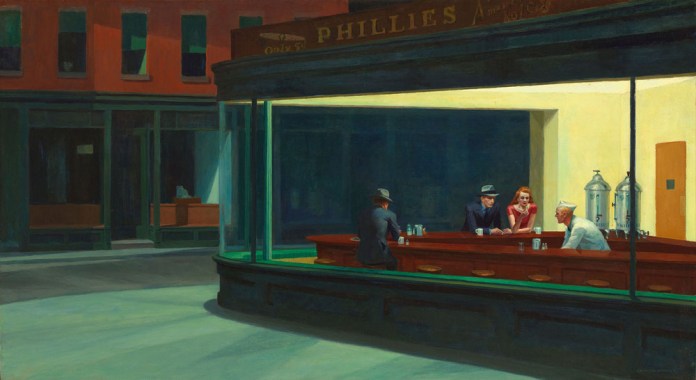
Rick and Ruth would be placed inside a large kitchen space encased in glass like the diner scene in Edward Hopper’s iconic painting Nighthawks.
Nighthawks by Edward Hopper, 1942

We would observe them sitting in their kitchen—drinking coffee, talking, cooking, and eating breakfast, lunch, or dinner, reading the newspaper, playing Scrabble, baking cookies, celebrating their birthdays, and washing and drying dishes.

The display would offer viewers an unfiltered window into the life of the couple, and the images, sounds, and conversations would document Rick and Ruth’s ease of interaction. The goal would be to reveal the secrets of this happy marriage.

As a result, the exhibit would aim to answer these central questions: What makes this couple different from others? What is the key to their bliss? And what advice or insights do they have for other couples in terms of making a relationship last?

From a technical standpoint, Rick and Ruth would need to be well-lit and microphones would need to be placed on or near them to pick up clean sound; the museum would also have to mount speakers or headphones near the display so the viewer could listen as the couple communicates.

As this idea spun wildly inside my brain, I felt a sense of joy bubbling within, and I smiled when I imagined Rick and Ruth hanging out in their hermetically sealed museum kitchen.

I could almost hear him saying something like, “You know, we’re gonna have to eat a little later because the chicken still needs to defrost before we put it in the oven.”

Ruth would then shoot Rick a dirty look, smack her lips or maybe place a hand on her hip. “Do you think so?” she would say. “God, you must think I’m a real idiot.”

Moments later, Ruth would be standing at the counter making a salad and Rick setting the table, and Ruth might turn to him and ask, “Hon, what do you feel like for dessert?”

“Oh, I don’t care,” he would say, his eyes lifting from the cutlery on the table. “Anything.”

“Well, we have that Entenmann’s crumb cake in the freezer. You want me to take it out?”

“Sure.”

“Yeah, that sounds good, doesn’t it hon?”

“You bet, Ruth. It does.”

Then, as the museum would get ready to close for the day, the lights to the kitchen display would be dimmed and Rick and Ruth would depart the exhibition space. And we wouldn’t be allowed to tag along with them when they walk outside the walls of the museum, get into their car, and head home for the night.

But I suspect not much would change between them, and I find this reassuring because I wouldn’t want to miss anything.

Standard

Book Giveaway

This week marks two years since my last poetry collection, The Truth I Must Invent, was released. The book is available from the publisher, Poets Choice. You can also find it on Bookshop and a Kindle version on Amazon.

The Truth I Must Invent is a collection of narrative and philosophical poems written in free-verse style. The book explores the themes of self, identity, loneliness, memory, existence, family, parenthood, disability, gratitude, and compassion.

I am giving away three print copies of the book, which I will mail to anyone in the U.S. You can use the contact form or email me directly at the gmail address listed in the form.

The Truth I Must Invent book cover.

Selections from the collection:

Man Inside Nighthawks

I assume I was nothing
before I found myself sitting here,
staring straight ahead.

I can’t move my head.
I can’t smoke the cigarette
pressed between the fingers
of my right hand or drink the cup
of coffee resting on top of the counter.
I can’t touch the woman seated next to me
or talk to the other men in the diner.

This is my life: suspended in warm, yellow light,
trapped in a soundless environment—
no water running, no fan whirring, or grill sizzling.
No sirens or street sounds beyond the glass.

Time drags on with no discernible shift—
no transition to morning.
Here, night never ends.

Yet my mind still works.
In fact, it never stops.
I’m cursed with thoughts that run continuously.

Why am I here?
And where exactly is here?
What purpose do I serve?

Do I have a past? Did I live elsewhere,
before I became frozen in this moment—
captured and imprisoned for eternity?

If only I could talk.
If only I could open my lips and make a sound.
Then I could scream for help.
But who would hear my voice?

If only I could stand up
and walk around,
stretch my legs and
stare outside the window.

But since I can’t move,
the composition will remain unaltered,
as I will stay locked in place
inside this painting,
hanging on a gallery wall.

Looking Through Spindles

I climb out of bed and clutch
the white balusters at the top of the stairs
as harsh words fly behind walls
too thin to hold my parents’ rage.

My sister creeps out of her room,
shrugs her shoulders,
and moves toward me in the hallway,
passing the door to the master bedroom.
She sits down next to me
and whispers, “What happened now?”
“I don’t know,” I say.
And we listen for clues, trying to determine
the cause of the latest fight.

Did Dad come to bed drunk
and make advances on our mother?
Did she recoil or lash out, scratching his eyes?
But we hear no violent action
on the other side of the white door—
only voices laced with acrimony.
And we remain seated on the stairs,
exhausted but unable to fall back asleep.

Zooming out, I see those siblings
in a Polaroid image, sealed under a plastic sheet
in a leather-bound photo album.
And as the adult looking back,
breaking the fourth wall,
I wonder why this memory pricks my brain
when so many others would illuminate my parents’
kindness, decency, and exemplary work ethic.
Why, when I could have chosen from
a myriad of positive scenarios,
does this one seize my attention,
demanding to be chronicled?

My mother and father are both dead
and can’t defend their actions.
And I feel riddled with guilt
for tarnishing their memories.
I also understand that the truth
doesn’t always tell the full story.
My conscience obligates me to explain that
while Mom and Dad weren’t perfect,
they loved us and endured sacrifices
to make our lives a little better.
And while that’s a weak way to end a poem,
the wider perspective allows me to
forgive my mother and father for being human—
for being real people and not just my parents.

Craniopharyngioma (Youthful Diary Entry)

Craniopharyngioma gave me
an excuse for being unattractive.
I had a problem inside my head.
It wasn’t my fault
I stood four foot eight inches tall
and looked like I was
twelve years old instead of eighteen—
and then nineteen
instead of twenty-four.
I couldn’t be blamed for
my sans-testosterone body
straddling the line
between male and female.

The brain tumor
spurred questions
about my appearance,
aroused ridicule,
and provoked sympathy.
I heard voices whispering:
“Guess how old that guy is?”
And, “Is that a dude or a chick?”

And while I waited for my
body to mature, to fall in line,
and to achieve normal progression,
I remember wishing the surgeons
had left the scalpel
inside my skull
before they closed me up,
knitting the stitches
from ear to ear.

I prayed the scalpel
would twist and twirl
while I slept at night—
carving my brain
like a jack-o’-lantern—
splitting the left and right
hemispheres,
and effacing the memory
of my existence.

Mattress Moment

You don’t get to cry
“No Fair”
Mr. Hyman Roth.

This is the life
you have chosen.

You don’t get to pine
for your salad days,
whatever the fuck that means.

You don’t get to
flip over the mattress
on the bed you’ve made.

The Wanting is the Hardest Part

Tom Petty was wrong.
The waiting isn’t the hardest part.
The wanting is the hardest part.

Wanting fucks everything up—
wanting a better job, a better marriage,
a better house, a better life.
That seed of desire fucks with your head,
makes you think you can be something you’re not.

What if I discarded desire? What if stopped wanting?
What if I no longer sought a better life?
Can I let go of that fantasy
and accept who I am right now,
without seeking a better version of myself—
the idealized me I hold inside my head?

Resolution

You must
Live the life
You have

And not
The one
You want.

Witness

I look up as a group of birds
circles buildings in downtown Syracuse.
I resist the urge to pull out my cellphone
and snap a picture for Instagram.

Instead, I hold my gaze skyward,
letting the wind swirl around my face
and the rain patter my forehead,
as the birds duck in unison
behind a limestone structure—
the moment preserved nowhere except in my mind.

No pictures retained or sound recorded.
No trace of the birds in digital form.
And I think that’s the point, that’s life—
a collection of these impromptu glimpses of existence,
built into a collage, a kaleidoscope of images
demanding attention when presented.

Crying at Bedtime

Nothing prepares a parent
for the tantrums of an autistic child.
There’s no well of patience to draw from.
You adapt. You divert. You distract.
You do whatever it takes to calm the child down—
until you earn that blessed moment of peace,
when his eyelids drop and he drifts off to sleep,
his small body folded in the cradle of your arms.

Fingers in Hair

I run my fingers through
my son’s tangled mop of brown hair
as he lies next to me in bed.
It’s 4:30 a.m. and we can’t fall asleep.

He waves his hands in front of his eyes,
making stimming motions,
and I imagine his head slamming
against the windshield,
a spiderweb crack forming
in the sheet of glass and
blood pouring from
an opening in his skull.

I press my hand to his head
to try to stop the bleeding,
but the crimson liquid
slips through my fingers
and stains the carpet
and fabric seat covers.

I am reminded of a
Gospel passage (Luke 12:7 NIV):
“Indeed, the very hairs
of your head are all numbered.”

I hold some of my son’s hairs
in my hand and realize
I cannot prevent a
car accident, fall, gunshot wound,
or disease from killing my son.
I can’t prolong or preserve his life.
I can only love him while he still lives.

His hands whip in front of his face,
and he prattles phrases
only he understands.
I bury my fingers deeper
into the mound of his hair and whisper,
“Come on now, sleepy time, Colin.”


Standard

Man Inside Nighthawks: A Flash Fiction Story

Here’s a flash fiction story inspired by the Edward Hopper painting Nighthawks.

I assume I was nothing before I found myself sitting here, staring straight ahead. But I don’t know for sure.

This is what I do know: I can’t move my head. I can’t smoke the cigarette pressed between the fingers of my right hand or drink the cup of coffee resting on top of the counter. I can’t touch the woman seated next to me or talk to the other two men.

This is my life. Suspended in warm, yellow light. Unable to move, locked in a soundless existence—no water running, fan whirring or grill sizzling. No sirens or street sounds beyond the glass.

Time drags on with no discernible shift—no transition to morning. Here night never ends.

Yet my mind still works. In fact, it never stops; I’m cursed with thoughts that run continuously.

I wonder: Why am I here? And where exactly is here? What purpose do I serve? Why put me next to these people and not give me an opportunity to interact with them?

Do I have a past? Did I exist before I became frozen in this moment—captured and imprisoned for eternity?

As you can see, I have nothing but questions that yield no answers. If only I could talk to the other people. If only I could pry open my lips and make a sound. Then maybe we could communicate. Maybe we could figure out our reason for being here. Then I could scream for help. But who would hear my voice and who would come to our aid?

If only I could stand up and walk around, stretch my legs and peek outside the window.

But then I would upset the balance of the composition. And so I will stay in place. Funny, right? I don’t have a choice. I can’t move even if I wanted to. So I’ll be here any time you feel like looking at me.

Standard

Beyond the Glass Premieres in Las Vegas

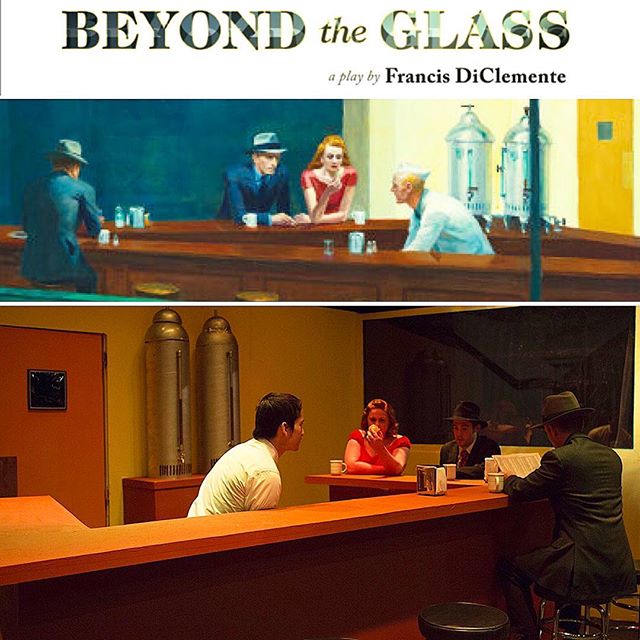
My full-length stage play Beyond the Glass, inspired by the Edward Hopper painting Nighthawks, premiered last weekend at the Las Vegas Little Theatre. As the winner of its ninth annual New Works Competition, the LVLT has produced the play in the theater’s black box space.

Images by Courtney Sheets and the Las Vegas Little Theatre.

The show closes on May 14, and I am going out to Las Vegas this weekend to see it. Prior to the production, the play had staged readings in Toronto and Chicago. Here is the synopsis for the work:

In Beyond the Glass, one of the diner’s customers, Ray, wrestles with an existence he abhors but cannot alter. Ray feels trapped inside the urban coffee shop, but he cannot leave, since there is no door. The character Ed then reveals that he once lived on the outside as the artist Edward Hopper and had painted the diner scene. Ray plots to escape, but his plans are thwarted by the restrictions of the space and the realization that he is a figure locked in a painting.

Images by Courtney Sheets and the Las Vegas Little Theatre.

As excited as I am about having my first play produced—with real sets, real costumes, and real actors speaking the words I wrote on the page—my greatest joy is that I finished the piece. The project proved to me the importance of persistence when it comes to the creative process.

Images by Courtney Sheets and the Las Vegas Little Theatre.

I started writing the play in the mid-1990s, but I struggled with the plot. None of the versions I wrote worked because I tried to make it so Ray could leave the diner. I thought about what would happen to him in the outside world, where he would go, how he would survive, etc. He ended up coming out of the painting and “falling” onto the floor in one of the gallery spaces at the Art Institute of Chicago. Security guards chased him and then he roamed the streets of the city, hiding out while the investigation into his disappearance from the painting continued. I even questioned whether his painted surface would wash away if it became exposed to rain. The whole idea seemed artificial and forced to me; I became blocked, and then I gave up and decided to shelve the script around 2006.

Images by Courtney Sheets and the Las Vegas Little Theatre.

But a couple of years ago, a question tickled my brain: What would happen if Ray could never leave the diner, if he found out he would remain stuck inside for all of eternity? How would he react? What would he do? That was my breakthrough, and the drama of the play laid itself out for me in a simple and direct fashion. I’m not sure if the story works in its current form, but I’ll be observing the play with the intention of revising the script after I return from Las Vegas.

Standard

Filed Under Miscellaneous

I’ve been busy with video projects and working on my long-term nonfiction project, so I haven’t had time to blog much lately. But I wanted to share a few items worth noting.

The No Extra Words flash fiction podcast has produced one of my stories, Frozen Food, as part of its Episode 39: Sum of the Parts. The story was originally published in the online magazine The Literary Hatchet. You can listen to the podcast from the website or access it here.

Secondly, one of my essays, on the topic of “the writing life,” has been posted as a blog entry by the online magazine South 85 Journal. You can read the story here.

I also have good some good news about my experimental short film Fragments of the Living. The piece has been accepted as an official entry in the 2016 Athens International Film + Video Festival in Athens, Ohio. It will be screened on April 10.

And NewFilmmakers NY has selected Fragments of the Living to be part of its Spring 2016 Screening Series on April 25 at the Anthology Film Archives in Manhattan.

new filmmakers laurels 2016

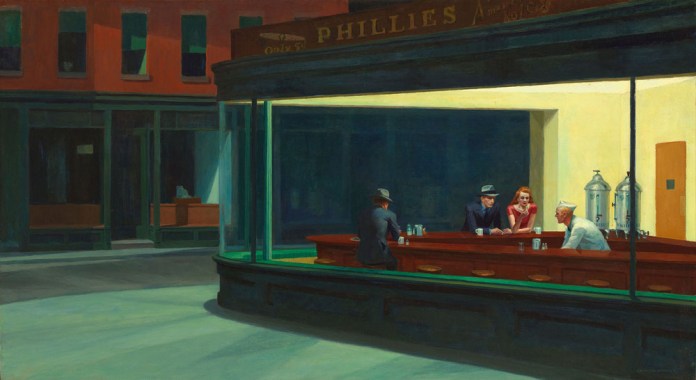
Lastly on the writing front, my full-length stage play Beyond the Glass, inspired by the Edward Hopper painting Nighthawks, was read by actors recently at the WILDsound Writing and Film Festival in Toronto.

Nighthawks by Edward Hopper, 1942.

Nighthawks by Edward Hopper, 1942.

Here’s the link with some information about the project, which I still consider a work in progress. When I get the time (and the courage), I intend to watch to the table reading with headphones and a notebook so I can jot down ideas and notes about problem areas in the script. Revision Awaits Me!

And finally I have one personal note I must share. And this trumps everything else. My wife Pamela gave birth to our son, Colin Joseph DiClemente, on Friday, Feb. 26, 2016, at 10:29 p.m. at St. Joseph’s Hospital in Syracuse.

Colin Joseph DiClemente at the pediatrician's office.

Colin Joseph DiClemente at the pediatrician’s office.

Both mother and baby are doing well, and we are getting used to having a little one in the apartment. Of course, this means less sleep for us and short writing blocks for me, before I get pulled away from the computer by the sound of Colin screaming or a request by Pam for me to make up a bottle of formula. So I will be writing in bursts, trying to get down bits of text before duty calls. I hope the words I type in first-draft form will make some sense to me later.


Standard