My newest indie film, The Bus Hub, premieres this week as part of the Summer Series online festival, presented by NewFilmmakers New York. You can watch the film for free here until the end of the month.

The film was also accepted into the 2026 New York Lift-Off Film Festival. My film is in the Trailblazers Shorts program. There is a paywall for the Lift-Off Festival, but you get access to many high-quality films.

Logline:
The Bus Hub immerses viewers in the sights and sounds of Syracuse’s Centro Transit Hub, revealing the rhythms of a city in motion.
Synopsis:
The Bus Hub is an experimental documentary short that explores the Centro Transit Hub in downtown Syracuse, New York, capturing the rhythms, architecture, and atmosphere of this vital urban space. Through observational footage, the film offers a unique perspective on the daily flow of commuters and the role a transit hub plays in a city’s life. The documentary invites viewers to experience the hub not just as a transportation center, but as a living, breathing part of Syracuse’s urban fabric.
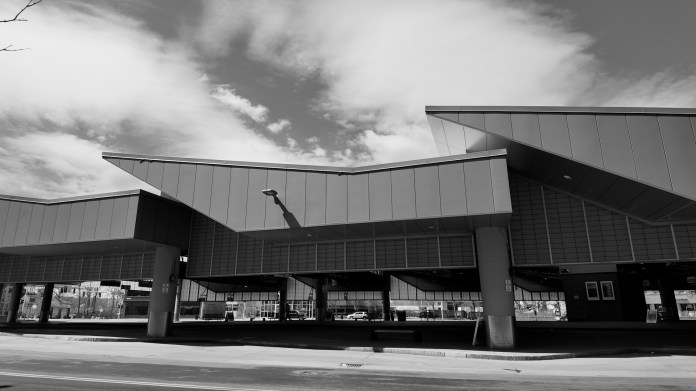
Exterior of the Centro Transit Hub (screen grab).
Director/Artist Statement:
Few places are as diverse or democratic as a city bus hub. Similar to an urban ER waiting room, the hub brings people from all walks of life together in a raw confluence of humanity.
The Centro Transit Hub at the intersection of Salina and Adams streets in downtown Syracuse is a beehive of activity—a small-scale, outdoor Grand Central Terminal. Here we encounter the careworn faces of people heading to work or home to their families.
We see the cycle of life with a diverse mix of young and old passengers occupying the space. It’s a mélange of people who would otherwise not mingle.
For this project, I had intended to meet bus riders (and some drivers) at the hub and interview them, inspired by Studs Terkel’s book Working: People Talk About What They Do All Day and How They Feel About What They Do. I am also a bus rider, taking a bus to downtown Syracuse every weekday morning for work, so I can relate to the experience of other Centro riders.
I wanted to ask people at the hub some questions on camera, such as:
Where are you going? Where are you coming from?
Why do you ride the bus?
Do you like riding the bus?
What do you think about while you ride the bus and look out the window?
What kind of work do you do? Do you like it?
Are you happy with your life? If not, why?
What frightens you? What are you passionate about?
What are your hopes and dreams?
What do you want most out of your life?
However, on the very first day of filming at the hub, an angry man snatched my camera (an Osmo Pocket 3) and threatened to throw it on the ground. A Centro staff member interceded on my behalf and defused the situation. But the dangerous encounter spooked me, and I was afraid to approach people and ask them questions. After that, the only interview I conducted was with myself as both filmmaker and bus rider.
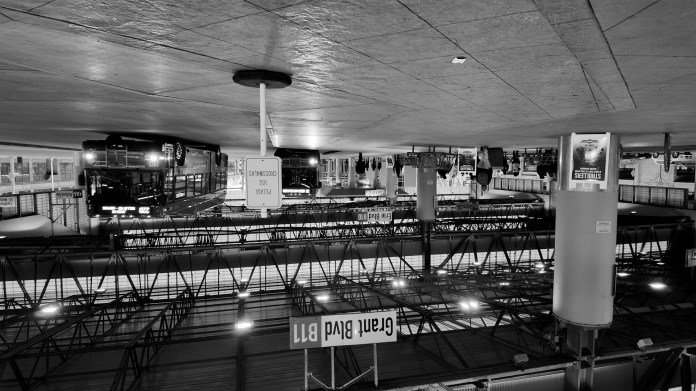
Upside down angle after the man took my camera. But the Osmo kept recording.
I kept going to the hub, but I stood back and filmed scenes in wide-angle mode, in an observational documentary style—watching the flow of passengers and sometimes shooting in slow motion. A separate video art piece, Bus Riders, emerged from the production of the documentary short. It is a straight visual expression with no narration.
I must also note that although I have several years of experience in video production, I am not a videographer. I lack the skills involved in that craft (or the strength to haul cameras and gear), but I wanted to try to shoot everything myself with the little Osmo.
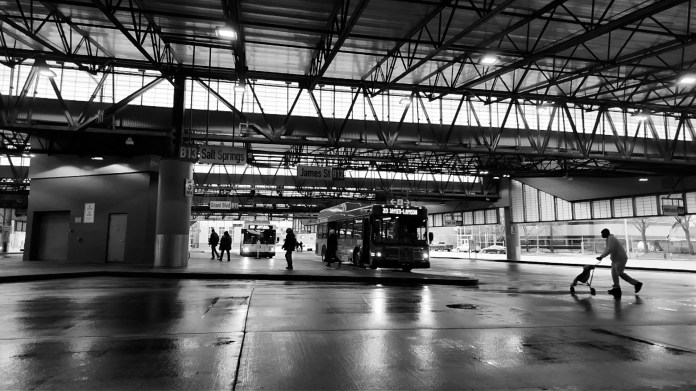
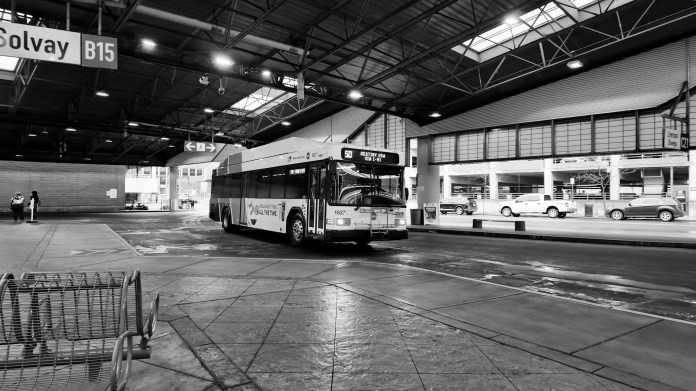
Screen grab showing observational style.