Recalling my Father on His Birthday

Today marks the birthday of my late father, who passed away from lung cancer at the age of 64 in August of 2007. This post was first published in 2016 and has been revised slightly. Francis DiClemente Sr. was a quiet man who led a solitary life.

My late father, Francis DiClemente Sr.

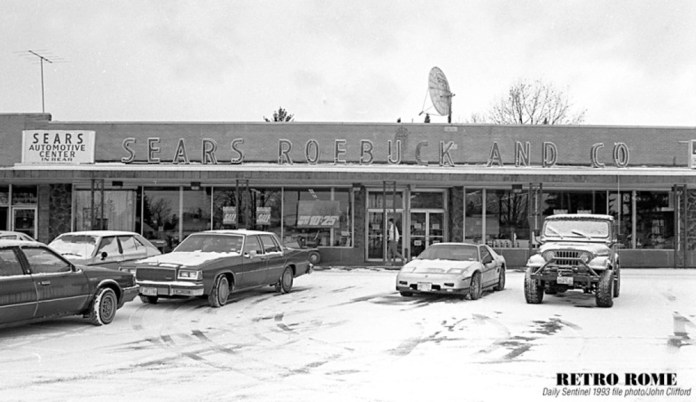
He put in 32 years at the Sears Roebuck store in Rome, New York, before the company decided to close it in the early 1990s. He rose to the ranks of a sales manager after starting his employment in his late teens, and he served in all departments: electronics, home improvement, heating and cooling, paints, and even the automotive center.

The Sears store in Rome in 1993. Photo by John Clifford/Daily Sentinel.

One of my childhood thrills was visiting him at the store after school, as we would descend a flight of stairs into a warehouse in the basement—filled with washers and dryers, lawnmowers, rolls of carpet, and other merchandise. We would go into the break room, and he would buy me a soda from the glass vending machine—usually Nehi grape, root beer, or Dr. Pepper—and then pour a cup of coffee for himself. We’d sit and talk at a little round table covered with the latest edition of the Utica Observer-Dispatch or the Rome Daily Sentinel newspaper.

Things I recall about him:

His lupine face with dark, searching eyes, bushy eyebrows and thick, black hair.

Being a devoted player of the New York Lottery. He scored some jackpots on occasion, including one that totaled more than a thousand dollars. But the scant prizes could never make up for what he spent on a daily basis.

After he died, I went through his room to clean out things, and I discovered innumerable losing lottery tickets stuffed inside one of his dresser drawers. I couldn’t understand why he would save tickets that held zero value. Was he trying to run the numbers through some elaborate mathematical system in order to calculate a winning combination, some key to unlock the mystery of how to beat the odds?

Being a habitual gambler with a penchant for playing football parlays. But his real joy came from betting the horses at the local OTB, sharing camaraderie with other men infected with the same urges, all of them standing around scribbling in the margins of the Daily Racing Form.

After the Sears store closed, he took a low-paying sales job at a carpet store. He complained about the crumbling upstate New York economy and grumbled about his bad luck, repeating the phrase, “I can never catch a break.” Even so, he endured his situation and became a valued employee at the store—one who was highly regarded for treating customers well and giving them deals whenever he could.

When he was diagnosed with cancer, the doctor told him he could try chemotherapy, but it would only give him a slim chance of living slightly longer. He decided against the treatment, noting, “What’s the point?” And so in February of 2007, he stoically accepted his fate, knowing he had only about six to nine months left to live.

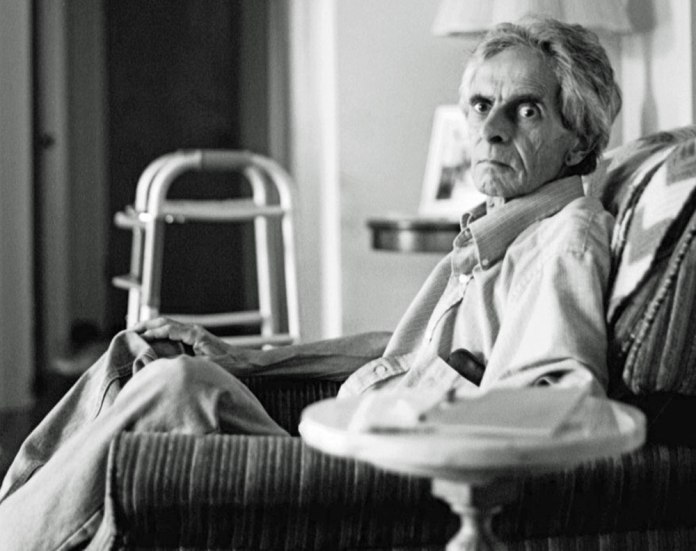
Dad in his chair. It’s out of focus, but I love how he looks directly at the camera. Photo by Francis DiClemente.

I had recently relocated to Central New York from Arizona, and I was fortunate enough to spend a lot of time with him before he passed.

He lived with his mother, my grandmother Amelia, a stooped, red-haired woman who had coddled my father from the early days of his youth. He clung to her as the anchor of his life, which contributed to the demise of my parents’ marriage and also affected our relationship.

My late grandmother, Amelia DiClemente.

I don’t fault my grandmother because I don’t think she could have helped herself when it came to trying to protect my dad. He had been born with a hole in his heart, and the life-threatening condition worsened as he grew. He was a short, frail, and underweight boy who was mocked by other kids about his size, labeled as a “shrimp.”

In the late 1950s, my grandparents took my father to Minneapolis, where pioneering heart surgeon C. Walton Lillehei repaired the ventricular septal defect in a seven-and-a-half-hour operation at the University of Minnesota Heart Hospital.

And Dad was proud to have been among the first batch of patients to survive open-heart surgery in the U.S. Whenever he told the story to someone, he would lift up his shirt and show off the long scar snaking down the middle of his chest.

His medical history inspired this short poem:

Open Heart

My father was born
with a hole in his heart,
and although repaired,
nothing in his life,
ever filled it up.
The defect remained,
despite the surgeon’s work—
a void, a place I could never touch.

Dreaming of Lemon Trees: Selected Poems (Finishing Line Press, 2019)

##

As the months passed in the spring and early summer of 2007, he became weaker and weaker as the cancer ate away at his body, leaving him looking like a shriveled scarecrow.

He had always eschewed desserts and when offered them, would say, “No. I hate sweets.” But as his time on earth elapsed, he went all out when it came to food—eating Klondike bars, Little Debbie snacks, Hostess cupcakes, and other junk food. His philosophy was “Why not?”

Although he had Medicaid, Dad left behind a staggering amount of unpaid medical bills. But what troubles me more, what I have been unable to reconcile, is how he ran up thousands of dollars in debt in the last few months of his life, the largest chunk coming from ATM cash withdrawals using my grandmother’s credit card.

I was never able to pin down how he spent the money. He made no large purchases of electronics or home furnishings. I assumed he used the money to gamble; but in some way I wish he had supported a mistress or a family he never told us about, or that he gave away the cash to charities. Instead, I am only left with unanswerable questions. I helped him to file for bankruptcy, but in an ironic turn to the story, he died before a decision was reached in the case.

Dad, side angle. Photo by Francis DiClemente.

I remember a funny conversation I had with him one afternoon while we sat in the living room of my grandmother’s small ranch house in north Rome. Sunlight poured through a large bay window, past the partially opened silk curtains. Outside I could see a clear sky and trees burgeoning with leaves—a bright, saturated landscape of blue and green.

I sat in a corner of the room and he sat in a forest-green recliner covered with worn upholstery.

“What’s the name of the angel of death?” he asked me.

I was surprised by the question, and I said, “I think he’s just called the angel of death.”

“No, he has another name,” he said.

And after a few seconds it came to me. “The Grim Reaper.”

“That’s right, that’s it,” he said.

“Why do you want to know?” I asked. “Did you see him in a dream or something?

“No, but I want to know his name when he comes.”

That conversation sparked an idea for a full-length play, entitled Awaiting the Reaper. I could go on and on about my dad, but that’s the strongest memory I have of him in his waning days.

Dad in the kitchen. Photo by Francis DiClemente.

Dad never earned prestigious academic honors, never published a book, never ran a company or made enough money in his lifetime to buy a retirement home in Florida.

Instead, he toiled away in obscurity and mediocrity as a working-class person. My sister and I received no inheritance, save a small insurance policy that paid out after his death. And his shy, aloof nature created a buffer with other people, a barrier to forming deep relationships (except with a few close friends).

A photo of my father and me following my Confirmation in 1984.

Yet in reviewing his life, I know his kindness, work ethic, and willingness to help others set an example for me that I have tried to uphold. And the debts he accrued do not cancel out those qualities.

The one word I keep coming back to is decency. My father was a good and decent man. That may not be cause for celebration in our society. But it’s enough to fill me with pride, and I hope to carry on his values as I carry on his name.

I’ll close this post with two poems. The second one also mentions my late mother, Carmella.

The Galliano Club

From street-level sunlight to cavernous darkness,
then down a few steps and you enter The Galliano Club.
Cigar smoke wafts in the air above a cramped poker table.
Scoopy, Fat Pat and Jules are stationed there,
along with Dominic, who monitors it all,
pacing pensively with fingers clasped behind his back.

A pool of red wine spilled on the glossy cherry wood bar,
matches the hue of blood splattered on the bathroom wall.
A cracked crucifix and an Italian flag loom above,
as luck is coaxed into the club with a roll of dice
and a sign of the cross.

Pepperoni and provolone are piled high for Tony’s boys,
who man the five phone lines
and scrawl point spreads on thick yellow legal pads.
Bocce balls collide as profanity whirls about . . .
and in between tosses, players brag about
cooking calamari (pronounced “calamad”).

Each Sunday during football season,
after St. John’s noon Mass,
my father strolls across East Dominick Street
and places his bets,
catapulting his hopes on the shoulder pads of
Bears, Bills, Packers and Giants.
His teams never cover
and he’s grown accustomed to losing . . .
as everything in Rome, New York exacts a toll,
paid in working class weariness and three feet of snow.

But once inside The Galliano, he feels right at home,
recalling his heritage, playing cards with his friends.
And here he’s no longer alone,
as all have stories of chronic defeat.
Blown parlays, slashed pensions
and wives sleeping around,
constitute the cries of small-town men
who have long given up on their out-of-reach dreams.

For now, they savor the moment—
a winning over/under ticket, a sip of Sambuca
and Sunday afternoons shared in a place all their own.

Dreaming of Lemon Trees: Selected Poems (Finishing Line Press, 2019)

Vestiges

My parents are gone.
They walk the earth no more,
both succumbing to lung cancer,
both cremated and turned to ash.

With each passing year,
their images become more turbid in my mind,
as if their faces are shielded
by expanding gray-black clouds.
I try to retain what I remember—
my father’s deep-set, dark eyes and aquiline nose,
my mother’s small head bowed in thought or prayer
while smoking a cigarette in the kitchen.

I search for their eyes
in the constellations of the night sky.
I listen for their voices in the wind.
Is that Rite Aid plastic bag snapping in the breeze
the voice of my father whispering,
letting me know he’s still around . . .
somewhere . . . over there?
Does the squawking crow
perched in the leafless maple tree
carry the voice of my mother,
admonishing me for wearing a stained sweater?

Resorting to a dangerous habit,
I use people and objects as “stand-ins”
for my mother and father,
seeking in these replacements
some aspect of my parents’ identities.

A sloping, two-story duplex with cracked green paint
embodies the spirit of my father saddled with debt,
playing the lottery, hoping for one big payoff.
I want to climb up the porch steps and ring the doorbell,
if only to discover who resides there.

In a grocery store aisle on a Saturday night
I spot an older woman
standing in front of a row of Duncan Hines cake mixes.
With her short frame, dark hair, and glasses,
she casts a similar appearance to my mother.
She is scanning the labels,
perhaps looking for a new flavor,
maybe Apple Caramel, Red Velvet, or Lemon Supreme,
just something different to bake
as a surprise for her husband.
A feeling strikes me and
I wish to claim her as my “fill-in” mother.
I long to reach out to this stranger in the store,
fighting the compulsion
to place a hand on her shoulder
and tell her how much I miss her.

I fear that if my parents disappear
from my consciousness,
then I too will become invisible.
And the reality of a finite lifespan sets in,
as I calculate how many years I have left.
But I realize I am torturing myself
with this twisted personification game.
I must remember my parents are dead
and possess no spark of the living.
And I can no longer enslave them in my mind,
or try to resurrect them in other earthly forms.
I have to let them go.
I have to dismiss the need for physical ties,
while holding on to the memories they left behind.

And so on the night I see the woman
in the grocery store aisle,
I do not speak to her,
and she does not notice me lurking nearby.
But as I walk away from her,
I cannot resist the impulse to turn around
and look at her one last time—
just to make sure
my mother’s “double” is still standing there.
I want her to lift her head and smile at me,
but she never diverts her eyes
from the boxes of cake mixes lining the shelf.

Sidewalk Stories (Kelsay Books, 2017)

Standard

For the First Day of Fall

Thought While Jogging

Can you hear the cries
of the leaves
carried on the wind
as they disengage
from the maple tree—
falling to the ground
and perishing in a pile?

This poem feels like a partner to “The Casualties of Autumn,” from November 2024, which you can find here.


Standard

Some Days

Some Days

Some days I love my life.
Some days I hate my life.
But I’m thankful for every day
I receive the gift of having
A life to complain about.

Standard

Remembering Damon DeCosty

My younger cousin Damon DeCosty died of a heart attack in Jacksonville, Florida, on May 25. He was 53 years old. A celebration of his life is planned for July 22 (his birthday) in Jacksonville.

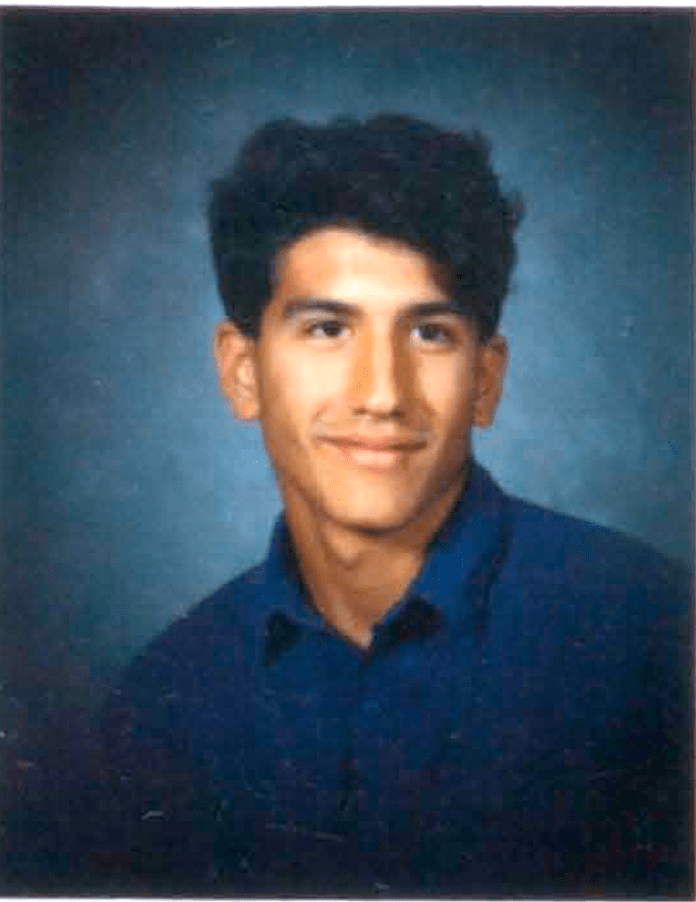
Damon’s high school yearbook photo.

Damon’s death was a huge blow to our family because his older brother, Derek DeCosty, passed away from pneumonia in January 2025.

My high school years overlapped with all three DeCosty brothers—Fiore (nicknamed “Fee”) being the oldest, followed by Derek, and then Damon, who was two years younger than me.

My cousin Fee (right), Damon (center) and I celebrate my sister Lisa’s birthday in 1980.

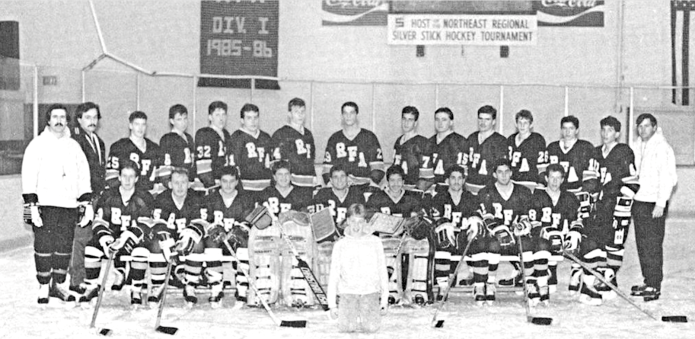
His obituary notes that he was born in Rome, New York, and was a member of the 1987-1988 undefeated Rome Free Academy hockey team, which won the state title. He played hockey and studied art at the State University of New York at Fredonia. He later worked in construction in Key West before beginning a career in agronomy at TPC Sawgrass Golf Course near Jacksonville.

The 1987-88 state champion RFA hockey team. Damon is the last player standing in the second row, next to Coach Dick Meiss.

But those facts don’t resonate with me on an emotional level. And in processing this loss and trying to write about it, no coherent narrative emerged. There’s no Hero’s Journey or three-act structure to guide you in mourning a loved one.

Instead, I recall images and voices—murky memories and episodic scenes that, when juxtaposed, add up to the human being known as Damon DeCosty and what he meant to his family and friends.

The things I remember about Damon:

His bronze skin, dark eyes, and black hair. He was of Italian American descent on his father’s side and Native American, with Caddo Nation heritage, on his mother’s side.

His artistic talent. I remember his hand moving across a sketch pad and seeing his artwork hanging in his room.

His placid, reserved, and affable personality. Although Damon possessed a James Dean coolness, he wasn’t aloof. Instead, you felt a sense of calmness in his presence, and people gravitated to him because of his kindness.

Damon with his dad, my Uncle Fiore DeCosty.

Damon had heart surgery at Crouse Hospital in Syracuse when he was about five years old in 1976. While my Uncle Fiore (Fee) and Aunt Pat stayed with Damon at the hospital, Fee and Derek spent the night at my parents’ house on Stanwix Street in Rome, near the Oneida County Courthouse on North James Street. I think it was a school night, and my mom packed my cousins’ lunches in their twin metal lunch boxes featuring Brazilian soccer legend Pelé.

When Damon recovered from surgery, he insisted on a sleepover at our house because he missed out on the fun, and I remember stretching out on the floor next to him as we slept.

I recall Damon and I spending a summer afternoon at our grandparents’ house on Crossgates Road. No one else was around, and we ran around in our bare feet on the patio, our feet turning black, and frolicked on the lawn, leaping over a sprinkler (a poor kid’s substitute for a swimming pool), our denim jean shorts getting soaked as we inhaled the scent of fresh-cut grass.

My cousins lived in a housing development on Seville Drive in north Rome. It seemed like a subdivision had been dropped in the middle of cleared farmland. Damon’s mom, my Aunt Pat, was a dietitian. And while the growing boys always had enough to eat, she didn’t buy them junk food. Their cereal choices were healthy, whole-grain products, such as Wheaties and Cheerios.

Damon (seated) and Derek with their mom, my Aunt Pat (sometime around 1980).

But on at least one occasion, while spending the weekend with my cousins, I remember my Aunt Pat went out shopping, and Derek and Fee sprang into action. They raced around the house, collecting small bills and coins, and gave the money to Damon with instructions to run across a cornfield and buy a box of sugary cereal at a nearby convenience store. Damon returned with a box of Frosted Flakes, Cocoa Pebbles, Trix, or Lucky Charms (I can’t remember the exact brand). But we all sat at the kitchen table, passing around the milk and wolfing down bowls of cereal, then discarding the box and hiding the evidence before Aunt Pat returned home.

In remembering Damon, I also find myself thinking about my late father, Francis DiClemente Sr., and reflecting on how divorce complicates family relationships, especially for children. When families fracture, the boundaries between relatives blur.

My mother and Damon’s father were siblings. Does that mean when my parents divorced, my dad stopped being an uncle to the DeCosty boys? Or after Damon’s parents divorced, did his mom (who was also my godmother) cease being my aunt?

Does divorce sever relations with non-blood relatives? Do you erase the bonds of love and family just because a couple separates? That’s a topic for a whole separate essay.

I bring this up because many years after my parents split, my dad would ask about Fee, Derek, and Damon. He really cared about them. And if they visited the Sears store in Rome where he worked, they would seek him out and say “hello.”

And it’s not politically correct, but whenever my father asked about Damon, he would say, “Hey, how’s the Little Chief doing? What’s up with the Little Chief? Tell the Little Chief I said ‘hello.’”

I must also admit that when I heard Damon had died, one of the first thoughts that popped into my head was that Fiore is now The Last of the Mohicans (also not politically correct).

Damon and I bonded over our mutual love of music. Our shared tastes included U2, The Cure, Grateful Dead, Genesis, The Replacements, R.E.M., Jane’s Addiction, The Cult, The Smiths, and many other artists.

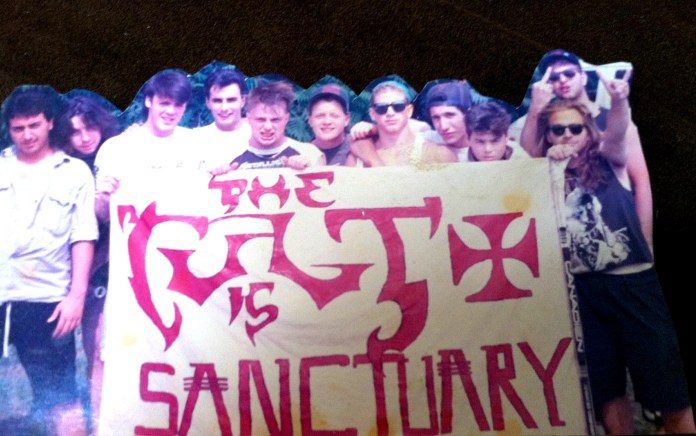
Damon and I were part of a contingent of Romans that went to the Metallica concert in Weedsport, NY on July 16, 1989. We were more eager to see the opening act, The Cult. Damon is wearing the backwards baseball cap.

Fee shared a couple of Damon’s YouTube music playlists with me. One is titled Essential Dead, and includes tracks from the Grateful Dead and other jam bands. The other is titled simply Work.

I enjoy shuffling through the Work playlist and imagining Damon mowing a fairway, adjusting a pin placement at TPC Sawgrass, doing some odd carpentry work, or putting the final touches on a large-scale oil painting. The playlist contains more than 300 tracks—over seven hours of music—and it consoles me knowing I’m listening to songs curated by Damon, tracks that held special meaning for him.

Standard

Memories of My Mother

My mother passed away from lung cancer thirteen years ago today. It’s hard to believe she’s been gone that long. When Carmella died, I was recovering from transsphenoidal brain surgery (through the nose) and couldn’t attend her wake or funeral mass. The surgeons instructed me to avoid blowing my nose for at least eight weeks, and I was concerned about getting emotional at the services and springing a cerebral spinal fluid leak.

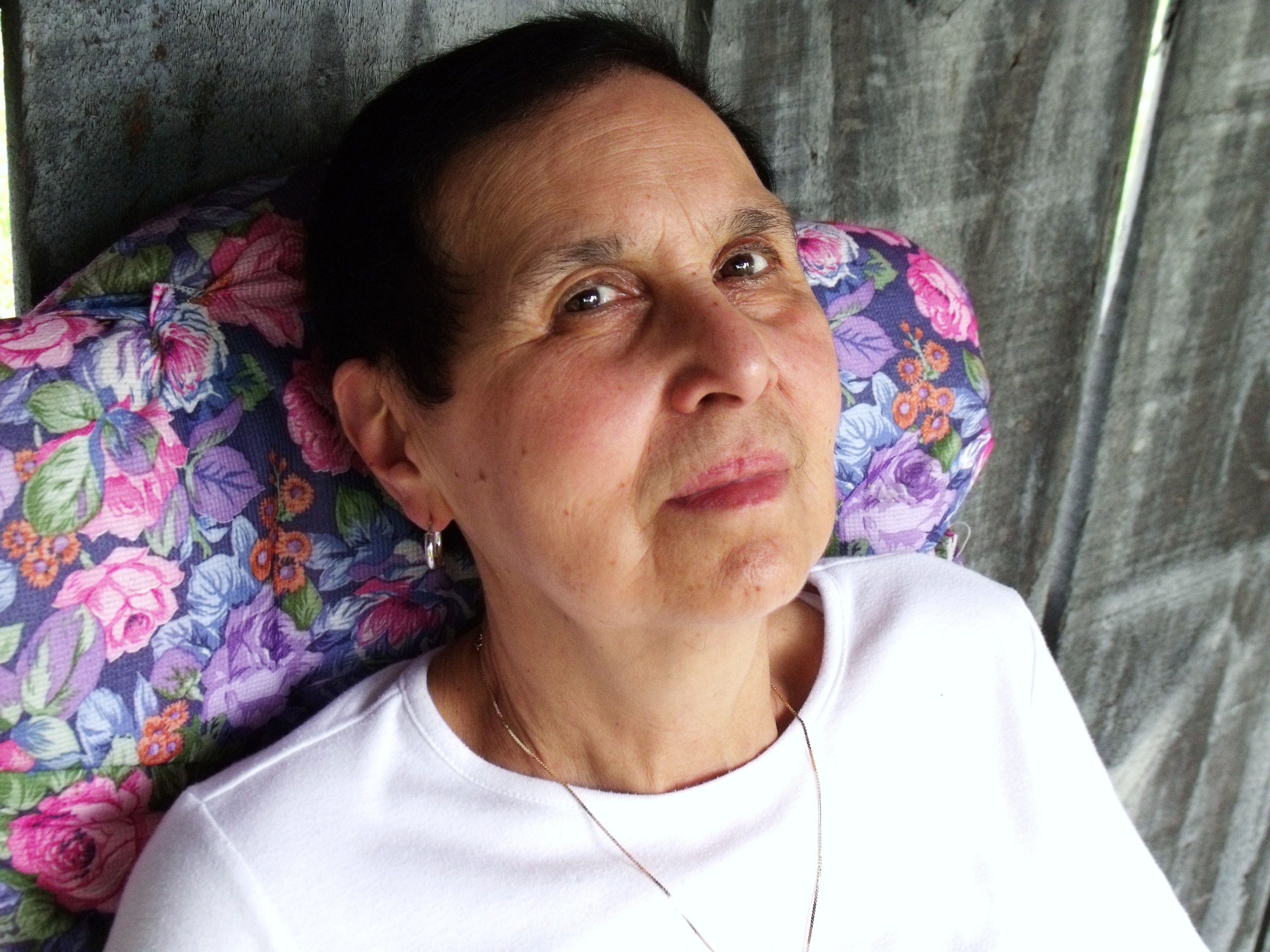
Carmella DeCosty Ruane.

These days, I think about Carm when washing the dishes she gave me or ruminating about how she would have loved spoiling my son, Colin.

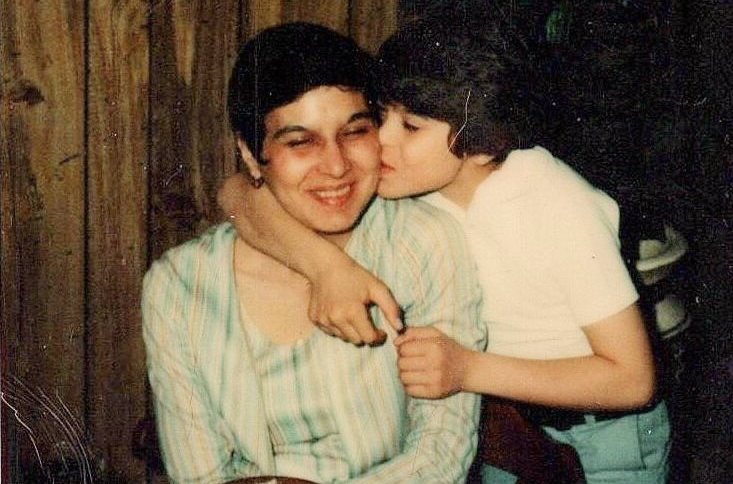
My parents and my sister, Lisa, kissing me.

Here are two poems that capture the memory and spirit of my mother.

Morning Coffee

My mother sits
in the kitchen chair
after she recites
her morning prayers.
Sunlight streams through
the lace curtains
and cigarette smoke
is suspended in the air.
She bows her small head
and presses her fingers
to the bridge of her nose,
as she contemplates
the chores for the day,
while her milky coffee cools
in a blue ceramic mug
resting within reach
on the laminate counter.

Vestiges

My parents are gone.
They walk the earth no more,
both succumbing to lung cancer,
both cremated and turned to ash.

With each passing year,
their images become more turbid in my mind,
as if their faces are shielded
by expanding gray-black clouds.
I try to retain what I remember—
my father’s deep-set, dark eyes and aquiline nose,
my mother’s small head bowed in thought or prayer
while smoking a cigarette in the kitchen.

I search for their eyes
in the constellations of the night sky.
I listen for their voices in the wind.
Is that plastic bag snapping in the breeze
the voice of my father whispering,
letting me know he’s still around …
somewhere … over there?
Does the squawking crow
perched in the leafless maple tree
carry the voice of my mother,
admonishing me for wearing a stained sweater?

Resorting to a dangerous habit,
I use people and objects as “stand-ins”
for my mother and father,
seeking in these replacements
some aspect of my parents’ identities.

A sloping, two-story duplex with cracked green paint
embodies the spirit of my father saddled with debt,
playing the lottery, hoping for one big payoff.
I want to climb up the porch steps and ring the doorbell,
if only to discover who resides there.

In a grocery store aisle on a Saturday night
I spot an older woman
standing in front of a row of Duncan Hines cake mixes.
With her short frame, dark hair, and glasses,
she casts a similar appearance to my mother.
She is scanning the labels,
perhaps looking for a new flavor,
maybe Apple Caramel, Red Velvet, or Lemon Supreme,
just something different to bake
as a surprise for her husband.
A feeling strikes me and
I wish to claim her as my “fill-in” mother.
I long to reach out to this stranger in the store,
fighting the compulsion
to place a hand on her shoulder
and tell her how much I miss her.

I fear that if my parents disappear
from my consciousness,
then I too will become invisible.
And the reality of a finite lifespan sets in,
as I calculate how many years I have left.
But I realize I am torturing myself
with this twisted personification game.
I must remember my parents are dead
and possess no spark of the living.
And I can no longer enslave them in my mind,
or try to resurrect them in other earthly forms.
I have to let them go.
I have to dismiss the need for physical ties,
while holding on to the memories they left behind.

And so on the night I see the woman
in the grocery store aisle,
I do not speak to her,
and she does not notice me lurking nearby.
But as I walk away from her,
I cannot resist the impulse to turn around
and look at her one last time—
just to make sure
my mother’s “double” is still standing there.
I want her to lift her head and smile at me,
but she never diverts her eyes
from the boxes of cake mixes lining the shelf.

Standard

In Honor of Abby

While walking on the campus of Le Moyne College last Sunday, I saw this bronze plaque with a poem in honor of a deceased student. The wording captured my interest.

Abby Bohnert ’19

Everyone’s friend.

Red lipstick and thick socks.
Giggles so loud they echo down the hall.
“She is Heaven and Hell’s love child.
Hold her. Name her poem.”

February 5, 1997 – August 8, 2016

A quick Google search shows that Abby died suddenly in 2016. And her mother passed away days later, making the story even more tragic.

I don’t have any wise words to share, except that Abby must have been a very special woman to be remembered with such a beautiful tribute on campus.

Standard

Honoring My Two Dads

On this Father’s Day, I pay tribute to my two dads, the late Francis DiClemente Sr. and my stepfather, the late William Ruane. I was blessed to have these two wonderful men nurture me and influence my life. Here are some photos and writing selections honoring them.

That’s me on the left with my father, mother and sister Lisa.

Open Heart

My father was born
with a hole in his heart,
and although repaired,
nothing in his life,
ever filled it up.
The defect remained,
despite the surgeon’s work—
a void, a place I could never touch.

Outskirts of Intimacy (Flutter Press, 2010) and Dreaming of Lemon Trees: Selected Poems (Finishing Line Press, 2019)

Photo of my dad and me from my Confirmation at St. John the Baptist Church in Rome, NY.

The Galliano Club

From street-level sunlight to cavernous darkness,
then down a few steps and you enter The Galliano Club.
Cigar smoke wafts in the air above a cramped poker table.
Scoopy, Fat Pat and Jules are stationed there,
along with Dominic, who monitors it all,
pacing pensively with fingers clasped behind his back.

A pool of red wine spilled on the glossy cherry wood bar,
matches the hue of blood splattered on the bathroom wall.
A cracked crucifix and an Italian flag loom above,
as luck is coaxed into the club with a roll of dice
and a sign of the cross.

Pepperoni and provolone are piled high for Tony’s boys,
who man the five phone lines
and scrawl point spreads on thick yellow legal pads.
Bocce balls collide as profanity whirls about . . .
and in between tosses, players brag about
cooking calamari (pronounced “calamad”).

Each Sunday during football season,
after St. John’s noon Mass,
my father strolls across East Dominick Street
and places his bets,
catapulting his hopes on the shoulder pads of
Bears, Bills, Packers and Giants.
His teams never cover
and he’s grown accustomed to losing . . .
as everything in Rome, New York exacts a toll,
paid in working class weariness and three feet of snow.

But once inside The Galliano, he feels right at home,
recalling his heritage, playing cards with his friends.
And here he’s no longer alone,
as all have stories of chronic defeat.
Blown parlays, slashed pensions
and wives sleeping around,
constitute the cries of small-town men
who have long given up on their out-of-reach dreams.

For now, they savor the moment—
a winning over/under ticket, a sip of Sambuca
and Sunday afternoons shared in a place all their own.

Outskirts of Intimacy (Flutter Press, 2010) and Dreaming of Lemon Trees: Selected Poems (Finishing Line Press, 2019)
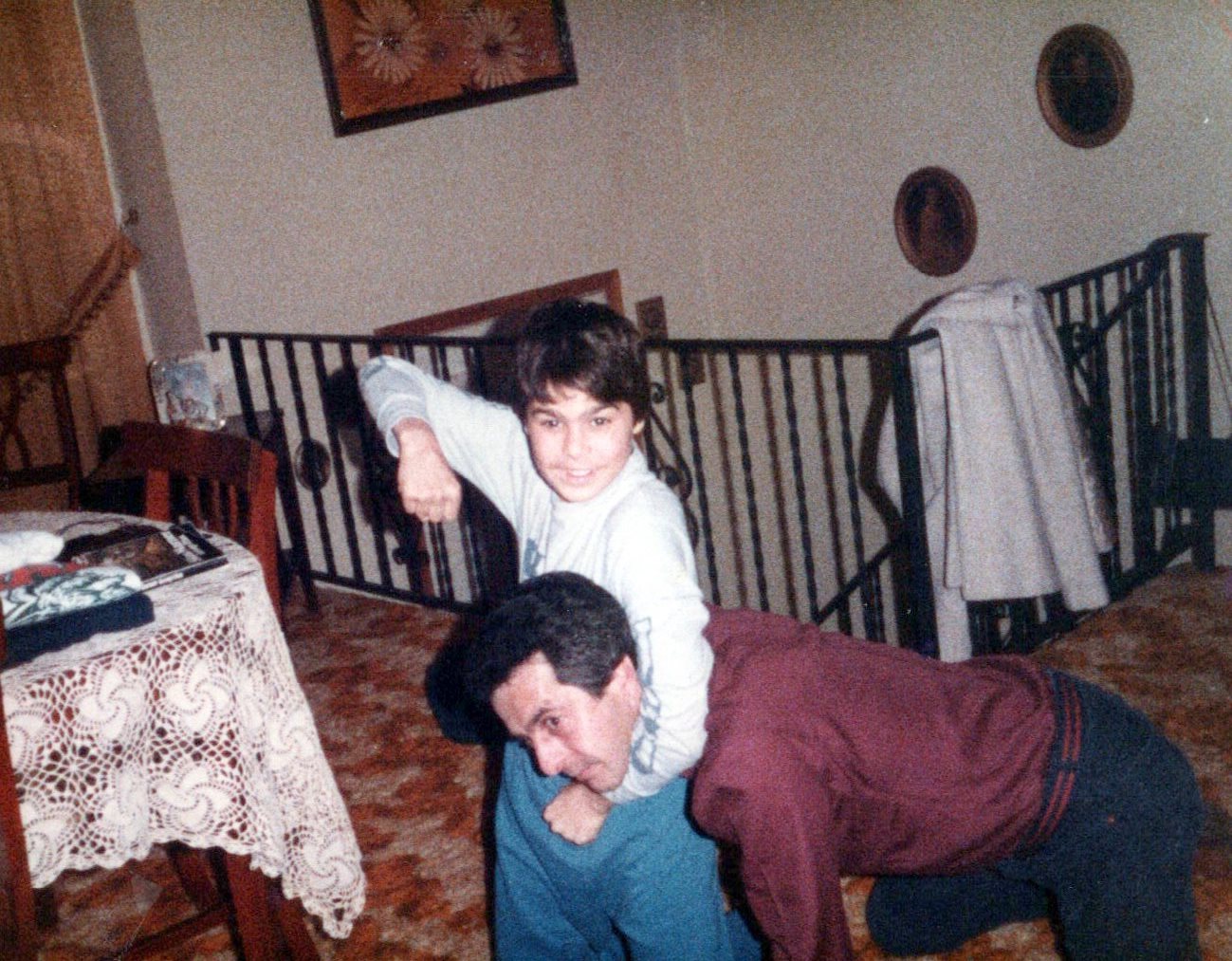
Dad and I rolling around on the floor.

Diagnosis

Dad put the car in park and let it idle,
and as I slid into the passenger seat and adjusted myself,
he leaned over and kissed me on the cheek,
his tan winter coat brushing against the steering wheel.
I felt a trace of his razor stubble against my skin,
and I could smell a faint odor of Aqua Velva or Brut,
combined with cigarette smoke.
The heater hummed, and he lowered the blast of air.
I wondered why we weren’t moving yet.
He wasn’t crying,
but he appeared on the verge of spilling emotions.

“What’s the matter, Dad?” I asked.
“The hospital called your mother today.”
He switched on the overhead light,
reached into his jacket pocket,
and pulled out a torn piece of paper.
“Here,” he said, handing me the slip of paper,
“This is what they think you have.
I wrote it down, but I don’t think I spelled it right.”
Scribbled in faint blue ink was a misspelling
of the word “craniopharyngioma.”
My father’s voice cracked as he said,
“It’s cranio-phah-reng,
something like that . . . oh, I don’t know,
it’s some kind of brain tumor.”

I looked at the paper and felt a wave of satisfaction
as my father let out a sigh.
He seemed locked into position in the driver’s seat,
unable to shake off the news and go through the motions
of putting the car in gear and driving away.
We clutched hands, and I said, “It’s OK, Dad. Don’t worry.
But what do we do now? What’s next?”
“You have to go back there for more tests,” he said.
You may need surgery.”
“All right,” I said.
He switched off the overhead light,
and we exited the parking lot.
We grew silent inside the car
as we passed the naked trees lining Pine Street
in our city of Rome, New York.

While my father was crestfallen,
I felt elated as I sat in the passenger seat.
The CT scan with contrast had given me
a medical diagnosis—
a reason for my growth failure at age fifteen.
It explained why my body had not changed,
why I had not progressed through puberty,
and why I was so different from the other boys my age.
I still considered myself a physical anomaly,
but the tumor proved it wasn’t my fault.

That knowledge gave me satisfaction
and a stirring of excitement.
I looked down at the piece of paper again
and studied the word—“craniopharyngioma.”
I tried to sound it out in my head while my dad drove on.
I thought the word would roll off my tongue
like poetry if I said it out loud.
Craniopharyngioma. Cranio-Phar-Ryng-Ee-Oh-Mah . . .
sort of like onomatopoeia.

The Truth I Must Invent (Poets Choice, 2023)

Dad in the kitchen. Photo by Francis DiClemente.

Death Mask

Assume the death mask,
put on your final face
like those insolent characters
in that Twilight Zone episode—you know the one,
with their cruel faces contorted
and fixed there for all time’s sake.

My father wore his death mask.
He kept it on even though I arrived after his passing
on that soft warm August evening.
I’ll never forget the way he looked,
with his mouth agape, eyes vacant, cheeks sunken,
body withered and shriveled,
curled up in the fetal position on his deathbed
in my grandmother’s sweltering death house.

I allowed myself to look at him for just a moment.
I then turned around and left him alone
in his small bedroom.
I did this for my benefit, since I wanted to remember him
as a father and a man
and not as a corpse in a locked-up state.
This is because the death mask grips its lonely victim
and sucks out the life and extinguishes the person.

I shuffled into the living room,
rejoining the Hospice nurse and the neighbors
who came across the street
to comfort my grandmother and express remorse.
And Grandma, still acting as host
despite the occasion and the heat,
asked me to make a pot of coffee for her guests.
The neighbors sat on the old, out-of-style couches
and chairs in my grandmother’s ranch home
off Turin Road in north Rome.
They conversed in hushed tones and sipped coffee
while we waited for the workers from the funeral parlor
To drive up to the house and wheel away my father.

Outskirts of Intimacy (Flutter Press, 2010) and Dreaming of Lemon Trees: Selected Poems (Finishing Line Press, 2019)

Dad in his chair. It’s out of focus, but I love how he looks directly at the camera. Photo by Francis DiClemente.

St. Peter’s Cemetery

I extend a hand to touch an angel trapped in marble.
Its face is cool and damp, like the earth beneath the slab.
I pose a question to my deceased father,
Knowing the answer will elude me.
For his remains are not buried in this cemetery,
But instead rest on a shelf in my sister’s suburban Ohio house.

Outskirts of Intimacy (Flutter Press, 2010) and Dreaming of Lemon Trees: Selected Poems (Finishing Line Press, 2019)

Dad rocking the denim cut-off shorts.

Vestiges

My parents are gone.
They walk the earth no more,
both succumbing to lung cancer,
both cremated and turned to ash.

With each passing year,
their images become more turbid in my mind,
as if their faces are shielded
by expanding gray-black clouds.
I try to retain what I remember—
my father’s deep-set, dark eyes and aquiline nose,
my mother’s small head bowed in thought or prayer
while smoking a cigarette in the kitchen.

I search for their eyes
in the constellations of the night sky.
I listen for their voices in the wind.
Is that Rite Aid plastic bag snapping in the breeze
the voice of my father whispering,
letting me know he’s still around . . .
somewhere . . . over there?
Does the squawking crow
perched in the leafless maple tree
carry the voice of my mother,
admonishing me for wearing a stained sweater?

Resorting to a dangerous habit,
I use people and objects as “stand-ins”
for my mother and father,
seeking in these replacements
some aspect of my parents’ identities.

A sloping, two-story duplex with cracked green paint
embodies the spirit of my father saddled with debt,
playing the lottery, hoping for one big payoff.
I want to climb up the porch steps and ring the doorbell,
if only to discover who resides there.

In a grocery store aisle on a Saturday night
I spot an older woman
standing in front of a row of Duncan Hines cake mixes.
With her short frame, dark hair, and glasses,
she casts a similar appearance to my mother.
She is scanning the labels,
perhaps looking for a new flavor,
maybe Apple Caramel, Red Velvet, or Lemon Supreme,
just something different to bake
as a surprise for her husband.
A feeling strikes me and
I wish to claim her as my “fill-in” mother.
I long to reach out to this stranger in the store,
fighting the compulsion
to place a hand on her shoulder
and tell her how much I miss her.

I fear that if my parents disappear
from my consciousness,
then I too will become invisible.
And the reality of a finite lifespan sets in,
as I calculate how many years I have left.
But I realize I am torturing myself
with this twisted personification game.
I must remember my parents are dead
and possess no spark of the living.
And I can no longer enslave them in my mind,
or try to resurrect them in other earthly forms.
I have to let them go.
I have to dismiss the need for physical ties,
while holding on to the memories they left behind.

And so on the night I see the woman
in the grocery store aisle,
I do not speak to her,
and she does not notice me lurking nearby.
But as I walk away from her,
I cannot resist the impulse to turn around
and look at her one last time—
just to make sure
my mother’s “double” is still standing there.
I want her to lift her head and smile at me,
but she never diverts her eyes
from the boxes of cake mixes lining the shelf.

Sidewalk Stories (Kelsay Books, 2017)

##

A fictional poem with a Father’s Day theme.

Father’s Day Forgotten

Daddy and Christi parted ways at a bus depot
In the early morning hours.
No big scene, just a kiss on the cheek,
Then she turned around and was gone for good—
Hopping aboard a Trailways bus
Headed westbound for Chicago.
And she never looked back.

Daddy went home to his beer bottle and sofa seat,
And he drew the living room curtains
On the rest of the world,
Letting those four eggshell walls close in
And swallow him up,
Wasting away in three empty rooms and a bath.

And the memories can’t replace his lost daughter and wife.
So he tries not to remember his mistakes
Or how he drove them away.
Instead, he recalls Halloween pumpkins
Glowing on the front porch,
Training wheels moving along the uneven sidewalk,
Little hands reaching for bigger ones in the park,
And serving Saltine crackers and milk
To chase away the goblins that haunted
Dreams in the middle of the night.

Now Christi has a life of her own,
And she lets the answering machine catch
Daddy’s Sunday afternoon phone call.
She never picks up and rarely calls back.
So Daddy returns to the green couch
Pockmarked with cigarette burns.
He closes his eyes, opens the door to his memory vault
And watches the pictures play in slow-motion.
He rewinds again and again,
Without noticing the film has faded
And the little girl has stepped out of the frame.

Vestiges (Alabaster Leaves Publishing/Kelsay Books, 2012) and Dreaming of Lemon Trees: Selected Poems (Finishing Line Press, 2019)

##

Carm and Bill celebrating Bill’s birthday.

I never called Bill “Dad,” but I considered him a second father instead of a stepfather. He and my mother, Carmella, started dating around 1985 and were married in 1990. From about the time I turned fifteen, during my formative years, Bill was always there, and he played an instrumental role in my transition from boy to man.

Weekend in Albany

Night—diminished faith now fights for restoration,
aided by rosary beads pressed between the gnarled fingers
of the retired Sisters of the Academy of Holy Names.
And silent petitions are mouthed
in an air-conditioned hospital chapel,
as Sister Carmella—my Aunt Theresa—
storms the gates of heaven for healing intervention,
sending out special pleas to Our Lady of Perpetual Help.

Inside the surgical Intensive Care Unit,
fluorescent lights reveal my stepfather Bill’s post-op image.
The sight of his figure catches me unprepared—
glassy eyes, belly stained with iodine,
an incision running down the sternum,
and a ventilator forcing air into his smoker’s lungs.
Mom stays close to his bed,
afraid to look away or leave the room.
Her small body trembles and
displays the effects of chemotherapy’s wrath,
evident in hollow cheeks
and in the absence of her black hair.

Unbearable heat conquers the Capital District,
and Mom finally crumbles when our used Chevy Blazer
hisses and groans and stalls along New Scotland Avenue.
She sits down on the roadside curb, dejected.
Her tears cannot be held in any longer . . . they gush forth
as she holds a cigarette and sips a lukewarm cup of coffee.
Almost in slow motion,
a few drops fall toward her Styrofoam cup.
I reach out to catch them,
but they slip through my outstretched fingers.

And after two days in Albany, my sister and I
must leave our mother to return home to Toledo.
On the flight back, in a plane high above
the patchwork of northwest Ohio’s farms and fields,
streaks of pink and lavender compose the sunset’s palette.
And I realize all I can do is pray;
I’m left to trust faith in this family crisis.
I ask God to hasten Bill’s recovery,
while giving Mom the strength to abide.

I lean against the window
as the plane touches down in Toledo.
I close my eyes and consider if my prayers
are just wishes directed toward the clouds.
No matter, I tell myself, pray despite a lack of trust.
And so I do. I focus my thoughts on my stepfather
breathing without a ventilator
and being moved out of the ICU.

Outskirts of Intimacy (Flutter Press, 2010) and Dreaming of Lemon Trees: Selected Poems (Finishing Line Press, 2019)

##

This essay was published in 2013 in Star 82 Review.

Man in the Chair

It is late in the afternoon on a fall or winter day, and I am visiting my mother and stepfather at their home in Rome, New York. They are sitting in their family room watching TV; if I had to guess, I’d say the show is Judge Judy, Criminal Minds or NCIS.

My stepfather Bill, who owns his own contracting business, is reclining in his favorite chair, wearing a work-stained hoodie and sipping a cup of coffee. I walk into the room and sidle up to him. I put my hand on the bald crown of his head, which has a fringe of brownish-gray hair on the sides, and I feel the warmth emanating from his skull. Often when I do this, Bill will say, “God, your hand is freezing.” But he does not say anything, and I leave my hand on top of his head and take a glance at the television screen while darkness gathers outside the windows.

A sick realization makes me shudder. I pull my hand away because I recognize in the moment that the head of this man I love could, in a matter of seconds, be crushed with a baseball bat or cracked open with an ax blade. Blood could splatter against the walls, and he would slump over in the chair, inert.

And I think this not because I am homicidal or possess a desire to kill my stepfather. Quite the opposite. Fear sets in because I realize the man sitting in the chair, with a beating heart, functioning brain and sense of humor, could be gone in an instant. He could be animated in one moment and his breath snuffed out in the next.

Bill getting a haircut from George, a barber in Rome, New York. Photo by Francis DiClemente.

Most likely my stepfather will not be killed by a blow to the head or a tree crashing through the house. A heart attack, stroke or cancer will probably get him in the end. And while I already know this, I pause and allow this knowledge to sink in, so I will appreciate him better.

A year or two after this dark afternoon, my mother would lose her battle with cancer. And her death would remind me that we do not live life all at once. It’s not one big project we need to complete by a deadline or a trip to Europe you have planned for years.

Instead, we experience life in small doses, tiny beads of time on a string. And it helps to recognize them, to acknowledge you are present and alive even in the most mundane circumstances—while you are talking with co-workers in the parking lot before heading home for the day, running errands, doing laundry, baking a chocolate cake, tossing a football with friends and reading to your kids at bedtime. These are subplots that drive our stories forward. They are not exciting. They are not memorable. But they are part of our existence, and we must value them before they and we are gone.

So, after I pull my hand away from Bill’s head, I decide to sit on the couch next to my mother. She hates when people talk during a program because it distracts her, so I look at the screen even though I am not interested in the show, and I do not say a word. But during a commercial break, she mutes the sound with the remote control, and Bill and I converse about something. And I can’t remember the topic we discussed, and it doesn’t really matter.

##

These clown wind chimes once hung on the walkway leading to Bill’s back door.

Black and white clown wind chimes. Photo by Francis DiClemente.

I wrote this poem in haste after finding out that Bill passed away on Dec. 25, 2021.

Poem for Bill 

I wonder where he is right now.
Is he soaring through the layers
of space between earth and heaven?

Is he sitting in a holding cell,
awaiting his purgatory sentence?

Is his body weightless
and his brain wiped clean?

Does he know he’s dead?
Or is there nothing left to know?

Standard

Bocce and Burial

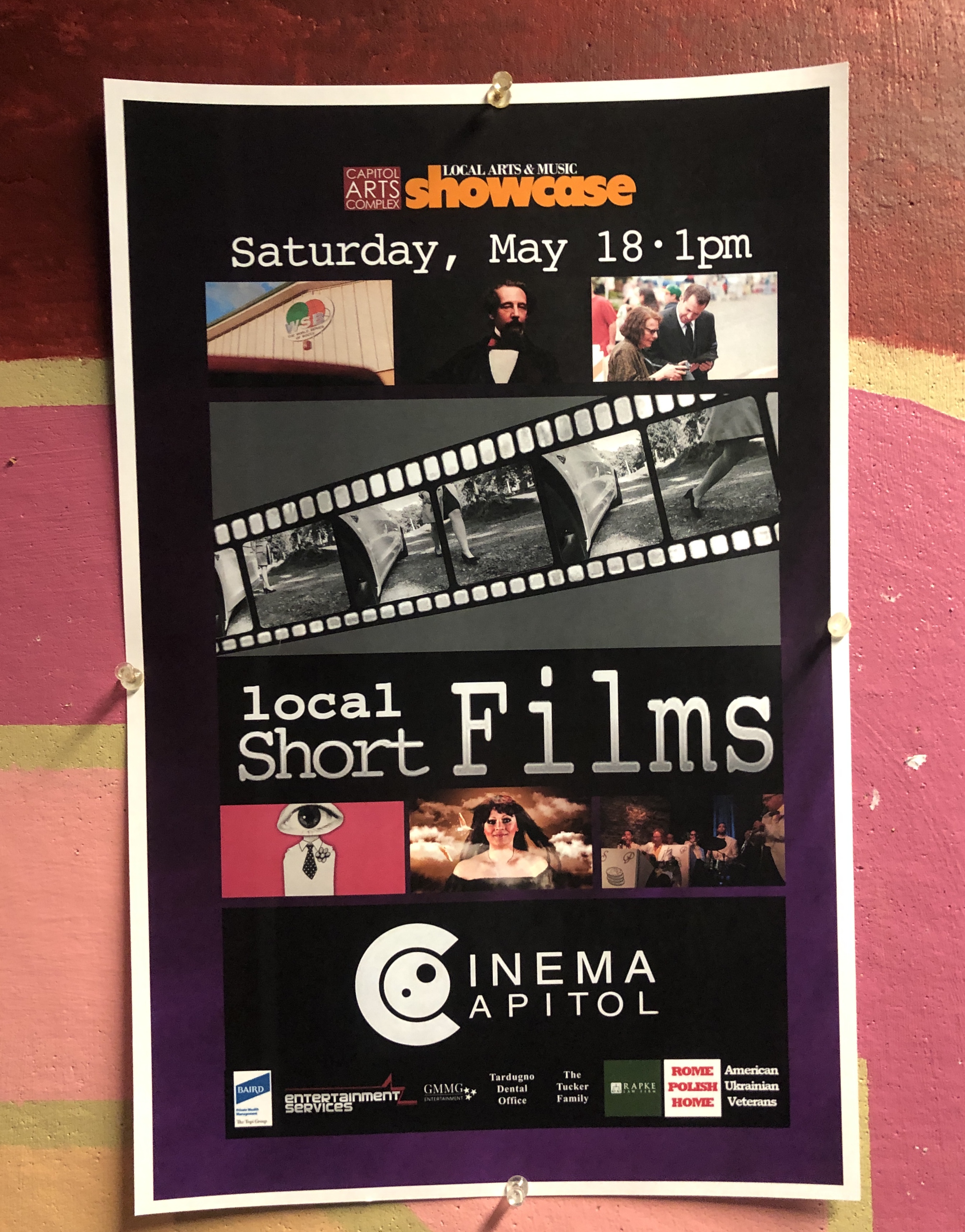
I am following up on my previous bocce documentary distribution post. Our film, The World Series of Bocce: A Celebration of Sport, Family and Community, was screened on Saturday, May 18 at Capitol Cinema in Rome as part of a Local Short Film Showcase. My family, co-producer Bill Vinci and editor Mary Kasprzyk attended the event.

From L to R: Francis DiClemente, Bill Vinci and Mary Kasprzyk.

That same day, in the morning, the cremated remains of my father were buried in St. Peter’s Cemetery. My dad had passed away in 2007, but I only found out recently that the plot he had purchased many years ago remained under his name—meaning we could inter his ashes in the cemetery. My sister, Lisa, had kept them with her in Ohio for all these years.

There’s no headstone or grave marker to indicate where Francis Sr. now rests, but it’s a nice spot tucked in a green corner not far from the intersection of Herkimer Avenue and Cayuga Street. I’m sure he’d approve of the location, especially since it’s only a few hundred feet from his parents’ graves.

St. Peter’s Cemetery in Rome, NY.

Under gray skies, Father I. presided over the burial service, sprinkling holy water while small, flying insects buzzed around us, my sister swatting them away.

Father I. said, “We are returning Francis. He stayed with you for a while, and now it’s time for him to rest. We know his spirit is already in heaven.”

Father I. then said the most consoling words I’ve ever heard at a wake, funeral or memorial service: “When you see him again, he will not look old. He will not look young. He will just be. And you will know him, and he will know you.”

And just a final note. The documentary will make its broadcast premiere on WCNY on July 11. But you can watch it for free now through the PBS app.

Standard

Father’s Day Poems

For Father’s Day, I thought I would post some pieces honoring my father, the late Francis DiClemente Sr., and my stepfather, the late William Ruane.

The first poem is a fictitious, but the father character was inspired by my dad.

Father’s Day Forgotten

Daddy and Christi parted ways at a bus depot
In the early morning hours.
No big scene, just a kiss on the cheek,
Then she turned around and was gone for good—
Hopping aboard the Trailways bus headed westbound for Chicago.
And she never looked back.

Daddy went home to his beer bottle and sofa seat,
And he drew the living room curtains on the rest of the world,
Letting those four eggshell walls close in and swallow him up,
Wasting away in three empty rooms and a bath.

And the memories can’t replace his lost daughter and wife.
So he tries not to remember his mistakes
Or how he drove them away.
Instead he recalls Halloween pumpkins glowing on the front porch,
Training wheels moving along the uneven sidewalk,
Little hands reaching for bigger ones in the park,
And serving Saltine crackers and milk
To chase away the goblins that haunted
Dreams in the middle of the night.

Now Christi has a life of her own,
And she lets the answering machine catch
Daddy’s Sunday afternoon phone call.
She never picks up and rarely calls back.
So Daddy returns to the green couch
Pockmarked with cigarette burns.
He closes his eyes, opens the door to his memory vault
And watches the pictures play in slow-motion.
He rewinds again and again without noticing the film has faded
And the little girl has stepped out of the frame.

Dad in the kitchen. Photo by Francis DiClemente.

Open Heart

My father was born
with a hole in his heart,
and although repaired,
nothing in his life
ever filled it up.
The defect remained,
despite the surgeon’s work—
a void, a place I could never touch.

The Galliano Club

From street-level sunlight to cavernous darkness,
then down a few steps and you enter The Galliano Club.
Cigar smoke wafts in the air above a cramped poker table.
Scoopy, Fat Pat and Jules are stationed there,
along with Dominic, who monitors the game,
pacing with fingers clasped behind his back.

A pool of red wine spilled on the glossy cherry wood bar,
matches the hue of blood splattered on the bathroom wall.
A cracked crucifix and an Italian flag hang above,
as luck is coaxed into the club with a roll of dice
and a sign of the cross.

Pepperoni and provolone are piled high for Tony’s boys,
who man the five phone lines
and scrawl point spreads on yellow legal pads.
Bocce balls collide as profanity whirls about . . .
and in between tosses, players brag about
cooking calamari (pronounced “calamad”).

Each Sunday during football season, after St. John’s noon Mass,
my father strolls across East Dominick Street and places his bets,
catapulting his hopes on the shoulder pads of
Bears, Bills, Packers and Giants.
His teams never cover and he’s grown accustomed to losing . . .
as everything in Rome, New York, exacts a toll,
paid in working class weariness and three feet of snow.

But once inside The Galliano, he feels right at home,
recalling his heritage, playing cards with his friends.
And here he’s no longer alone,
as all have stories of chronic defeat.
Blown parlays, slashed pensions and wives sleeping around,
constitute the cries of small-town men
who have long given up on their out-of-reach dreams.

For now, they savor the moment—
a winning over/under ticket, a sip of Sambuca
and Sunday afternoons shared in a place all their own.

Dad, side angle. Photo by Francis DiClemente.

Death Mask

Assume the death mask,
put on your final face
like those insolent characters
in that Twilight Zone episode—you know the one,
with their cruel faces contorted and fixed there for all time’s sake.

My father wore his death mask.
He kept it on even though I arrived after his passing
on that soft, warm August evening.
I’ll never forget the way he looked,
with his mouth agape, eyes vacant, cheeks sunken,
body withered and shriveled,
curled up in the fetal position on his soiled deathbed
in my grandmother’s sweltering death house.

I allowed myself to look at him for just a moment.
I then turned around and left him alone in his small bedroom.
I did this for my benefit, since I wanted to remember him
as a father and a man and not as a corpse in a locked-up state.
This is because the death mask grips its lonely victim
and sucks out the life and extinguishes the person.

I shuffled into the living room,
rejoining the Hospice nurse and the neighbors who came
across the street to comfort my grandmother and express remorse.
And Grandma, still acting as host despite the occasion and the heat,
asked me to make a pot of coffee for her guests.
The neighbors sat on the old, out-of-style couches and chairs
in my grandmother’s ranch home.
They conversed in hushed tones and sipped coffee
while we waited for the workers from the funeral parlor
to drive up to the house and wheel away my father.

St. Peter’s Cemetery

I extend a hand to touch an angel trapped in marble.
Its face is cool and damp, like the earth beneath the slab.
I pose a question to my deceased father,
Knowing the answer will elude me.
For his remains are not buried in this cemetery,
But instead rest on a shelf in my sister’s suburban Ohio house.

##

I never called Bill “Dad,” but I considered him a second father instead of a stepfather. He played an instrumental role in my adult formation. Here are two works about him.

Weekend in Albany

Night—diminished faith now fights for restoration,
aided by rosary beads pressed between the gnarled fingers
of the retired Sisters of the Academy of Holy Names.
And silent petitions are mouthed
in an air-conditioned hospital chapel,
as Sister Carmella—my Aunt Theresa—
storms the gates of heaven for healing intervention,
sending out special pleas to Our Lady of Perpetual Help.

Inside the surgical Intensive Care Unit,
fluorescent lights reveal my stepfather Bill’s post-op image.
The sight of his figure catches me unprepared—
glassy eyes, belly stained with iodine,
an incision running down the sternum,
and a ventilator forcing air into his smoker’s lungs.
Mom stays close to his bed,
afraid to look away or leave the room.
Her small body trembles and
displays the effects of chemotherapy’s wrath,
evident in hollow cheeks
and in the absence of her black hair.

Unbearable heat conquers the Capital District,
and Mom finally crumbles when our used Chevy Blazer
hisses and groans and stalls along New Scotland Avenue.
She sits down on the roadside curb, dejected.
Her tears cannot be held in any longer . . . they gush forth
as she holds a cigarette and sips a lukewarm cup of coffee.
Almost in slow motion,
a few drops fall toward her Styrofoam cup.
I reach out to catch them,
but they slip through my outstretched fingers.

And after two days in Albany, my sister and I
must leave our mother to return home to Toledo.
On the flight back, in a plane high above
the patchwork of northwest Ohio’s farms and fields,
streaks of pink and lavender compose the sunset’s palette.
And I realize all I can do is pray;
I’m left to trust faith in this family crisis.
I ask God to hasten Bill’s recovery,
while giving Mom the strength to abide.

I lean against the window as the plane touches down in Toledo.
I close my eyes and consider if my prayers
are just wishes directed toward the clouds.
No matter, I tell myself, pray despite a lack of trust.
And so I do. I focus my thoughts on my stepfather
breathing without a ventilator and being moved out of the ICU.

Bill getting a haircut from George, a barber in Rome, New York. Photo by Francis DiClemente.

This essay was published in Star 82 Review several years ago.

Man in the Chair

It is late in the afternoon on a fall or winter day, and I am visiting my mother and stepfather at their home in Rome, New York. They are sitting in their family room watching TV; if I had to guess, I’d say the show is Judge Judy, Criminal Minds or NCIS.

My stepfather, Bill, who owns his own contracting business, is reclining in his favorite chair, wearing a work-stained hoodie and sipping a cup of coffee. I walk into the room and sidle up to him. I put my hand on the bald crown of his head, which has a fringe of brownish-gray hair on the sides, and I feel the warmth emanating from his skull. Often when I do this, Bill will say, “God, your hand is freezing.” But he does not say anything, and I leave my hand on top of his head and take a glance at the television screen while darkness gathers outside the windows.

A sick realization makes me shudder. I pull my hand away because I recognize in the moment that the head of this man I love could, in a matter of seconds, be crushed with a baseball bat or cracked open with an ax blade. Blood could splatter against the walls, and he would slump over in the chair, inert.

And I think this not because I am homicidal or possess a desire to kill my stepfather. Quite the opposite. Fear sets in because I realize the man sitting in the chair, with a beating heart, functioning brain and sense of humor, could be gone in an instant. He could be animated in one moment and his breath snuffed out in the next.

Most likely my stepfather will not be killed by a blow to the head or a tree crashing through the house. A heart attack, stroke or cancer will probably get him in the end. And while I already know this, I pause and allow this knowledge to sink in, so I will appreciate him better.

A year or two after this dark afternoon, my mother would lose her battle with cancer. And her death would remind me that we do not live life all at once. It’s not one big project we need to complete by a deadline or a trip to Europe you have planned for years.

Instead, we experience life in small doses, tiny beads of time on a string. And it helps to recognize them, to acknowledge you are present and alive even in the most mundane circumstances—while you are talking with co-workers in the parking lot before heading home for the day, running errands, doing laundry, baking a chocolate cake, tossing a football with friends, reading to your kids at bedtime. These are subplots that drive our stories forward. They are not exciting. They are not memorable. But they are part of our existence, and we must value them before they and we are gone.

So, after I pull my hand away from Bill’s head, I decide to sit on the couch next to my mother. She hates when people talk during a program because it distracts her, so I look at the screen even though I am not interested in the show, and I do not say a word. But during a commercial break, she mutes the sound with the remote control, and Bill and I converse about something. And I can’t remember the topic we discussed, and it doesn’t really matter.

What I remember is three family members spending an evening together.

Standard

Remembering Bill

It’s been a while since I’ve blogged. The holidays were very sad, as my stepfather, William Ruane, passed away on Christmas Day at Upstate University Hospital. He had broken his femur and then had a stroke after surgery. I’m still processing the loss.

I never called Bill “Dad,” but I considered him a second father instead of a stepfather. He played an instrumental role in my adult formation. I could write a lot more about this, but I don’t think I’d find the right words now to express how much Bill meant to me.

So I thought I’d repost an essay from 2013 that was published in Star 82 Review. I remember Bill posing for some pictures while sitting at the kitchen table, and I think this essay captures a little of his spirit.

Bill smoking. Photo by Francis DiClemente.

Man in the Chair

It is late in the afternoon on a fall or winter day, and I am visiting my mother and stepfather at their home in Rome, New York. They are sitting in their family room watching TV; if I had to guess, I’d say the show is Judge Judy, Criminal Minds or NCIS.

My stepfather Bill, who owns his own contracting business, is reclining in his favorite chair, wearing a work-stained hoodie and sipping a cup of coffee. I walk into the room and sidle up to him. I put my hand on the bald crown of his head, which has a fringe of brownish-gray hair on the sides, and I feel the warmth emanating from his skull. Often when I do this, Bill will say, “God, your hand is freezing.” But he does not say anything, and I leave my hand on top of his head and take a glance at the television screen while darkness gathers outside the windows.

A sick realization makes me shudder. I pull my hand away because I recognize in the moment that the head of this man I love could, in a matter of seconds, be crushed with a baseball bat or cracked open with an ax blade. Blood could splatter against the walls, and he would slump over in the chair, inert.

And I think this not because I am homicidal or possess a desire to kill my stepfather. Quite the opposite. Fear sets in because I realize the man sitting in the chair, with a beating heart, functioning brain and sense of humor, could be gone in an instant. He could be animated in one moment and his breath snuffed out in the next.

Bill getting a haircut from George, a barber in Rome, New York. Photo by Francis DiClemente.

Most likely my stepfather will not be killed by a blow to the head or a tree crashing through the house. A heart attack, stroke or cancer will probably get him in the end. And while I already know this, I pause and allow this knowledge to sink in, so I will appreciate him better.

A year or two after this dark afternoon, my mother would lose her battle with cancer. And her death would remind me that we do not live life all at once. It’s not one big project we need to complete by a deadline or a trip to Europe you have planned for years.

Instead, we experience life in small doses, tiny beads of time on a string. And it helps to recognize them, to acknowledge you are present and alive even in the most mundane circumstances—while you are talking with co-workers in the parking lot before heading home for the day, running errands, doing laundry, baking a chocolate cake, tossing a football with friends, reading to your kids at bedtime. These are subplots that drive our stories forward. They are not exciting. They are not memorable. But they are part of our existence, and we must value them before they and we are gone.

So, after I pull my hand away from Bill’s head, I decide to sit on the couch next to my mother. She hates when people talk during a program because it distracts her, so I look at the screen even though I am not interested in the show, and I do not say a word. But during a commercial break, she mutes the sound with the remote control, and Bill and I converse about something. And I can’t remember the topic we discussed, and it doesn’t really matter.

What I remember is three family members spending an evening together.

Standard