Recent Writing

I’ve been busy lately with video work, a long-term writing project and watching over my seven-month-old son, Colin, who is now crawling and standing up (with the assistance of furniture). But in the meantime, I have a few short nonfiction pieces posted online that I would like to share. Thanks for taking a look.

The first is a meditation on prayer and faith, published in PILGRIM: A Journal of Catholic Experience.

The second presents some reflections about the loss of my parents. It was published in ENTROPY.

And in the third story, an opinion piece that appears on the blog of South 85 Journal, I muse about Charles Bukowski and my love for gritty, honest poetry.

Standard

Doctor Office Visit

Hopper-esque sunlight pours through the fifth-floor windows of an exam room in a medical office building in Syracuse. The light clings to the white walls on this Tuesday morning as I await the appearance of my neurosurgeon to give me the results of the MRI of the brain I had done earlier in the morning.

I notice the stenciling of letters on the wall directly across from me. The uplifting slogan reads: “Life isn’t about waiting for the storm to pass. It’s about learning to Dance in the Rain.” The words hold little meaning to me on this bright sunny day with highs expected in the eighties.

Words on a wall

Words on a wall

Dr. H. comes in a short time later; I rise from the chair, greet him and shake his hand. He is bald, thin, wears brown-rimmed glasses and is chewing gum. He takes a seat across from me and says, “Everything on your scan—the one you just had—is perfect. No change from a year ago.”

I ask him about residual scar tissue from the Gamma Knife surgery he performed in 2012 to remove remnants of a craniopharyngioma, a benign tumor in the sellar region of the brain, near the pituitary gland. The neoplasm was initially removed at Upstate in 1984, but it grew back and I needed follow-up surgeries in 1988 and in 2011. But it has not returned since the Gamma Knife procedure four years ago.

“It’s just scar tissue,” Dr. H. says. “Everything is clear. So we’ll just plan another MRI in a year. We’ll get you in before the winter comes.”

And so I can proclaim that I am tumor-free for another year. We have kept the craniopharyngioma at bay. And although I push the fear of its return to the outskirts of my mind, I know the tumor could sneak up again at any time. But on this morning I am thankful for the reprieve. It means no follow-up scans, no biopsies, no inpatient admission and no additional surgeries. I am grateful that I don’t need to wait for the storm to pass or learn to dance in the rain—at least for now.

Standard

Late Summer Melange

It’s been a busy summer at work, as I’ve been shooting and editing Syracuse University-related video projects. Last week, a colleague and I traveled to Washington, DC and Baltimore to conduct interviews in the District and in Charm City. Here are a couple of iPhone photos I took outside our hotel in downtown Baltimore, across the street from Oriole Park at Camden Yards, home of the Baltimore Orioles.

Oriole Park at Camden Yards, Baltimore, MD

Oriole Park at Camden Yards, Baltimore, MD

Brooks Robinson statue, Baltimore, MD

Brooks Robinson statue, Baltimore, MD

I also wanted to point out that I had a couple of essays published online this week. The first was about an episode of low potassium and periodic paralysis I suffered while living in Toledo, Ohio, in the 1990s. The piece was published on the Be Yourself blog at Medium. It’s entitled Pursuit of Gratitude. And here’s a photo of the medication I now need to take twice a day to compensate for my condition of hypokalemia (low potassium).

Potassium effervescent medication

Potassium effervescent medication

And lastly, an essay about my mother’s love of the 1965 movie musical The Sound of Music was published by The Millions. The story is called Comfort Objects.

Thanks for listening to my ramblings and for reading my stories. Enjoy the rest of the warm summer weather before the cold air takes over (at least here in central New York).


Standard

Goodbye Ford Focus

We said goodbye to a member of the family last weekend—my 2001 white Ford Focus, as I traded it in, fetching only $500, and bought a new-used vehicle, a 2007 Honda CR-V. The switch was long overdue. The Focus had outlived its time. It had rust, dings, scratches and a rotting subframe that my mechanic told me wouldn’t make it through another winter or pass another New York State inspection.

The Ford Focus

The Ford Focus

So after doing some online research, I decided to buy a used vehicle, as opposed to leasing. I went with the Honda CR-V because of its reliability and the all-wheel drive feature for the snow. Also, as a larger vehicle, it’s well suited for our small family that includes my wife, Pam, and my nearly six-month-old son, Colin Joe.

I test drove the CR-V a couple of weeks ago, and at first felt odd sitting in such a large vehicle. But after driving it on the highway and in my neighborhood, I felt more comfortable navigating the roads. I’m still not used to it yet, and I think parking may take me some time to master.

The Honda CR-V

The Honda CR-V

As for the Focus, I had mixed feelings as we parted ways. The car certainly didn’t owe me anything and had sustained a long—although at times troublesome—life.

I bought the Focus in November 2001 at Bell Ford in Phoenix, Arizona, where I used to reside, after a woman ran a red light and slammed into my used, root-beer colored Honda Accord, caving in the passenger side, causing damage too great to repair. I decided to go with an American car during the post 9-11 days when patriotic Americans felt the need to buy U.S.-made vehicles. In Arizona the car was perfect; it had air conditioning and got great gas mileage.

Ford Focus paperwork

Ford Focus paperwork

I was single at the time with no kids. I was working an overnight shift at a news wire service in Scottsdale and made the half-hour, one-way commute from my apartment in Phoenix to the office park each night. Other than running errands and making occasional trips to Turf Paradise racetrack to watch the thoroughbreds and bet a few races, my driving was limited so I didn’t put a lot of miles on the car.

Turf Paradise in Phoenix. Photo credit: Q-Racing Journal

Turf Paradise in Phoenix. Photo credit: Q-Racing Journal

But the Focus had its share of problems:

The fuel pump died along the steep incline of State Route 87 northbound during a trip I made from Phoenix to Pine, Arizona. I was on my way to visit some friends who lived in Pine, and the vehicle started losing power, puttering along. I had to turn on my emergency flashers and the car finally died on the side of the road. The highway patrol came along, and I called a tow truck to tow me into Payson, where the car was left with a mechanic in town. My friend came to pick me up and I had to stay the weekend in Pine and wait until the fuel pump was replaced on Monday morning.

In 2006 I decided to relocate to upstate New York, and for a short time stayed with my mother and stepdad, Bill, at the their home in Rome. I left Phoenix on a clear, star-filled night and drove northbound on I-17 and then eastbound on I-40 into New Mexico, Texas and Oklahoma—where I almost got washed off the road during a torrential thunderstorm in Tulsa.

In the early part of the winter of 2006-07, I drove from Rome to nearby Utica during a snowstorm. I had a job interview scheduled at WKTV-TV, but I never made it there because I had failed to realize that all-season tires on a small car would simply not perform well enough in the snow of a fierce central New York winter. My car kept sliding down Smith Hill Road, and I became so afraid that I would end up stuck on the side of the road that I just turned around and drove home, dejected.

Imagine my embarrassment when I called the operations manager to apologize for being a no-show and had to give the lame excuse that I couldn’t make it to the station in the snow.

Even after I put on new snow tires, the Focus still struggled in the snow. I had one scare where I did a 180 on Route 5 in Madison County during a snowstorm, with traffic coming at me in the opposite lane. Fortunately, the other motorists were driving slowly and they saw me ahead of time and were able brake and avoid a collision. I was able to steer back to my lane and keep going on my way.

Since the time I started working at Syracuse University in 2007, I have lived within walking distance to campus. So during the winter I would leave the car in my apartment parking space or in the University Avenue Garage a short distance away. I walk to work practically every day and only took out the car out in the winter for grocery shopping or other errands. I also rarely visit my family in Rome between Christmas and Easter because of the snow.

As a result of my limited driving, when I finally traded in the Focus, its mileage read about 87,000. Not bad for nearly 15 years of existence.

What else gave me headaches?

The car’s wheel bearings went another time. Then the power window on the driver’s side malfunctioned and wouldn’t go back up, getting stuck halfway in between.

One year the Focus failed the New York State inspection because the machine couldn’t read the mileage. The mechanic told me to just keep driving and bring it back. I ended up having to drive an additional 300 miles before the computer reset and the state inspection machine could read the mileage and run the test.

But the car had been paid off since 2006 and although I had to put some money into repairs, it had been a decent car for me for the past several years. Although I realized how small it was when our son came along and we had to add the car seat. It was always hard getting Colin situated in the car seat in the backseat because the Focus had just two doors. And I was always afraid I would trip while lifting his car seat and stepping out of the car.

So in many ways, I had no choice but to buy a new-used car, even though I didn’t want to have to carry a monthly car payment. I’m hoping I’ll get adjusted to the CR-V soon and will come to appreciate the added size. But I’ve also realized cars are finite machines, and eventually they all break down. I hope this one gives me a little life. It has about 97,000 miles on it and I’m hoping to stretch it to at least 160,000 to 200,000.

Standard

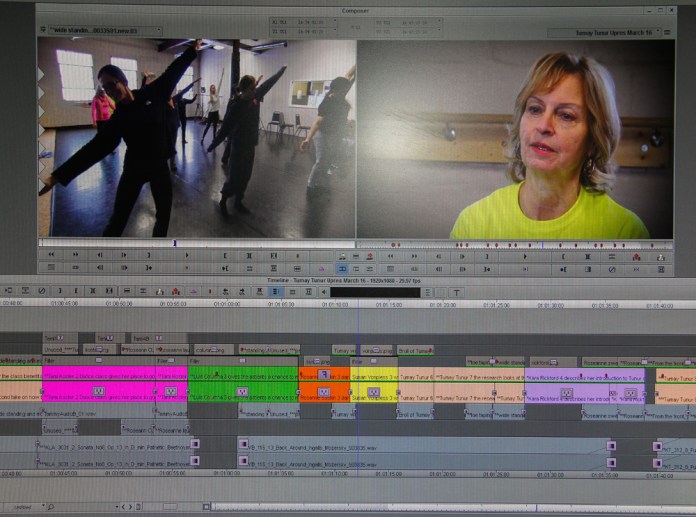
Essay: I Close My Eyes When I Edit

I have a short essay that’s published in the June 2016 online edition of Post Magazine. The piece recounts a technique I use in editing video projects at Syracuse University. You can read the story here.

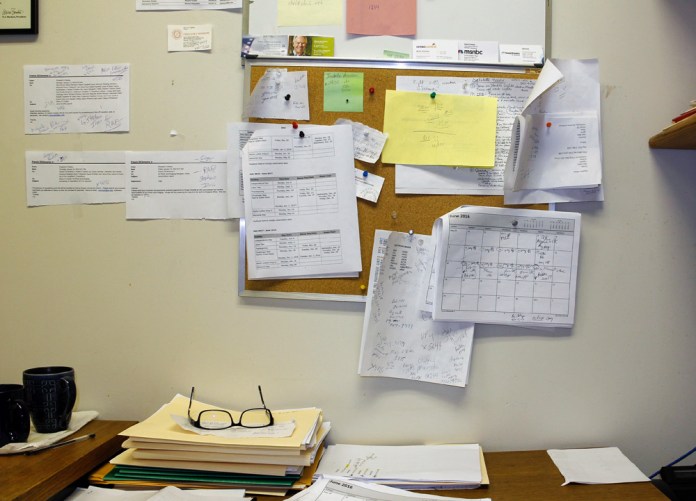
And here are images of my editing workstation that are relevant to the story.

Avid Media Composer workstation

Avid Media Composer workstation

Avid Media Composer screen shot

Close-up of video timeline in Avid Media Composer

Office wall

Office wall


Standard

Dentist Office Artwork

I love when art makes me stop and pay attention to it, to lose myself in the experience of viewing the work. This happened to me earlier this week when I accompanied my wife Pam to the periodontist’s office for an appointment.

While I sat in the waiting room—rocking our nearly three-month-old son Colin and hoping the other patients would ignore what I thought was the smell of his soiled diaper—I stared at some artwork hanging on the walls. There were three oil paintings illuminated by the warm glow of recessed lighting.

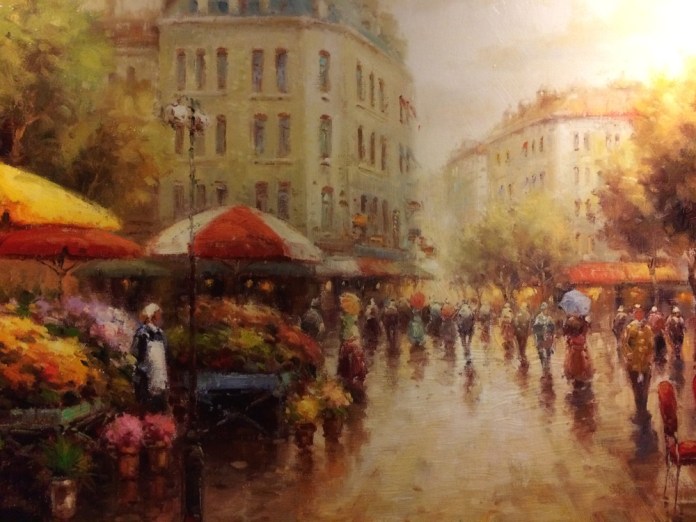
The first painting showed a European plaza with flower stands on one side and an outdoor cafe on the other; the pedestrians were dressed in 19th century attire and some carried umbrellas. Even though it was a rainy day scene, the palette contained a mix of bright colors, including pink and violet flowers. At the top right corner of the frame, yellow sunlight fought to break through the clouds.

An oil painting of a European street scene (artist unknown).

An oil painting of a European street scene (artist unknown).

Another image showed a pedestrian bridge over a canal in Venice (or so I presumed) with cypress trees rising in the distance.

Venice scene. Oil on canvas, artist unknown.

Venice scene. Oil on canvas, artist unknown.

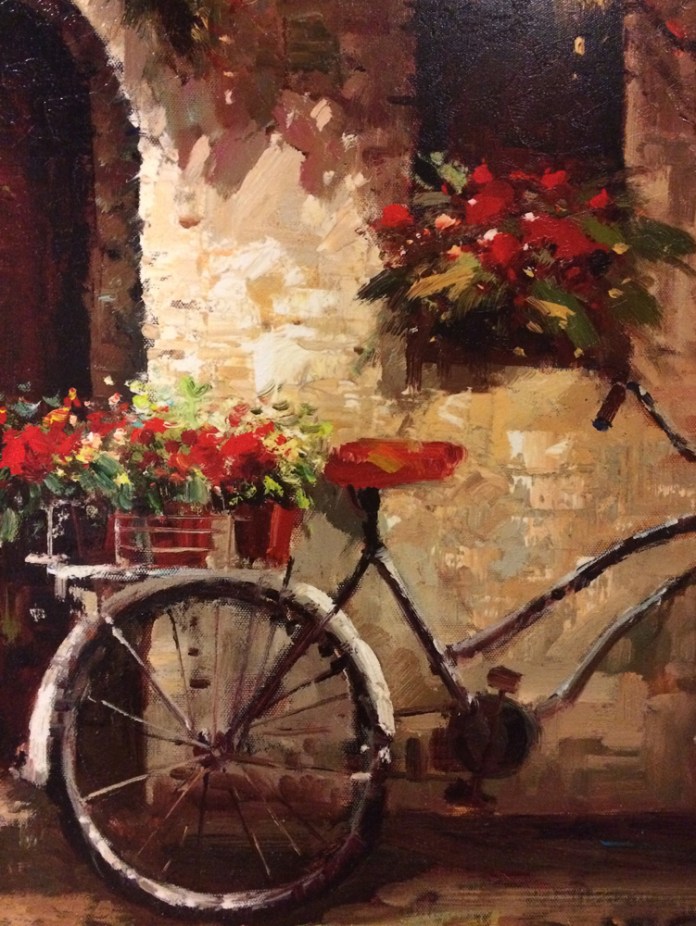
And the third one depicted a woman’s bicycle leaning against a stone or brick building with an arched doorway and a windowsill festooned with red flowers.

Bicycle leaning against building. Oil on canvas, artist unknown.

Bicycle leaning against building. Oil on canvas, artist unknown.

I wish I could give the artist credit by name, but I didn’t see a signature on the paintings. Of course these were not masterpieces painted by Van Gogh or Monet. However, the three works transported me to another place and allowed me to vicariously roam through the streets of an Old World city and stand on a bridge in Venice and observe the beautiful scenery.

Looking at these images interrupted the mundane experience of waiting in a dentist’s office and made the time pass more quickly. I also felt happy embarking—at least mentally—on a trip overseas. Although I dream of going on a European vacation one day, I know it’s unlikely I will visit Paris, Rome or Florence anytime soon, due to work demands and financial constraints. You see, right now the priority is paying for cans of Similac Expert Care Alimentum formula and a new bridge for my wife. Not to mention another box of Pampers for Colin.

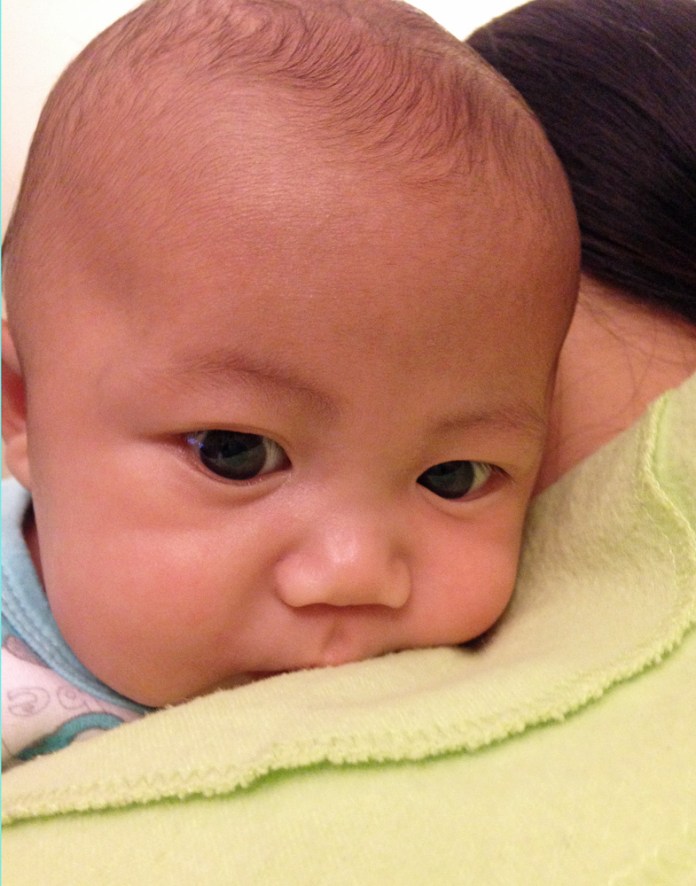
Colin Joseph Close-Up.

Colin Joseph Close-Up.

Standard

Sister Joselle Orlando: A Life of Art, Faith and Service

Here’s a follow up to a freelance article I wrote about artist and educator Sister Joselle Orlando of Syracuse. In our original interview, Sister Joselle told me a few stories that could not be included in the short magazine piece and web article published by the Sisters of St. Francis of the Neumann Communities, and so I’ve decided to collect them here.


With her short stature, salt-and-pepper hair and tendency to talk with her hands—hands that have labored for many years—you could easily picture Sister Joselle Orlando as an Italian grandmother standing in a kitchen, stirring a pot of pasta fagioli (pasta beans) on a cold winter night. But these days Orlando, 74, a member of the Sisters of St. Francis of the Neumann Communities in Syracuse, New York, stays active by working on personal art projects, teaching art classes, and serving as a hospital volunteer.

Sister Joselle Orlando

Sister Joselle Orlando. Photos by Francis DiClemente.

At the Franciscan Art Studio on the grounds of the Spirituality and Nature Center at Alverna Heights in Fayetteville, she currently teaches adult watercolor classes, hosts “art as pray” sessions, and offers private art lessons. To find out more information, go here.

“Over My Dead Body”

As a young girl growing up in an Italian-American family in East Rutherford, New Jersey, Orlando loved to draw and her father, Salvatore, a machinist who worked in an airplane factory, showed her how to blend colors with crayons. Her mother, however, opposed her daughter’s budding creativity and wanted her to focus on the fundamentals of her education. Orlando says her mother, Mary Carmella, a homemaker and seamstress, once told her, “You go and learn your spelling and you’re not coming out of that room until you know them.”

But as a rambunctious child, Orlando says she rebelled against her mother.

“It took me until about fifth grade before I actually learned how to read or how to do math. So I fought with my mother all through the early stages of my education,” she says. “But I always loved drawing and I knew that I could sing. So the fact that I couldn’t read or spell or do math, once we had music or art, I had more confidence, so that kind of balanced it out.”

When she was in fourth grade, Orlando’s family moved to a neighboring town and the Felician sisters from Lodi, New Jersey, educated her. Through the Felicians, as well as her parish church, Orlando found herself drawn to St. Francis of Assisi, and her affection for the saint strengthened her faith in the Lord and sparked a desire in her to pursue a religious life.

“When I was 18 and ready to graduate, I finally said to my mother, ‘Mom, I’m going to enter the convent.’ And she said, ‘Over my dead body you’re going to enter the convent.’”

Orlando says her mother wanted her to become a secretary. But Orlando followed her instincts. She wrote to the Sisters of St. Francis in Syracuse and they wrote back and welcomed her into the community.

She recalls the pain of leaving home on Sept. 1, 1959, and beginning her new life. “My mother would not come with me that day, she was sobbing terribly. My dad and my brother, my future sister-in-law, and I drove to Syracuse and they dropped me off at the back door. They left and I entered the convent. It was a bit of a dramatic way of entering the community, but I really knew that this was my call from God.”

Sharing Knowledge about Art and Life

Because the Sisters of St. Francis recognized Orlando’s artistic talents, she says the community wanted her to pursue an education in art with the goal of becoming a teacher. Orlando received a bachelor’s degree in fine arts and education from Syracuse University in 1974. She later earned a master’s degree in art education from SU and a master’s in religious studies from St. Charles Seminary in Philadelphia.

Assumption Church, a watercolor painting by Sister Joselle Orlando.

Assumption Church, a watercolor painting by Sister Joselle Orlando.

Orlando spent more than 40 years in the field of education, teaching at both the elementary and secondary levels, and her profession became a calling, as she derived joy in molding students and helping them to develop their artistic skills.

She says, “I love to teach and to see how either children or adults evolve and discover talent within themselves and can say to themselves, ‘Oh my God, I did this.’”

Sister Jacqueline Spiridilozzi, who is also a member of the Sisters of St. Francis, has known Orlando for more than 40 years and says her vivacious and free-spirited personality is reminiscent of the character Maria from The Sound of Music. Spiridilozzi says Orlando always gave her students the “space, encouragement, and direction” needed to “bring out the best, promote the potential.”

Orlando has mentored many students throughout her career, including Sarah Guardia-Weir. Guardia-Weir met Orlando when Guardia-Weir was a freshman at Seton Catholic Central High School in Binghamton, where Orlando taught art and served as a campus minister from 1995 to 2007.

Guardia-Weir says Orlando “showed me so many tricks that advanced my art skills and creativity.” She credits Orlando for helping her to get accepted into the demanding architecture program at Syracuse University.

But the relationship went beyond just the teaching of technical skills. While studying at SU, Guardia-Weir reconnected with Orlando, who was working and living in Syracuse at the time.

She says Orlando “taught me the power of friendship and the enjoyment of life through art … to have an adventure and trust in God’s path.”

Guardia-Weir graduated in 2014 with a bachelor’s degree in architecture and a minor in ceramics. She works at an architectural firm in New Jersey and remains active in art, making crafts for her family and friends.

And she remembers some inspirational words Orlando shared with her that still resonate today. “I was worried about aging and worried that life might get boring as my young ideas fade,” Guardia-Weir says. “But Sister explained, ‘As an artist, I can assure you, even at my age that the gift of imagination will never die.’”

Challenged by Jerome Witkin

Bright sunlight streams through the windows of the converted chicken coop that now serves as Orlando’s art studio in Fayetteville.

On this morning, a clear subfreezing day in late February of 2015, Orlando sits at a long table, working on a bright watercolor painting of St. Marianne Cope dressed in her habit and standing in a Hawaiian setting.

Sister Joselle Orlando in her studio.

Sister Joselle Orlando working on a watercolor painting in her studio in Fayetteville, New York.

St. Marianne was a Sister of St. Francis of the Neumann Communities. She helped to found St. Joseph’s Hospital in Syracuse in 1869 and later devoted her life to caring for those afflicted with Hansen’s disease (leprosy) in Hawaii. She was canonized by Pope Benedict XVI on Oct. 21, 2012.

Orlando feels a close bond with Marianne and has produced many watercolor works depicting her, including some pieces for the Saint Marianne Cope Shrine and Museum in Syracuse.

Orlando dips her brush in water, swishes it around, dips her brush in paint, and applies it to a white-yellow flower seen in the foreground. Later, she rises, walks a few feet, and points out a print of what she considers her favorite painting. It’s an image of dark cave area with a face visible in the scene.

Close-up of watercolor painting by Sister Joselle Orlando.

Close-up of a watercolor painting by Sister Joselle Orlando.

She painted the piece in 1990 while she was a master’s student at SU, and she recounts how one of her art professors, renowned figurative painter Jerome Witkin, taught her an important lesson about overcoming creative challenges.

In Witkin’s class students had to create a series of large-scale oil works, but they could only use two primary colors plus black and white.

“I painted St. Marianne leaning over a woman in a wheelchair on a beautiful Hawaiian beach,” Orlando says.

Orlando used red and yellow as her primary colors and had worked on the painting for several hours when Witkin came to critique it. As he inspected the piece, Orlando explained to him how Mother Marianne and the other Franciscan sisters had treated patients with Hansen’s disease in Hawaii.

Orlando recalls Witkin’s comments. “He said, ‘And they’re getting close to death, aren’t they?’ I said, ‘Yes, they were dying.’ He said, ‘Well get rid of the sunset, get rid of the beauty … and show me that they’re suffering with death.’ And he walked away. That was Friday afternoon. They were due Monday. And I took my turpentine, washed the whole thing. I was swearing, I was so angry at Jerome.”

Orlando regained her composure and directed her energy toward the canvas, working over the weekend to paint a darker palette according to Witkin’s instruction, choosing red and blue as her primary colors.

The final scene depicts a leprous woman seated in a wheelchair and the woman appears to be part of a cave. The viewer can also see a leprous child’s face in the canvas, and the only source of light is the small figure of Mother Marianne entering the gloomy cave.

For Orlando, Marianne symbolizes the only source of hope for the desperate victims of Hansen’s disease.

Witkin praised the revised work and called it the best piece Orlando had ever done. But Orlando told him, “If I take this home and show the sisters, they’re gonna think I’m in a state of depression, it’s so dark.” She says Witkin then replied, “You don’t go down to the level of your audience, you bring them up to your level.”

Art as Prayer

One way Orlando combines her artistic and spiritual pursuits is by teaching an “art as prayer” class, in which non-artists learn how to use simple watercolor techniques as a language of prayer; a session is scheduled to be held in her studio in September.

During the retreats, Orlando incorporates the symbol of the mandala as an impetus for meditation. The mandala is a sacred circle that “represents the dialogue between the visible and the invisible, earth and heaven, the conscious and unconscious.” Students engage in quiet reflection, learn to paint mandalas, and share their prayer experiences.

A watercolor painting of a mandala by Sister Joselle Orlando.

A watercolor painting of a mandala by Sister Joselle Orlando.

Orlando says the “art as prayer” program helps to enrich the faith lives of participants and gives them confidence in their creative abilities.

“I tell them, ‘It is not the product that you’re going to be displaying in a museum, it is your experience that you have when you’re using simple art tools. It’s what you feel inside.’”

Hospital Volunteer

In her community work, Orlando serves as a volunteer in the Surgical Waiting Room at St. Joseph’s Hospital Health Center.

She interacts with the family members of patients who are in surgery, engaging them in a conversation and listening to their concerns.

Spiridilozzi, who serves as a coordinator for the sister volunteers at St. Joe’s, says Orlando possesses the ability to reach out to others, even strangers, and her presence provides support and strength to patients and their families.

“She kinda has a natural gift for being empathetic and sympathetic,” Spiridilozzi says. “She’s got that warm Italiano heart, and you know she’s just a natural with people.”

Orlando says she doesn’t ask the people she meets what faith they are, “because it doesn’t matter,” but she tries to allay their fears through an informal connection and the power of prayer.

“It’s sharing part of my spirituality with them and letting somebody know that God still loves them,” she says.

Orlando also privately reflects on her encounters with the family members. She will go to an upper floor at the hospital, look out at the view of the city of Syracuse, and pray for the people she has come into contact with. Her prayer is a simple one, summed up with the words: “Oh God help them.”

“You Don’t Go Singing in the Shower”

Inside Orlando’s art studio, a propane heater hums briefly before shutting off. Orlando stands over it, pushing some buttons and trying to coax the heater to stay on; she makes a plea to St. Anthony and then says in a singsong voice, “do your thing, do your thing, don’t go out again.” But when her attempts to revive the heater fail, she walks back to her seat, picks up her brush, and resumes working on the watercolor painting of Mother Marianne.

Sister Joselle in her studio.

Sister Joselle in her studio.

Her determination to create art and contribute to community life remains strong despite her age. And blessed with good health, she says she has no intention of slowing down her ministry as an artist, teacher, and volunteer. “I have longevity in my family. My dad died at 102 and he was still sharp … and my mother was in her nineties, so I have about another 25 years to go, so hang around.”

Orlando also says she has no regrets about the direction she chose when she professed her vows of poverty, chastity, and obedience more than 50 years ago. She believes that what she gave up to God when she entered the convent has come back to her more than a hundredfold.

“And I know that gifts that are given to us to share are not just for us. You don’t go singing in the shower,” she says. “Gifts that are given to us are given for others, and the more you give the more has come back to me.”

Standard

Four Poems

Four of my poems were recently published on the website Albany Poets. And for my contribution to National Poetry Month, I have posted the poems here, along with some relevant images.

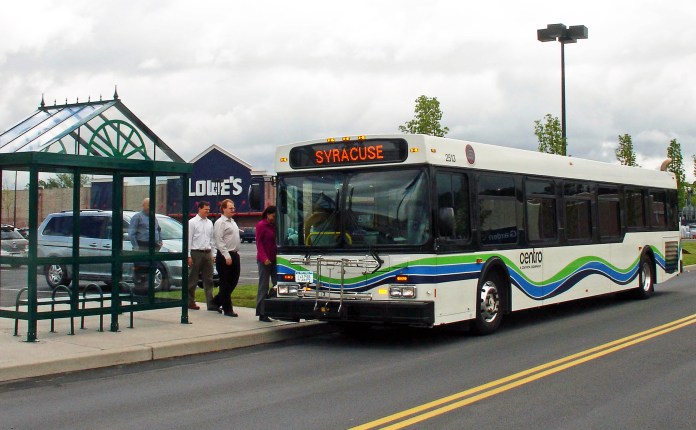
Centro Bus

Centro Bus

Taking the Bus

The blind man in the blue striped shirt
stands in front of the bus stop,
clutching a red and white
walking stick in his right hand.
He smiles as the bus’s tires roll to a stop
and the door swings open with a whooshing sound.
He climbs inside and takes a seat,
just another passenger in another vehicle
crawling along the congested thoroughfare
on this Wednesday morning commute.

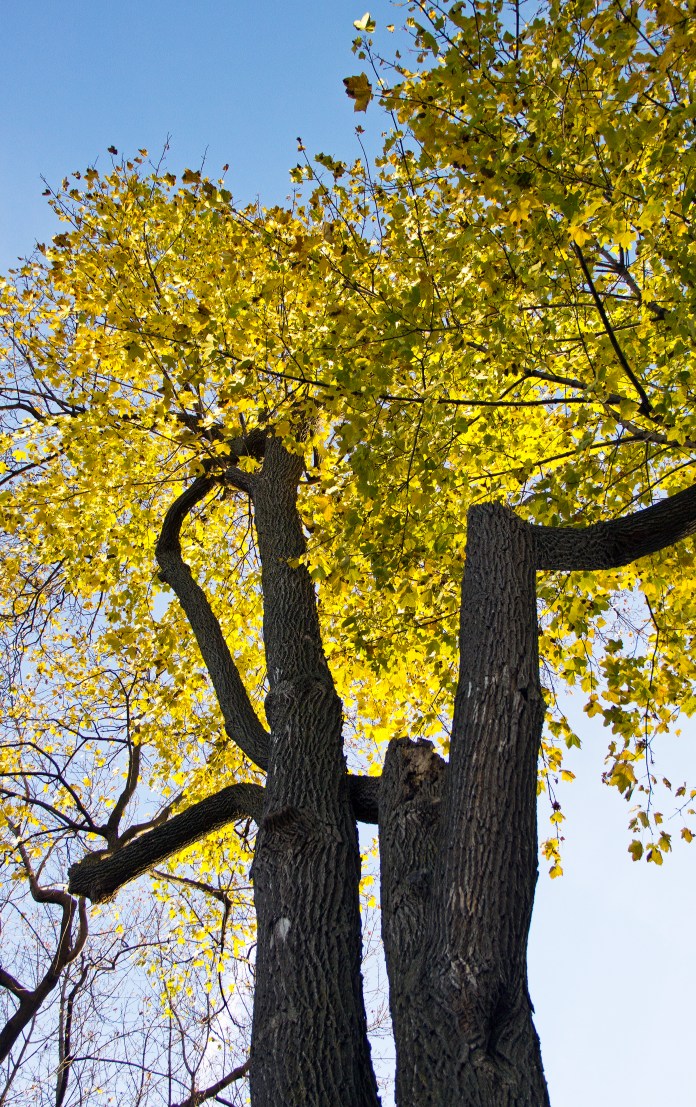
Fall Trees

Fall Trees

Falling Leaf

The golden maple leaf
fell to the ground
in front of my feet,
making a slapping sound.
It greeted me
on this frosty November morning,
reminding me that one day
I too will lie on the ground,
and others will pass by
without stopping
or looking down.

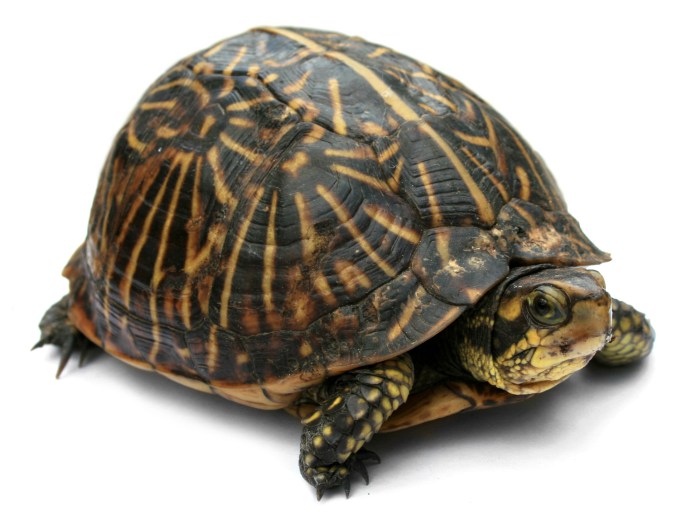
Florida box turtle. Photo by Jonathan Zander (Digon3).

Florida box turtle. Photo by Jonathan Zander (Digon3).

Hard Shell

What goes through the mind of a turtle
When it’s sprawled on its back and can’t roll over?
Does it panic as its legs squirm in the air?
Does it stick out its tongue and try to scream for help?
Does it curse its maker as it writhes on the asphalt,
With the sun scorching its belly?
How long does it wait before giving up and accepting fate?

No. This turtle does not think.
It lacks the capacity to reason.
Instincts fire as it battles to survive:
“Get off your shell. Roll over. On your feet.”
It rocks from side to side as it labors to turn over.
It strains, twists and kicks … but fails.

And no one will intervene—
There’s no Tom Sawyer kid with a hickory stick,
Skipping along and flipping the turtle over.
No semi truck rumbles down the road,
Stirring up a blast of air and setting the turtle upright.

It struggles alone, refusing to quit
As it attempts to conquer physics.
The turtle keeps working
Until the sun desiccates its flesh
And it releases a final breath—
A low croak that goes unheard along the deserted road.
The turtle is gone and no one witnessed the fight.

Woman walking along Genesee Street in Syracuse, New York. I snapped this photo a few years ago while standing on the front porch of my apartment building, while testing out my new Canon DSLR.

Woman walking along Genesee Street in Syracuse, New York. I snapped this photo a few years ago while standing on the front porch of my apartment building, while testing out my new DSLR.

Stooped

An old woman hunched over,
looking down at the sidewalk,
adjusting her knit hat.
She limps forward,
shuffling along,
riddled with pain.
Her face reveals
the hurt she endures.
She receives no aid,
no intercession from human or heaven.
I pass her on the sidewalk,
and I say a quick prayer
that her suffering wanes.
It may not do any good,
but I send the thought aloft
and hope someone is listening.
The woman crosses the street
and fades out of sight.
I then hear an inner voice say,
“You were there,
you could have helped her.”

Standard

Planting Wild Grapes by Kathleen Kramer

Ithaca, New York-area poet and playwright Kathleen Kramer has published a new full-length collection of poems, entitled Planting Wild Grapes (Yesteryear Publishing).

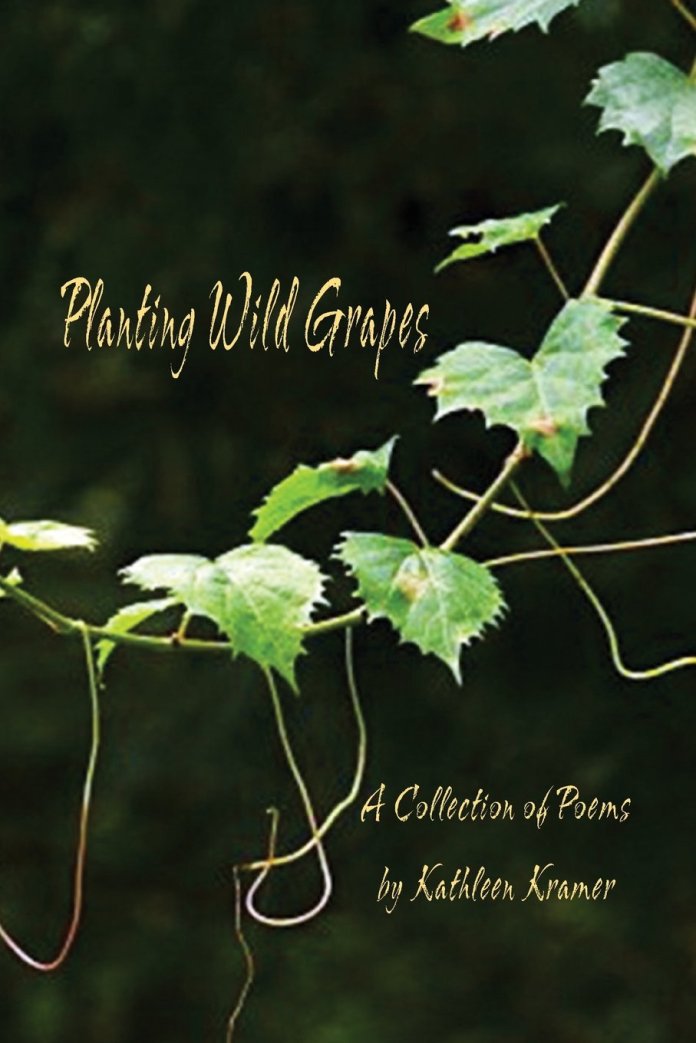
Planting Wild Grapes by Kathleen Kramer. Cover and book design by E. Nan Edmunds. Cover photograph by Green Deane.

Cover and book design by E. Nan Edmunds. Cover photograph by Green Deane.

I became acquainted with Kathleen through our mutual connection with the Syracuse writing group Armory Square Playwrights, and I consider her a friend and a writing confidant.

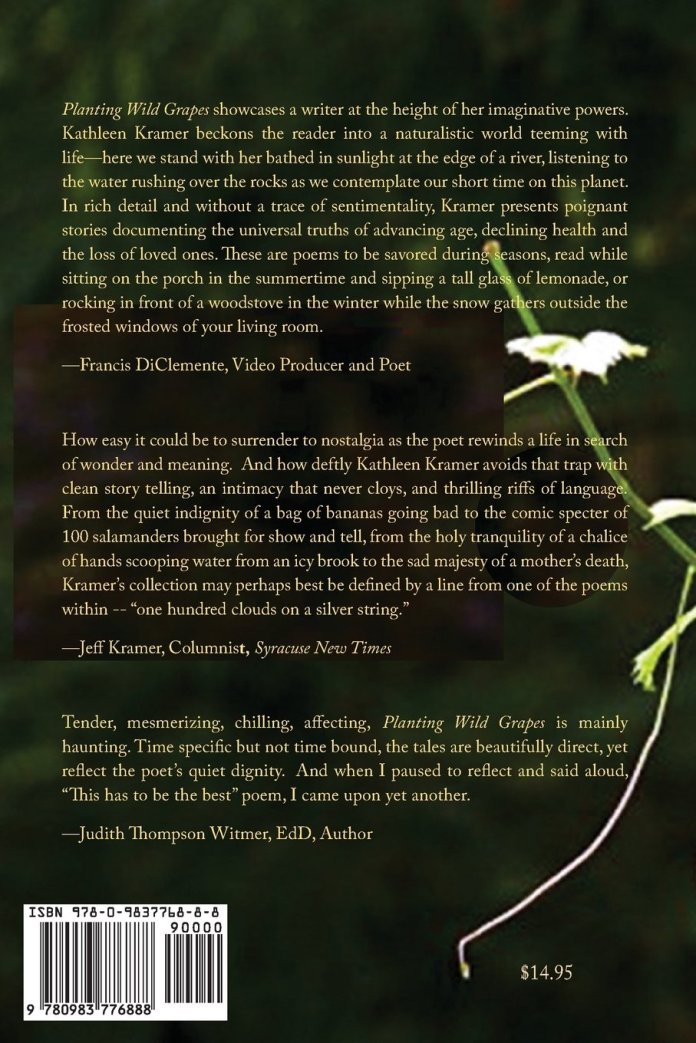
I was honored when she asked me to write a “blurb” for the back of her book, and I read the collection in galley form via PDF. Holding the hard copy now, I am looking forward to taking my time in reading the printed version; I want to sift through each line of text and let the words and their meanings linger in my mind.

Planting Wild Grapes by Kathleen Kramer. Cover and book design by E. Nan Edmunds. Cover photograph by Green Deane.

Kramer is the author of a poetry chapbook, Inside the Stone (Ithaca Writers’ Association/JK Publications), and a previous full-length collection, Boiled Potato Blues (Vista Periodista). Her poems have appeared in The Comstock Review, Passager, Avocet, a Journal of Nature Poems, The Healing Muse and other publications. And her plays have been presented regionally in central New York, as well as in the Midwest and in Canada.

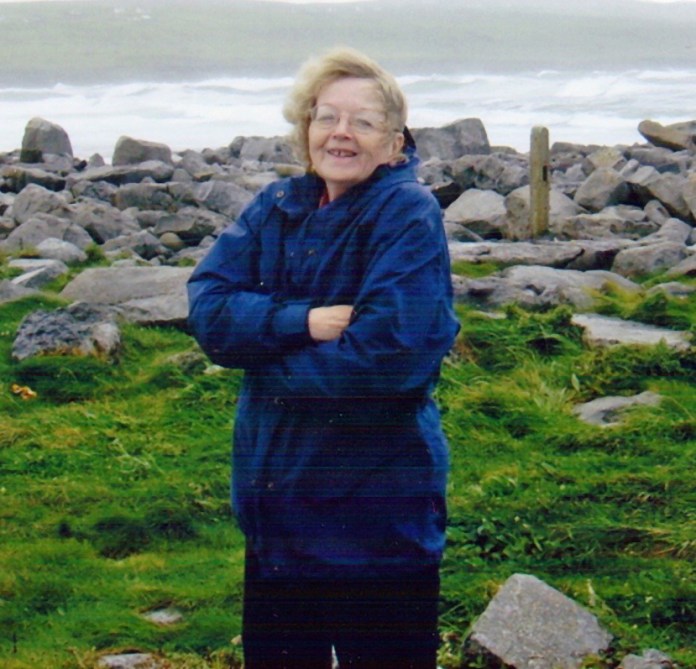
Kathleen Kramer in Ireland.

Kathleen Kramer in Ireland. Photo by Jack Kramer.

Here is her biography from the interior of the book:

Growing up in Pennsylvania’s coalmining and farming region, Kathleen Kramer’s early life was influenced by the solidity of the earth and the rhythm of seasons.

At 19, she left for the city and spent five years working in Washington, DC for the Department of Defense. There followed a stint in Maine where subsistence farming took her back to the land. A second marriage brought her to Long Island, where she and her husband Jack reared their three sons in Northport, a small town on Long Island Sound. During that time and over a period of 10 years of balancing classes, family and work, Kathy earned a BA at Empire State College and an MLS at C.W. Post.

Now, following retirement from the Boyce Thompson Institute at Cornell, Kathy lives with her husband in New York’s Finger Lakes area where she writes poetry and plays. Again, the natural world and changing seasons have assumed center stage. It’s these foundational elements and the strength of generational ties which largely inform Kathy’s poems.

##

And in this interview, Kramer talks about her book and discusses the motivations that propel her writing. I hope you come to appreciate this artist and her work as much as I do.

Can you give a brief description of this collection of poems?  

These poems were written over a period of years and each represents a moment in time when something that seemed important was recognized. Most often, however, the actual moment was, on the surface, quite ordinary. It’s the extraordinariness of the ordinary that moves me. I’ve tried to capture that in these poems.

Not all of these poems address this directly, but I view each one as I might a handcrafted bead: each has its own shape and color and when strung together, they create a necklace that, for me, speaks of wonder and meaning, embracing both good times and hard times.

What do you hope readers will take away from your book?

This collection tries to do a few different things. It explores the enigmatic title, Planting Wild Grapes, which was given to me in a vivid dream. It seeks to illustrate what I think is required of us as finite beings—to engage in our lives as deeply and meaningfully as we can and then, when the times comes, to release them with thanksgiving and grace. It is my hope that the reader will come away from reading this book with a sense of the wonder and meaning in his or her own life.

What do you enjoy most about writing poetry?

For me, writing poetry has been a connection not only to my inner self and to the natural world, but also to something beyond myself. At the risk of sounding grandiose or pious, I believe creativity and the divine are interwoven. When I can touch that moment as I write a poem, I feel exceptionally blessed.

I’m sure it varies with each poem, but can you describe your typical process for constructing poems—from the moment you get an idea for a work until the final revision?

First of all, who knows where the idea for a poem comes from? Sometimes it’s a snatch of overheard conversation. Sometimes it’s a word or line from someone else’s poem or a flash of memory. Often it’s an experience of being with another person and knowing the tie between you is precious. It’s being outdoors and sensing the wholeness. Regardless of where it comes from, there’s a little “thrill,” like a tiny, soundless bell that rings and says, “Follow this one.”

Then I start to write. I write by hand and I almost always go out of my house to write; I especially like to write in cemeteries. (Very quiet and no one interrupts!) When I have a rough sketch of the poem, I go home and type it into my computer, where it’s easier to shape it on the page.

I’m fortunate to be a member of a poetry group, The High Noon Poets. We meet twice a month and it’s there that we each have our poems critiqued. We’re free to accept the suggestions made or to reject them. Often, even if I feel resistant at first, by the time I’m home again, I’m seeing the wisdom of those suggestions.

How does writing poetry compare to writing plays? Do you have a preference? 

What strikes me most are the similarities. In my opinion, both demand an economy of language. Every word must carry its own weight. Sometimes, a word might be there simply because it is beautiful, and if that isn’t overdone, it adds to the whole and, indeed, carries its own weight.

I like writing both poetry and plays. One of the pleasures of playwriting is the characters one can create. They become real and will often tell me what they will or won’t say or do.

However, I think I have a slight preference for writing poetry. There’s satisfaction in writing a single, well-crafted poem. It can stand on its own. There’s no need to sustain a long narrative, yet if the poet creates a number of poems, giving each a shape and color of its own, together, they can tell the story of a life or a time.

What’s next for you in terms of writing projects?

I’ll continue to write poems and, occasionally, plays—I must, in order to be happy—but for a time now, my main focus will be on doing readings and trying in whatever ways I can to share my pleasure in this new book, Planting Wild Grapes.

Kathleen Kramer reading a poem at an event. Photo by Debbie Rexine for The Healing Muse.

Kathleen Kramer reading a poem at an event. Photo by Debbie Rexine for The Healing Muse.

##

Here are two excerpts from Planting Wild Grapes (reprinted with the permission of the author and Yesteryear Publishing).

Planting Wild Grapes

Every day at dawn I go down to the river,
fill my bucket to the brim and wash stones.
Big or small, I take all that come to hand,
dip them in my pail, rub them between my palms
and drop them back into the river. I listen
for the satisfying sound—the watery thunk—
as they settle among their fellows.

At mid-day I wade the waves of goldenrod
to the center of the sunny field behind the barn.
Beneath my feet, my shadow crouches,
small and black. The candle in my hand
stands tall, like me, its wick waiting for
the match, prepared to be proud of a flame
invisible in the noonday light.

Sunset finds me again at river’s edge, a teacup
cradled in my hands. It holds rainwater caught
in the downpour at dinnertime. I lift it up
to the sinking sun, see the rim turn gold,
then tip the cup, spilling rain into the river.
Tomorrow, if I keep to my course,
there will be time to plant wild grapes.

Still

When we noticed lunchtime voices
in the hall, the ding of a call button,
squeak of rubber soles on tile floors,

we knew the sound of her breathing
had ceased. For long moments,

her shoulder, under my hand,
remained warm. Then a stillness,
profound and deep, came upon her—

not of worldly sleep but
of rest unbounded by time.

All her ailments, her frailties,
fell away and the wholeness…
the holiness… which remained

gave her back to us
as she was, as she is.

##

Readers can find Kramer’s 96-page collection on Amazon. And the book is also available at Buffalo Street Books in Ithaca.

Standard

Filed Under Miscellaneous

I’ve been busy with video projects and working on my long-term nonfiction project, so I haven’t had time to blog much lately. But I wanted to share a few items worth noting.

The No Extra Words flash fiction podcast has produced one of my stories, Frozen Food, as part of its Episode 39: Sum of the Parts. The story was originally published in the online magazine The Literary Hatchet. You can listen to the podcast from the website or access it here.

Secondly, one of my essays, on the topic of “the writing life,” has been posted as a blog entry by the online magazine South 85 Journal. You can read the story here.

I also have good some good news about my experimental short film Fragments of the Living. The piece has been accepted as an official entry in the 2016 Athens International Film + Video Festival in Athens, Ohio. It will be screened on April 10.

And NewFilmmakers NY has selected Fragments of the Living to be part of its Spring 2016 Screening Series on April 25 at the Anthology Film Archives in Manhattan.

new filmmakers laurels 2016

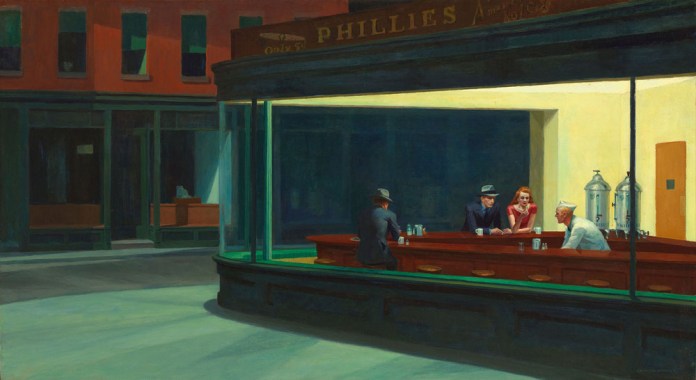
Lastly on the writing front, my full-length stage play Beyond the Glass, inspired by the Edward Hopper painting Nighthawks, was read by actors recently at the WILDsound Writing and Film Festival in Toronto.

Nighthawks by Edward Hopper, 1942.

Nighthawks by Edward Hopper, 1942.

Here’s the link with some information about the project, which I still consider a work in progress. When I get the time (and the courage), I intend to watch to the table reading with headphones and a notebook so I can jot down ideas and notes about problem areas in the script. Revision Awaits Me!

And finally I have one personal note I must share. And this trumps everything else. My wife Pamela gave birth to our son, Colin Joseph DiClemente, on Friday, Feb. 26, 2016, at 10:29 p.m. at St. Joseph’s Hospital in Syracuse.

Colin Joseph DiClemente at the pediatrician's office.

Colin Joseph DiClemente at the pediatrician’s office.

Both mother and baby are doing well, and we are getting used to having a little one in the apartment. Of course, this means less sleep for us and short writing blocks for me, before I get pulled away from the computer by the sound of Colin screaming or a request by Pam for me to make up a bottle of formula. So I will be writing in bursts, trying to get down bits of text before duty calls. I hope the words I type in first-draft form will make some sense to me later.


Standard