Since I have been busy with video projects at work, I haven’t had a chance to post anything lately. But I have a short story published in Issue 8 of the Penduline Press, a Portland-based literary and art magazine. You can read Ticket to Ride and check out the many fine stories, poems, interviews and works of art in the latest issue of the magazine.
Author Archives: Francis DiClemente
Spring Anyone?
The anticipation of spring is overwhelming here in upstate New York. March ushers in a sense of hope as winter relents and spring creeps toward us. We’re not there yet. We still have more cold gray days ahead, with temperatures barely climbing out of the thirties. More snow will fall and the wind will continue to chafe exposed earlobes, noses and cheeks.
But you can sense spring is almost here. We’ll be setting our clocks ahead this weekend as Daylight Saving Time resumes.
March brings with it Friday fish fry specials that are welcomed by Lenten observers, St. Patrick’s Day celebrations and the apogee of the college basketball season. After the conference tournaments wind down, fans will be dissecting the NCAA tourney pairings and filling out their brackets. The NHL season is moving along and the playoffs will be upon us soon.
This is my favorite time of year, because it’s a season of possibility, where the full glory of spring and summer lies ahead, just waiting to be plucked like a ripe peach. Now we can allow ourselves to imagine barbecues, pool parties, softball games, weekend getaways, outdoor concerts and fireworks on the Fourth of July.

Trees in full glory. Photo by Francis DiClemente.
I am reminded of The Twilight Zone episode Walking Distance (1959) where a business executive returns to his hometown and finds it unchanged. He is overcome by a feeling of nostalgia when he encounters his boyhood self during a summer marked by merry-go-rounds, cotton candy and band concerts, and he tries to instruct his younger self to savor his childhood while he still has the chance.
The man, Martin Sloan, says to the boy: “I only wanted to tell you that this is a wonderful time for you.”
So in this northern corner of the world, as Mother Nature gets ready to release a measure of heat, we can prepare to store our boots, coats, gloves, hats, sweaters and scarves for another year. We can get to ready to strike the terms black ice, lake effect, wind chill and Nor’easter from our vocabulary, at least for another nine months. It’s about time to step outside, stretch our limbs and live again.
Baseball’s Opening Day and the Big Feast at Vinci’s House
Meanwhile, spring training continues in Florida and Arizona—another sign that winter will be ending soon—and the first pitch of Major League Baseball’s regular season is less than a month away.
Bill Vinci, my best friend from my hometown of Rome, N.Y., holds an annual party on the first full day of the MLB season. Regardless of the weather, regardless of where he happens to be employed at the time—and he’s rotated through several jobs over the past decade—he invites friends over to his house to watch the opening day games.

The party host, Bill Vinci. Photo courtesy of Bill Vinci.
It’s an all-day party with a group of friends debating their fantasy teams. Unfortunately, I haven’t had a chance to attend one of these parties because I’ve always had to work or I’ve lived elsewhere in the U.S.
But I find the concept appealing because of the allure of playing hooky from work to watch baseball; and it’s also entertaining to see the players shivering on the basepaths and in the dugouts and outfield grass during early April games in cities like Chicago, Detroit, Cincinnati and Boston.
Vinci tells me the party consists of watching baseball from the first at-bat to the “final pitch on the West Coast.” And his celebration has real roots in the Rome area, stretching back to Vinci’s high school days, starting around 1985.
“I would skip school and have my friends come over and watch baseball and eat in my parents’ basement,” he says. He adds, “As the years go by the attendees have decreased due to work, kids, etc., but that hasn’t stopped me from putting on the greatest opening day party in Rome.”

Bill Vinci swinging away. Photo courtesy of Bill Vinci.
And the action on the diamond is enhanced by the menu for the occasion; the spread of food includes “dogs, burgers, sausage, hot and sweet peppers and sausage bread, along with chips and dip.”
So that’s what I’ve been missing all these years.
But Vinci, who serves as director of marketing for the Utica Brewers baseball club of the Perfect Game Collegiate Baseball League (PGCBL), says the “reason I host opening day is the love and passion of the game of baseball. It’s in my blood and to have friends and family enjoy it with me makes it all worth it.”
He adds, “as long as I’m on this earth, you can always count on one thing—opening day of baseball at Vinci’s house.”
To that I say batter up.

Getting ready for the season. Photo by Francis DiClemente.
The Big Move
Someone called my attention to a recent New York Times article about the concept of relocation therapy. It seems more and more people who experience a major life change, such as the death of a loved one or the end of a relationship, are deciding to move to different neighborhood or another part of the country as a way of coping and to get a fresh start.
I think it’s an interesting topic because at one time or another most people have probably felt the urge to pack up their belongings and make a new home somewhere else. Place is important for our sense of wellbeing and where we live can influence how we feel.
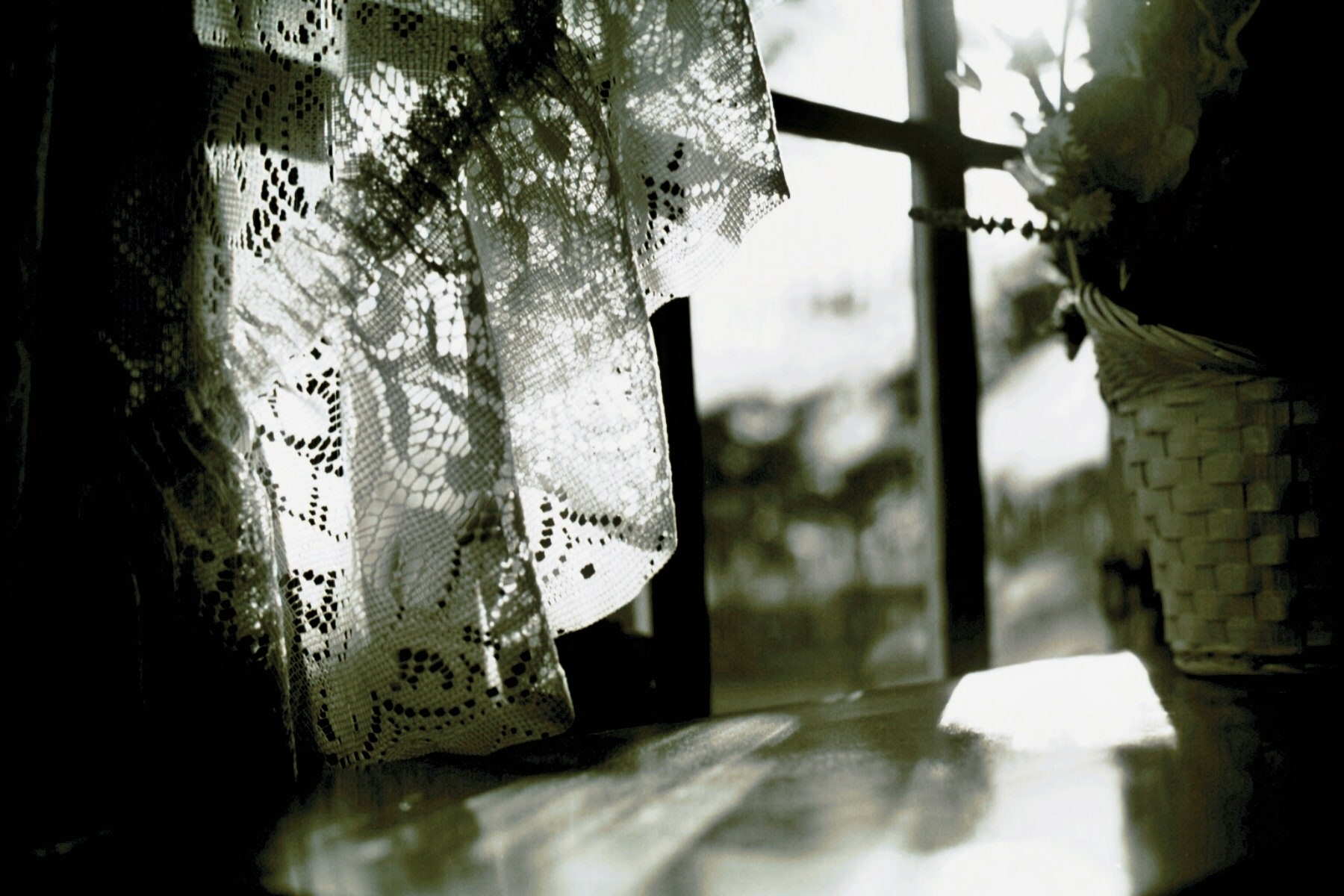
Window with Lace Curtains. Photo by Francis DiClemente.
At the same time, I’ve discovered—in the process of moving several times—that you can’t outrun yourself and your problems follow you wherever you go.
Ken Torrino, a web relations specialist for Elliman, brokers for New York City real estate, shares some information about RT:
What is Relocation Therapy and How Can It Help?
You might have heard the term relocation therapy being tossed around, but what does it really mean? It’s a concept that seems contradictory to most people. The contradiction lies in the fact that moving is considered one of the stressful events of a person’s life. Therapists suggest relocation for overcoming a stressful event such as job loss, a loss in the family, a mid-life crisis or a divorce. While adding the stress of moving to another life stressor seems to be counterintuitive, it may be effective. Here are some reasons why relocation therapy works.
It Offers a Chance to Start Over
Starting over after a divorce, job loss, or a death in the family can be easier in a new location. There are fewer reminders of the person or job you are mourning, and thus, it may be easier to heal. Even if you are just going through a mid-life crisis, moving can help you establish a new identity in a new location. You can buy a new car, a new house, and a new wardrobe. You can even find new friends. This could give you a more youthful feeling and help you get over your mid-life crisis.
Better Networking Opportunities
There are often better networking opportunities in other locations. When the networking circles are fresh, you can try a new and more effective approach that may not work in social circles that are already familiar with you and your style. A change of scenery may help you meet more people for work or for other tasks in your life that you are trying to complete. Moving to a high volume city could maximize your potential to get more job leads and interviews.
A New Home
A new home can prevent you from mourning or crying every time you look at a room or a common place that you and a deceased loved one shared or that you and a former mate shared. This may help the healing process go faster and easier. Experts, however, do not recommend this strategy until one year after a major split or the loss of a loved one.
If you are finding yourself in a rut or simply down in life, relocation therapy has been proven to be effective. Speak to your therapist to learn more about the concept.
Follow-Up Questions
Why is relocation therapy gaining popularity? Is the rising interest tied in any way to the growth of technology?
The reason that relocation therapy is gaining so much popularity is because it is now, more than ever before, easier to pack up and move to another city. The opportunities and options are endless throughout the world.
The growth of technology has absolutely tied into the rising growth. In a simple Google search those that are interested can find a number of communities and areas, along with job opportunities, that will make a transition in a new city extremely simple.
Are we seeing this trend played out across the U.S., in small towns and cities, or just in major metropolitan areas like New York, Chicago and Los Angeles?
While this trend can certainly be seen throughout cities and towns both small and large, it seems as though the most popular options are large cities. The reason behind this trend seems to be the endless amount of possibilities and activities that lie within a larger city.
What are some things people should think about before they decide to go through with a move like this?
The most important thing that readers need to know before making a move like this is that it will not instantly eliminate the pain. Whatever your reason that caused the move, it will always lie within you. Relocation therapy is a solution to block out these painful feelings and memories and help you to move on from these sorrows but not eliminate them altogether. For this reason, it is very important to consider your options heavily before you pack up and make a life-changing decision such as this.
Thanks Ken. I would be interested in hearing any stories from people who may have moved after a life-changing event. Did it work out for you? Were you happier before or after the move?
Travel Encounters
This essay appears on the Yahoo! Voices Contributor Network.
To me travel has always been more than just scenery, hotels and restaurants. What makes it memorable is meeting travelers along the way and finding some connection with them.
I may have developed this philosophy—even though I haven’t traveled all that much—because in my youth I read Jack Kerouac’s On the Road and John Steinbeck’s Travels with Charley. In fact, Travels with Charley altered my viewpoint of America and helped to ease the groaning I possessed in my twenties to see beyond the hills of my hometown in upstate New York and investigate the full landscape of the U.S.
Even in the 21st Century, when travelers occupy and insulate themselves with iPads, iPods and smartphones, the central message of Travels with Charley still holds up: interesting characters can be found anywhere and the humanity of people can be discovered on the road.
I witnessed this during a train trip in the spring of 2009. I took an overnight Amtrak ride from Syracuse to Toledo, as I was heading to northwest Ohio to see my sister, her husband and their two young kids, Paul and Elizabeth, along with my mother and stepfather, who had already driven there from their home in Rome, New York.
The cab was scheduled to pick me up after work on a Friday, since I would be boarding Amtrak’s westbound Lake Shore Limited shortly after 10 p.m.

Aboard the Lake Shore Limited. Photo by Francis DiClemente.
It was one of those late May days when all traces of winter had passed. The evening sky was bright, with hints of lavender color, and the sun felt warm, as if its heat originated from someplace far away from upstate New York.
The taxi picked me up at my apartment in Syracuse. The cab driver was a black man missing two front teeth who wore an opened gray sweat jacket, revealing his smooth brown chest. I’ll call him Leon, because he reminded me of boxer Leon Spinks from the Sports Illustrated cover in 1978 when Spinks defeated Muhammad Ali.
We talked in the cab, and Leon said he was a resident of Fort Lauderdale but was living and working in Syracuse for an undetermined period of time. I think he said his kids lived in Syracuse, and he came there because he had a huge fight with his wife in Florida.
“We weren’t getting along, so I just left,” he said. “I tell people when you’re having problems, just take a break. No one gets hurt and you can come back to each other.”
I had the sense this was not a permanent situation for him and that he would likely return to Florida sometime soon. He said, “I don’t like this cold, my blood’s too thin. I’m a Florida boy.”
In the meantime, he said he wanted to earn some money as a cabbie and just spend time with his children.
Leon dropped me off at the Regional Transportation Center near Alliance Bank Stadium (home of the Triple-A Syracuse Chiefs), and I thanked him for giving me the ride.
What impressed me most about the cabbie was you could tell he really cared about his kids. And he said he still loved his wife, despite the argument and separation, and he had every intention of going back to her at some point in the near future. He also said he was happy spring had finally come to Syracuse.
On my return to trip to Syracuse, again on board the Lake Shore Limited, which I picked up at around 2:30 a.m. on a Saturday in Toledo, I sat next to a soldier or former soldier. I never got his name, but I remember he was dressed in a sweatshirt and jeans and was traveling all the way from the West Coast to visit his children in the Syracuse or Watertown area.
Somewhere between Rochester and Syracuse, when both of us happened to be awake, we had some time to talk.

Aboard the Lake Shore Limited. Photo by Francis DiClemente.
He said he was originally from Oregon and had served overseas, in either Iraq or Afghanistan (I can’t remember which one), while stationed at Fort Drum as a member of the 10th Mountain Division. He said he had to get back to “see his boys” in upstate New York. I took “his boys” to mean his sons—I think he said he had four of them—as opposed to his Army brothers. I didn’t ask him about his marital status or whether the mother of the boys was around.
It also did not sound like he would be redeployed to the Gulf anytime soon. He had taken up digital photography as a hobby, and with pride, he showed me his camera and some of the pictures he had snapped. There were images of scenery, landscapes, sunsets, his sons and shots out train windows.
Later I said to him, “Thank you for serving.” It had been bothering me that I hadn’t said it sooner, and I wanted to make sure I said it before we parted. He responded, “Thanks.” He then paused for a few seconds, perhaps sighing, and said it had taken him a long time to learn to say “thank you” in return when someone expressed gratitude for his military service.
He told me he used to get angry and tell the person offering thanks, “Well, why didn’t you serve too?” He said now he just replies “thank you” back to the person.
When it was time to leave the train in Syracuse, I turned to the man and told him I had enjoyed talking to him.
I scooted out first because I had the aisle seat. I waited for the passengers ahead of me to gather their bags and then I walked forward and stepped down to the cement train platform suffused with bright afternoon sunlight, and made my way down the tunnel leading to the inside of the station.
In reflecting on that trip, these two figures, the cabbie at the beginning and the soldier at the end, served as bookends to my journey and renewed in me a desire to explore more of the U.S. in the future, by train, by plane or by car. It also sparked my imagination about all the other characters still waiting to be encountered on the road. I guess we all have stories worth telling and I am eager to listen and learn.

Trestle seen from passenger seat. Photo by Francis DiClemente.
Here’s to nurturing goals in the year ahead
Last week I was looking through some composition books that I use for jotting down writing exercises, journal entries, story ideas and other scraps of information. In leafing through the pages I found an entry dated August 3, 2012. It’s about an encounter I had over the summer, but I will present it here as a brief essay because I think the story has some relevance as we get ready to catalog another calendar year.
A woman was sitting with her legs crossed on a wooden bench in a wide hallway near the entrance to a lecture hall in the S.I. Newhouse School of Public Communications on the campus of Syracuse University.
Her back was to me as I came down the stairs from my office on the second floor of Newhouse One. I turned in her direction and walked toward the men’s room at the other end of the hallway.

A hallway in Newhouse Three in the S.I. Newhouse School of Public Communications.
I noticed she was in her early twenties and I surmised she was a graduate student. She had long straight brown hair, was wearing a gray sweater and had a cell phone cupped to her ear.
As I strode past her I overheard her say, “I love it. I really do. But I have all these other goals that need to be nurtured. They really need to be nurtured.”
I wondered who was on the other end of the phone. I also wanted to know what goals she was talking about.
Were they career goals, family goals, personal goals, artistic goals, romantic goals, financial goals? What did this young woman want from her life and what was standing in her way? Lack of time, lack of money, lack of opportunity, lack of patience, lack of support? Or was she on the cusp of seeing her ambitions realized?
But I also thought, can goals really be nurtured? Can we massage them and bend them to our will?
And what’s the difference between goals and dreams? Goals and hopes? I guess a goal implies making a plan, setting forth on a path toward a destination, toward accomplishing something tangible. There’s more effort involved than just making a wish and hoping for the best.
In reading my notes, I wanted to relive the incident; instead of going down the hallway to the bathroom, I would have liked to stop and talk to the woman and try to get some answers to my questions.
And since this is just a notebook exercise, I took the liberty of transcribing a fictitious conversation with her.
“What do you mean by nurturing goals?” I asked the woman.
“What?”
“What are you talking about when you say you have all these goals that need to be nurtured?”
“Were you listening to me?”
“Yes. I couldn’t help it. I was walking to the men’s room.”
“It’s none of your business.”
“OK, I understand. And I’m sorry to bother you, but I’m interested.”
“In what?”
“In you.”
“Why?”
“Because I’m curious to know if people can really nurture goals. And since you mentioned it, I’d like to know what goals you’re talking about.”
“I already told you, that’s none of your business. Now leave me alone, please.”
“All right. But I had to ask. The curiosity was killing me.”
Even in a fictional world the woman revealed nothing to me, so her story must remain a mystery.
I don’t know if she will make good on her plans for success. I don’t know if she will go beyond nurturing her goals to seeing them come to fruition.
But I will make a wish as we usher in 2013. I wish her good luck on her journey of self-discovery and I hope all of her goals will be fulfilled in the new year.
I also wonder if the woman was a plant by God, an angel placed there to make me listen to the ticking clock, to awaken me from the routine of that summer workday and remind me that time is elapsing. And if I want to do anything with my life I can’t wait for tomorrow.
So the incident makes me reflect on my own life goals. I ask myself, am I doing all I can to nurture them? Am I expending the effort necessary to achieve them? I guess I have a way to go in that department.
But I will take my cue from the woman sitting on a bench and talking on a cell phone. In 2013 I will do my best to nurture my personal and professional goals. I hope you will do the same, and I wish you the best of luck as you go at it.
Final push for Infinity
Advance sales for my poetry chapbook In Pursuit of Infinity end on Dec. 28. And since pre-publication sales will determine the size of the press run, I am sending out a gentle reminder for those who might be interested in purchasing the book. You can order it here or by using the following order form:
Please send me ______ copy (ies) of In Pursuit of Infinity, by Francis DiClemente, at $14.00 per copy plus $1.99 shipping . . .
Enclosed is my check (payable to Finishing Line Press) for $__________
Name
Address
City/State/Zip
Please send check or money order to:
Finishing Line Press
Post Office Box 1626
Georgetown, KY 40324
With that said, thank you for enduring this sales intrusion and I wish everyone a Merry Christmas, happy holidays and a blessed new year. I hope all of your blogging, professional and personal goals will be achieved in 2013.
Book Review: The Wonderful Wizard of Oz
I get by with a little help from my friends . . .
Some books offer pure joy between the pages. There is no other reason to read them except for their entertainment value. These are not masterworks of literature like Tolstoy’s Anna Karenina, Dickens’ Great Expectations, Marquez’s Love in the Time of Cholera and Steinbeck’s The Grapes of Wrath. Consider the Danielle Steel or Nicholas Sparks’ romance or James Patterson thriller. The value of these books lies in capturing the attention of readers and keeping them turning the pages until the conflict is resolved.
I think L. Frank Baum’s The Wonderful Wizard of Oz falls into this category. I decided to read Oz because I recently purchased a Kindle and found the free eBooks on Amazon. But it wasn’t the digital device that produced my happiness, but rather Baum’s prose and storytelling ability.
And what hooked me about Oz, aside from the colorful imagery of the Munchkins, the Flying Monkeys and the Wicked Witch, were the main characters—Dorothy, the Scarecrow, the Tin Woodman and the Cowardly Lion—and how this band of misfits stuck together as they overcame obstacles while embarking on their journey to the Emerald City to see the Wizard.
I also liked how the group expanded along the way to include new members, all yearning for some need to be filled. At each stage, it was as if the existing members said to the strangers, “sure, come and join us . . . the more the merrier.”
This passage, courtesy of Mr. Baum, illustrates the point:
“Do you think Oz could give me courage?” asked the Cowardly Lion.
“Just as easily as he could give me brains,” said the Scarecrow.
“Or give me a heart,” said the Tin Woodman.
“Or send me back to Kansas,” said Dorothy.
“Then if you don’t mind, I’ll go with you,” said the Lion, “for my life is simply unbearable without a bit of courage.”
“You will be very welcome,” answered Dorothy, “for you will help to keep away the other wild beasts.”
In an introduction, datelined Chicago, April, 1900, Baum writes that the story of The Wonderful Wizard of Oz was “written solely to please children of today.” He adds, “It aspires to being a modernized fairy tale, in which the wonderment and joy are retained and the heartaches and nightmares are left out.”
Even though the book was written more than a century ago, Marie Deegan, children’s librarian at the Sullivan Free Library in Chittenango, New York—the birthplace of Baum—says it still appeals to kids today because of its adventure story and “the concept of going someplace and losing yourself and finding your way home again.” But she says more adults than children come to the library in search of the book, in part due to the nostalgic appeal of Oz.
Having seen the 1939 MGM movie several times, I encountered one problem while reading the novel. I could not envision the character of Dorothy except as Judy Garland, who played the girl in the film. No matter how Baum described Dorothy or her actions, in my mind I could only see Garland in her full Technicolor glory.
In comparison with the film, the book reveals much greater character detail about the Scarecrow, Tin Woodman and Cowardly Lion. For example, I discovered that the Scarecrow and Tin Woodman did not need to eat, drink or sleep in order to survive. I don’t remember this being mentioned in the movie. And I found it comical in one scene when Dorothy went to sleep and the Scarecrow stood in a corner and “waited patiently until morning came.”
For me I suppose the greatest testament to the literary power of The Wonderful Wizard of Oz was I did not want to abandon the characters after finishing the book; so I decided to read it a second time. I also downloaded other free Oz-related eBooks by Baum.
In Pursuit of Infinity Chapbook Forthcoming
Two of my poetry collections are now available. The first, entitled Vestiges, was released in November by Alabaster Leaves Publishing. And advance sales for the second book, In Pursuit of Infinity, by Finishing Line Press, are underway and will continue until Dec. 28. The release date for the book is scheduled for Feb. 22, 2013. Pre-publication sales will determine the press run, and so if anyone is interested, you can order the chapbook online. Thanks for taking the time to read this. I appreciate it. Below you’ll find some excerpts from Infinity.
Dreaming of Lemon Trees
I dream of words
I strive to recapture
When I awaken in the morning.
I dream of stories with endings unknown,
Vibrant scenes imagined in my sleep—
A Degas ballerina alone in her dressing room,
A wagon train backlit on the horizon,
A hummingbird dancing on the windowsill,
And a lemon tree in the church courtyard in mid-afternoon.
Wherever I go in my dreams,
The air is balmy and sunlight abundant.
Trees sway and the scent of evergreen finds its way to my nose.
I dream because when this tired body hits the mattress,
It relaxes, then releases and gives up its earthly weight.
My eyes close and I sink to the deep recesses of my mind,
Setting the subconscious free.
Morning Coffee
My mother sits
in the kitchen chair
after she recites
her morning prayers.
Sunlight streams through
the lace curtains
and cigarette smoke
is suspended in the air.
She bows her small head
and presses her fingers
to the bridge of her nose,
as she contemplates
the chores for the day,
while her milky coffee cools
in a blue ceramic mug,
resting within reach
on the laminate counter.
The Shed
Independence Day, 1979 (Rome, New York)
Whipped-cream clouds smear a powder blue sky,
while Grandpa nurses a carafe of Chianti
and dreams of waltzing down Bourbon Street.
The DeCosty family gathers on the patio,
with Uncle Fee roasting sausage and peppers
and Nana dribbling olive oil over fresh tomatoes,
then adding alternating pinches of basil and parsley.
Inside the backyard bordered by overgrown hedges,
the rambunctious cousins wham Wiffle balls
with a thin banana-colored plastic bat,
evoking the hollers of Grandpa . . .
who watches out for his mint-green aluminum shed,
situated perfectly in left-center field—serving as our own Green Monster.
And when we get ahold of that little white ball,
it smacks up against the aluminum obstacle,
clashing like two marching band cymbals in a halftime show.
And with sweat coursing down his neck,
Grandpa barks out his familiar line under the patio awning:
“Son of a bitch . . . keep that goddamn ball away from my shed.”
But Nana is always on our side,
and cancels out his power and keeps him in check.
“Fiore, you let those kids play and mind your mouth,” she says.
Grandpa abandons his no-win cause,
turns up the volume on the Yankee game
and pours himself another glass of red wine.
He watches quietly as the shed stands erect in the late afternoon sun,
sacrificing its facade for our slew of ground-rule doubles.
The Bridesmaid
The most adorable pregnant bridesmaid ever
Waddles down the church’s center aisle,
Unable to hide her protruding belly.
And with her feet swollen,
Her lower back sore and forehead warm,
She endures the ceremony standing
On the altar beside the joyous couple.
But she nearly passes out while
Posing for pictures in the lakefront park.
Inside the reception hall,
She almost vomits at the sight
Of shrimp cocktail and chicken Florentine.
She orders hot tea and lemon from the top-shelf bar,
And dines on rolls and garden salad.
This single-mom-to-be, though not merry,
Offers a smile when others turn to stare,
And bobs her head to the music
As the guests hit the dance floor.
She nibbles on a sliver of white-frosted wedding cake,
And asks for guidance from her parish priest, wise old Father Meyer.
Then the bride overthrows the eager females huddled
Near the dance floor and the bouquet lands
Softly in the expectant mother’s lap.
Her face turns red as everyone looks at her.
So she just grabs the bouquet and throws it back.
New poetry collection published
It’s been a while since I’ve had time to write, as I was busy working on some video projects for the past couple of months. But I am now happy to announce that my latest poetry collection, Vestiges, has been published by Alabaster Leaves Publishing.

This 58-page chapbook features both narrative and observational poems. And the book is available for sale on Amazon.com. Please do not feel pressured or obligated to purchase it, but I just wanted to provide the link in case anyone is interested.
And here are a few excerpts from the collection:
Father’s Day Forgotten
Daddy and Christi parted ways at a bus depot
In the early morning hours.
No big scene, just a kiss on the cheek,
Then she turned around and was gone for good—
Hopping aboard the Trailways bus headed westbound for Chicago.
And she never looked back.
Daddy went home to his beer bottle and sofa seat,
And he drew the living room curtains on the rest of the world,
Letting those four eggshell walls close in and swallow him up,
Wasting away in three empty rooms and a bath.
And the memories can’t replace his lost daughter and wife.
So he tries not to remember his mistakes
Or how he drove them away.
Instead he recalls Halloween pumpkins glowing on the front porch,
Training wheels moving along the uneven sidewalk,
Little hands reaching for bigger ones in the park,
And serving Saltine crackers and milk
To chase away the goblins that haunted
Dreams in the middle of the night.
Now Christi has a life of her own,
And she lets the answering machine catch
Daddy’s Sunday afternoon phone call.
She never picks up and rarely calls back.
So Daddy returns to the green couch
Pockmarked with cigarette burns.
He closes his eyes, opens the door to his memory vault
And watches the pictures play in slow-motion.
He rewinds again and again without noticing the film has faded
And the little girl has stepped out of the frame.
Man Versus Ant
an ant races
across the sidewalk,
intent on getting
to the grass
on the other side.
I face a quick decision:
do I step on it
or avoid its path?
better leave the ant alone,
I think to myself.
what if that’s me
in the next life?
Side Dish
A mundane scene of modern living
played out one evening
while I walked along Ninth Street
near East Grovers Avenue in north Phoenix.
I heard the sound of a sliding glass door
opening from behind a retaining wall
running parallel to the sidewalk.
And although I had
no intention of eavesdropping,
I then overheard a woman call out:
“And now the great vegetable debate, green beans or corn?”
The question evoked a few seconds of silence,
followed by a man’s reply:
“Uh . . . both,” he said.
And as I turned the corner,
heading up the next block,
I was tempted to stop and ask the couple,
“Hey, what else is for dinner?”
Perseverance
You can’t expect the world to fall in line for you.
You can’t will happiness or alter your existence by whim.
You have to accept you are not in control.
Work and sleep.
Sleep and work.
Monotony and solitude.
You march on with stubborn persistence.
I believe there are other forms of bravery
Besides firefighters scaling burning buildings
And plucking toddlers from the top floor.
There is courage in accepting your condition,
Realizing you have fallen short,
But not quitting, not becoming bitter,
Not drinking yourself to death,
Or giving up and erasing your place in the world.
There is dignity in continuing to endure an unhappy life.
By making due and moving on,
You shine forth and elevate your humanity—
Even if no one notices or your situation doesn’t change.
Maya Deren’s Ritual in Transfigured Time
This story was published on the website of Film International magazine. Go to the link and scroll down to the bottom of the page to see the film by Maya Deren.
Last summer, in the midst of the blockbuster movie season dominated by sequels, 3-D animation and superhero offerings, I stumbled upon a cinematic treat from a forgotten era. While eating my lunch at my desk one afternoon, I went to YouTube to look up some alternative music bands. After a while, an impulse made me type “Maya Deren” in the search box, and I soon entered the hypnotic world of the late choreographer, dancer and experimental filmmaker.
Several years ago I had watched Deren’s Meshes of the Afternoon and read her essay “Cinematography: The Creative Use of Reality” in Film Theory and Criticism, edited by Gerald Mast and Marshall Cohen (1974). I was exposed to filmmakers like Deren, Luis Buñuel, Fritz Lang and Sergei Eisenstein while studying for my master’s in film and video in the early 1990s. Yet one does not need to understand film theory, semiotics, psychology or feminist theory to appreciate Deren’s work. When some selections of Deren’s movies popped up on YouTube, I opted for Ritual in Transfigured Time, a short silent film from 1946.
The black and white, slow-motion images washed over me and I sat there transfixed by the surrealistic scenes. I think this may be the best way to explore Deren’s films – to know nothing about them except the title. Then the viewer enters Deren’s dream landscape and soon abandons all preconceived notions of the film medium and the carefully-constructed plots demanded by Hollywood. You surrender to the hallucination and, in doing so, you accept the idea that all art, including Deren’s work, is open for interpretation.
And while we do not get a linear storyline, character arcs, a three-act structure or a clear resolution, Ritual in Transfigured Time spurs questions in the minds of viewers. Who is this woman (Maya Deren) leaning against a doorway and playing with yarn at the outset? Is she waiting for someone? A lover? Or another version of herself? Why do the dancers at the party switch partners so frequently? Are the lead dancers in the park lovers? What do they represent? And why does it seem the female dancer is afraid of the male dancer? What has provoked this fear?
These questions then marinate in the brain and the result is a narrative that can only be completed by the audience. Everything is left up to our imaginations. We fill in the details and attempt to put the pieces of the puzzle together. Of course this means each viewer develops his or her ideas about the story. I can’t tell you the meaning of Ritual or even give you a clear plot description. There is too much ambiguity at work within the frame. I can only tell you it draws you in and you don’t want to look away.
I would like to point out a few memorable moments from Ritual, as these scenes have brought me back to YouTube for repeated viewings.
At about the 7-minute mark, we are placed in the middle of what looks like a house party attended by well-dressed guests. The men and women begin to dance, the figures moving from one person to the next. They do not dance so much as merely shuffle between partners. They exchange a few words, shake hands, latch on to shoulders and dance from side to side before turning to the next person and repeating the process. I wonder if this is a dream sequence, a party game or a meditation about the fragility of romance – the second you grasp on to it, it is gone. Affection blooms and withers and other people step in to replace our former lovers. But if this is the case, then why are so many of the “dancers” at the party smiling, their happy faces revealing no hint of despair?
Later at the party, at about the 8:20 mark, the lead actress and dancer, Rita Christiani, and the lead actor/dancer, Frank Westbrook, draw close to each other and nearly touch cheeks. The scene then cuts from the house party to a park, with the same two people holding hands. In this location, we also see women standing together and dancing. The shirtless male dancer tosses Christiani skyward, and her arms are extended in the air as she takes flight in slow motion. She remains suspended for a moment.
A short time later, we see Westrbrook in a low-angle shot against what appears to be the background of a stadium. He makes motions from side to side with his arms. His frame is taut and every muscle in his body stands out. Later he hops, spins in place and twirls in the air, his image frozen briefly. He expresses the joy of movement and he reminds me of a puppy wanting to play with its owner.
At the 11:38 mark, a wrought iron gate opens and Christiani enters a garden. We see Westbrook standing like a statue on a pedestal. She walks toward him. But now he breaks the plaster pose by looking at her. She displays fear and runs away. He remains standing momentarily and then gives chase, jumping after her. At 12:35 she disappears down a hill with Westbrook in pursuit, leaping along the way.
At the 13-minute mark we come to a courtyard and Christiani continues to run away, now passing stone archways. Westbrook follows. At 13:27 he tries to grab her; she escapes his grasp. But now it is Maya Deren fleeing, running under a wooden pier and rushing out into the sea until her legs disappear and the water swallows her.
At 13:50 we cut back to Christiani making motions with her arms, and then in a negative image, a white dancer falls against a black background. This is repeated a few times. The last image is a close-up of a female dancer’s head. The woman lifts a veil covering her face and then opens her eyes, and it’s hard to tell whether this face belongs to Christiani or Deren.
There is no doubt Ritual in Transfigured Time offers rich potential for psychological interpretation. But the more I watch it, the less I care about trying to decode its meaning. I think the combination of bodies in motion, dream-like images and underlying tension is enough to satisfy me. Answers are not necessary for me to enjoy the ride. I also realize that with the power of YouTube there are countless other experimental films waiting to be discovered on my lunch hour.
 Francis DiClemente