Planting Wild Grapes by Kathleen Kramer

Ithaca, New York-area poet and playwright Kathleen Kramer has published a new full-length collection of poems, entitled Planting Wild Grapes (Yesteryear Publishing).
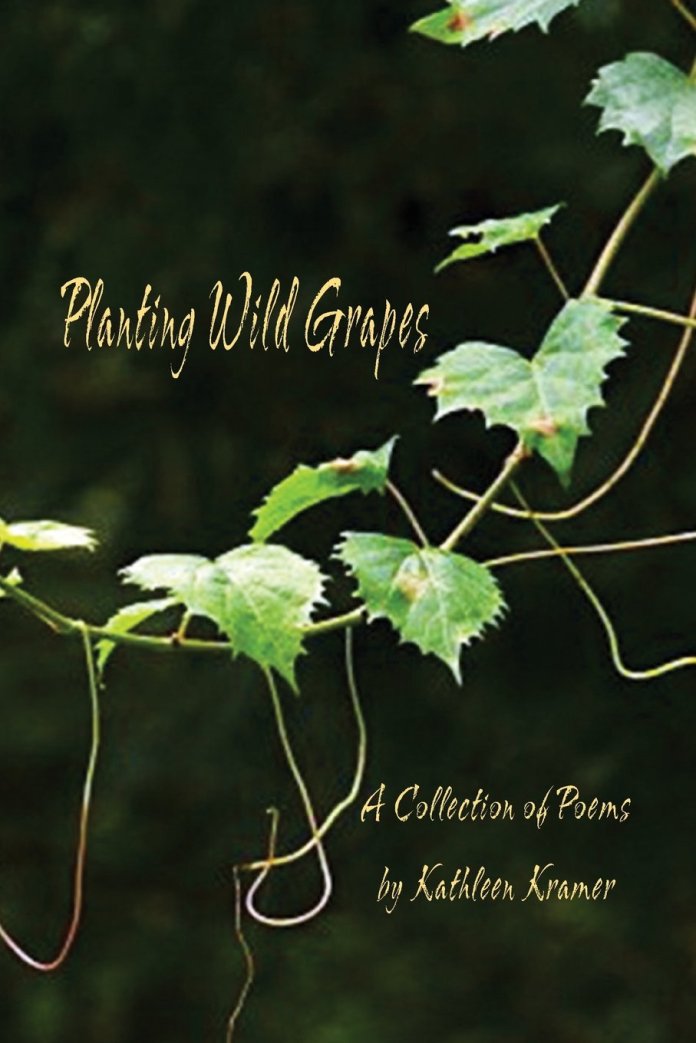
Planting Wild Grapes by Kathleen Kramer. Cover and book design by E. Nan Edmunds. Cover photograph by Green Deane.

Cover and book design by E. Nan Edmunds. Cover photograph by Green Deane.

I became acquainted with Kathleen through our mutual connection with the Syracuse writing group Armory Square Playwrights, and I consider her a friend and a writing confidant.

I was honored when she asked me to write a “blurb” for the back of her book, and I read the collection in galley form via PDF. Holding the hard copy now, I am looking forward to taking my time in reading the printed version; I want to sift through each line of text and let the words and their meanings linger in my mind.
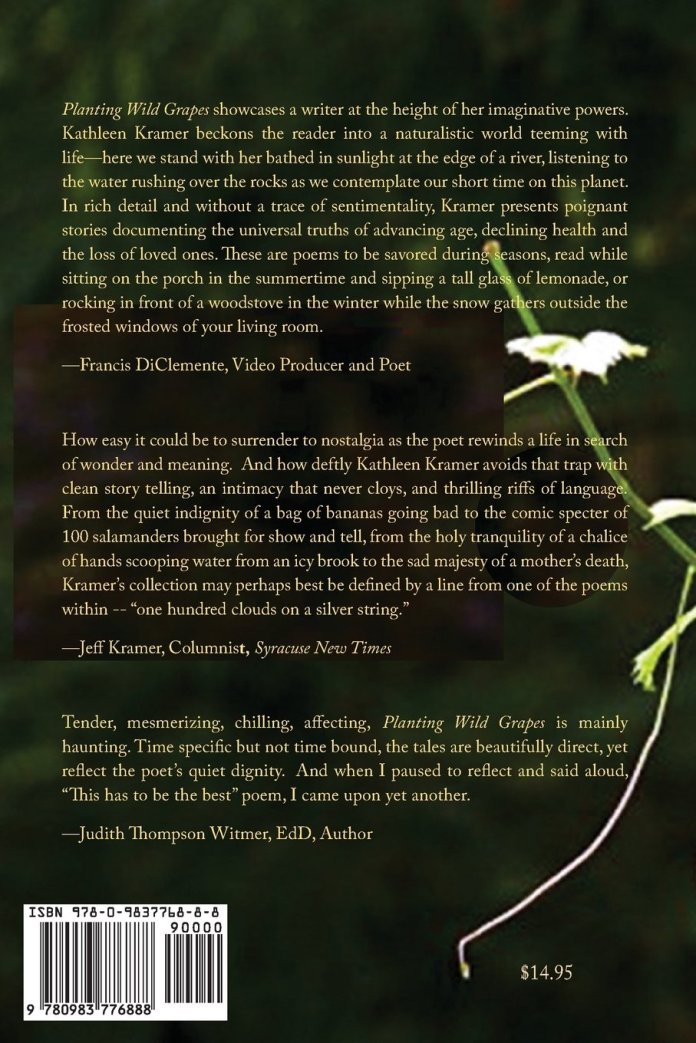
Planting Wild Grapes by Kathleen Kramer. Cover and book design by E. Nan Edmunds. Cover photograph by Green Deane.

Kramer is the author of a poetry chapbook, Inside the Stone (Ithaca Writers’ Association/JK Publications), and a previous full-length collection, Boiled Potato Blues (Vista Periodista). Her poems have appeared in The Comstock Review, Passager, Avocet, a Journal of Nature Poems, The Healing Muse and other publications. And her plays have been presented regionally in central New York, as well as in the Midwest and in Canada.
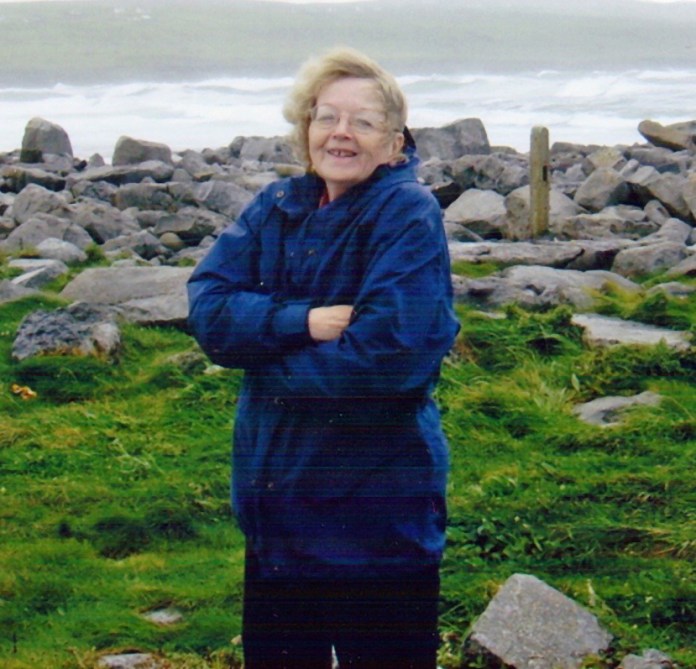
Kathleen Kramer in Ireland.

Kathleen Kramer in Ireland. Photo by Jack Kramer.

Here is her biography from the interior of the book:

Growing up in Pennsylvania’s coalmining and farming region, Kathleen Kramer’s early life was influenced by the solidity of the earth and the rhythm of seasons.

At 19, she left for the city and spent five years working in Washington, DC for the Department of Defense. There followed a stint in Maine where subsistence farming took her back to the land. A second marriage brought her to Long Island, where she and her husband Jack reared their three sons in Northport, a small town on Long Island Sound. During that time and over a period of 10 years of balancing classes, family and work, Kathy earned a BA at Empire State College and an MLS at C.W. Post.

Now, following retirement from the Boyce Thompson Institute at Cornell, Kathy lives with her husband in New York’s Finger Lakes area where she writes poetry and plays. Again, the natural world and changing seasons have assumed center stage. It’s these foundational elements and the strength of generational ties which largely inform Kathy’s poems.

##

And in this interview, Kramer talks about her book and discusses the motivations that propel her writing. I hope you come to appreciate this artist and her work as much as I do.

Can you give a brief description of this collection of poems?  

These poems were written over a period of years and each represents a moment in time when something that seemed important was recognized. Most often, however, the actual moment was, on the surface, quite ordinary. It’s the extraordinariness of the ordinary that moves me. I’ve tried to capture that in these poems.

Not all of these poems address this directly, but I view each one as I might a handcrafted bead: each has its own shape and color and when strung together, they create a necklace that, for me, speaks of wonder and meaning, embracing both good times and hard times.

What do you hope readers will take away from your book?

This collection tries to do a few different things. It explores the enigmatic title, Planting Wild Grapes, which was given to me in a vivid dream. It seeks to illustrate what I think is required of us as finite beings—to engage in our lives as deeply and meaningfully as we can and then, when the times comes, to release them with thanksgiving and grace. It is my hope that the reader will come away from reading this book with a sense of the wonder and meaning in his or her own life.

What do you enjoy most about writing poetry?

For me, writing poetry has been a connection not only to my inner self and to the natural world, but also to something beyond myself. At the risk of sounding grandiose or pious, I believe creativity and the divine are interwoven. When I can touch that moment as I write a poem, I feel exceptionally blessed.

I’m sure it varies with each poem, but can you describe your typical process for constructing poems—from the moment you get an idea for a work until the final revision?

First of all, who knows where the idea for a poem comes from? Sometimes it’s a snatch of overheard conversation. Sometimes it’s a word or line from someone else’s poem or a flash of memory. Often it’s an experience of being with another person and knowing the tie between you is precious. It’s being outdoors and sensing the wholeness. Regardless of where it comes from, there’s a little “thrill,” like a tiny, soundless bell that rings and says, “Follow this one.”

Then I start to write. I write by hand and I almost always go out of my house to write; I especially like to write in cemeteries. (Very quiet and no one interrupts!) When I have a rough sketch of the poem, I go home and type it into my computer, where it’s easier to shape it on the page.

I’m fortunate to be a member of a poetry group, The High Noon Poets. We meet twice a month and it’s there that we each have our poems critiqued. We’re free to accept the suggestions made or to reject them. Often, even if I feel resistant at first, by the time I’m home again, I’m seeing the wisdom of those suggestions.

How does writing poetry compare to writing plays? Do you have a preference? 

What strikes me most are the similarities. In my opinion, both demand an economy of language. Every word must carry its own weight. Sometimes, a word might be there simply because it is beautiful, and if that isn’t overdone, it adds to the whole and, indeed, carries its own weight.

I like writing both poetry and plays. One of the pleasures of playwriting is the characters one can create. They become real and will often tell me what they will or won’t say or do.

However, I think I have a slight preference for writing poetry. There’s satisfaction in writing a single, well-crafted poem. It can stand on its own. There’s no need to sustain a long narrative, yet if the poet creates a number of poems, giving each a shape and color of its own, together, they can tell the story of a life or a time.

What’s next for you in terms of writing projects?

I’ll continue to write poems and, occasionally, plays—I must, in order to be happy—but for a time now, my main focus will be on doing readings and trying in whatever ways I can to share my pleasure in this new book, Planting Wild Grapes.

Kathleen Kramer reading a poem at an event. Photo by Debbie Rexine for The Healing Muse.

Kathleen Kramer reading a poem at an event. Photo by Debbie Rexine for The Healing Muse.

##

Here are two excerpts from Planting Wild Grapes (reprinted with the permission of the author and Yesteryear Publishing).

Planting Wild Grapes

Every day at dawn I go down to the river,
fill my bucket to the brim and wash stones.
Big or small, I take all that come to hand,
dip them in my pail, rub them between my palms
and drop them back into the river. I listen
for the satisfying sound—the watery thunk—
as they settle among their fellows.

At mid-day I wade the waves of goldenrod
to the center of the sunny field behind the barn.
Beneath my feet, my shadow crouches,
small and black. The candle in my hand
stands tall, like me, its wick waiting for
the match, prepared to be proud of a flame
invisible in the noonday light.

Sunset finds me again at river’s edge, a teacup
cradled in my hands. It holds rainwater caught
in the downpour at dinnertime. I lift it up
to the sinking sun, see the rim turn gold,
then tip the cup, spilling rain into the river.
Tomorrow, if I keep to my course,
there will be time to plant wild grapes.

Still

When we noticed lunchtime voices
in the hall, the ding of a call button,
squeak of rubber soles on tile floors,

we knew the sound of her breathing
had ceased. For long moments,

her shoulder, under my hand,
remained warm. Then a stillness,
profound and deep, came upon her—

not of worldly sleep but
of rest unbounded by time.

All her ailments, her frailties,
fell away and the wholeness…
the holiness… which remained

gave her back to us
as she was, as she is.

##

Readers can find Kramer’s 96-page collection on Amazon. And the book is also available at Buffalo Street Books in Ithaca.
Standard

Filed Under Miscellaneous

I’ve been busy with video projects and working on my long-term nonfiction project, so I haven’t had time to blog much lately. But I wanted to share a few items worth noting.

The No Extra Words flash fiction podcast has produced one of my stories, Frozen Food, as part of its Episode 39: Sum of the Parts. The story was originally published in the online magazine The Literary Hatchet. You can listen to the podcast from the website or access it here.

Secondly, one of my essays, on the topic of “the writing life,” has been posted as a blog entry by the online magazine South 85 Journal. You can read the story here.

I also have good some good news about my experimental short film Fragments of the Living. The piece has been accepted as an official entry in the 2016 Athens International Film + Video Festival in Athens, Ohio. It will be screened on April 10.

And NewFilmmakers NY has selected Fragments of the Living to be part of its Spring 2016 Screening Series on April 25 at the Anthology Film Archives in Manhattan.

new filmmakers laurels 2016

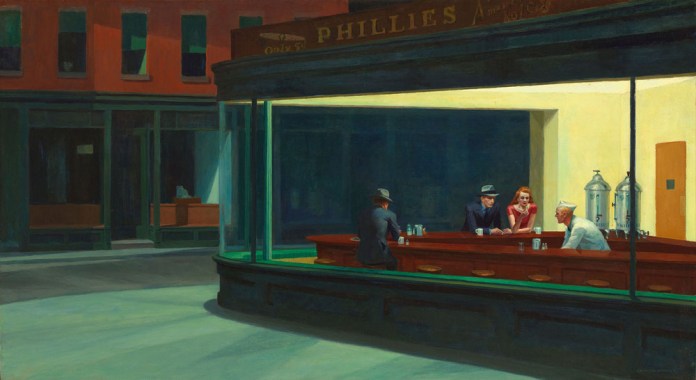
Lastly on the writing front, my full-length stage play Beyond the Glass, inspired by the Edward Hopper painting Nighthawks, was read by actors recently at the WILDsound Writing and Film Festival in Toronto.

Nighthawks by Edward Hopper, 1942.

Nighthawks by Edward Hopper, 1942.

Here’s the link with some information about the project, which I still consider a work in progress. When I get the time (and the courage), I intend to watch to the table reading with headphones and a notebook so I can jot down ideas and notes about problem areas in the script. Revision Awaits Me!

And finally I have one personal note I must share. And this trumps everything else. My wife Pamela gave birth to our son, Colin Joseph DiClemente, on Friday, Feb. 26, 2016, at 10:29 p.m. at St. Joseph’s Hospital in Syracuse.

Colin Joseph DiClemente at the pediatrician's office.

Colin Joseph DiClemente at the pediatrician’s office.

Both mother and baby are doing well, and we are getting used to having a little one in the apartment. Of course, this means less sleep for us and short writing blocks for me, before I get pulled away from the computer by the sound of Colin screaming or a request by Pam for me to make up a bottle of formula. So I will be writing in bursts, trying to get down bits of text before duty calls. I hope the words I type in first-draft form will make some sense to me later.


Standard

A short profile of Sister Joselle Orlando

One of my freelance stories, a short profile of Sister Joselle Orlando, a Roman Catholic nun in Syracuse, New York, appears online. Sister Joselle, a member of the Sisters of St. Francis of the Neumann Communities and an accomplished visual artist, expresses her creativity and carries on her faith by serving as an art teacher and hospital volunteer.

Close-up of Sister Joselle Orlando working on a watercolor piece. Photo by Francis DiClemente.

Close-up of Sister Joselle Orlando working on a watercolor piece. Photo by Francis DiClemente.

I conducted an interview with Sister Joselle in her art studio last year, and I would like to expand the story as a longer blog post in the near future. In the meantime, here are two examples of her artwork.

Assumption Church, a watercolor by Sister Joselle Orlando.

Assumption Church, a watercolor by Sister Joselle Orlando.

An example of Sister Joselle Orlando's use of the mandala as a symbol of faith.

An example of Sister Joselle Orlando’s use of the mandala as a symbol of faith.

Standard

Memories of Grizzly Adams

I was saddened to learn about the death of actor Dan Haggerty, who passed away at the age of 74. Haggerty starred in the 1974 wilderness-themed film The Life and Time of Grizzly Adams.

This movie has a special significance for me, and so in threading the projector of my memory vault, I recall . . .

One of the first movies I remember seeing in a theater was The Life and Times of Grizzly Adams, starring Dan Haggerty, playing at the Capitol Theatre in downtown Rome, New York.

Dan Haggerty as Grizzly Adams.

Dan Haggerty as Grizzly Adams.

The experience was memorable because my parents were bickering at the time. It was a Sunday, a bleak winter night in the 1970s. I had begged our parents to take my sister Lisa and I to see to the movie. They had agreed a few days earlier, but now as we prepared to head out into the snow, Mom refused to go. She tried to foil our plans, saying we had misbehaved and should be punished.

I don’t remember what we had done to raise my mother’s ire. Lisa and I had probably fought that day or caused some chaos around the house. Mom was the disciplinarian in our family. And if we acted up she would whip our bottoms with a wooden spoon, the same spoon she used to stir the pot when she cooked her Italian marina sauce.

As my parents continued to argue, their voices echoed throughout the house. I think my mother was saying how Dad let us get away with everything and how she resented her role as enforcer—the parent who meted out punishment. “You shouldn’t reward them by taking them to the movies,” she told my father. “They don’t deserve it.”

But Dad stood up for us. “No Carm, we promised them,” he insisted. “We can’t disappoint them now. We’re going.” And I remember Mom saying, “Fine. You always give in to them anyway.”

And so we left the house, the blowing snow and the frigid air hitting us as we piled into the car and then drove from our rural road in south Rome to downtown. Everyone was quiet in the car as the heater roared and the windshield wipers flapped back and forth.

We parked in an alley near the city parking garage and walked on the icy sidewalk toward the Capitol on West Dominick Street. And then I saw it—the glowing marquee advertising the movie.

Dad bought our tickets and we entered the lobby, warm air brushing against me as we walked across the salt-stained red carpet toward the concession stand. And I instantly forgot about my parents fighting.

I was hooked by the movie-going experience, the smell of popcorn and the colorful display of candy under the glass. I think we bought popcorn, sodas and Milk Duds. And inside the historic theater, I looked up and peered at the gilded railings along the steps leading to the balcony.

Mom led the way toward a row near the front. She placed my sister and me in between her and Dad, our bodies creating distance between them.

Once the movie started, I got lost in the story of the mountain man played by Haggerty and the life he lived in the wild with his bear Ben. I was struck by the cinematography, the beautiful nature scenes showing the mountains of the western U.S.

We kept quiet on the drive home. But I think Dad asked us if we enjoyed the movie. We said we did and my sister and I thanked both of them for taking us. Mom didn’t say anything.

At home we all got ready for bed. And my parents did not argue any more that night. I think by then Mom had moved on from fighting to the next stage—the silent treatment.

I remember being tired but renewed by the power of cinema. I realized here was a place of refuge. By going to the movies, you could escape your unhappy household; inside the movie theater the arguments of your parents ceased and their squabbles faded away. It didn’t matter that your parents would soon be divorced or that your family did not have much money. Nothing mattered in the cinematic realm except sight and sound—images on the big screen and the characters and plot of the story as it unfolded before you.

I would carry that lesson with me throughout my adulthood. Whenever I felt lonely or caught up in the troubles of life, I could always find comfort and emotional succor inside the darkened atmosphere of a movie theater.

##

I first wrote about that experience in a poem that appeared in my chapbook Outskirts of Intimacy, published by Flutter Press in 2010. Here it is.

First Time at the Movies

FADE IN:

A Sunday night in Rome, New York,
the middle of winter in the 1970s.

I remember neon lights that spelled out:
“Now Playing . . . The Life and Times of Grizzly Adams,
Starring Dan Haggerty . . .”
Snow traipsed in on the red carpet,
salt stains in the Capitol Theatre’s lobby,
gilded railings leading to the balcony,
which looked to me like bleachers extending from heaven.
We hurried down the aisle and piled into the front row,
Mom placing my sister Lisa and me between herself and Dad.
We were the buffer zone in those seats that strained our necks.

With the aroma of buttered popcorn swirling around me,
the burgundy curtain slowly parted, revealing the silver screen.
As I chewed on Milk Duds and nibbled black licorice,
the projector flickered and the soundtrack crackled.
And I recall squeezing my sister’s hand,
unable to control my first-time giddiness.
Mom and Dad ignored our exuberance,
kept scowling in unison, caught up in their own close-up shots.

But I took it all in, mesmerized by the Magic Lantern’s dancing light,
instantly hooked by the cinematic illusion.
And as I focused my gaze on the wide screen surrounding me—
the altered reality created by the camera lens ignited my imagination.
I was no longer trapped in a scene charged with domestic quarrels.
I was cut loose from the tentacles of my family—
free to get lost in Tinseltown’s glittering lights and make-believe magic.

FADE OUT.

Standard

Squirrel on the Roof: An Essay

This essay appears in the Fall 2015 edition of New Plains Review, a literary magazine in Oklahoma. Since there is no online version of the story, I thought I would post it here. The text follows below. And I would just like to take this opportunity to wish everyone Happy Holidays, Merry Christmas and a Happy New Year.

##

The squirrel refused to be intimidated by my figure appearing in the window.

I was spending a few days with my stepfather Bill at his home in Rome, New York, during the week of Christmas 2013. One afternoon I went upstairs to grab one of my prescriptions from the guest bedroom.

I paused on the landing leading to the upper floor and gazed out the window. Thin white clouds slid across a blue sky more suited for June than December. Bright sunlight radiated against the layer of snow that covered the backyard, and the tall pine trees standing in the alley behind Bill’s house swayed in the breeze.

I saw the brown squirrel running on the roof of the addition to the house—which included the family room and a small mudroom located at the back entrance. Tiny squirrel tracks dotted the snow on the roof and led to an ash tree with large branches leaning over the house.

This squirrel sat up on his hind legs with his front paws pressed to his mouth as he nibbled on a seed or a small nut. He was turned in profile to me, so the left side of his head and body faced me. He had grayish-brown fur with fine hairs and small black eyes.

A gray squirrel (not the one from the roof). Photo by Sannse, downloaded from Wikipedia.

A gray squirrel (not the one from the roof). Photo by Sannse, downloaded from Wikipedia.

The squirrel seemed to be looking at me out of the corner of his eye. I tapped loudly on the window and said, “Hey, hey, get outta there. Get off there.”

I was worried he would sneak into the house, either by going down the chimney or squeezing through an opening somewhere on the roof.

But the squirrel remained in place near the window. I banged on the glass again.

He ran a few feet away and then stopped. He scurried back to his original spot and resumed eating his morsel, while continuing to look at me out of the corner of his eye. He had judged correctly that I was unwilling to crawl out on the roof and chase him away.

I considered opening the window, reaching down to make a snowball and tossing it at the squirrel. But I feared if I lifted the storm window the squirrel would leap past me and enter the house.

I imagined the scratching sound his claws would make on the hardwood staircase if he got inside and ran downstairs. I thought about the shock Bill would receive if he saw the squirrel racing around the kitchen or family room.

I knocked on the glass again, waved my hands and yelled at the squirrel, attempting to shoo him away. He ignored my gesticulations and stood his ground.

Then I conjured an image of the animal in human form, taking on the shape, appearance and personality of a tough-guy New York City construction worker, a sarcastic pragmatist.

I imagined if the squirrel could have talked at that moment, he would have said to me: “Go ahead buddy. Bang all you want. I’m not going anywhere. Sure, open the window if you want. I’ll be in that house so fast you won’t know where to find me. I’ll crawl into your bed and gnaw on your face at night.”

After the imaginary, one-way conversation I decided it was unnecessary to waste any more time worrying about the squirrel. I figured if he could have found a way to sneak into the house via the roof, he would have done so already.

I moved away from the landing, walking up the last few steps of the staircase and then entered my guest bedroom. I grabbed the pill I needed from the top of the dresser and headed back downstairs. I did not look outside as I passed in front of the window again, as I avoided the alert black eyes of the squirrel. But I suspected the animal was still crouched on the roof, eating his nut, confident that his meal would no longer be disrupted and his home would remain secure.

Postscript: Summer 2014

The following summer the homeowner took action to address the squirrel infestation. Bill decided he was fed up with acorns being scattered on his patio and the squirrels stealing all of the birdseed from his bird feeder. He bought some metal cages, put peanuts in them and placed the traps on the back lawn, near the bird feeder.

Bill owns and operates a small contracting company in Rome. He and Butch, one of his laborers, would set the traps repeatedly, and over the course of the summer they nabbed 18 squirrels (at last count).

They also developed a strategy for removing the rodents. At first Butch would release them in the neighborhood, but then Bill and Butch discovered that some of them had returned to the backyard. They knew this because Butch had sprayed the tail of one of the squirrels with yellow parking lot line paint; he let it go a few blocks away from Bill’s house, near the Rome Art and Community Center. And sure enough the squirrel came back again, scampering freely in the yard with a streak of yellow color showing on its back end.

From that point on, Bill and Butch transported the squirrels to an area near Delta Lake dam in the Town of Western, north of Rome.

The backyard is much quieter now. When I visit Bill I rarely see squirrels darting about on the lawn, racing up the trunks of the trees or hanging off the bird feeder, stealing the birdseed from Bill’s feathered neighbors. I also wonder if Bill and Butch captured my rebellious friend, or if the rodent in question avoided the temptation of the peanuts and escaped the jaws of the metal cage. I’d like to think the squirrel I observed on the roof is now enjoying a new home near the dense forestland surrounding Delta Lake.

Standard

Fragments of the Living: A Short Film

I am excited to announce the completion of a short film, a personal project I tackled in my spare time.

Fragments of the Living is an experimental work composed of public domain home movie clips. The piece is a celebration of the American family, a nostalgic salute to the past and a meditation on the fleeting nature of life.

In researching stock footage libraries for a work project last year, I discovered several home movie files on the website Archive.org; most of the clips were dated from the 1940s to the 1960s. I became fascinated with the videos—the cinematic vestiges that originated from reels of old film stuffed in boxes and stored in dusty attics or garages.

I have always been enamored with the past, and the lure of nostalgia remains strong for me, with two examples being my love of Frank Sinatra songs and classic film noir movies. And I realized these Super 8 movies were the forerunners of today’s selfies and YouTube videos.

It’s worth noting I had no connection with the people seen on screen; the films were not my family’s home movies. As a result, I observed the images from an objective viewpoint.

I enjoyed watching the subjects’ reactions when they noticed the camera capturing their movements. Some of the people smiled and waved, while others acted coy and some girls even ran away from the lens.

One stretch of the film takes place on a street in the late 1930s or early 1940s. I’m not sure where the black and white scenes were recorded, but the place reminded me of a small town in Nebraska or Colorado, the type of community that could serve as the setting for a Kent Haruf novel.

And I wondered: were the people smiling in the frame really happy or were they just acting that way for the camera? Were they trying to present an image of a happy family because that’s what was expected of them? I wish I could have been there to see what happened when the camera turned away from them.

I also understood that many of the men and women on screen were now either dead or very old. Yet in the clips they are alive and joyous as they celebrate holidays, vacations and special occasions with their families and friends.

I wondered if the subjects realized at the time that they were experiencing the prime of their lives, that the events captured by the camera marked their happiest moments.

I wondered if it all went downhill from there? Did they watch their loved ones grow old, become sick and die? Did they suffer economic misfortune? No doubt some of the couples later divorced. Did the children in the videos grow up and leave their parents, severing family ties?

The snippets of film revealed the ephemeral nature of life. In editing the piece, I limited each clip to only a few seconds. So we see a bob of the head, a smile, a wave, a blink of the eye and then we cut to something else. And I guess that “cut to” serves as a reminder to me that time is slipping away for all of us living here in the present.

Standard

The Old Man’s Morning Ritual

I have a short nonfiction story that appears online in this month’s issue of Foliate Oak Literary Magazine. The text of the piece follows:

The old man leaves his nursing home in the grayness of early morning, walking up the steep incline of South Crouse Avenue in Syracuse, as a stiff wind smacks him in the face. He swings his right arm out to the side—pumping it in rhythm—almost as if he is matching the beat of a marching band playing in his head. He has gray-black hair, balding in the front, and he wears a light blue jacket, tan pants, and gray sneakers.

Looking southbound along South Crouse Avenue.

Looking southbound along South Crouse Avenue.

I often see him sitting on the steps outside Bruegger’s Bagels near Marshall Street, sipping a cup of coffee and smoking a cigarette, a blank expression pressed to his face. What does he think about as he sits there and watches the world rush by? What goes through his mind as he observes college students chattering in groups, nurses starting or ending their shifts, and cab drivers pulling over to the curb to pick up or drop off a fare or grab a quick cup coffee?

Despite his age the man asserts his independence as he escapes the white walls and the fetid smells of the nursing home. Each day he goes to Bruegger’s his creaky legs carry him up the hill and his lungs circulate oxygen. He remains alive, connected to the outside world as he savors the simple pleasure of a drinking cup of coffee and a smoking a cigarette in public.

No one seems to notice the man sitting there; he’s a faceless figure taking up space on a crowded street. I see him, recognizing his existence, and I am tempted to stop and talk to him, to find out about his life. But his blank expression dissuades me, as I don’t want to disturb him or cause him to become frightened, thinking that I may want something from him.

No, I do not say a word to the man. But I preserve his image in my mind, recording his likeness in detail. I do this because I think he foreshadows my existence 20 to 25 years from now, if I am not already dead.

A fence located on South Crouse Avenue near an apartment building serving senior citizens.

A fence located on South Crouse Avenue near an apartment building serving senior citizens.

If I am still able to walk then, I hope to mimic the old man’s movements, making an attempt to cling to a normal life despite being confined to a nursing home. I too will leave my bed in the morning, walk to a coffee shop nearby, grab a cup coffee or a bagel, and then sit down somewhere and say to the world, or only to myself, “It’s another day and I’m still here.”

Standard

Quiet Intersections: The Graphic Work of Robert Kipniss

The ventilation system hums inside the Palitz Gallery at Syracuse University’s Lubin House in New York City. But standing in front of some of the graphic works of Robert Kipniss currently on view at the gallery, you may imagine other sounds—a screen door swinging shut, a train roaring in the distance, cicadas singing and the wind moving through tree limbs.

Quiet Intersections: The Graphic Work of Robert Kipniss presents more than 30 prints depicting interior still life scenes and rural landscapes composed of plants, windows, houses, trees, hills and fields. Most of the works are black and white, while others have subtle earth tones like mauve, green and brown.

Branches by Robert Kipniss (1967)

The prints are part of the Syracuse University Art Collection, a gift from James F. White, and cover more than 40 years of Kipniss’ career—from 1967 to 2013. Most are small works, the largest measuring 24 by 18 inches (height to width).

These pieces show a consistency in style and composition, as the artist uses a dark palette, dynamic angles and carefully constructed geometric patterns to draw the viewer’s eye and create a moody atmosphere.

Four Houses by Robert Kipniss (1991)

Four Houses by Robert Kipniss (1991)

With the human figure pulled from the scenes, we get the sense of seeing the subjective point of view of a person standing in a living room and looking out a window at a dew-covered backyard or hillside in southern Indiana, or sitting at the kitchen table in the early morning hours, sipping that first cup of coffee and observing the sunlight filtering through parted curtains. Hence, the works stimulate introspection and possess greater allure than straight still life or landscape prints. Their power lies in what they are able to represent or conjure in the mind of the viewer.

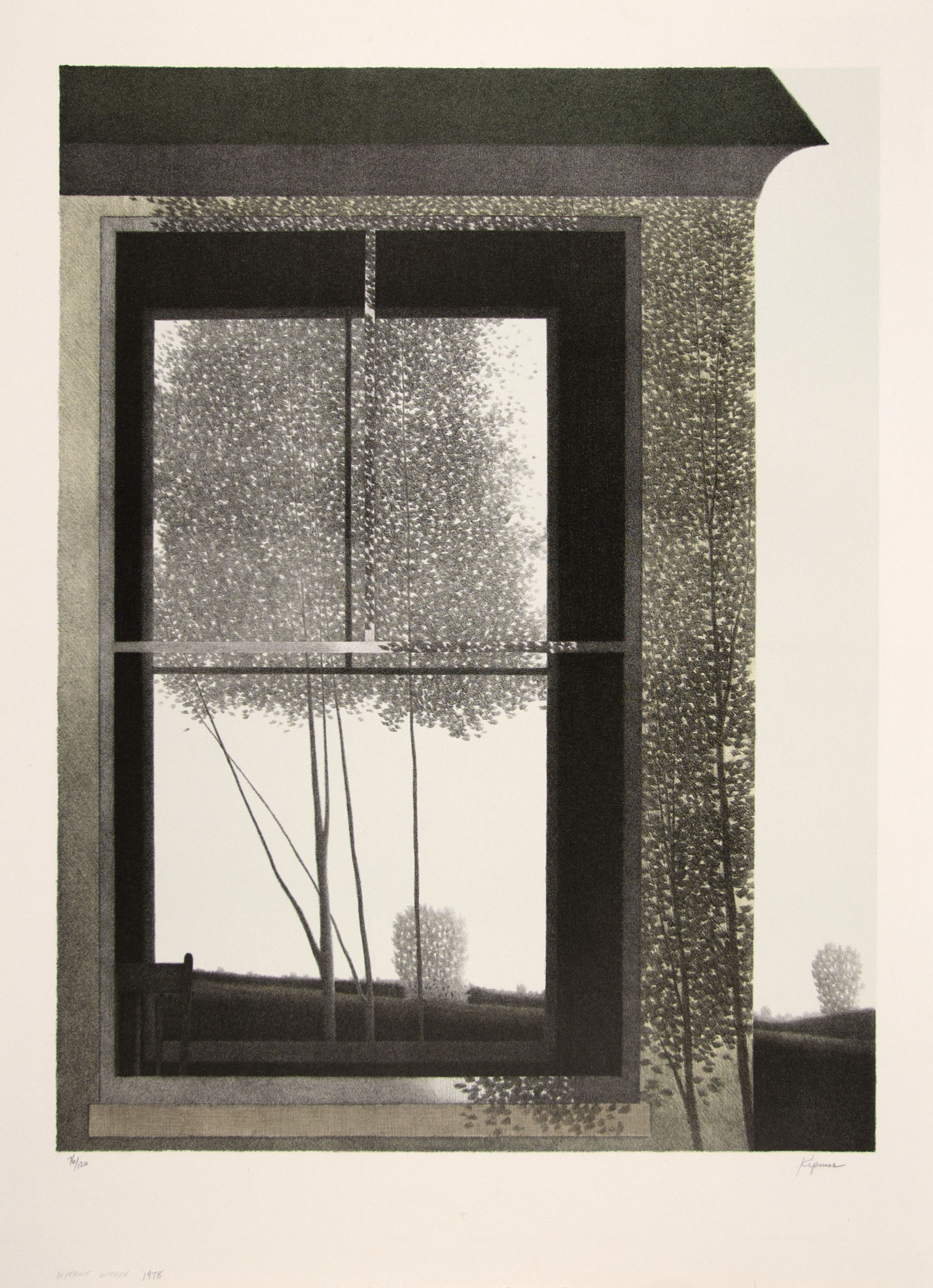
Without Within by Robert Kipniss (1978)

Without Within by Robert Kipniss (1978)

And Kipniss prevails in his subtlety. This is not art on a grand scale showcased in a massive and overcrowded gallery space; instead, this is art to live with and reflect on, objects to hang on a wall and return to on a daily basis.

Kipniss was born in Brooklyn in 1931. Both of his parents were artists and he developed an interest in both verbal and visual expression. He studied at the Art Students League and earned two degrees from the University of Iowa—a bachelor’s in English literature in 1952 and a master of fine arts in painting and art history in 1954.

He won an art competition in New York in 1951 and was awarded his first one-man show. After serving in the Army, he and his wife returned to New York City. He worked evenings at the U.S. Post Office and spent his days painting and writing poetry. He then made the decision to devote his time entirely to painting, which meant he shelved his writing.

He would, however, jot down observations about his life and work over the next several years, and these memories would form the basis of his 2011 memoir, Robert Kipniss: A Working Artist’s Life (University Press of New England).

Kipniss has exhibited his work in more than 200 solo shows. He is represented in the permanent collections of several prominent museums, including the Metropolitan Museum of Art, the Whitney Museum of American Art, the Art Institute of Chicago, the Los Angeles County Museum of Art and the Museum of Fine Arts in Boston.

He was elected to the National Academy of Design and to the Royal Society of Painter-Printmakers in London.

Vase with Branches and Chair (2013)

Vase with Branches and Chair (2013)

The exhibition will remain on view through Nov. 12; it is open Monday to Friday from 10 a.m. to 6 p.m. and Saturday from 11 a.m. to 4 p.m. It is free and open to the public. The Lubin House is located at 11 East 61st Street between Madison and Fifth avenues. Contact 212-826-0320 or lubin@syr.edu for more information.

After it closes in New York, the exhibit will travel north and then open in January at the Syracuse University Art Galleries in Syracuse, New York.

Standard

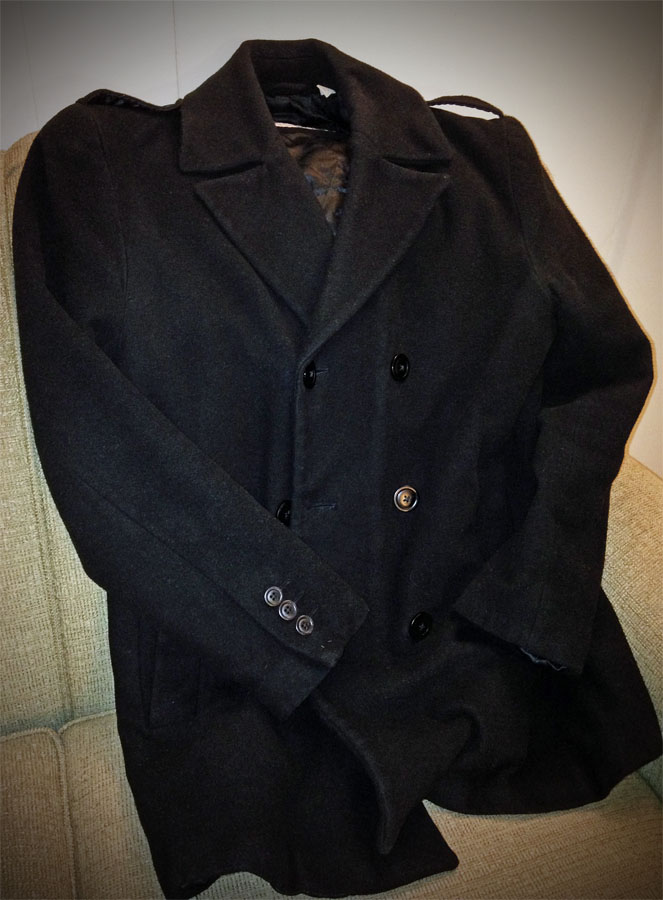
Change of Seasons (The Pea Coat Poem)

I woke up with a chill this morning in my apartment, and this poem came to me.

My trusty pea coat.

My trusty pea coat.

Change of Seasons (The Pea Coat Poem)

The first day of October
and temperatures dip
into the low 40s.
A feeling of utter gloom
as I reach into the shadows
of the hall closet and retrieve
my worn, black pea coat.
And so begins another
six months of winter
in Central New York.

I should be used to it by now,
but I can’t reconcile with this weather.
And my pea coat will not return
to the closet until after Easter.
So until spring arrives,
I will continue to complain
with zeal about the cold,
while making sure
to button up my coat
before I step outside
to face the elements.

Standard

An Assortment of Prose and Poetry

I haven’t had a chance to blog in a while, as I have been busy with video projects in my full-time job and a long-term writing project in my off-hours. But I wanted to point out that a couple of my stories have been published online. The first is an essay that was originally published in a Chicken Soup for the Soul anthology; it’s now posted in the Life Tips section of Medium. You can read it here.

The second story is a fantasy flash fiction piece that was originally published in the magazine The Literary Hatchet. I recently received an email from the editor of Sub-saharan Magazine, an online magazine dedicated to publishing speculative fiction with an African flavor. It was a nice surprise, having someone from across the globe read something I had written and want to use it. The editor asked if he could re-publish the story and change the characters’ names to African names so the piece would be consistent with the magazine’s mission. I said sure and the story is now online. You can read it here.

Now switching gears, I would like to mention I’ve been reading some poems by Samuel Menashe (1925-2011).

Samuel Menashe

Samuel Menashe

He was a master of compact, precise poems that leave an impact; it seems Menashe never wasted a word or wrote more than was needed to produce the desired effect. I’ve been scanning through the website Poem Hunter to read some of his works. Here are a few I found memorable:

The Living End

Before long the end
Of the beginning
Begins to bend
To the beginning
Of the end you live
With some misgivings
About what you did.

##

Rue

For what I did
And did not do
And do without
In my old age
Rue, not rage
Against that night
We go into,
Sets me straight
On what to do
Before I die—
Sit in the shade,
Look at the sky

##

Here Now

Now and again
I am here now
And now is when
I’m here again

##

I need to check out a Menashe book from the library to really probe his work; online skimming doesn’t do justice to a poet of his magnitude. Reading Menashe also brought back warm memories of when I discovered two of my all-time favorite poems—both great examples of brevity and wit. They are Langston Hughes’ Suicide’s Note and Dorothy Parker’s Resumé, and I think they resemble Menashe’s style.

Suicide’s Note

The calm,
Cool face of the river
Asked me for a kiss.

##

Resumé

Razors pain you;
Rivers are damp;
Acids stain you;
And drugs cause cramp.
Guns aren’t lawful;
Nooses give;
Gas smells awful;
You might as well live.

##

That’s it for now. I hope to come back to the blog more frequently, but alas I make no promises. Happy reading and creating.

Standard