Maya Deren’s Ritual in Transfigured Time

This story was published on the website of Film International magazine. Go to the link and scroll down to the bottom of the page to see the film by Maya Deren.

http://filmint.nu/?p=6028

Last summer, in the midst of the blockbuster movie season dominated by sequels, 3-D animation and superhero offerings, I stumbled upon a cinematic treat from a forgotten era. While eating my lunch at my desk one afternoon, I went to YouTube to look up some alternative music bands. After a while, an impulse made me type “Maya Deren” in the search box, and I soon entered the hypnotic world of the late choreographer, dancer and experimental filmmaker.

Several years ago I had watched Deren’s Meshes of the Afternoon and read her essay “Cinematography: The Creative Use of Reality” in Film Theory and Criticism, edited by Gerald Mast and Marshall Cohen (1974). I was exposed to filmmakers like Deren, Luis Buñuel, Fritz Lang and Sergei Eisenstein while studying for my master’s in film and video in the early 1990s. Yet one does not need to understand film theory, semiotics, psychology or feminist theory to appreciate Deren’s work. When some selections of Deren’s movies popped up on YouTube, I opted for Ritual in Transfigured Time, a short silent film from 1946.

The black and white, slow-motion images washed over me and I sat there transfixed by the surrealistic scenes. I think this may be the best way to explore Deren’s films – to know nothing about them except the title. Then the viewer enters Deren’s dream landscape and soon abandons all preconceived notions of the film medium and the carefully-constructed plots demanded by Hollywood. You surrender to the hallucination and, in doing so, you accept the idea that all art, including Deren’s work, is open for interpretation.

And while we do not get a linear storyline, character arcs, a three-act structure or a clear resolution, Ritual in Transfigured Time spurs questions in the minds of viewers. Who is this woman (Maya Deren) leaning against a doorway and playing with yarn at the outset? Is she waiting for someone? A lover? Or another version of herself? Why do the dancers at the party switch partners so frequently? Are the lead dancers in the park lovers? What do they represent? And why does it seem the female dancer is afraid of the male dancer? What has provoked this fear?

These questions then marinate in the brain and the result is a narrative that can only be completed by the audience. Everything is left up to our imaginations. We fill in the details and attempt to put the pieces of the puzzle together. Of course this means each viewer develops his or her ideas about the story. I can’t tell you the meaning of Ritual or even give you a clear plot description. There is too much ambiguity at work within the frame. I can only tell you it draws you in and you don’t want to look away.

I would like to point out a few memorable moments from Ritual, as these scenes have brought me back to YouTube for repeated viewings.

At about the 7-minute mark, we are placed in the middle of what looks like a house party attended by well-dressed guests. The men and women begin to dance, the figures moving from one person to the next. They do not dance so much as merely shuffle between partners. They exchange a few words, shake hands, latch on to shoulders and dance from side to side before turning to the next person and repeating the process. I wonder if this is a dream sequence, a party game or a meditation about the fragility of romance – the second you grasp on to it, it is gone. Affection blooms and withers and other people step in to replace our former lovers. But if this is the case, then why are so many of the “dancers” at the party smiling, their happy faces revealing no hint of despair?

Later at the party, at about the 8:20 mark, the lead actress and dancer, Rita Christiani, and the lead actor/dancer, Frank Westbrook, draw close to each other and nearly touch cheeks. The scene then cuts from the house party to a park, with the same two people holding hands. In this location, we also see women standing together and dancing. The shirtless male dancer tosses Christiani skyward, and her arms are extended in the air as she takes flight in slow motion. She remains suspended for a moment.

A short time later, we see Westrbrook in a low-angle shot against what appears to be the background of a stadium. He makes motions from side to side with his arms. His frame is taut and every muscle in his body stands out. Later he hops, spins in place and twirls in the air, his image frozen briefly. He expresses the joy of movement and he reminds me of a puppy wanting to play with its owner.

At the 11:38 mark, a wrought iron gate opens and Christiani enters a garden. We see Westbrook standing like a statue on a pedestal. She walks toward him. But now he breaks the plaster pose by looking at her. She displays fear and runs away. He remains standing momentarily and then gives chase, jumping after her. At 12:35 she disappears down a hill with Westbrook in pursuit, leaping along the way.

At the 13-minute mark we come to a courtyard and Christiani continues to run away, now passing stone archways. Westbrook follows. At 13:27 he tries to grab her; she escapes his grasp. But now it is Maya Deren fleeing, running under a wooden pier and rushing out into the sea until her legs disappear and the water swallows her.

At 13:50 we cut back to Christiani making motions with her arms, and then in a negative image, a white dancer falls against a black background. This is repeated a few times. The last image is a close-up of a female dancer’s head. The woman lifts a veil covering her face and then opens her eyes, and it’s hard to tell whether this face belongs to Christiani or Deren.

There is no doubt Ritual in Transfigured Time offers rich potential for psychological interpretation. But the more I watch it, the less I care about trying to decode its meaning. I think the combination of bodies in motion, dream-like images and underlying tension is enough to satisfy me. Answers are not necessary for me to enjoy the ride. I also realize that with the power of YouTube there are countless other experimental films waiting to be discovered on my lunch hour.

Standard

Collage Postscript

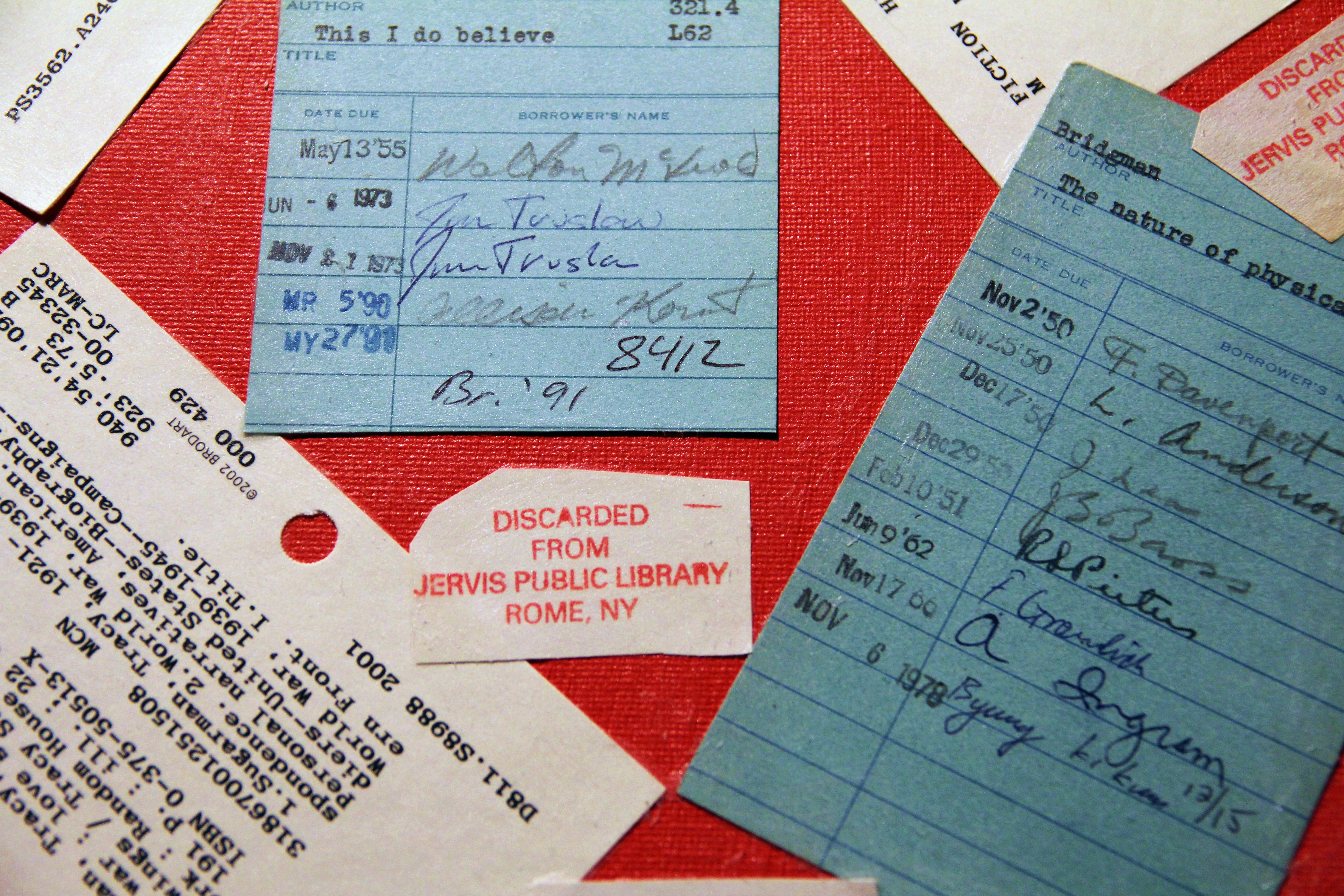
Since I made the first collage piece in 2009, I have tried my hand a few more times, with varying results. I made two library-themed collage works called Archive and Checkout, seen here.

Digital image of mixed media work, 2011.

Digital image of collage, 2011.

The idea for the pieces came to me because over the years my mother had purchased several used books from Jervis Public Library in Rome; most sold for one dollar or less. Flipping through some of the books, I noticed they were all stamped with the phrase “Discarded From Jervis Public Library” in red ink on one of the inside covers or pages.

Many of the books were in good condition, and some of the titles came from popular authors like James Patterson, Scott Turow, Anne Rice and Dick Francis. Even so, whether a title was a Harlequin romance or a prize-winning literary novel, I felt sadness because books that seemed to be still readable were being pulled from the stacks and deposited on cluttered shelves in a dark hallway of the library near the men’s and women’s bathrooms. I’m sure there’s a good reason why the books needed to be moved out of circulation, but on a visceral level I felt empathy for the discarded inanimate works.  

As a result, I went to the library, bought several of the used books and cut out the stamped pages. I then gathered the pages and some old library cards that I found for sale online and pasted them together on two painted canvases.

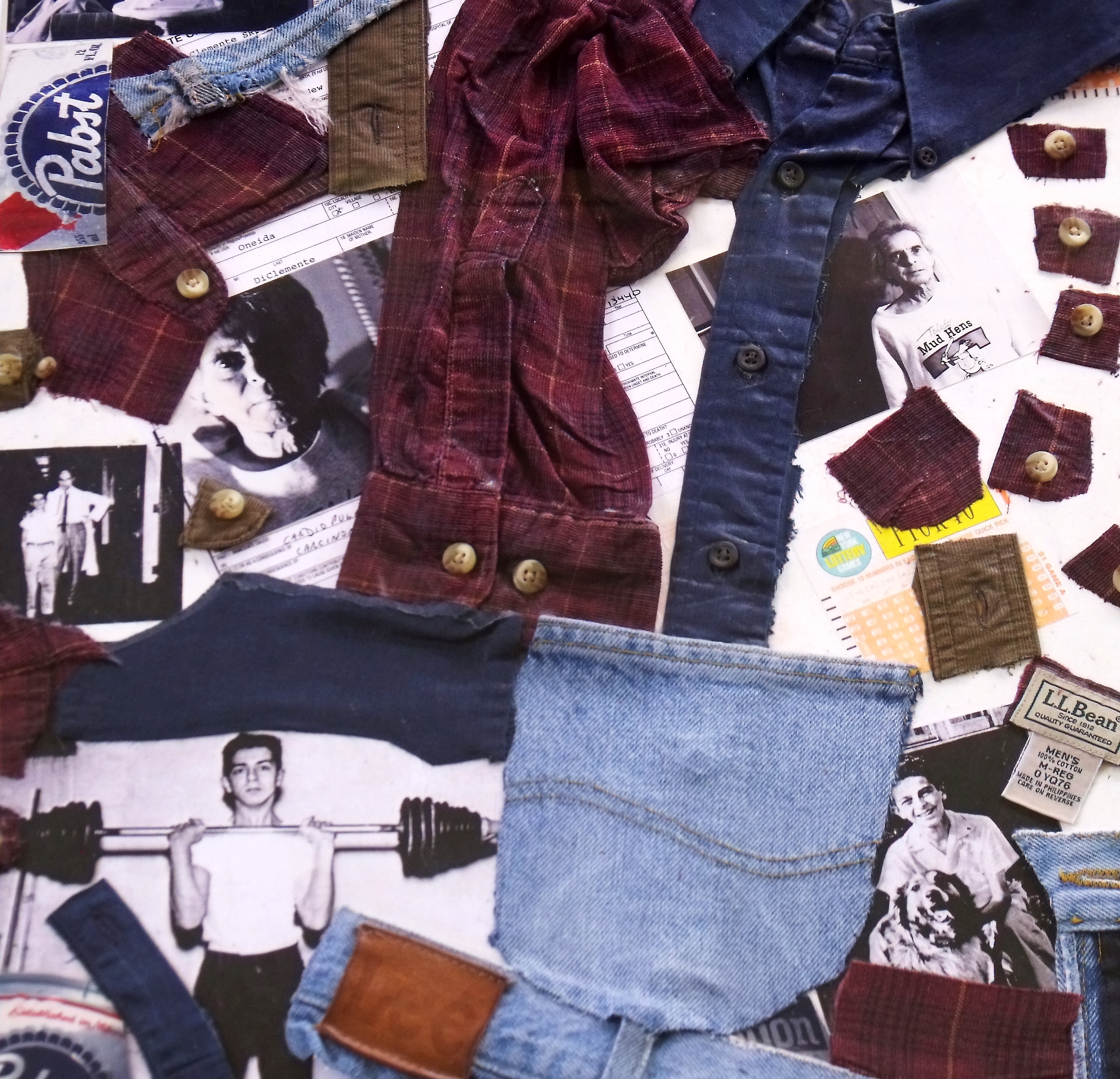
This fun project in the summer of 2011 led to another unrelated work. My father had passed away in 2007 and I still had some of his old clothes and other personal items. So I thought I would try to make a collage tribute to him using materials left over from his life. Here is the finished product.

Digital image of mixed media work, 2011.

In hindsight, I should have painted the surface before I added the collage materials to give it some color. I also think I should have limited the number of buttons from my dad’s shirts.

Still, what I like most about these three collage works is I had no expectations when I started working on them. As stated in my last post, I am a collage novice, but an idea came to me and I said to myself, “OK, give it a try.”

And I think it’s a good lesson for me to learn, as artistic experimentation is vital to keeping work fresh. It helps to shake up the juices and allow new paths of creation to flow. This philosophy of taking risks and following your instincts applies to practitioners of all art forms and is also relevant in other areas of life, such as learning, career, dating, cooking and social experiences.

On a personal note, the three collages hold special meaning for me because they pay tribute to my late parents. I mentioned my father’s collage, but the two library-themed pictures also honor my mother, even if that was not the intention when I made them. My mom, who died last November after a long battle with cancer, was a bibliophile who researched and compiled detailed biographies and booklists for her favorite authors, including Danielle Steel and Nora Roberts. When I would mock her for taking a hobby to such a fanatical level, she would just say, “I’m very organized.”

She also gave me permission to rip out all of the “Discarded From Jervis Public Library” stamps from the used books she had finished reading. She piled the books in a wicker basket placed near the fireplace in the living room, with yellow Post-it notes on the covers indicating they had been “read.”

And I’m glad she had a chance to see the finished library collages since she contributed to the making of them. Right now all three collages are wrapped in brown paper and tucked under the bed in one of the spare bedrooms in my stepfather’s house in Rome. But if a day comes when I have some wall space in a future apartment—not the furnished studio I currently rent—I’ll hang up the collages and look upon the images with satisfaction, knowing a little bit of my parents’ spirit lives on underneath the glass frames.

Digital photograph of collage, 2011.

Digital photograph of mixed media piece, 2011.


Standard

Collage in the Closet

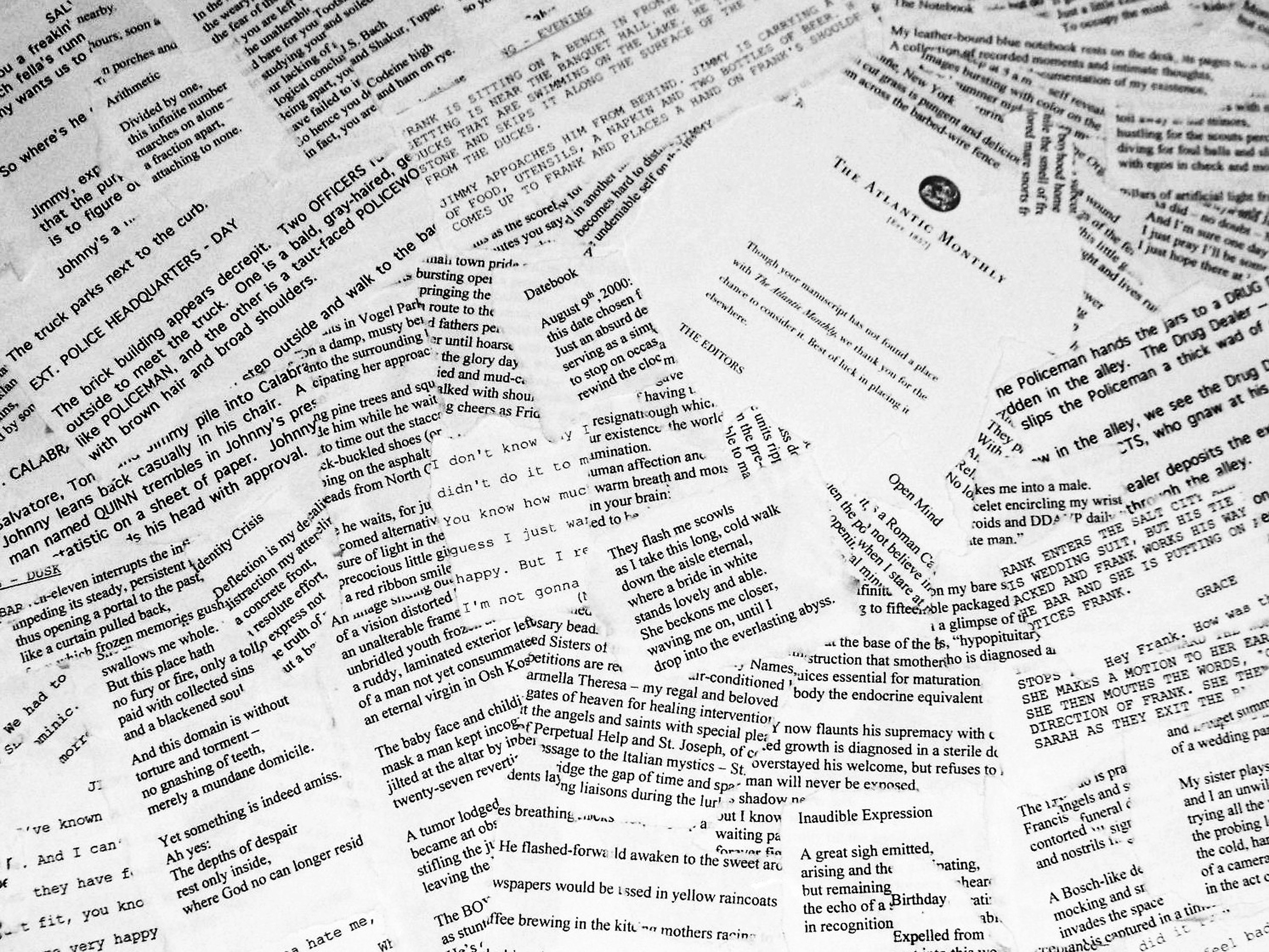
The manuscripts had collected in my bottom drawer. This verbal clutter consisted of poems, stories and film scripts, all fused into the genre of unwanted black ink on white paper; in short, words rejected by the eyes of editors.

And then in early December 2009, an idea struck me. I decided to try to create a work of art in another form, gluing the scraps of paper to a foam board to make a collage composed of cut-up manuscripts. I even had a title for the piece: “Unpublished Manuscripts.”

As a recreational artist I have taken photographs over the years with my Pentax K1000 camera. Some of the images have been exhibited in small galleries in central New York and also published in literary magazines.

However, I had never created a collage before, so I wasn’t familiar with the process.

But that December I had an exhibit scheduled at the Rome Art and Community Center in my hometown of Rome, New York, and I thought I would make the collage as an additional work to go along with the group of photographs. I purchased a 20-by-30-inch piece of foam board, several 3M glue sticks and a can of acrylic spray. 

I now felt ready to tackle the medium. Then time became a factor because I had one week to go before I had to travel to Rome to drop off the artwork for the exhibition. I worked feverishly several hours a night after work, selecting the manuscripts, ripping the pages into non-uniform pieces and pasting them to the board. 

And it was fitting because I received a rejection form letter from The Atlantic that week in response to some poems I had submitted. I added it to my collage.  

When I was finished gluing all of the pieces of paper, I sprayed a few heavy coats of acrylic spray on the surface. I remember being petrified that the release of the chemical spray would lead to spontaneous combustion in my apartment or cause the gas stove to explode. So just to be safe I opened my door to allow the frigid night air to dissipate the cloud hovering over my bed, as I had placed the collage on top of the green comforter covering my mattress.

A few days later I dropped off the collage, along with about a dozen of my framed photographs, at the RACC. I also made sure the unframed mixed media piece had wire attached to the back for gallery hanging.

Christmas came and went, and before New Year’s Eve I headed back to the RACC with my stepfather Bill to pick up the artwork.

As we went inside, trying to dodge the melting snow dripping from the overhang of the roof, a female museum employee was talking to the mailman outside. The lady told me the executive director, who approves and schedules all exhibitions, was off that day. Bill and I climbed the stairs to the second floor, turned down a hallway and entered the small community room gallery where my pieces had been displayed.

Bill helped me to pack the framed photographs into some blue plastic totes we had brought with us, but we could not find the collage anywhere. Fear consumed me, and I said to Bill, “I hope they haven’t thrown it out.”

We asked the woman who had been talking to the mailman if she knew where the collage was hiding. She did not have a clue, but she said the executive director would not have thrown it out because the director had too much respect for artists. I doubted this claim.

Bill walked downstairs with a couple of totes stacked in his arms, while I searched every inch of the white room, along with some of the other gallery spaces. I then came back to the community room and noticed the outline of a narrow closet door near one of the corners.

The door creaked as I opened it slowly, and I found my collage leaning against some shelving, still sheathed in the plastic bag I had put it in.     

I was crestfallen, as it seemed all my effort to create the piece was wasted. If I wasn’t so disappointed, I would have found the humor in it. The piece to celebrate a writer’s rejection was stuffed in a closet, hidden by the art museum and deemed unworthy for the eyes of visitors. 

Bill and my mother tried to cheer me up later in the day. In the evening, after going to Mass, they went to Wal-Mart and bought a large black frame. After they brought it home, Bill, who works as a contractor and possesses a craftsman’s magic when it comes to matting, framing and hanging pictures, set my collage on the kitchen table and put it inside the new frame.

And the frame looked attractive hanging on a wall in my parents’ living room. Since then, friends and family who have seen the work have complimented it; some have called it a “conversation piece” and also inquired about the time and effort it took to rip up the small pieces of paper and attach them to the surface.     

Truth be told, I am not a collage artist at heart. I have been raised with digital media, and photography and video are the tools I use to express myself visually.  

At the same time, I have discovered collage to be the most freeing medium. It seems there are no mistakes, as the wrong turns and “goofs” only make the work more interesting. Even the bubbling of the paper behind the glass of the frame gives the work a three-dimensional quality. In collage, all fear is banished and the artist is allowed to set his or her imagination free without regard to the consequences.

And what I love is the physical nature of the materials, which have no electronic components. There are no computers, no circuits, no wires and no Internet connections. No batteries are needed.

You take vestiges from the world, things that are discarded or items that no longer have use in their original form, and you add them to other small pieces to create something new and beautiful.    

I had salvaged something of merit from my piles of rejected manuscripts. Through collage, I allowed the writing to live in another form, as the manuscripts now had value in the appearance of the words, instead of in the quality of the content. 

And whether rejected by editors or the museum director of the Rome Art and Community Center, I had added something new to the world that did not exist before. I learned that art is in the creation itself, the expression of the artist, the sending forth of his or her vision; it is not dictated by the acceptance of others.

Perhaps this collage project also brought me some good luck. Because a few months later, many of the rejected poems included in the artwork were accepted by Flutter Press and published in chapbook form. 

And the joy I experienced when I first opened the cover of the publication matched my delight in seeing those same words hanging on a wall.


Standard