41st Tumorversary

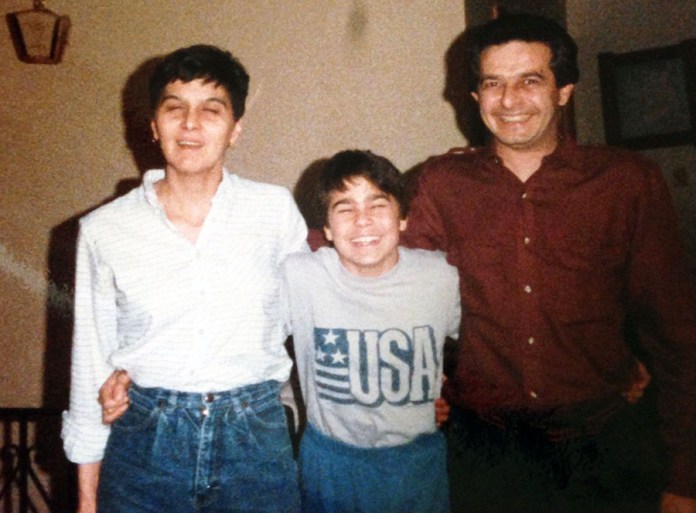
Today marks the forty-first anniversary of my first brain surgery. As I’ve written about before, on Dec. 12, 1984, when I was fifteen years old and a sophomore in high school, surgeons at SUNY Upstate Medical Center (now named Upstate University Hospital) in Syracuse, New York, removed a large craniopharyngioma that had engulfed my pituitary gland, leading to stunted growth and delayed puberty. Since then, I’ve had four additional surgeries and two Gamma Knife radiosurgery treatments at Upstate.

Posing with my parents prior to my surgery in 1984.

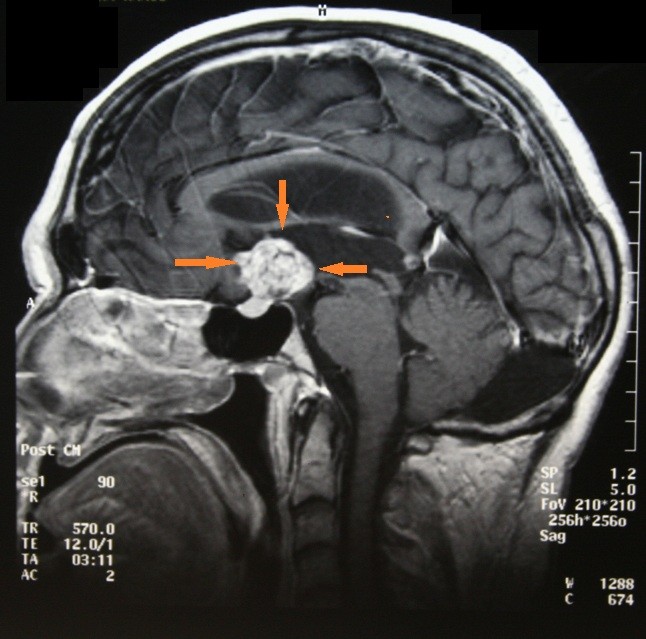
Prior to the initial surgery, in the fall of 1984, a scan of my head had revealed a cloudy mass in the sella region at the base of the skull, and the results of a follow-up CT scan with radiation contrast came a few weeks later.

I received the news about the brain tumor diagnosis from my father when he picked me up from wrestling practice on a cold November night. This essay describes that encounter.

Craniopharyngioma

##

After I put on my black wool pea coat, pulled a knit hat down around my ears, and slung my book bag over my shoulders, I pushed open the back door of the gym and walked outside to meet my father, who had parked behind the high school.

The cold air hit my face and stung my gloveless hands as I strode toward the car; a floodlight cast a large net of bright, white light on the pavement. Dad drove up, and I got in.

He left the car idling, and as I slid into the passenger seat and adjusted myself, he leaned over and kissed me on the cheek, his tan winter coat brushing against the steering wheel. I felt a trace of his beard stubble against my skin, and I could smell a faint odor of Aqua Velva or Brut combined with cigarette smoke. The heater hummed, and he lowered the blast of air and turned and looked at me. I wondered why we weren’t moving yet. He wasn’t crying, but he appeared on the verge of spilling emotions.

“What’s the matter, Dad?” I asked.

“Upstate called your mother today,” he said. He switched on the overhead light, reached into his jacket pocket, and pulled out a torn piece of paper. “Here,” he said, handing me the slip of paper, “this is what they think you have. I wrote it down, but I don’t think I spelled it right.”

In a slashing style in faint, blue ink, my father had scribbled a misspelling of the word craniopharyngioma. His voice cracked as he said, “It’s cranio-phah-reng . . . something like that . . . oh, I don’t know. It’s some kind of brain tumor.”

I looked at the paper as my father let out a sigh. He shook his head and said, “I prayed to God when you were born that this wouldn’t happen to you, that you wouldn’t have to go through the same thing I did.” His words referred to his health crisis as a teenager, one that caused small stature and delayed puberty and led to ridicule by his classmates.

Francis DiClemente Sr. was born with a hole in his heart, a ventricular septal defect. On June 12, 1959, when he was sixteen years old, pioneering cardiac surgeon C. Walton Lillehei performed open-heart surgery on him at the University of Minnesota Hospital, successfully repairing the defect.

The heart problem disrupted Dad’s high school years, and he faced a long recovery; but he rebounded after the surgery, lifting weights to become stronger and adding muscle to his thin frame. He grew to his final adult height, graduated high school from St. Aloysius Academy in Rome, and went to work at the city’s Sears Roebuck store.

After sharing the information with me, he pressed his lips together and shook his head again, and he seemed locked in position in the driver’s seat, unable to contend with the news, incapable of going through the motions of driving away. We clenched hands, and I said, “It’s OK, Dad. Don’t worry. But what do we do now? What’s next?”

“You have to go back there for more tests. You may need surgery.”

“All right,” I said. “It’s OK.”

“I hope so,” he said. “All we can do is pray.”

He switched off the overhead light, put the car in drive, and drove out of the parking lot. We grew silent as we passed the naked trees lining Pine Street in our city of Rome, New York.. We crossed the intersection at James Street and made our way toward Black River Boulevard.

While my father was anxious and crestfallen, I felt elated as I gripped my book bag in the passenger seat. The CT scan with contrast had confirmed my suspicions, indicating a grave medical condition was responsible for my growth failure at age fifteen, offering a reason why my body had not changed, why I had not progressed through puberty, and why I remained so different from the other boys my age. I still considered myself a physical anomaly, but the tumor proved it wasn’t my fault.

I looked down at the piece of paper again and studied the word. Craniopharyngioma. I tried to sound it out in my head while my dad steered the vehicle, and I thought the word would twirl off my tongue like poetry if I rolled down the window and yelled it. Craniopharyngioma. Cranio-Phar-Ryng-Ee-Oh-Mah. It reminded me of onomatopoeia, which I had learned about in my tenth-grade English class.

##

And here are two related poems:

Case History

Stricken with pituitary insufficiency,
I felt my way through
a stage of delayed puberty.
When adolescence took hold for other kids,
I remained like a boy wrapped in toddler’s clothes.

My face looks older now,
and my body has grown.
But I could not escape
the endocrine impact of that cranial intrusion.
For even though benign,
the tissue overtook me,
and in effect, the tumor
scarred my life and altered my future.

Craniopharyngioma (Youthful Diary Entry)

Craniopharyngioma gave me
an excuse for being unattractive.
I had a problem inside my head.
It wasn’t my fault
I stood four foot eight inches tall
and looked like I was
twelve years old instead of eighteen—
and then nineteen
instead of twenty-four.
I couldn’t be blamed for
my sans-testosterone body
straddling the line
between male and female.

The brain tumor
spurred questions
about my appearance,
aroused ridicule,
and provoked sympathy.
I heard voices whispering:
“Guess how old that guy is?”
And, “Is that a dude or a chick?”

And while I waited for my
body to mature, to fall in line,
and to achieve normal progression,
I remember wishing the surgeons
had left the scalpel
inside my skull
before they closed me up,
knitting the stitches
from ear to ear.

I prayed the scalpel
would twist and twirl
while I slept at night—
carving my brain
like a jack-o’-lantern—
splitting the left and right
hemispheres,
and effacing the memory
of my existence.


Standard

Hospital Artwork

I had an appointment at the Upstate Cancer Center last week for a CT simulation to “map” my left hand so I can receive low-dose radiation treatment. It’s a new program offered by the radiation oncology department to treat arthritis. In my case, the radiation will target my left middle finger, which bulges like the knuckles of an NFL center after several seasons in the league. (I imagine the hands of #52 Mike Webster of the Pittsburgh Steelers.)

I arrived early for my appointment and wandered through the hallways and waiting rooms, observing the artwork hanging on the walls. I always look around when I visit hotel lobbies or medical offices so I can spot artwork. I appreciate the accessibility of this art and how it grants viewers quiet moments of reflection and meditation—which is especially beneficial for patients waiting for treatment in clinical settings. It’s there for anyone to discover; you just have to put away the iPhone and glance around.

Here are some pieces I noticed:

Sacred Completion by Alexandra DeLaCruz.

Road Home by Wendy Harris.

Magenta Meadowbrook by Wendy Harris.

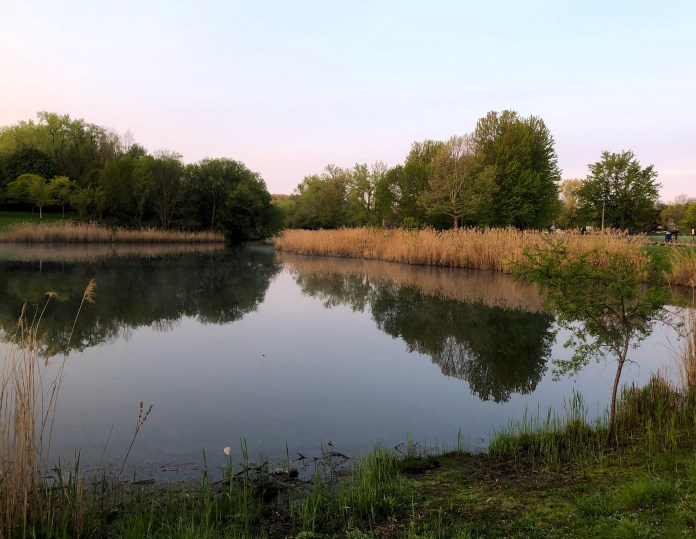
A few years ago, I took an iPhone photo of a pond near Barry Park, and I wonder if the same setting served as the inspiration for Wendy’s pastel landscape painting. Here’s my picture.

Pond near Barry Park by Francis DiClemente.

Distant Land (artist unknown).

Standard

Dormant But Not Dead

Two years ago today, I underwent my sixth brain surgery at Upstate Medical University Hospital for a recurring benign tumor on my pituitary gland. A neurosurgery and ENT team removed the stubborn craniopharyngioma in a four-hour surgery on July 24, 2023.

Upstate Medical University Hospital (Photo by Francis DiClemente)

I wrote a poem based on the postoperative medical report uploaded to the MyChart portal. I consider this a “reverse redacted poem.” Instead of blacking out words from my source text, I pulled words and phrases from the summary.

Neurosurgery Report

Date of Procedure: July 24, 2023

Endonasal endoscopic
transsphenoidal resection
of tumor
with nasal septal flap.

Preoperative diagnosis:
Recurrent craniopharyngioma
Postoperative: Same

Patient is a 53-year-old male
with a long history
of known craniopharyngioma.
Recurrence of craniopharyngioma
abutting the optic chiasm.
Not a great candidate
for repeat radiosurgery—
not enough margin
between the tumor
and the optic chiasm.

Counseled on the risks
and benefits of endonasal
transsphenoidal resection.
Elected to proceed
despite the risks.

Patient was intubated
by anesthesia.
Positioned supine
with the bed turned 90 degrees.

Endonasal approach
to the sphenoid sinus.
Once the sella was exposed
and the bone drilled down,
we began our resection.
A long handled arachnoid knife
was used to incise the dura.
The tumor was located
mainly on the right side.

We then encountered
thick scar tissue,
which was also incised
in cruciate fashion.

Once both layers of dura
had been opened,
there was immediate egress
of thin viscous brown fluid.
With the endoscope
we could see a
calcified appearing tumor
just in front of our field.

At this point, there was a brisk
CSF (cerebrospinal fluid) leak
from the chiasmatic cistern most likely.
Once we had attempted
to scrape along the floor
of the sella posteriorly and laterally
along the cavernous sinus,
we then turned our attention
to the tumor hanging in front of us.
We used laryngeal biopsy forceps
to coax the tumor out.

At this point, the tumor
seemed fairly stuck and plastered
to the arachnoid superiorly,
and thus we resected the
remaining tumor in front of us
in piecemeal fashion.

Given the brisk CFS leak,
our ENT colleagues then turned to
the right-sided nasal septal flap.
The ENT repaired the CSF leak.
Packing Surgical and NasoPore dressing
placed by the ENT surgeons.
This concluded our procedure.
The drapes were then removed.
The patient was returned to the stretcher.
He was successfully extubated
by anesthesia and transported
to PACU (Post Anesthesia Care Unit)
in stable condition.

Now, two years later, I am still living with a brain tumor. My last MRI in December 2024 revealed:

“The lesion measures 14 mm x 13 mm (TV by AP; Transverse by Anteroposterior), unchanged compared to prior scan dated 5/17/2024, allowing difference in technique and slice selection. The superior aspect of the mass abuts supraclinoid ICA, which remains patent. The right prechiasmatic optic nerve demonstrates mild atrophy but remains unchanged.”

My next MRI is scheduled for September. I suffer some mild headaches and have double vision when looking at a computer screen without my prism prescription glasses or gazing to the extreme right. But otherwise, the tumor is not affecting my health.

And I know what Dr. H. will say when he reads the MRI report in September. He’ll say, “Your scan looks good. It hasn’t grown. Let’s leave it alone and get another MRI in six months.”

This wait-and-see approach works well for me. But at the same time, I can never get the tumor out of my head—literally and figuratively.

And although Dr. H. is the surgeon and I respect his medical advice, his Pollyanna outlook ruffles me.

That’s because Dr. H. isn’t troubled by a repetition of sneezes that I fear could dislodge the tumor from its nook and cause it to invade healthy brain tissue. Dr. H. doesn’t worry that eating an entrée of fish and chips will add protein and fat to the tumor cells and make the mass larger. He’s not worried that the tumor will expand and start pressing against the optic nerve.

Craniopharyngiomas consistently grow back; that’s their nature. Having this dormant beast taking up real estate inside my skull feels like having Godzilla asleep in your cellar. You know he’ll wake up eventually. And then what? So how can you sit at the kitchen table and blithely enjoy a quiet dinner when you know the predator lurks beneath your feet?

At the same time, life and death could trade places on any given day. I’ve lost two cousins younger than sixty years old in the past six months (Derek DeCosty and Damon DeCosty), and I know tomorrow is not guaranteed. I am also very fortunate not to have a malignant tumor or a fatal disease.

And since I have no alternative, I live with the tumor as best as I can and try to forget it’s still there. Meanwhile, the tumor remains in the act of waiting—waiting to decide what it will become, waiting to find its path, waiting to strike. The neoplasm’s presence inside my head troubles me if I allow the image of the fluid-wrapped mass to provoke my worst fears. But for now, I try not to disturb the sleeping beast.

Standard