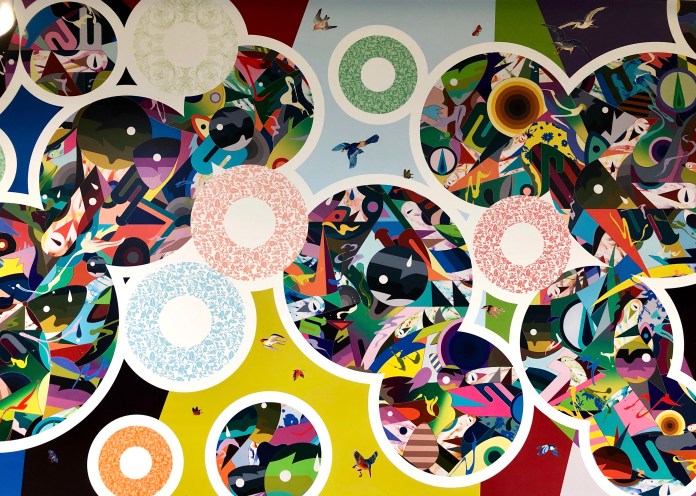
During a recent appointment at the Nappi Wellness Institute at SUNY Upstate Medical University Hospital, I saw this impressive mural by Japanese artist Tomokazu Matsuyama.
Solitude Aqua Amore, 2023 by Tomokazu Matsuyama.
I’ve written about the soothing effect of hospital art before. A few years ago, a framed print in an MRI waiting room inspired this poem, which was published in my 2021 collection, Outward Arrangements: Poems.
Waiting with Vincent
A scheduled MRI
of the brain shifts
my thoughts toward
all of the
“what if, worst-case scenarios.”
While waiting for my name
to be called,
I see a print of Irises (1889)
hanging on a wall.
From far across the room,
without my glasses,
the slanted vertical
green leaves
look like snakes
writhing in the dirt.
But the longer
I stare at the image,
the calmer I feel. Placid is the word
that comes to mind.
And I’m thankful Vincent
spends a few
moments with me
prior to my appointment
with the tube machine.
Because when sitting
in a hospital
waiting room,
artwork by Vincent
never fails to lift the spirits.
A van Gogh painting beats People magazine
or an iPhone screen
every time.
The mural is entitled Solitude Aqua Amore, 2023, and Matsuyama worked with the nonprofit organization RxART, which “pairs leading contemporary artists with pediatric hospitals to develop site-specific projects that humanize the healthcare environment and improve the patient experience.”
I think it’s a wonderful concept, and I have no doubt that colorful artwork in hospitals lifts the spirits of little patients and their parents during their tense moments (or hours) of testing, waiting, and meeting with doctors and medical staff.
The RxART website displays images of completed projects at hospitals across the country.
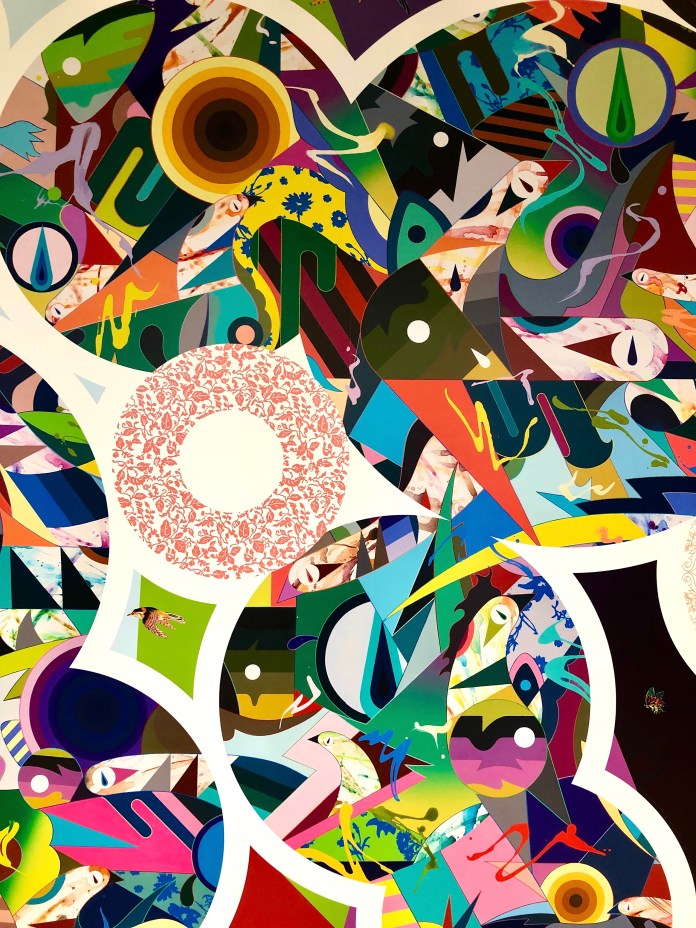
I like the close-up iPhone photo I took because it put me smack in the middle of the painting, and the detailed image made me think of a Jackson Pollock drip painting—but featuring birds.
Detail image of Solitude Aqua Amore, 2023.
Here is the wall text for Matsuyama’s piece:
Tomokazu Matsuyama Solitude Aqua Amore, 2023
Courtesy of the Artist
“Tomokazu Matsuyama is a contemporary artist who is keenly aware of the nomadic diaspora, a community of wandering people who seek to understand their place in a world of contrasting visual and cultural dialects. Tomokazu has created this bright and uplifting imagery to transform the institute’s International department. This work, inspired by “a thousand origami cranes,” encapsulates the essence of hope, peace, and the mythical attributes of good fortune. Utilizing geometric forms and organic curves, he weaves the inherent desire associated with the ‘senbazuru’ tradition into a narrative that resonates with the contemporary era. Tomokazu was born in Takayama, Gifu, Japan, and lives and works in Brooklyn, NY. RxART is grateful to Chris Salgardo, ATWATER, and Ducati for lead support of this project.”
Side note: These days, it seems whenever I read biographical text about a writer, poet, filmmaker, or artist, the bio invariably ends . . . “[Insert artist name] lives and works in Brooklyn, New York.” And that makes me wonder if poems are flying through the air and paint is flowing in the streets of Brooklyn. If I ever get to New York again, I’ll need to make my way there to explore the scene.
I had an appointment at the Upstate Cancer Center last week for a CT simulation to “map” my left hand so I can receive low-dose radiation treatment. It’s a new program offered by the radiation oncology department to treat arthritis. In my case, the radiation will target my left middle finger, which bulges like the knuckles of an NFL center after several seasons in the league. (I imagine the hands of #52 Mike Webster of the Pittsburgh Steelers.)
I arrived early for my appointment and wandered through the hallways and waiting rooms, observing the artwork hanging on the walls. I always look around when I visit hotel lobbies or medical offices so I can spot artwork. I appreciate the accessibility of this art and how it grants viewers quiet moments of reflection and meditation—which is especially beneficial for patients waiting for treatment in clinical settings. It’s there for anyone to discover; you just have to put away the iPhone and glance around.
Here are some pieces I noticed:
Sacred Completion by Alexandra DeLaCruz.
Road Home by Wendy Harris.
Magenta Meadowbrook by Wendy Harris.
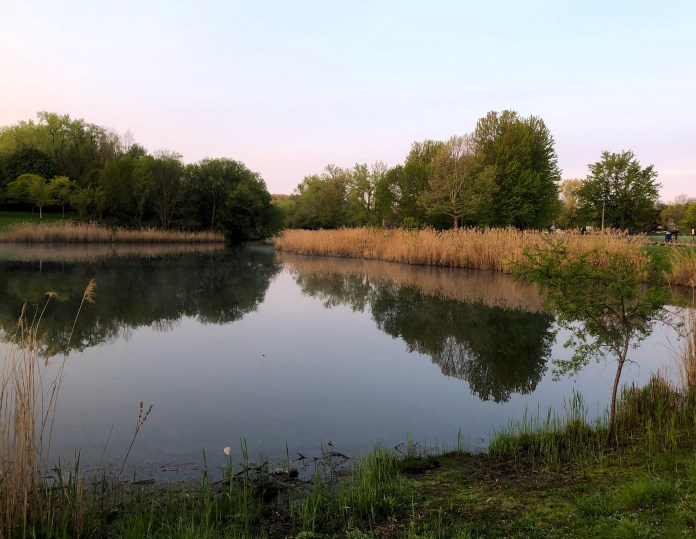
A few years ago, I took an iPhone photo of a pond near Barry Park, and I wonder if the same setting served as the inspiration for Wendy’s pastel landscape painting. Here’s my picture.
Two years ago today, I underwent my sixth brain surgery at Upstate Medical University Hospital for a recurring benign tumor on my pituitary gland. A neurosurgery and ENT team removed the stubborn craniopharyngioma in a four-hour surgery on July 24, 2023.
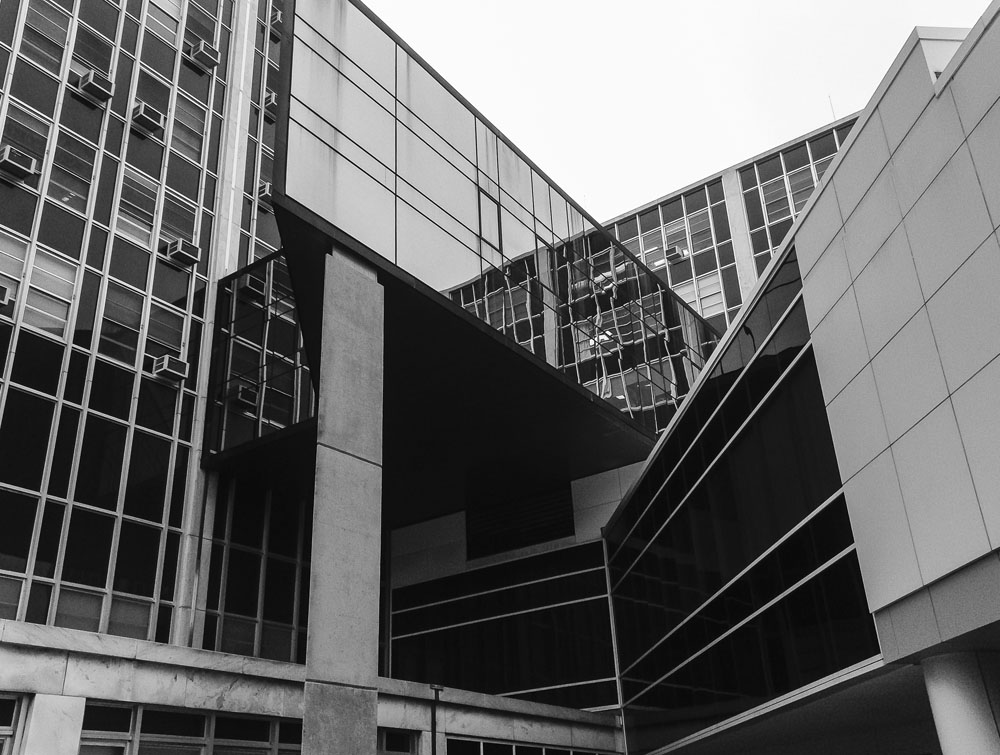
Upstate Medical University Hospital (Photo by Francis DiClemente)
I wrote a poem based on the postoperative medical report uploaded to the MyChart portal. I consider this a “reverse redacted poem.” Instead of blacking out words from my source text, I pulled words and phrases from the summary.
Neurosurgery Report
Date of Procedure: July 24, 2023
Endonasal endoscopic
transsphenoidal resection
of tumor
with nasal septal flap.
Preoperative diagnosis:
Recurrent craniopharyngioma
Postoperative: Same
Patient is a 53-year-old male
with a long history
of known craniopharyngioma.
Recurrence of craniopharyngioma
abutting the optic chiasm.
Not a great candidate
for repeat radiosurgery—
not enough margin
between the tumor
and the optic chiasm.
Counseled on the risks
and benefits of endonasal
transsphenoidal resection.
Elected to proceed
despite the risks.
Patient was intubated
by anesthesia.
Positioned supine
with the bed turned 90 degrees.
Endonasal approach
to the sphenoid sinus.
Once the sella was exposed
and the bone drilled down,
we began our resection.
A long handled arachnoid knife
was used to incise the dura.
The tumor was located
mainly on the right side.
We then encountered
thick scar tissue,
which was also incised
in cruciate fashion.
Once both layers of dura
had been opened,
there was immediate egress
of thin viscous brown fluid.
With the endoscope
we could see a
calcified appearing tumor
just in front of our field.
At this point, there was a brisk
CSF (cerebrospinal fluid) leak
from the chiasmatic cistern most likely.
Once we had attempted
to scrape along the floor
of the sella posteriorly and laterally
along the cavernous sinus,
we then turned our attention
to the tumor hanging in front of us.
We used laryngeal biopsy forceps
to coax the tumor out.
At this point, the tumor
seemed fairly stuck and plastered
to the arachnoid superiorly,
and thus we resected the
remaining tumor in front of us
in piecemeal fashion.
Given the brisk CFS leak,
our ENT colleagues then turned to
the right-sided nasal septal flap.
The ENT repaired the CSF leak.
Packing Surgical and NasoPore dressing
placed by the ENT surgeons.
This concluded our procedure.
The drapes were then removed.
The patient was returned to the stretcher.
He was successfully extubated
by anesthesia and transported
to PACU (Post Anesthesia Care Unit)
in stable condition.
Now, two years later, I am still living with a brain tumor. My last MRI in December 2024 revealed:
“The lesion measures 14 mm x 13 mm (TV by AP; Transverse by Anteroposterior), unchanged compared to prior scan dated 5/17/2024, allowing difference in technique and slice selection. The superior aspect of the mass abuts supraclinoid ICA, which remains patent. The right prechiasmatic optic nerve demonstrates mild atrophy but remains unchanged.”
My next MRI is scheduled for September. I suffer some mild headaches and have double vision when looking at a computer screen without my prism prescription glasses or gazing to the extreme right. But otherwise, the tumor is not affecting my health.
And I know what Dr. H. will say when he reads the MRI report in September. He’ll say, “Your scan looks good. It hasn’t grown. Let’s leave it alone and get another MRI in six months.”
This wait-and-see approach works well for me. But at the same time, I can never get the tumor out of my head—literally and figuratively.
And although Dr. H. is the surgeon and I respect his medical advice, his Pollyanna outlook ruffles me.
That’s because Dr. H. isn’t troubled by a repetition of sneezes that I fear could dislodge the tumor from its nook and cause it to invade healthy brain tissue. Dr. H. doesn’t worry that eating an entrée of fish and chips will add protein and fat to the tumor cells and make the mass larger. He’s not worried that the tumor will expand and start pressing against the optic nerve.
Craniopharyngiomas consistently grow back; that’s their nature. Having this dormant beast taking up real estate inside my skull feels like having Godzilla asleep in your cellar. You know he’ll wake up eventually. And then what? So how can you sit at the kitchen table and blithely enjoy a quiet dinner when you know the predator lurks beneath your feet?
At the same time, life and death could trade places on any given day. I’ve lost two cousins younger than sixty years old in the past six months (Derek DeCosty and Damon DeCosty), and I know tomorrow is not guaranteed. I am also very fortunate not to have a malignant tumor or a fatal disease.
And since I have no alternative, I live with the tumor as best as I can and try to forget it’s still there. Meanwhile, the tumor remains in the act of waiting—waiting to decide what it will become, waiting to find its path, waiting to strike. The neoplasm’s presence inside my head troubles me if I allow the image of the fluid-wrapped mass to provoke my worst fears. But for now, I try not to disturb the sleeping beast.
I am celebrating an important milestone today—the 40th anniversary of my first brain surgery to remove a benign tumor engulfing my pituitary gland. I have written about this ordeal many times in the past, including in this long 2014 post.
On this day, four decades ago, surgeons cracked open my skull and extracted the craniopharyngioma that had stunted my growth and delayed my transition from boy to man.
In this essay, I reflect on my experience as a teenager in 1984 while a patient at SUNY Upstate Medical Center (renamed Upstate University Hospital) in Syracuse, New York. I am limiting the narrative period to the day of surgery and my immediate recovery.
Upstate University Hospital
Surgery Day: An Essay
1.
Early morning. Blackness. I can smell the breakfast trays delivered on the hospital floor—watery eggs, ham and bacon, soggy oatmeal, and weak tea and coffee. The noise outside my room grows as patients awaken and nurses draw blood and administer medicine.
My appointment with the medical intervention team has arrived. I am fifteen years old and ready for surgery day, prepared for the trauma that awaits me on the table. My head will be shaved, and my skull sawed open. The tumor growing in my head—wrapped around my pituitary gland and stifling my maturation—will be plucked free, yanked out like an infected molar and then examined under a microscope to determine its classification. We must name our enemies to defeat them.
Once removed, the lesion will relinquish dominion over my body. I will be cut loose from its tentacles. The surgery will disrupt my endocrine system, leading to a permanent condition known as hypopituitarism and propelling me on a long road toward “catch-up” growth and development.
A photo of my father and me two months before the operation in 1984.
2.
A nurse enters my room and hands me a small plastic cup filled with a few pills. “This will just relax you,” she says as I swallow the pre-surgery drugs. About a half-hour later, she returns and says, “It’s time for you to go down now.” A softness squishes against the edges of my mind; I am drifting from consciousness.
An orderly comes to take me away—filling nearly the entire space inside the door frame. A hulking figure with thick, black hair, a black beard, and muscular forearms, he reminds me of Bluto from the Popeye the Sailor cartoons. But for some reason, I call him Hugo.
“OK, Hugo,” I say, “I’m ready now.” Hugo helps me slide over from my bed to a stretcher as the nurse covers me with a sheet and a blanket.
My family gathers around me, bending down to kiss me and wish me “good luck.” What does “good luck” mean on the operating table? I wonder.
Tears stream down my mother’s cheeks, which are red and wind-burned and feel cold against my skin as she kisses my face and forehead; she squeezes my hand and then releases her grip and steps away.
Hugo unlocks the wheels of the gurney and steers it out of the room and into the hallway. Even though I am sleepy, I stay awake for the ride, keeping my eyes open and watching the panels of fluorescent lights pass overhead as we make our way through the hospital corridors and into an elevator. We take a silent ride down to the surgical wing.
The temperature drops when we enter the frigid, sterile operating room. A chill runs over my body; my lips tremble as gooseflesh buds on my arms.
The surgical team members buzz around the operating room, each doctor or nurse carrying out a specific task. They transfer me from the stretcher to the operating table. An overhead light shines into my eyes while I lay splayed on the table.
A nurse covers me with an extra blanket and stretches tight, white stockings over my calves. She says the stockings will help to prevent blood clots after surgery.
One of the doctors sits down near the table and says he will shave my head. When he asks me if I want my whole head sheared or just the front, I make the mistake of telling him to clip only the front. As a result, weeks after the surgery, my hair remains uneven—bald in front and growing long in the back—similar to the long hair sticking out the back of helmets worn by hockey players with mullets.
After they jab an IV in my arm, I grow drowsy, my eyelids shutting; but before I drift off, I tell one of the nurses that I need to pee. The woman chuckles and says, “Oh, you don’t have to worry about that now. We’ve already put in a catheter.”
And then I leave the world—falling under the power of general anesthesia for about eight-and-a-half hours while the surgeons perform their work.
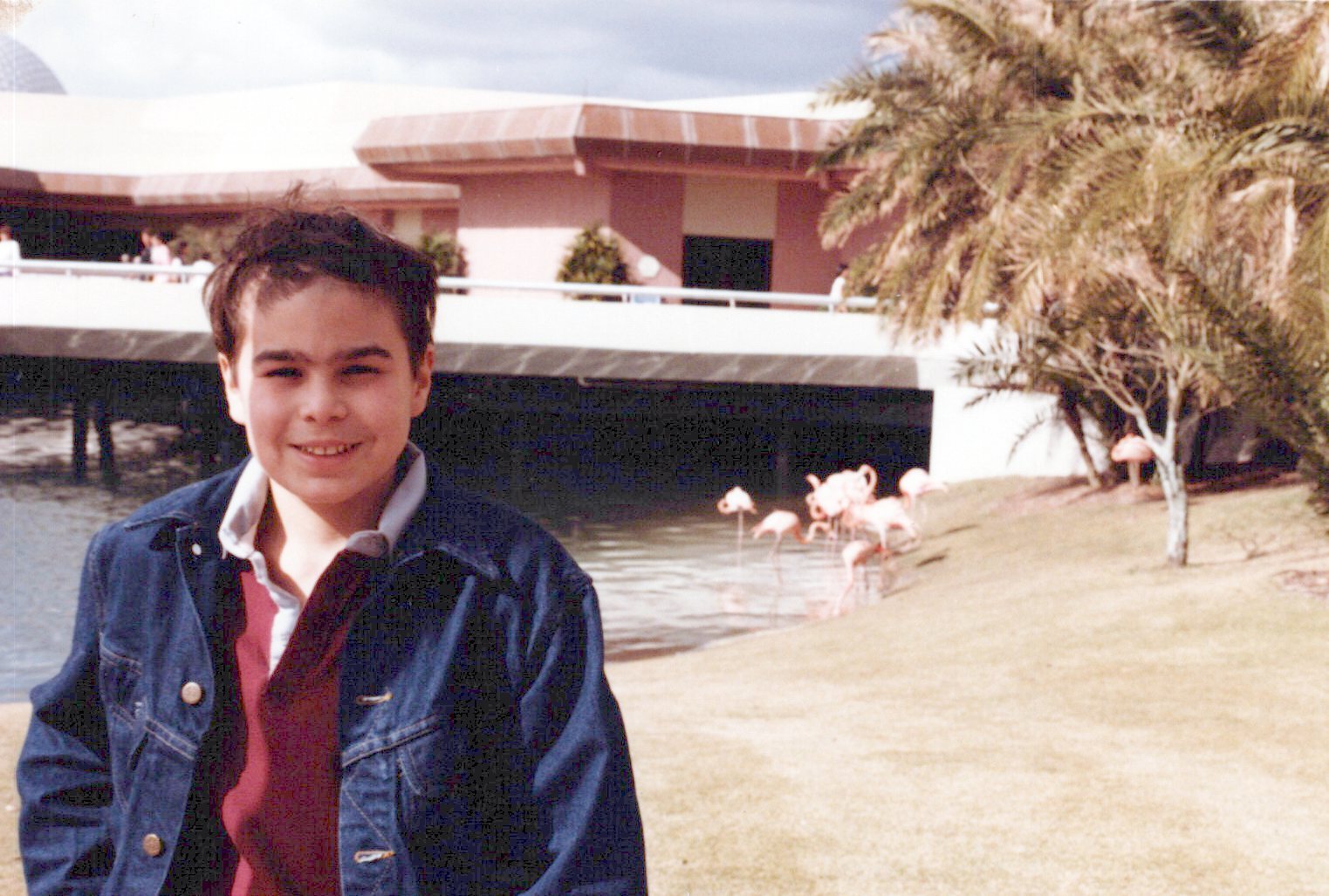
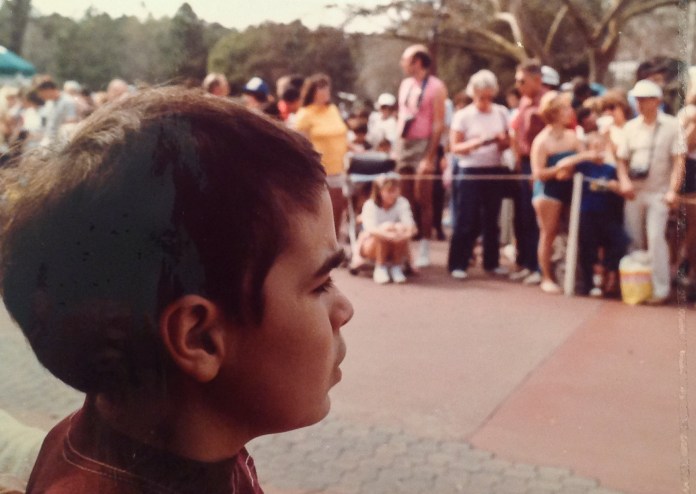
At Walt Disney World in February 1985.
3.
I have often wondered where I traveled to during that gap of time. What realms or landscapes did I explore in my mind while my skull lay open and I remained unconscious on the operating table?
Here is me stepping out of the story momentarily to travel back in time and investigate the scene. It’s a fantasy of the man I hoped I would become once the surgeons extracted the tumor. It’s the future I had envisioned for myself—marked by maturation and normalcy, playing the role of a fully formed male accompanied by a female partner.
A green canopy of trees. A trilling stream. Sunlight filtering through leaves overhanging a hiking path. Birds chirp, and tree limbs sway in the wind.
Boots touch the soft, muddy earth. A man emerges from a wooded path. He is dressed in a red checkered flannel shirt, tan khakis, and hiking boots, and he carries a knapsack on his shoulders. He is about five feet six inches tall, lean and muscular, and has a slight beard.
A twig snaps, and we see a woman walking out of a clearing. She’s wearing a fleece sweatshirt, jeans, hiking boots, and a backpack. The two figures stride toward one another, share a kiss, and then grasp hands. Sunlight bathes them as they leave the clearing and start walking on a path leading over a ridge. They climb the slight incline and disappear as they walk down the other side, their bodies concealed by the curve of the Earth.
Late high school or early college years.
4.
I wake up in a bed tucked in a corner of the surgical intensive care unit. I feel dizzy, and a dull, continuous ache presses against my head as if my skull is being squeezed in a vice. Nurses inject the opioid Demerol into my thighs over several hours to alleviate the pain, and I keep drifting in and out of sleep. I hear machines beeping and the sound of a respirator somewhere on the floor. The gentle sound of the ventilator puts me at ease as I listen to it—in and out, in and out, in and out.
EKG stickers are pressed to my chest, and machines monitor my heart rate and blood pressure. Vaseline has been smeared on my eyelids and eyelashes, clouding my vision, and I feel like I am straining to see from under the cover of a heavy, wet blanket. The white stockings the surgical team had given me are pulled up to my knees and constrict the circulation in my lower limbs.
I feel small—shriveled up in the bed like a green-gray alien being prodded by U.S. government doctors and scientists on an operating table in Roswell or Los Alamos, New Mexico. A scar runs the entire length of my head, from the tip of my right ear to the tip of my left ear. I tap a slight dent in my skull (produced by a right frontal craniotomy during surgery), about the width of two fingers, just above my forehead on the right side.
The stitches itch, and I reach up to feel the thick, black threads. I wonder if I resemble a twisted version of the Mr. Met mascot.
5.
But I feel relieved because I have awakened from the operation, and my brain function remains intact. Some doctors lean over my bed and ask me a series of questions: Do I know my name, the current year, the president of the U.S., and the name of the city I am in? I answer the questions correctly, and when instructed, I squeeze their fingers, wiggle my toes, puff my cheeks, stick out my tongue, and follow a penlight with my eyes.
My senses function properly, as I can see, hear, speak, and smell. I can form thoughts, and the trauma of the surgery has not altered my mental ability or effaced my memory.
My mother, father, sister, and Aunt Teresa huddle around my bed, their faces beaming like those of Dorothy’s relatives in the scene when she wakes up from the dream at the end of The Wizard of Oz.
“Hey, buddy,” my dad says.
My mom leans over the bed rail, kisses my face and eyelids, and says, “You did great, honey, just great.”
“Yeah, Dr. B. said he got most of it,” Dad says.
“Was it big?” I ask.
My mom holds up her right thumb, indicating the size of the tumor. “It was about the size of a thumb,” she says. She caresses my face and adds, “Dr. B. said there’s a little bit left over, but we don’t need to worry about that now.”
“OK,” I say, closing my eyes and returning to sleep.
High school graduation in 1987.
6.
I wake up on the first night with a raging thirst in my parched throat. I feel like I have been deprived of water for days. But because the doctors are concerned about swelling in the brain, they load me with corticosteroids and restrict my fluid intake. My face is swollen, and I feel bloated from the steroids; I am not allowed to drink water, but I am permitted to suck on ice chips.
However, late in the evening, with the lights dimmed on the floor after visiting hours have ended, I turn my head, look around, and notice a sink in the corner, only a few feet away from my bed.
Somehow, despite being woozy, I lower the bed rail, swing my legs out to the side, and climb out of bed. I try to be quiet as I wheel my IV stand toward the small, stainless-steel sink. I turn on the foot pedal faucet, cup my hands, and gulp the water like it’s rushing in an icy mountain river.
The cold liquid pours down my throat and gives me immediate relief. I want to stay here and drink more water, but a man—a male nurse or an orderly—races toward me and pulls me away from the sink.
“What are you doing?” he yells. “You just had brain surgery.”
He then escorts me back to bed, swings my legs over, covers me with the blankets, and lifts the bed rail.
“Now, don’t get up again,” he says. “What do you wanna do, crack your head open and screw up the work those surgeons did?”
And now tucked back into bed, I resume sleeping, drifting off until the next wave of pain hits, and I press the call button to request another dose of Demerol.
##
Recalling these past forty years, I run a tally of my surgeries at Upstate. The number stands at six—counting the initial surgery in 1984 and the subsequent operations to remove tumor regrowth in 1988, 2011, 2012 (Gamma Knife), 2020 (Gamma Knife), and 2023.
I have some double vision when looking at things up close and to my extreme right (right sixth nerve palsy), and I must be hyper-vigilant in the management of my care to treat my hypopituitarism. But except for my corticosteroid-induced osteoporosis and rheumatoid arthritis (unrelated to the tumor), I am a healthy, middle-aged man.
My next MRI is scheduled for Dec. 18. And with the stubborn resilience of craniopharyngiomas, I know more surgeries (or radiation treatments) loom in the future. But I face each day with gratitude, recognizing how lucky I am to have survived the scalpel on multiple occasions. I also don’t look beyond each six-month window of time between MRIs. Once my current neurosurgeon orders the next MRI, I go about my life without thinking about the tumor still lurking in my head.
Late high school or early college years.
##
And because of the significance of the number 40 on this anniversary date, I’ll leave you with U2 playing “40” live at Red Rocks Amphitheatre in Colorado in 1983.
I never post pictures of myself, but I want to share this photo taken by my wife in our backyard. Eight days have passed since my brain surgery. I’m still a little wobbly, but I am getting stronger every day and trying not to strain myself.
Backyard photo. Credit: Pamela DiClemente.
I am also grateful for being able to soak up the sunshine—standing and breathing on my own. And I wish speedy recoveries for other people enduring health crises.
Here’s a follow-up to my last post. It’s been less than a week since my surgery, so please excuse my scattered and fragmented thoughts.
A neurosurgery and ENT team at Upstate University Hospital removed a stubborn craniopharyngioma in a four-hour surgery earlier this week.
Upstate University Hospital (Photo by Francis DiClemente)
All test results and surgeons’ notes are posted to the MyChart patient portal, and I love the description of my surgery in ALL CAPS. It reads like poetry to me:
ENDONASAL ENDOSCOPIC TRANSSPHENOIDAL RESECTION OF TUMOR WITH NASAL SEPTAL FLAP
Before surgery, George, one of the neurosurgery residents, stepped into the pre-op room to get me to sign some consent forms. He scared the shit out of me when he ran through the complications—cerebral spinal fluid leak (CSF), bleeding, the need for a blood transfusion, stroke, and death. I thought, maybe I should just get out of bed, put on my clothes, leave the hospital, and let the tumor keep growing until it really messes up my vision.
But I overcame my fear and signed the consent forms. Then I met the anesthesia team, a nurse stuck me with a couple of IVs, and I was off to Fairyland.
I woke up in recovery feeling like only seconds had passed. The pain came in waves—going from zero to eight and centered around my forehead, above the bridge of my nose. I was given fentanyl and oxycodone, while a Foley catheter took care of my urine output.
The neuro team quizzed me: What’s your name? Do you know where you are? What year is it? At first, I said 2013, but then I added ten years to arrive at the correct year.
A parade of surgeons, residents, and interns entered my room in the hospital’s Neuroscience Intensive Care Unit, and someone told me they had encountered a CSF leak, but they patched it with cartilage from my nose. Dr. H., my primary neurosurgeon, said they scooped up most of the craniopharyngioma, but some calcium fragments adhered to structures and had to be left behind.
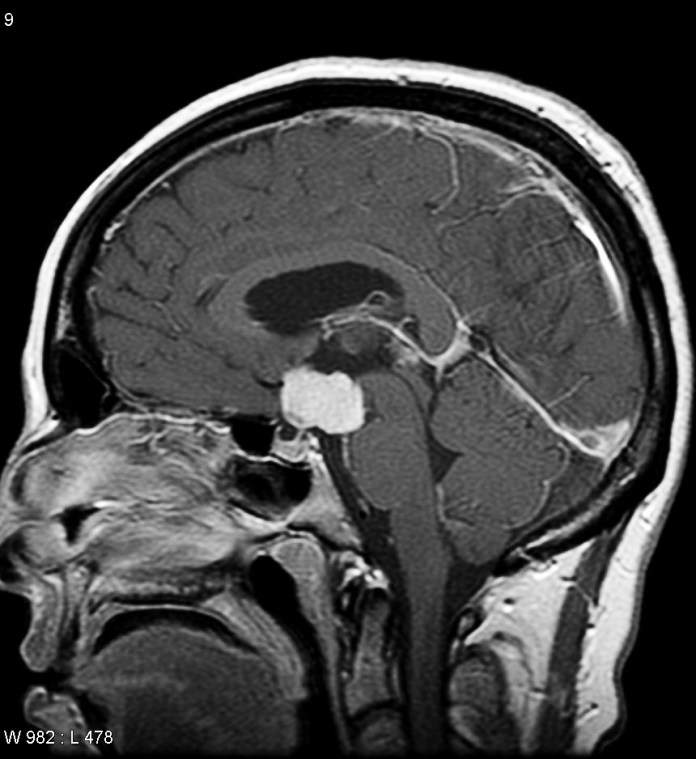
Craniopharyngioma example.
Lying in that hospital bed—humiliated from lack of privacy, with wires twisted around me, with my gown barely covering my naked body, tumid from the high dosage of corticosteroids—I felt like a wounded animal. After the surgical trauma, I now saw my body as simply an object—a machine that either functions or fails.
And I was now at the mercy of the fine nurses who treated me. I enjoyed my conversations with them, and most were serving as traveling nurses doing rotations at Upstate. And one side note: many of the nurses wore Hoka sneakers.
Because of my persistent headaches, I could not read, watch TV, or even look at my phone. With the wall clock ticking incessantly, I closed my eyes, prayed, and reflected on my life.
This was my sixth surgery if you count two Gamma Knife treatments. And since they didn’t get everything, I wondered, how soon will I be back? Will it be two, four, or ten years? How many surgeries will I need before death claims me?
But when I walked the floor on my second day after surgery, I passed other rooms with patients unresponsive and intubated, and deeper thoughts gave me solace. The words that kept coming to me were nothingness, fragility, and gratitude. I saw myself as a minuscule being with absolutely no control over my body or power to alter my existence. Death could come at any point. This is my fate and everyone’s fate. But I remained alive. I was still here.
And late in the afternoon, two days after surgery, I was discharged. While waiting to get a couple of prescriptions filled at the hospital pharmacy, I was wheeled to the Discharge Hospitality Center. Let me tell you, if you need to be in the hospital, that’s the place to go.
A nurse with blond hair, brown plastic-framed glasses, and wearing orange scrubs, greeted my wife Pam and me, asking us if we wanted a cup of coffee. “Sure,” we said. We enjoyed a cup of coffee and some Lorna Doone cookies while we waited, and I told the nurse that her room was a sanctuary.
Then, while waiting at the circular drive for Pam to pick me up, she asked me about my medical history. When I told her this was my sixth surgery, she expressed concern and said she was sorry I had such problems.
I said, “Yeah, but the thing is, you can’t change it, so you just deal with it. And every time I leave Upstate, I feel lucky that I can just walk and breathe.”
“Right, that’s true,” she said. “That’s a good way to look at it.”
At home, Pam told our autistic son Colin that “Daddy is sick and needs rest.” She put a note on our bedroom door—which has a lock—to remind him not to go inside. With his strong physical presence and his habit of jumping into our bed at night, we need to keep him away so he doesn’t whack me accidentally.
The post-op precautions include no nose blowing and drinking from straws. No straining or lifting more than five pounds. Sneeze with your mouth open and keep your head elevated at least thirty degrees. Pretty simple rules to follow.
I’ll keep you posted as my recovery progresses—slow healing, day by day.
I am now recuperating from Gamma Knife radiosurgery, which was performed on Tuesday, Jan. 28 at Upstate University Hospital in Syracuse.
I experienced a complication and a greater degree of pain compared to the Gamma Knife procedure I had in 2012 (the goal then being to prevent my pituitary tumor from growing back).
When neurosurgeon Dr. W. and radiation oncologist Dr. M. inserted the four aluminum pins in my head—used to fasten the titanium head frame—they had difficulty at one of the sites, near where I had a portion of bone removed during my initial brain surgery in 1984.
Gamma Knife head frame. Photo by Pamela DiClemente.
The pin placement caused cerebral spinal fluid to leak, and I heard the sound of liquid dripping against the metallic structure, followed by rose-colored fluid splashing on my hands and on the blanket covering me. Nurse B. applied gauze to stanch the flow, but as the droplets fell from my right temple area, I conjured the image of Christ wearing the crown of thorns.
Christ Crowned with Thorns, 1550, by Maarten van Heemskerck (Frans Hals Museum).
After a mapping MRI was performed, Dr. W. and Dr. M. met in a treatment planning room to devise the course of action. The MRI report, which was sent to me electronically the next day, showed the tumor had from grown from my last MRI in December; it now measured 18.6 millimeters by 10.4 mm by 10.6 mm, compared to 13.3 by 8.6 by 9.9.
The terminology in the report amused me, and I imagined a spotlighted Beat poet or a rapper riffing on stage using the following phrases:
Expanded sella
Transaxial
Craniocaudal
Necrotic degeneration
Residual peripheral enhancement
Hypoenhancing mass
Inferior displacement of the optic chiasm
Deviation of infundibulum
After the planning meeting, Nurse B. came back and announced my treatment would last one hour. An older doctor or tech, stocky with salt and pepper hair and a beard, positioned me on the Gamma Knife machine. Then he fastened another head gear to the frame, and I heard cracking sounds and felt pressure in my skull. It made me think a mobster was sticking my head in a vice and turning the lever—to a much lesser degree—or using his meaty hands to squeeze my head like a grapefruit.
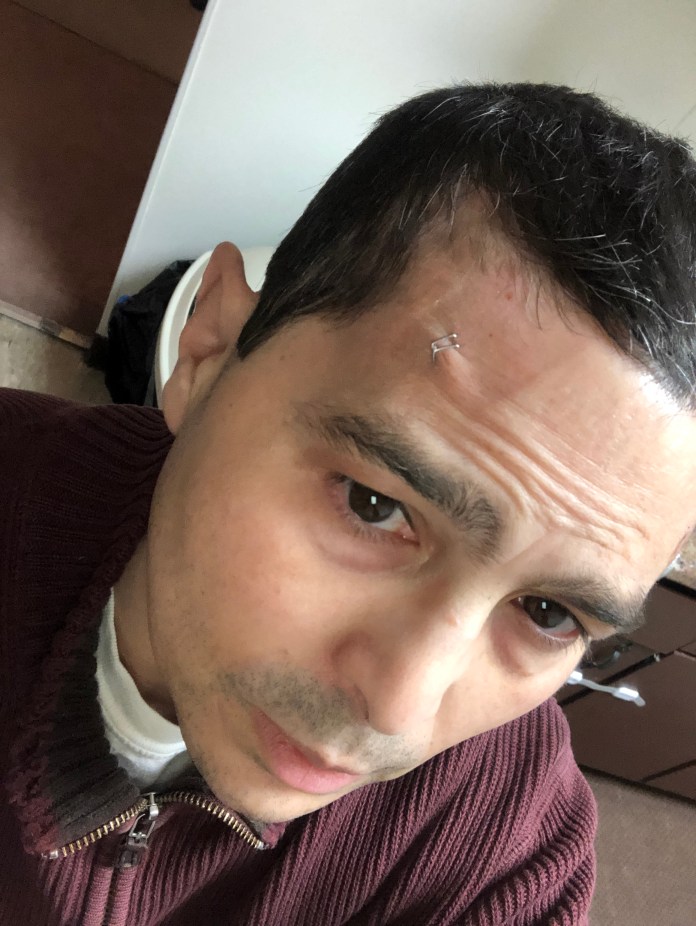
My body moved in and out of the tube for about an hour, and then Nurse B. and the tech came back into the room. I felt woozy transferring from the table to the wheelchair, and I feared the CSF leak may cause me to pass out. When I returned to the patient area, Dr. W. removed the frame and placed two small staples near the pin hole that leaked CSF.
A short time later they wrapped me in a head bandage, fed me some toast and discharged me.
My wife Pam took some photos of the ordeal, capturing the gory details. I don’t think I could look more gruesome if a Hollywood makeup artist made me up like Freddy Krueger. However, the more accurate cultural reference is Frankenstein. That’s how I looked and felt.
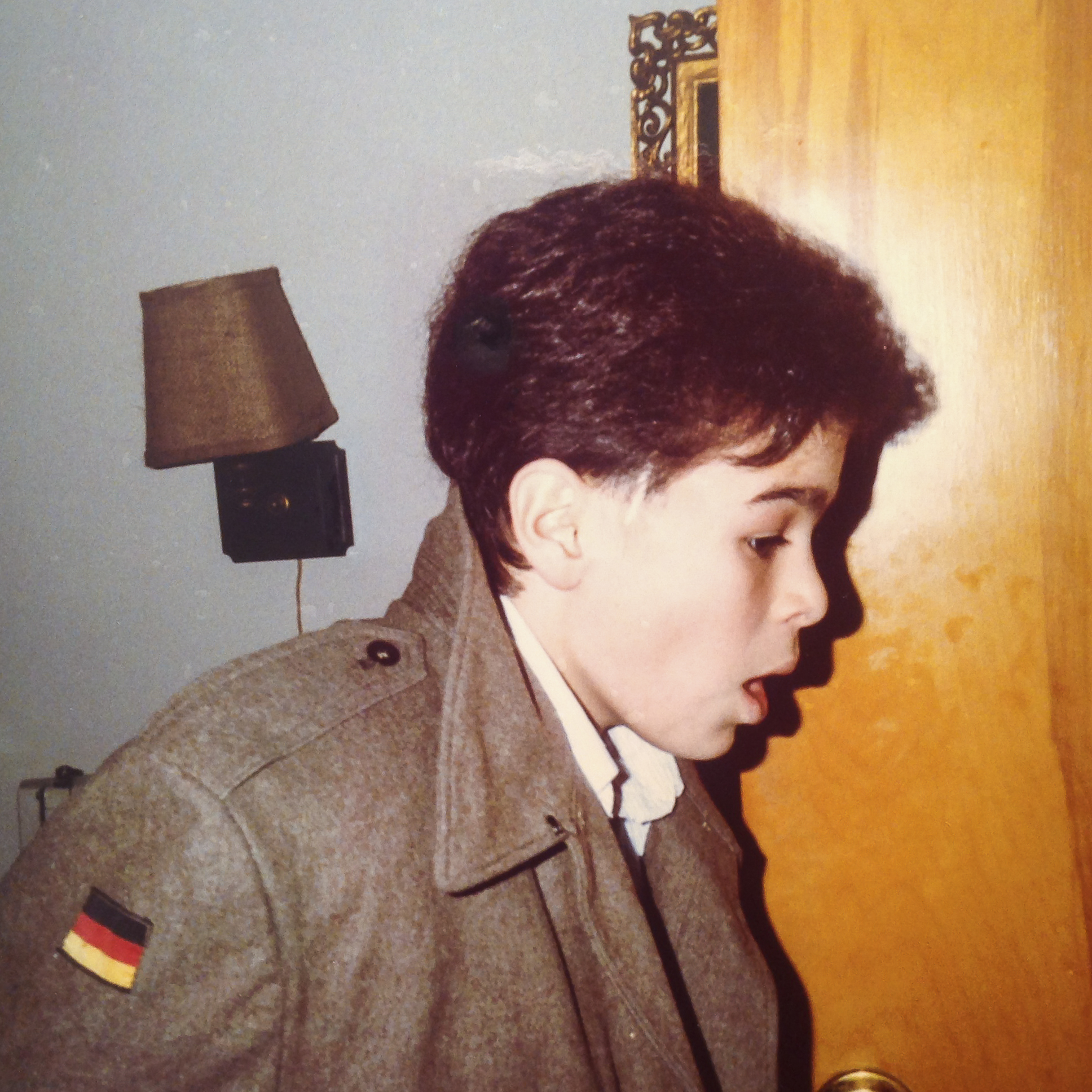
Take a look at the comparison of these two profile photos: one from the post-op period in 1985 and the other from the recent Gamma Knife day. I retained the shape of my boyhood head in adulthood, but now gray hair is sprinkled throughout.
Florida, 1985.
Gamma Knife, side angle. Photo by Pamela DiClemente.
At home, the cranial pressure seemed elevated and my head ached, especially when moving from one position to another—most notably when leaning my head against the pillow to go to sleep.
I was given instructions to take Tylenol when needed and Dr. W. also prescribed an antibiotic.
I have a series of follow-up appointments scheduled in the next few weeks, and it’s too soon to tell whether the Gamma Knife procedure was successful in restoring normal eyesight (going from double vision back to single).
But while off a couple of days from work, while recovering and lying in bed, I thought about being sick and how when you’re in the moment—whether suffering from the flu or healing from a broken bone—you have the sense you will never be well again. You can’t remember a time when you didn’t feel bad.
Head bandage selfie.
It’s similar to living in a cold climate—like here in upstate New York—enduring harsh winter temperatures and heavy snow and never believing spring will come—until one day it does. And the next thing you know it’s a balmy summer day and the sun is shining, the air warm, ice cubes rattling in glasses of lemonade and lawn mowers buzzing in the neighborhood. And you think, I can’t remember what winter felt like.
Selfie of two small staples puncturing my forehead.
That’s the way I see this health situation. I consider it a short interlude of hardship to endure before I reclaim normalcy. At the same time, judging from my more than 35-year experience with a pernicious craniopharyngioma, I sense this is not the end. More trials will likely come, but my fear is diminished because I already know what to expect, as I can anticipate the movement of a tumor that is stubborn but not swift.
Disclaimer: The following is my interpretation of what the doctors told me recently. The medical information may not be 100-percent accurate. I wanted to get the details down primarily for my benefit, as a log of my symptoms, hospital visits and treatment plan.
##
This month marks 35 years since surgeons at Upstate University Hospital in Syracuse extracted a tumor that had been growing on my pituitary gland.
At Disney World in the winter of 1985; the scar from my Dec. 1984 surgery is visible and my hair has not grown completely back.
Subsequent surgeries to remove regrowth followed in 1988 and 2011, along with Gamma Knife radiosurgery in 2012 as a preventative measure.
Two for the Price of One
I had planned to write my annual post, expressing gratitude that I remain tumor free, but it appears a residual craniopharyngioma is now affecting my vision. I started experiencing double vision a few weeks ago, mainly when looking at someone or something from the front—at a distance of a few feet—or at a 45-degree angle. I noticed the faces of my colleagues would separate when I glanced at them across our cubicles. Also of note: I see fine with a hand over either eye. The double vision comes when I look at things with both of my eyes.
Craniopharyngioma example
I went to see my eye doctor prior to Thanksgiving; after a series of tests, he stated my eyes seem to be crossing, whereas previously they had diverged slightly. I asked if the double vision could be caused by his new eyeglass prescription and he said, “No, it’s definitely something neurological.” He contacted my neurosurgeon, who scheduled me for an MRI.
The MRI was performed with and without contrast on Dec. 4, and I saw the neurosurgeon later in the day. When Dr. W. came into the exam room, chewing gum and wearing brown tortoise shell glasses, he said, “OK, so we have some good news. The scan is beautiful, very clear. There’s very little change from the one in September, nothing pressing on the optic nerve. But we have to find out what’s causing the double vision.”
He said he believes scar tissue in the sella turcica, a saddle-shaped cavity at the base of the brain where the pituitary gland rests, is affecting the cranial nerves and causing the double vision.
He said surgery may not help and could exacerbate the problem or damage healthy nerves and blood vessels in the region. He recommended an appointment with Dr. M., the radiation oncologist who teamed up with Dr. W. for the Gamma Knife procedure in 2012.
I asked if the double vision could be caused by a new tumor in another part of the brain or by an aneurysm. He said no. I asked if it could be caused by a stroke and he said, “No, you would have other symptoms.”
He also offered some positive news—he mentioned my eye doctor could prescribe prism lenses, an add-on to prescription glasses that can correct double vision. It doesn’t address the underlying problem, but it allows you to see normally.
I felt relieved because the MRI had not revealed a massive tumor pressing on the optic nerve or infiltrating another area of the brain. No insidious glioblastoma—giving me a death sentence within six to nine months. This was my old friend/foe visiting me again—a benign tumor, slow- growing but capable of causing problems, a health issue leading to concern but not panic.
Radiation Oncology Consultation
At my next appointment on Dec. 13, the tall, thin figure of Dr. M. entered the room and I noticed his hair had become gray in the intervening years. He shook my hand and said, “We’ve made a lot of progress in seven years,” referring to more advanced procedures in radiation treatments.
He held up his right index finger and had me follow it. He asked if I was seeing double vision all the time and whether it was getting worse. “Are you seeing two of me now?” he asked. I said, “Yes,” and I used the wall bumper as an example. “If I look at that thing with both of my eyes, I see two. When I hold a hand over one eye, I see one.”
I told him the eye doctor had performed some tests, including a visual field test, which had showed defects in both the right and left sides.
Dr. M. told me the tumor was tube-like in appearance and near the cavernous sinus, impacting the cranial nerves that control the muscles of the eye.
He recommended five radiation treatments over the course of a week, as opposed to another round of Gamma Knife surgery. He ran through a series of figures—percentages about the efficacy of treatment compared to the risks. I had trouble following the complex information, but the basic idea is to give me the highest dose of radiation possible without causing any damage to healthy structures, e.g. blood vessels in the cavernous sinus. A safe but effective course of action.
He said I may experience some fatigue, but I can return to work every day after the treatments, which should only last about a half hour.
He also made a disheartening statement. “There’s no guarantee the radiation will correct the double vision. But if we don’t do anything, the craniopharyngioma will keep growing.”
Strapping on the Goalie Mask
On Monday, Dec. 16, I received a call at work from Upstate to come in do a radiation map of my brain. When I arrived at the Upstate Cancer Center in the afternoon, the waiting room was packed with patients sitting in the large, comfy faux leather white chairs; one irate man complained he had been waiting longer than an hour past his appointment time. He dropped some profanity and his blonde-haired wife tried to calm him down, to no avail. “This is fucking ridiculous,” he said.
A female radiation doctor called me and brought me to an exam room. She had me sign the treatment consent form and asked if I had any questions. I inquired about side effects. She said the main side effect is fatigue; patients can also experience headaches and some hair loss. She added, “Think of it more like surgery than chemotherapy.”
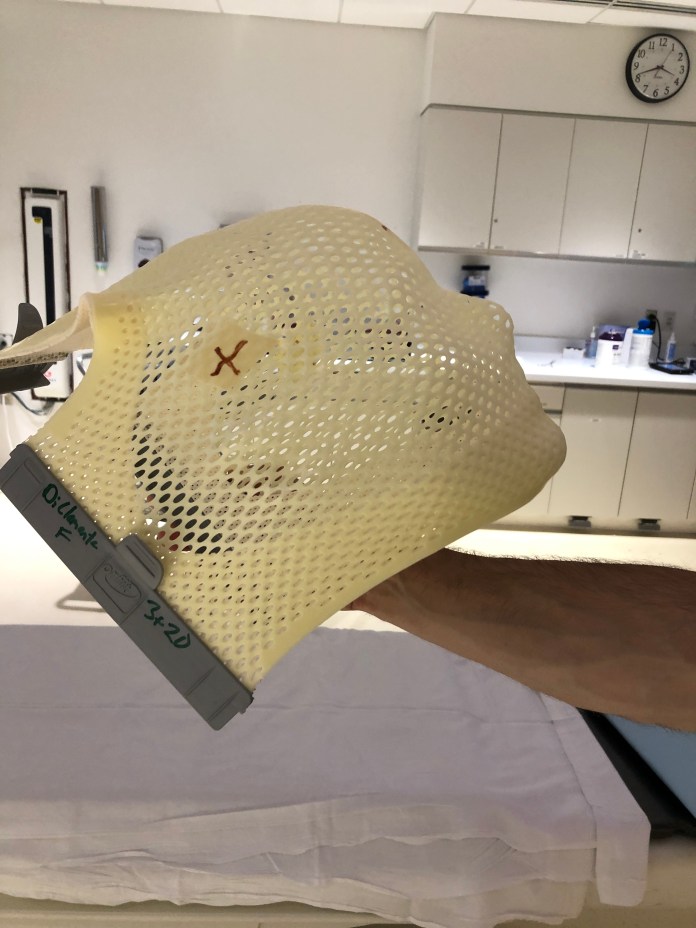
Then a male tech with dark hair ushered me into a large room with the CT machine. A number of nurses and techs scurried about. They asked me to remove my sweater and dress shirt, leaving me with just my white undershirt and khakis. They had me lie down on the table as they positioned a few different head rests. Once they had the right one in place, they applied to my face what felt like a wet, tight-fitting mask—with the consistency of rubber or papier-mâché. The mask had numerous holes in it, but it was still hard to breathe.
The test itself took very little time; I remained still while the machine moved my body in and out of the tube. When it was done, they pulled me out and the male tech held up the mask so I could see it. I thought it looked like a goalie mask and I asked if could snap a picture with my phone.
Radiation mask
Song Rewind
Since the double vision began, I’ve had Lou Gramm’s voice playing over and over in my head, with the words from the 1978 Foreigner song titled “Double Vision”:
Fill my eyes with that double vision
No disguise for that double vision
Ooh, when it gets through to me, it’s always new to me
My double vision gets the best of me …
An interesting side note: Gramm was diagnosed with a craniopharyngioma in the late 1990s; the tumor caused headaches and memory problems, and Gramm underwent surgery to have it removed. The story is included in Gramm’s autobiography, Juke Box Hero: My Five Decades in Rock ‘N’ Roll, co-written by Rome, New York native Scott Pitoniak.
In conclusion, I present a breakdown of my current health situation.
The negative facts:
The tumor has regrown.
It is causing double vision
The radiation treatments may not fix the problem.
The positive facts:
No glioblastoma or other malignant tumor is swelling inside my head.
I don’t have an aneurysm and I did not suffer a stroke.
The craniopharyngioma is not pressing against the optic nerve.
Prism glasses can be prescribed to correct the double vision.
And so gratitude hits me again, as I feel lucky every time I step inside Upstate University Hospital, thankful that my heart beats and I can breathe, walk, talk, see and hear. Not everyone inside Upstate can say the same thing.
Busy with work and side creative projects, I haven’t had a chance to update this blog in a while. So here is a mishmash of entries from a scatterbrained blogger:
I snapped this photo of University United Methodist Church on my way home from work on Thursday evening. The way the late afternoon light hit the stone façade of the church commanded my attention.
United University Methodist Church in Syracuse, New York. Photo by Francis DiClemente.
As I took the photo, with the cold air nipping my face and the evening traffic rushing along Genesee Street, I thought the image served as a reminder to me to not allow the hardness and difficulties of this world to form an impermeable barrier around my heart—to separate me from other people.
And looking at the tan exterior of the church, the scene hinted—at least to me—that Christian faith rests not with bricks and mortar, but rather upon trusting in God and loving others. And I think that’s a good message for the Lenten season.
##
Early in the week, Sunday night into Monday morning, I spent several hours in the Upstate ER due to a stomach virus; I spiked a fever above 103 and my sodium level dropped. Because I have hypopituitarism, I require a stress dose of cortisone when the flu and other short-term health crises strike, since my adrenal glands do not produce sufficient amounts of the hormone. So a nurse put in an IV, they gave me fluids and pushed a high dose of cortisone.
And sitting upright in the bed—since I was feeling nauseous (which was treated with Zofran)—I listened to a 99-year-old man on the other side of the curtain wailing in pain after breaking his hip. He told the nursing staff he lives in Pulaski, is widowed and has three children. He also possessed charm when engaging with the nurses on the floor, telling each of the women who rushed in to assist him, “I love you like a friend.”
And then after someone from the surgical team came to talk to him, he said, “I’m ready to go home to my heavenly father.” The surgeon was trying to find out from the man whether he wanted them to perform CPR if necessary. The older man never answered the question.
Later I heard him praying aloud, saying, “Please help that surgeon’s hands to be where they need to be. Guide his hands Lord.”
A few hours later, I was well enough to be released. And I realized, once again, the importance of gratitude, especially in terms of health. Every time I go to Upstate—whether to have blood drawn, to get an MRI or to be admitted for any reason—I am thankful for the essential functions of my body. I can breathe, see, hear and my brain works. I remain upright, capable of walking, and my fingers can type on this keyboard. It takes about ten minutes in an ER waiting room to make you realize how quickly your health can fail, how easy it seems for your life to be erased. Illness and accidents await us every day.
##
And a day later, lying in bed on the night before I would return to work, I felt stressed about the workload I would face. As I let out a few deep breaths, a line came to me that led to a short poem: “It’s only life.” And here is the finished product.
Gaining Perspective
A thought to keep me calm
Amid the pressures of work:
It’s only life.
Why worry about it?
For in the end,
Despite your best effort,
You will die anyway.
I know this poem is trite and mawkish. I am guilty as charged. But the more and more I write—or should I say attempt to write, or better yet, attempt to write something worth of being published—I have come to a conclusion, one that mollifies me when I consider my lack of success in my literary pursuits.
And here it is: sometimes as a writer you do not choose the words, the story or the best means of expression; instead the words choose you as the only instrument capable of delivering them. So while I am not proud of the above poem, I am glad the three-word first sentence popped into my head and spurred me to put something on paper that did not exist before. That bad poem needed my voice to give it birth.
Please forgive my terrible alliteration, but I couldn’t think of a more accurate headline.
While getting some blood work done at the Upstate University Hospital patient blood draw lab, I spotted this message written on the back of an issue of Upstate Health magazine (Winter 2018):
Dear Meadow,
I am so Glad
you have a friend
like reily (or reilly). I hope
you have fun tonight.
I Love You!
You deserve to have fun!
The message was dated Saturday, Sept. 22 and was written with a black Sharpie and adorned with two red ink hearts.














 Francis DiClemente