41st Tumorversary

Today marks the forty-first anniversary of my first brain surgery. As I’ve written about before, on Dec. 12, 1984, when I was fifteen years old and a sophomore in high school, surgeons at SUNY Upstate Medical Center (now named Upstate University Hospital) in Syracuse, New York, removed a large craniopharyngioma that had engulfed my pituitary gland, leading to stunted growth and delayed puberty. Since then, I’ve had four additional surgeries and two Gamma Knife radiosurgery treatments at Upstate.
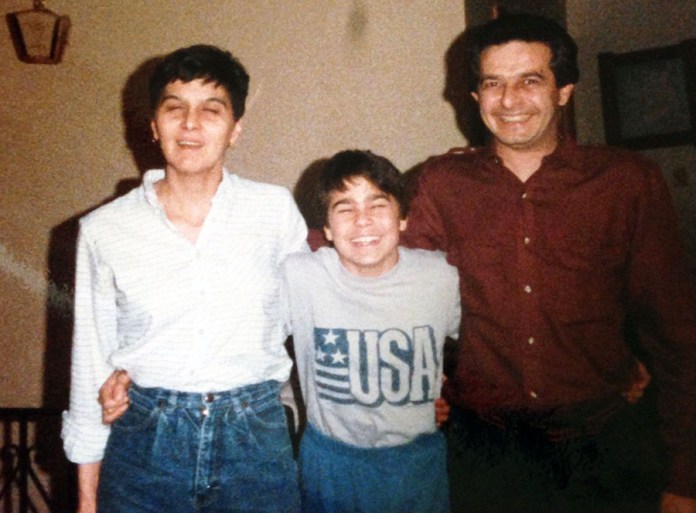
Posing with my parents prior to my surgery in 1984.

Prior to the initial surgery, in the fall of 1984, a scan of my head had revealed a cloudy mass in the sella region at the base of the skull, and the results of a follow-up CT scan with radiation contrast came a few weeks later.

I received the news about the brain tumor diagnosis from my father when he picked me up from wrestling practice on a cold November night. This essay describes that encounter.
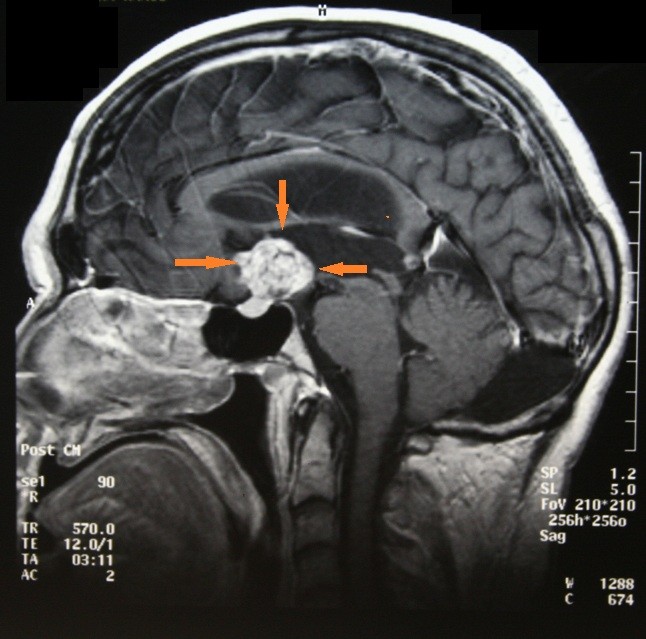
Craniopharyngioma

##

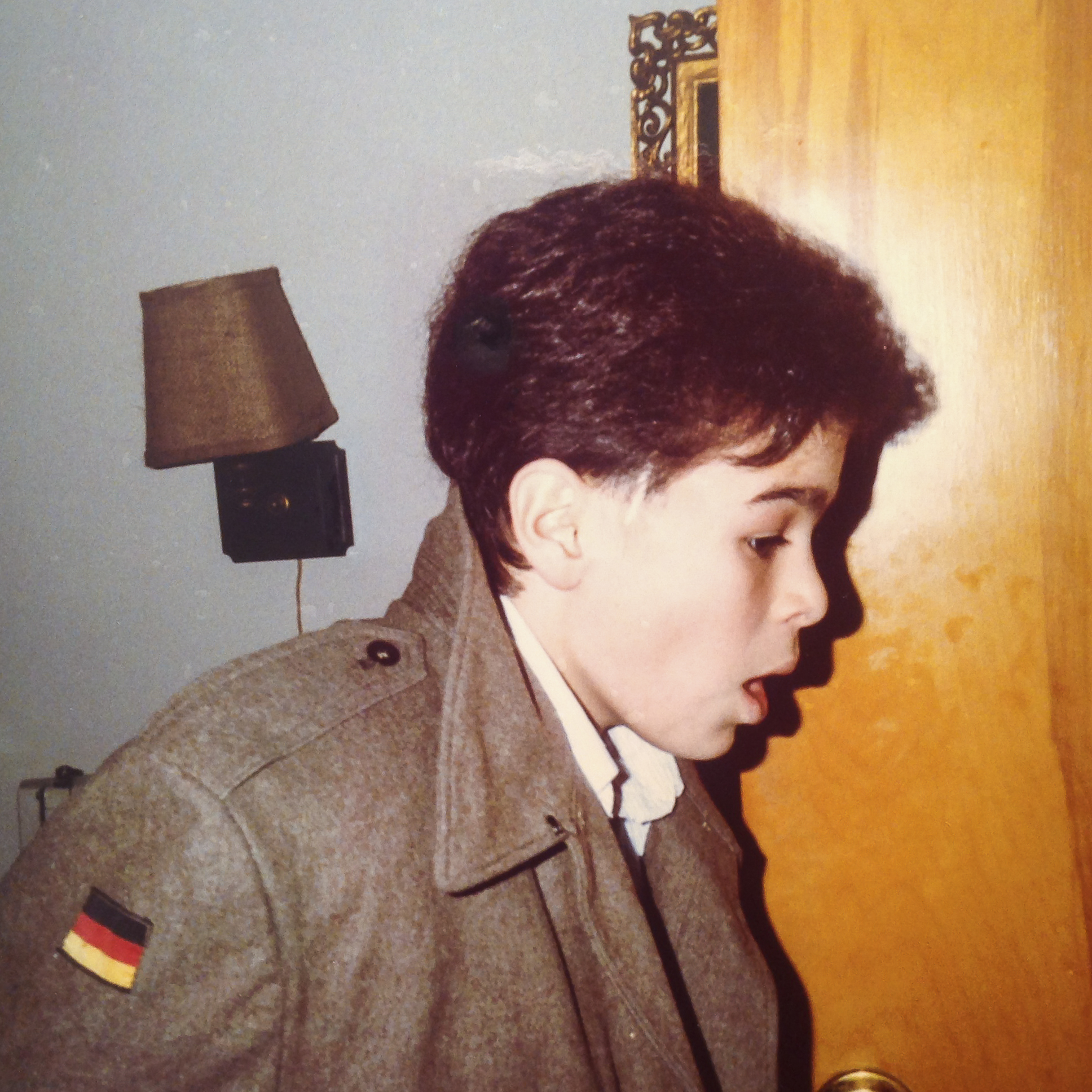
After I put on my black wool pea coat, pulled a knit hat down around my ears, and slung my book bag over my shoulders, I pushed open the back door of the gym and walked outside to meet my father, who had parked behind the high school.

The cold air hit my face and stung my gloveless hands as I strode toward the car; a floodlight cast a large net of bright, white light on the pavement. Dad drove up, and I got in.

He left the car idling, and as I slid into the passenger seat and adjusted myself, he leaned over and kissed me on the cheek, his tan winter coat brushing against the steering wheel. I felt a trace of his beard stubble against my skin, and I could smell a faint odor of Aqua Velva or Brut combined with cigarette smoke. The heater hummed, and he lowered the blast of air and turned and looked at me. I wondered why we weren’t moving yet. He wasn’t crying, but he appeared on the verge of spilling emotions.

“What’s the matter, Dad?” I asked.

“Upstate called your mother today,” he said. He switched on the overhead light, reached into his jacket pocket, and pulled out a torn piece of paper. “Here,” he said, handing me the slip of paper, “this is what they think you have. I wrote it down, but I don’t think I spelled it right.”

In a slashing style in faint, blue ink, my father had scribbled a misspelling of the word craniopharyngioma. His voice cracked as he said, “It’s cranio-phah-reng . . . something like that . . . oh, I don’t know. It’s some kind of brain tumor.”

I looked at the paper as my father let out a sigh. He shook his head and said, “I prayed to God when you were born that this wouldn’t happen to you, that you wouldn’t have to go through the same thing I did.” His words referred to his health crisis as a teenager, one that caused small stature and delayed puberty and led to ridicule by his classmates.

Francis DiClemente Sr. was born with a hole in his heart, a ventricular septal defect. On June 12, 1959, when he was sixteen years old, pioneering cardiac surgeon C. Walton Lillehei performed open-heart surgery on him at the University of Minnesota Hospital, successfully repairing the defect.

The heart problem disrupted Dad’s high school years, and he faced a long recovery; but he rebounded after the surgery, lifting weights to become stronger and adding muscle to his thin frame. He grew to his final adult height, graduated high school from St. Aloysius Academy in Rome, and went to work at the city’s Sears Roebuck store.

After sharing the information with me, he pressed his lips together and shook his head again, and he seemed locked in position in the driver’s seat, unable to contend with the news, incapable of going through the motions of driving away. We clenched hands, and I said, “It’s OK, Dad. Don’t worry. But what do we do now? What’s next?”

“You have to go back there for more tests. You may need surgery.”

“All right,” I said. “It’s OK.”

“I hope so,” he said. “All we can do is pray.”

He switched off the overhead light, put the car in drive, and drove out of the parking lot. We grew silent as we passed the naked trees lining Pine Street in our city of Rome, New York.. We crossed the intersection at James Street and made our way toward Black River Boulevard.

While my father was anxious and crestfallen, I felt elated as I gripped my book bag in the passenger seat. The CT scan with contrast had confirmed my suspicions, indicating a grave medical condition was responsible for my growth failure at age fifteen, offering a reason why my body had not changed, why I had not progressed through puberty, and why I remained so different from the other boys my age. I still considered myself a physical anomaly, but the tumor proved it wasn’t my fault.

I looked down at the piece of paper again and studied the word. Craniopharyngioma. I tried to sound it out in my head while my dad steered the vehicle, and I thought the word would twirl off my tongue like poetry if I rolled down the window and yelled it. Craniopharyngioma. Cranio-Phar-Ryng-Ee-Oh-Mah. It reminded me of onomatopoeia, which I had learned about in my tenth-grade English class.

##

And here are two related poems:

Case History

Stricken with pituitary insufficiency,
I felt my way through
a stage of delayed puberty.
When adolescence took hold for other kids,
I remained like a boy wrapped in toddler’s clothes.

My face looks older now,
and my body has grown.
But I could not escape
the endocrine impact of that cranial intrusion.
For even though benign,
the tissue overtook me,
and in effect, the tumor
scarred my life and altered my future.

Craniopharyngioma (Youthful Diary Entry)

Craniopharyngioma gave me
an excuse for being unattractive.
I had a problem inside my head.
It wasn’t my fault
I stood four foot eight inches tall
and looked like I was
twelve years old instead of eighteen—
and then nineteen
instead of twenty-four.
I couldn’t be blamed for
my sans-testosterone body
straddling the line
between male and female.

The brain tumor
spurred questions
about my appearance,
aroused ridicule,
and provoked sympathy.
I heard voices whispering:
“Guess how old that guy is?”
And, “Is that a dude or a chick?”

And while I waited for my
body to mature, to fall in line,
and to achieve normal progression,
I remember wishing the surgeons
had left the scalpel
inside my skull
before they closed me up,
knitting the stitches
from ear to ear.

I prayed the scalpel
would twist and twirl
while I slept at night—
carving my brain
like a jack-o’-lantern—
splitting the left and right
hemispheres,
and effacing the memory
of my existence.
 

Standard

Forty Years Later

I am celebrating an important milestone today—the 40th anniversary of my first brain surgery to remove a benign tumor engulfing my pituitary gland. I have written about this ordeal many times in the past, including in this long 2014 post.

On this day, four decades ago, surgeons cracked open my skull and extracted the craniopharyngioma that had stunted my growth and delayed my transition from boy to man.

In this essay, I reflect on my experience as a teenager in 1984 while a patient at SUNY Upstate Medical Center (renamed Upstate University Hospital) in Syracuse, New York. I am limiting the narrative period to the day of surgery and my immediate recovery.

Upstate University Hospital

Surgery Day: An Essay

1.

Early morning. Blackness. I can smell the breakfast trays delivered on the hospital floor—watery eggs, ham and bacon, soggy oatmeal, and weak tea and coffee. The noise outside my room grows as patients awaken and nurses draw blood and administer medicine.

My appointment with the medical intervention team has arrived. I am fifteen years old and ready for surgery day, prepared for the trauma that awaits me on the table. My head will be shaved, and my skull sawed open. The tumor growing in my head—wrapped around my pituitary gland and stifling my maturation—will be plucked free, yanked out like an infected molar and then examined under a microscope to determine its classification. We must name our enemies to defeat them.

Once removed, the lesion will relinquish dominion over my body. I will be cut loose from its tentacles. The surgery will disrupt my endocrine system, leading to a permanent condition known as hypopituitarism and propelling me on a long road toward “catch-up” growth and development.

A photo of my father and me two months before the operation in 1984.

2.

A nurse enters my room and hands me a small plastic cup filled with a few pills. “This will just relax you,” she says as I swallow the pre-surgery drugs. About a half-hour later, she returns and says, “It’s time for you to go down now.” A softness squishes against the edges of my mind; I am drifting from consciousness.

An orderly comes to take me away—filling nearly the entire space inside the door frame. A hulking figure with thick, black hair, a black beard, and muscular forearms, he reminds me of Bluto from the Popeye the Sailor cartoons. But for some reason, I call him Hugo.

“OK, Hugo,” I say, “I’m ready now.” Hugo helps me slide over from my bed to a stretcher as the nurse covers me with a sheet and a blanket.

My family gathers around me, bending down to kiss me and wish me “good luck.” What does “good luck” mean on the operating table? I wonder.

Tears stream down my mother’s cheeks, which are red and wind-burned and feel cold against my skin as she kisses my face and forehead; she squeezes my hand and then releases her grip and steps away.

Hugo unlocks the wheels of the gurney and steers it out of the room and into the hallway. Even though I am sleepy, I stay awake for the ride, keeping my eyes open and watching the panels of fluorescent lights pass overhead as we make our way through the hospital corridors and into an elevator. We take a silent ride down to the surgical wing.

The temperature drops when we enter the frigid, sterile operating room. A chill runs over my body; my lips tremble as gooseflesh buds on my arms.

The surgical team members buzz around the operating room, each doctor or nurse carrying out a specific task. They transfer me from the stretcher to the operating table. An overhead light shines into my eyes while I lay splayed on the table.

A nurse covers me with an extra blanket and stretches tight, white stockings over my calves. She says the stockings will help to prevent blood clots after surgery.

One of the doctors sits down near the table and says he will shave my head. When he asks me if I want my whole head sheared or just the front, I make the mistake of telling him to clip only the front. As a result, weeks after the surgery, my hair remains uneven—bald in front and growing long in the back—similar to the long hair sticking out the back of helmets worn by hockey players with mullets.

After they jab an IV in my arm, I grow drowsy, my eyelids shutting; but before I drift off, I tell one of the nurses that I need to pee. The woman chuckles and says, “Oh, you don’t have to worry about that now. We’ve already put in a catheter.”

And then I leave the world—falling under the power of general anesthesia for about eight-and-a-half hours while the surgeons perform their work.

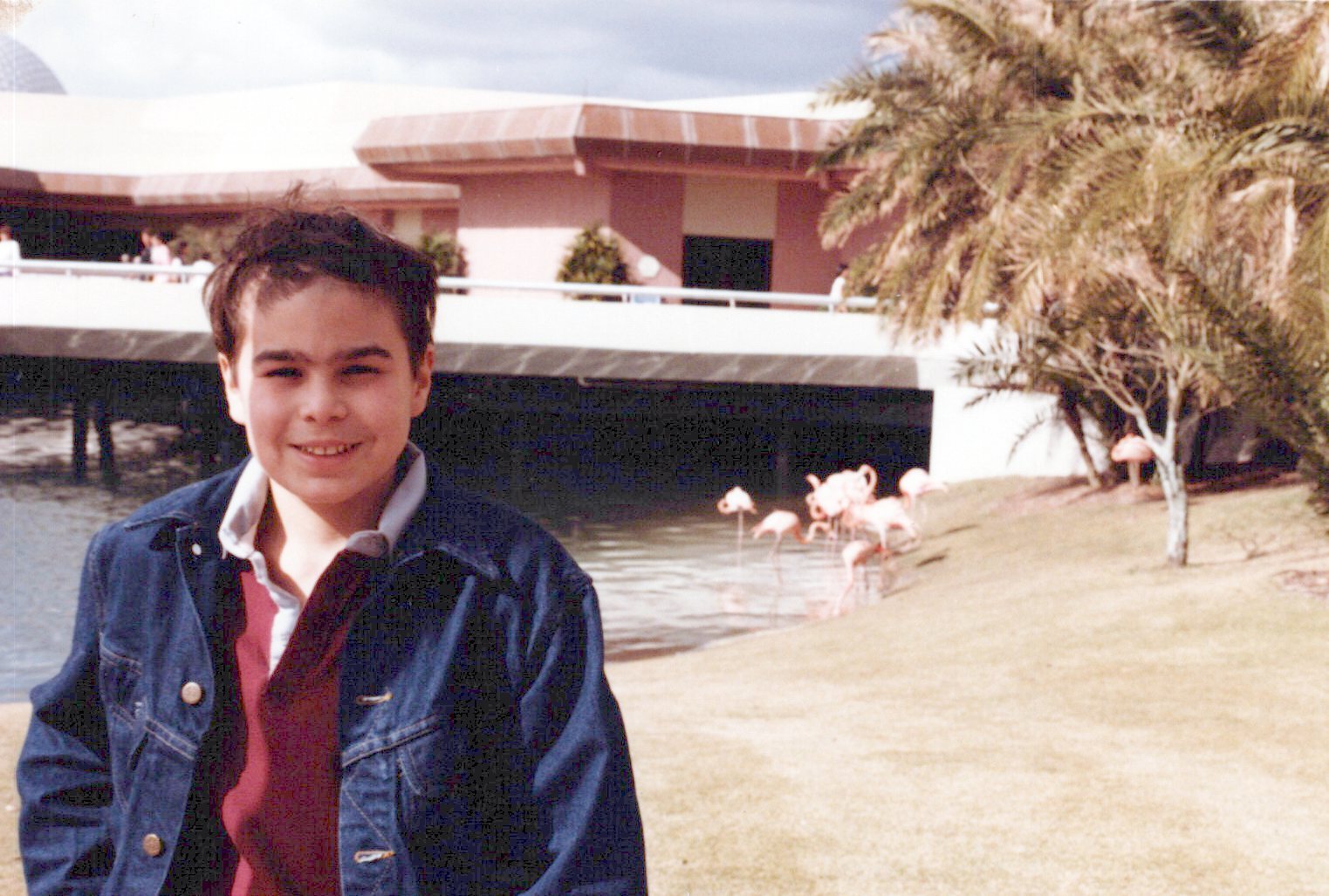
At Walt Disney World in February 1985.

3.

I have often wondered where I traveled to during that gap of time. What realms or landscapes did I explore in my mind while my skull lay open and I remained unconscious on the operating table?

Here is me stepping out of the story momentarily to travel back in time and investigate the scene. It’s a fantasy of the man I hoped I would become once the surgeons extracted the tumor. It’s the future I had envisioned for myself—marked by maturation and normalcy, playing the role of a fully formed male accompanied by a female partner.

A green canopy of trees. A trilling stream. Sunlight filtering through leaves overhanging a hiking path. Birds chirp, and tree limbs sway in the wind.

Boots touch the soft, muddy earth. A man emerges from a wooded path. He is dressed in a red checkered flannel shirt, tan khakis, and hiking boots, and he carries a knapsack on his shoulders. He is about five feet six inches tall, lean and muscular, and has a slight beard.

A twig snaps, and we see a woman walking out of a clearing. She’s wearing a fleece sweatshirt, jeans, hiking boots, and a backpack. The two figures stride toward one another, share a kiss, and then grasp hands. Sunlight bathes them as they leave the clearing and start walking on a path leading over a ridge. They climb the slight incline and disappear as they walk down the other side, their bodies concealed by the curve of the Earth.

Late high school or early college years.

4.

I wake up in a bed tucked in a corner of the surgical intensive care unit. I feel dizzy, and a dull, continuous ache presses against my head as if my skull is being squeezed in a vice. Nurses inject the opioid Demerol into my thighs over several hours to alleviate the pain, and I keep drifting in and out of sleep. I hear machines beeping and the sound of a respirator somewhere on the floor. The gentle sound of the ventilator puts me at ease as I listen to it—in and out, in and out, in and out.

EKG stickers are pressed to my chest, and machines monitor my heart rate and blood pressure. Vaseline has been smeared on my eyelids and eyelashes, clouding my vision, and I feel like I am straining to see from under the cover of a heavy, wet blanket. The white stockings the surgical team had given me are pulled up to my knees and constrict the circulation in my lower limbs.

I feel small—shriveled up in the bed like a green-gray alien being prodded by U.S. government doctors and scientists on an operating table in Roswell or Los Alamos, New Mexico. A scar runs the entire length of my head, from the tip of my right ear to the tip of my left ear. I tap a slight dent in my skull (produced by a right frontal craniotomy during surgery), about the width of two fingers, just above my forehead on the right side.

The stitches itch, and I reach up to feel the thick, black threads. I wonder if I resemble a twisted version of the Mr. Met mascot.

5.

But I feel relieved because I have awakened from the operation, and my brain function remains intact. Some doctors lean over my bed and ask me a series of questions: Do I know my name, the current year, the president of the U.S., and the name of the city I am in? I answer the questions correctly, and when instructed, I squeeze their fingers, wiggle my toes, puff my cheeks, stick out my tongue, and follow a penlight with my eyes.

My senses function properly, as I can see, hear, speak, and smell. I can form thoughts, and the trauma of the surgery has not altered my mental ability or effaced my memory.

My mother, father, sister, and Aunt Teresa huddle around my bed, their faces beaming like those of Dorothy’s relatives in the scene when she wakes up from the dream at the end of The Wizard of Oz.

“Hey, buddy,” my dad says.

My mom leans over the bed rail, kisses my face and eyelids, and says, “You did great, honey, just great.”

“Yeah, Dr. B. said he got most of it,” Dad says.

“Was it big?” I ask.

My mom holds up her right thumb, indicating the size of the tumor. “It was about the size of a thumb,” she says. She caresses my face and adds, “Dr. B. said there’s a little bit left over, but we don’t need to worry about that now.”

“OK,” I say, closing my eyes and returning to sleep.

High school graduation in 1987.

6.

I wake up on the first night with a raging thirst in my parched throat. I feel like I have been deprived of water for days. But because the doctors are concerned about swelling in the brain, they load me with corticosteroids and restrict my fluid intake. My face is swollen, and I feel bloated from the steroids; I am not allowed to drink water, but I am permitted to suck on ice chips.

However, late in the evening, with the lights dimmed on the floor after visiting hours have ended, I turn my head, look around, and notice a sink in the corner, only a few feet away from my bed.

Somehow, despite being woozy, I lower the bed rail, swing my legs out to the side, and climb out of bed. I try to be quiet as I wheel my IV stand toward the small, stainless-steel sink. I turn on the foot pedal faucet, cup my hands, and gulp the water like it’s rushing in an icy mountain river.

The cold liquid pours down my throat and gives me immediate relief. I want to stay here and drink more water, but a man—a male nurse or an orderly—races toward me and pulls me away from the sink.

“What are you doing?” he yells. “You just had brain surgery.”

He then escorts me back to bed, swings my legs over, covers me with the blankets, and lifts the bed rail.

“Now, don’t get up again,” he says. “What do you wanna do, crack your head open and screw up the work those surgeons did?”

And now tucked back into bed, I resume sleeping, drifting off until the next wave of pain hits, and I press the call button to request another dose of Demerol.

##

Recalling these past forty years, I run a tally of my surgeries at Upstate. The number stands at six—counting the initial surgery in 1984 and the subsequent operations to remove tumor regrowth in 1988, 2011, 2012 (Gamma Knife), 2020 (Gamma Knife), and 2023.

I have some double vision when looking at things up close and to my extreme right (right sixth nerve palsy), and I must be hyper-vigilant in the management of my care to treat my hypopituitarism. But except for my corticosteroid-induced osteoporosis and rheumatoid arthritis (unrelated to the tumor), I am a healthy, middle-aged man.

My next MRI is scheduled for Dec. 18. And with the stubborn resilience of craniopharyngiomas, I know more surgeries (or radiation treatments) loom in the future. But I face each day with gratitude, recognizing how lucky I am to have survived the scalpel on multiple occasions. I also don’t look beyond each six-month window of time between MRIs. Once my current neurosurgeon orders the next MRI, I go about my life without thinking about the tumor still lurking in my head.

Late high school or early college years.

##

And because of the significance of the number 40 on this anniversary date, I’ll leave you with U2 playing “40” live at Red Rocks Amphitheatre in Colorado in 1983.


Standard

Nine Months Later

Today marks nine months since my surgery to remove a benign brain tumor on my pituitary gland. Although it’s not a major milestone, it’s tied to a once-in-a-lifetime event—seeing Bruce Springsteen in concert on April 18 in the JMA Wireless Dome in Syracuse.

The concert was originally scheduled for September 7, 2023, and I would have been in no condition during my recovery to climb the concrete steps to the upper rafters of the Dome in Section 336, Row Y. I transferred my ticket to a co-worker, but then the tour was sidelined due to Bruce’s peptic ulcer disease. I’d like to think some heavenly intervention permitted me to attend the rescheduled event in April in a fully restored state.

I went to the concert with my wife, Pam—a rare night out for us and a break for her as she completed her first full year in her occupational therapy assistant program at Bryant and Stratton College. We hired a babysitter and took a Lyft to the show, arriving before the gates opened.

The Dome’s muddy sound system threw me off as the concert began. Bruce’s opening number was “Lonesome Day,” but I couldn’t figure out the tune. I felt like an outfielder in baseball who can’t pick up the ball off the bat. The first song I recognized was “No Surrender,” and the sound quality seemed to improve as the concert wore on.

Bruce and the E Street Band played the anthemic classics, which I have been reliving through the miracle of YouTube: “Badlands,” “Backstreets,” “The Promised Land,” “Thunder Road,” and “Born to Run.”

Up in the nosebleeds, an exuberant middle-aged woman with long, dark hair kept bumping me as she swayed, stomped her feet, clapped her hands, and pumped her fists. She kept apologizing, but I didn’t care about the incidental physical contact. I appreciated the pure joy she displayed, and we formed a bond through our mutual love of the music.

After “Born to Run” finished with a flourish, we shared a two-word conversation—screamed into each other’s ears.

I turned to her and said, “Amazing.”

“Right!” she said.

I hardly go to concerts, and I can’t remember the last stadium concert I attended. It may have been when I saw Bruce in Phoenix in 2002 during The Rising Tour. I went alone to America West Arena during the sweltering heat of August.

A Syracuse woman posted on Facebook that she didn’t enjoy the show because of the behavior of the people around her. And I know a debate persists about proper concert etiquette. As for me, I love it when fans dance and shout the lyrics at the top of their lungs. I mean, if you can’t let loose at a rock concert, where can you? They’re not serving tea and finger sandwiches. I think your ticket should come with a warning like “buyer beware … this isn’t your living room,” and I sang many songs, my voice growing hoarse as the night continued.

Music provides bookmarks for people’s lives. Fans connect songs to significant moments in their lives. Bruce’s music sustained me during my darkest days when I was consumed by loneliness, shame, and self-hatred.

So when Bruce belted out the words to “The Promised Land,” I joined him and thousands of others in screaming:

Blow away the dreams that tear you apart,
Blow away the dreams that break your heart,
Blow away the lies that leave you nothing
But lost and brokenhearted …

And I didn’t care that my voice was way off-key.

Standard

Tumor Talk

I am undergoing another brain surgery on Monday morning. This marks the fourth time since my craniopharyngioma (benign brain tumor on the pituitary gland) first appeared when I was fifteen years old.

Image by the National Cancer Institute.

My last blast of Gamma Knife radiation in 2020 kept the tumor away, but subsequent regrowth began affecting my vision in the past two years. Another round of radiation could not be performed because the tumor sits only a millimeter away from the optic nerve. My radiation oncologist gave me the grim news that radiation presented a twenty-five percent risk of blindness.

So a neurosurgeon and an ears, nose, and throat surgeon at Upstate will team up for a transsphenoidal approach—meaning they would go through the nose to access the tumor. I had the same surgery in 2011, followed by a rough recovery where I stayed locked in my room for about a month, suffering from excruciating headaches. I have added concerns now because in 2011 I was on my own; now I have my wife and son to think about.

Image by the National Cancer Institute.

Anyway, I want to present a piece of experimental writing inspired by my tumor. I think this falls under the essay category, but it could also be considered fiction.

Tumor Talk: A Conversation with My Craniopharyngioma

“I’m back, baby!”

I heard those words in my head after my radiation oncologist discussed the results of my latest MRI. Dr. L. said my craniopharyngioma—a benign, slow-growth tumor at the base of the brain near the pituitary gland—had grown over the last two years, causing my recent double vision.

Dr. L. said the proximity of the neoplasm to the optic nerve and blood vessels meant radiation was no longer an option. I would need surgery.

“You must be pretty proud of yourself, Fred,” I said to my tumor friend resting inside my head.

“Oh, come on, man, don’t be like that,” Fred said. “You know this was inevitable. Us craniopharyngiomas are like the cockroaches of the tumor world. You know no matter what you do, we always come back. You think that weak-ass radiation was gonna work on me?”

Yes, my tumor has a name. Since he’s been residing inside me for so long, I figured we should at least be on a first-name basis.

And Fred was right. There’s no denying his Terminator instincts for coming back. He’s like Buster Keaton in The General. He keeps barreling down the tracks no matter what you do to him.

Fred first appeared in 1984 as a large tumor engulfing my pituitary gland. His removal led to hypopituitarism and diabetes insipidus (a disease affecting water and sodium balance).

Despite surgeries in 1984, 1988, and 2011, plus two blasts of Gamma Knife radiation, Fred continued to aggregate the tumor vestiges, scooping up the fragments and wrangling them into a well-formed regiment. I gotta give him credit for its spunk and resiliency.

But after leaving the medical office and waiting at the bus stop, I wanted to set some ground rules with Fred, to see if I could talk him down or at least minimize his impact.

“Why are you doing this to me again? Life has been pretty stable with my family. Why do you have to make trouble for us now?”

“Come on, man, get real. Don’t give me those bullshit questions. Why anything? Why do you breathe or drink water? Why does a horse gallop, a deer prance, a cat meow, or a goat bleat? Do I need to go on? I’m a fucking brain tumor.”

“So what if you’re a tumor? Can’t you control yourself? Can’t you stop growing?”

“Now you just sound naïve. I can’t be something other than what I am. And I have a clear objective. As a tumor, my job is to expand and invade. That’s it. That’s why I’m here on this planet.”

What could I say? I couldn’t offer any retort.

“Look, don’t be so glum. You’re in good hands with your doctors, and our history shows we both come out alive.”

“Yeah, but I wish you’d agree to leave.”

“Well if it’s any consolation, I do like where I live. You’re a good host. Don’t get me wrong, I’d prefer to be inside the head of some brilliant mathematician or a swimsuit model reclining on a beach. No offense. Look, you’re not a bad guy. But let’s not get carried away. You’re no fucking Einstein or Dave Chappelle. And frankly, I get a little bored with your prosaic thoughts.”

“Tell me how you really feel.”

“Oh come on, man. I’m just busting your balls a little bit, trying to cheer you up. Which reminds me—I thought of a theme song for our relationship. Come on, sing it with me:

“In your head, in your head,
Zombie, zombie, zombie-ie-ie-ie …”

“Very funny.”

“Come on, man, don’t be like that. We need to learn to live together. Look, I haven’t caused irreparable damage. Your brain functions, memory, and language processing are all intact.”

“I suppose I should thank you for that. But with any luck, the neurosurgeon will go up through the nose and pluck you out.”

“Oh, why so adversarial? We’re just talking here.”

“You have your objective. And I have mine. You’re a squatter. A nuisance tenant who needs to be evicted.”

“Yeah, good luck. I adhere to things. You can’t just kick me out. I stick around. Been doing it for more than thirty-five years.

“Yes, you’re one tough foe.”

“But why do you have to think of me like that?”

“What do you mean?”

“Maybe I’m more friend than foe?”

“I don’t buy it.”

“Just hear me out. You wouldn’t be the man you are today if it weren’t for me.”

“How do you figure?”

“You’re pretty driven, ambitious, and disciplined, right?”

“Yeah, I suppose.”

“Well, if it weren’t for me, you wouldn’t have had to overcome those endocrine challenges—being the shortest guy in your class. I may have stunted your growth, but I gave you determination—a fire in the belly.”

“You know, I have to admit, I think you have a point. From the moment you came along, I felt like you were a ticking time bomb inside my head, and I had to strive to achieve something before you exploded and shattered my skull.”

“But, lucky for you, I’m not a bomb. And I’m not vicious, pernicious fucking glioblastoma. I’m just an aggravating nuisance, a little hangnail or a sliver under the skin. Think of me as a dented fender or a toilet that keeps running.”

“Well, I guess I should say, ‘thank you’ for that.”

“Don’t mention it.”

“Can we at least come to some agreement? Can you just stop growing and stay put for a while, until I have this surgery?”

“I don’t have that kind of control, kid. You give me too much credit. I don’t know where I’m going. I just keep moving.”

“Well listen, after Dr. H. does his transsphenoidal resection work, I’ll let you come back slowly, over the next ten years.”

“I hate to break it to you, but I don’t need your permission to inhabit some space inside your head. And let’s face it—we’re gonna be together for a long, long time. We’ll be two old, shriveled geezers playing shuffleboard in Clearwater. So let’s stay friends.”

I laughed. “I guess you’re right. I don’t know what else to say. See you later, Fred.”

“See you in the operating room, kid.”

Standard