Planting Wild Grapes by Kathleen Kramer

Ithaca, New York-area poet and playwright Kathleen Kramer has published a new full-length collection of poems, entitled Planting Wild Grapes (Yesteryear Publishing).

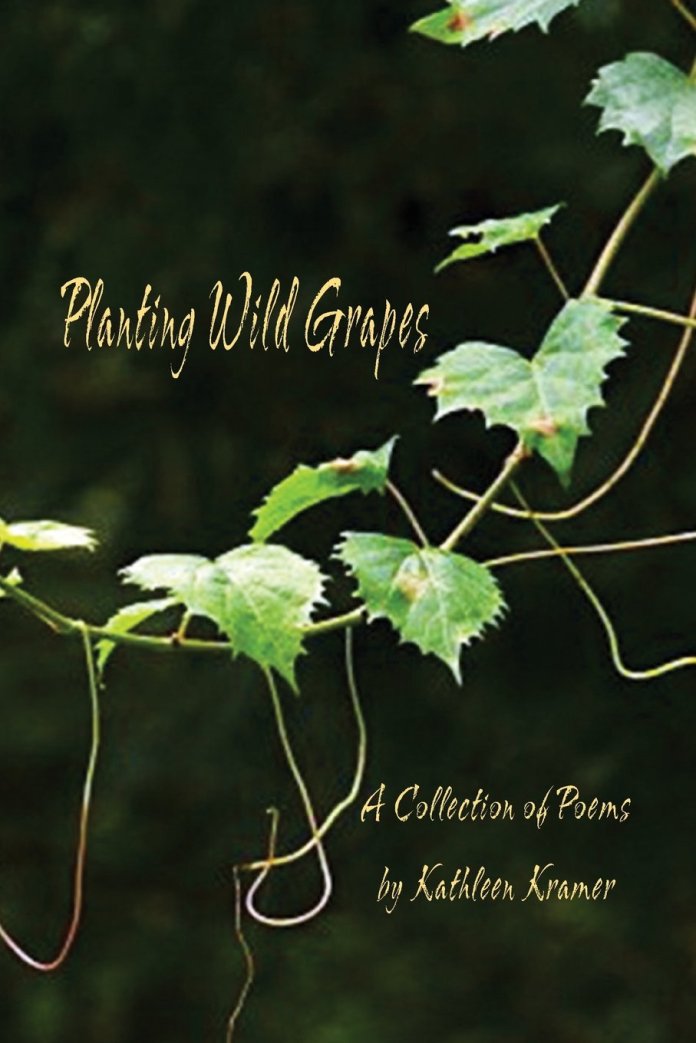
Planting Wild Grapes by Kathleen Kramer. Cover and book design by E. Nan Edmunds. Cover photograph by Green Deane.

Cover and book design by E. Nan Edmunds. Cover photograph by Green Deane.

I became acquainted with Kathleen through our mutual connection with the Syracuse writing group Armory Square Playwrights, and I consider her a friend and a writing confidant.

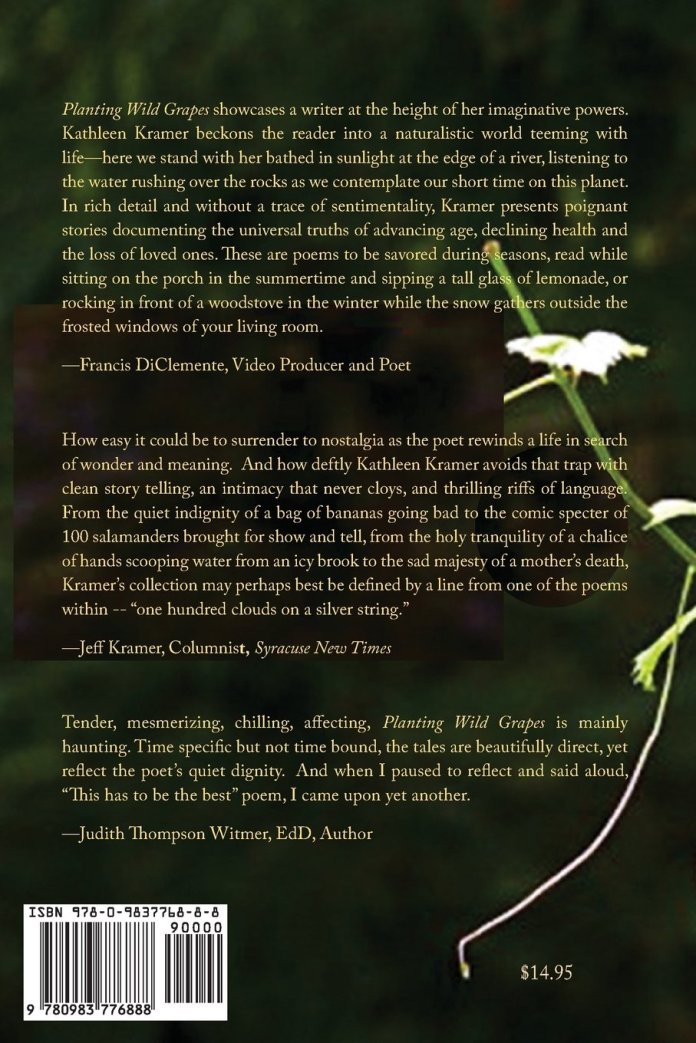
I was honored when she asked me to write a “blurb” for the back of her book, and I read the collection in galley form via PDF. Holding the hard copy now, I am looking forward to taking my time in reading the printed version; I want to sift through each line of text and let the words and their meanings linger in my mind.

Planting Wild Grapes by Kathleen Kramer. Cover and book design by E. Nan Edmunds. Cover photograph by Green Deane.

Kramer is the author of a poetry chapbook, Inside the Stone (Ithaca Writers’ Association/JK Publications), and a previous full-length collection, Boiled Potato Blues (Vista Periodista). Her poems have appeared in The Comstock Review, Passager, Avocet, a Journal of Nature Poems, The Healing Muse and other publications. And her plays have been presented regionally in central New York, as well as in the Midwest and in Canada.

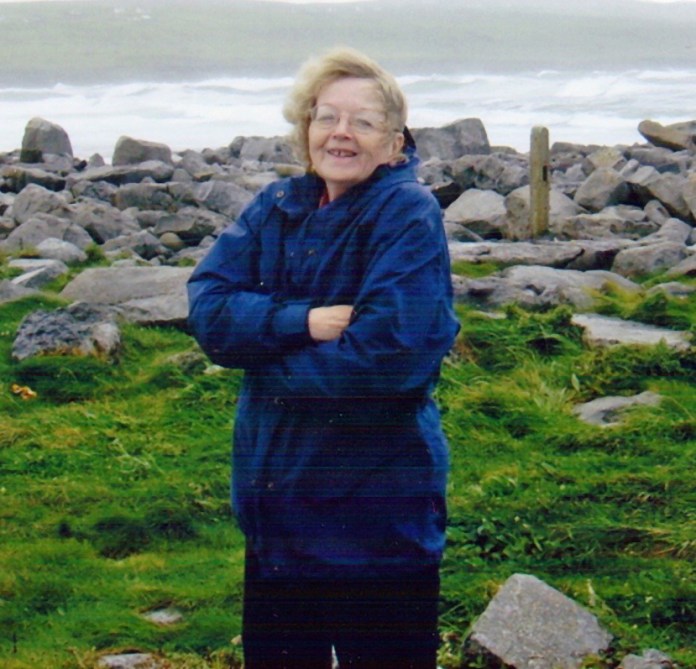
Kathleen Kramer in Ireland.

Kathleen Kramer in Ireland. Photo by Jack Kramer.

Here is her biography from the interior of the book:

Growing up in Pennsylvania’s coalmining and farming region, Kathleen Kramer’s early life was influenced by the solidity of the earth and the rhythm of seasons.

At 19, she left for the city and spent five years working in Washington, DC for the Department of Defense. There followed a stint in Maine where subsistence farming took her back to the land. A second marriage brought her to Long Island, where she and her husband Jack reared their three sons in Northport, a small town on Long Island Sound. During that time and over a period of 10 years of balancing classes, family and work, Kathy earned a BA at Empire State College and an MLS at C.W. Post.

Now, following retirement from the Boyce Thompson Institute at Cornell, Kathy lives with her husband in New York’s Finger Lakes area where she writes poetry and plays. Again, the natural world and changing seasons have assumed center stage. It’s these foundational elements and the strength of generational ties which largely inform Kathy’s poems.

##

And in this interview, Kramer talks about her book and discusses the motivations that propel her writing. I hope you come to appreciate this artist and her work as much as I do.

Can you give a brief description of this collection of poems?  

These poems were written over a period of years and each represents a moment in time when something that seemed important was recognized. Most often, however, the actual moment was, on the surface, quite ordinary. It’s the extraordinariness of the ordinary that moves me. I’ve tried to capture that in these poems.

Not all of these poems address this directly, but I view each one as I might a handcrafted bead: each has its own shape and color and when strung together, they create a necklace that, for me, speaks of wonder and meaning, embracing both good times and hard times.

What do you hope readers will take away from your book?

This collection tries to do a few different things. It explores the enigmatic title, Planting Wild Grapes, which was given to me in a vivid dream. It seeks to illustrate what I think is required of us as finite beings—to engage in our lives as deeply and meaningfully as we can and then, when the times comes, to release them with thanksgiving and grace. It is my hope that the reader will come away from reading this book with a sense of the wonder and meaning in his or her own life.

What do you enjoy most about writing poetry?

For me, writing poetry has been a connection not only to my inner self and to the natural world, but also to something beyond myself. At the risk of sounding grandiose or pious, I believe creativity and the divine are interwoven. When I can touch that moment as I write a poem, I feel exceptionally blessed.

I’m sure it varies with each poem, but can you describe your typical process for constructing poems—from the moment you get an idea for a work until the final revision?

First of all, who knows where the idea for a poem comes from? Sometimes it’s a snatch of overheard conversation. Sometimes it’s a word or line from someone else’s poem or a flash of memory. Often it’s an experience of being with another person and knowing the tie between you is precious. It’s being outdoors and sensing the wholeness. Regardless of where it comes from, there’s a little “thrill,” like a tiny, soundless bell that rings and says, “Follow this one.”

Then I start to write. I write by hand and I almost always go out of my house to write; I especially like to write in cemeteries. (Very quiet and no one interrupts!) When I have a rough sketch of the poem, I go home and type it into my computer, where it’s easier to shape it on the page.

I’m fortunate to be a member of a poetry group, The High Noon Poets. We meet twice a month and it’s there that we each have our poems critiqued. We’re free to accept the suggestions made or to reject them. Often, even if I feel resistant at first, by the time I’m home again, I’m seeing the wisdom of those suggestions.

How does writing poetry compare to writing plays? Do you have a preference? 

What strikes me most are the similarities. In my opinion, both demand an economy of language. Every word must carry its own weight. Sometimes, a word might be there simply because it is beautiful, and if that isn’t overdone, it adds to the whole and, indeed, carries its own weight.

I like writing both poetry and plays. One of the pleasures of playwriting is the characters one can create. They become real and will often tell me what they will or won’t say or do.

However, I think I have a slight preference for writing poetry. There’s satisfaction in writing a single, well-crafted poem. It can stand on its own. There’s no need to sustain a long narrative, yet if the poet creates a number of poems, giving each a shape and color of its own, together, they can tell the story of a life or a time.

What’s next for you in terms of writing projects?

I’ll continue to write poems and, occasionally, plays—I must, in order to be happy—but for a time now, my main focus will be on doing readings and trying in whatever ways I can to share my pleasure in this new book, Planting Wild Grapes.

Kathleen Kramer reading a poem at an event. Photo by Debbie Rexine for The Healing Muse.

Kathleen Kramer reading a poem at an event. Photo by Debbie Rexine for The Healing Muse.

##

Here are two excerpts from Planting Wild Grapes (reprinted with the permission of the author and Yesteryear Publishing).

Planting Wild Grapes

Every day at dawn I go down to the river,
fill my bucket to the brim and wash stones.
Big or small, I take all that come to hand,
dip them in my pail, rub them between my palms
and drop them back into the river. I listen
for the satisfying sound—the watery thunk—
as they settle among their fellows.

At mid-day I wade the waves of goldenrod
to the center of the sunny field behind the barn.
Beneath my feet, my shadow crouches,
small and black. The candle in my hand
stands tall, like me, its wick waiting for
the match, prepared to be proud of a flame
invisible in the noonday light.

Sunset finds me again at river’s edge, a teacup
cradled in my hands. It holds rainwater caught
in the downpour at dinnertime. I lift it up
to the sinking sun, see the rim turn gold,
then tip the cup, spilling rain into the river.
Tomorrow, if I keep to my course,
there will be time to plant wild grapes.

Still

When we noticed lunchtime voices
in the hall, the ding of a call button,
squeak of rubber soles on tile floors,

we knew the sound of her breathing
had ceased. For long moments,

her shoulder, under my hand,
remained warm. Then a stillness,
profound and deep, came upon her—

not of worldly sleep but
of rest unbounded by time.

All her ailments, her frailties,
fell away and the wholeness…
the holiness… which remained

gave her back to us
as she was, as she is.

##

Readers can find Kramer’s 96-page collection on Amazon. And the book is also available at Buffalo Street Books in Ithaca.

Standard

John Horder: A Sense Of Being

I discovered a gem of a short poetry book while roaming through Syracuse University’s Bird Library in search of a Nick Hornby novel (which I was unable to find).

The book, A Sense of Being by John Horder, was published in 1968 as part of the Phoenix Living Poet Series. The book runs 40 pages and I was able to read the entire work during my lunch hour.

A Sense of Being by John Horder.

A Sense of Being by John Horder.

I couldn’t find any biographical information about Horder online, but I consider his spare, philosophical poems very moving. They made me stop and reflect on my own life and ponder the points Horder raised in his text. And that to me seems like the purpose of good poetry—to remind the reader that time is passing and our existence is fleeting.

Here are a few of my favorite selections from the book.

A Sense of Being

There is nothing in me to assure me of my being.
That is why I so often think
About my heart beating.
Nothing to do with the fear of it stopping.
It’s just it’s so hard to imagine it – beating –
Just as it’s so hard to imagine that I derive from something
That actually works. Something that lives and breathes.
Something that has a sense of its own being.
Oh, it’s so very hard to imagine these things,
And I’ve always been told I was imaginative by nature.

Imagine: a tree has roots: it knows where it springs from.
We have parents. But the orphan and the murderer have one
thing in common.
Something vital in each of them has been wiped out.
It’s hard to explain exactly what. It’s something
A word or a glance from a parent may have set in motion
Or not. It’s not that this gives a child a sense of itself
Just like that. Nothing as simple as that.
But it can be the basis. Something to start from, something
that grows
And will eventually determine who and what he’s to be
Or not to be, as the case may be. Whether he is, or is not.

##

In A Time When I Was Nothing

In a time when I was nothing
I was strangely surprised to see
My name in The Times Literary Supplement.

In a time when I was nothing
There was an emptiness both inside and outside of me
And I felt no thing substantially.

In a time when I was nothing
It was most difficult to separate past from present
And the present moment held no sway.

In a time when I was nothing
There seemed no end to this state of non-being
The bottom had been kicked away from everything.

After a long time being nothing
There came at long last a dim realization
That one day I might eventually become something.

In the time when I was no one
There was simply nothing left to give anyone
And I found myself cut off from everyone.

In the time when I was no one
I knew no man, no woman
And that was when my sense of self began.

##

Everyman’s Vietnam

Our whole lives are designed as a means of escape
From the psychic forces that are deep down within.
We do anything rather than reckon with them.

Rather naively, we make call after call
Upon the telephone, in order to try exorcise them.
These forces which if submerged, first malinger, spit out
then wear our selves thin.

We cram our lives full to the brim with work.
We come home late, too tired even to speak to our wives.
We get drunk, which only makes our ulcers more peptic,

And still these forces won’t leave us alone.
Still they will never allow us a moment of rest.
Still we give them no real means of expression.

We don’t reckon with these forces.
They are demons.
They will run us to the grave

Unless we turn them to the good.
We underestimate their power.
Most of the time, we don’t even acknowledge that
they’re there.

More fool us.

##

Not Far Of

Eternity is not far off:
On a clear day
I feel it to be
Just out of sight.

The folly of men
Is there purposefully ignoring
What is so painfully obvious
On a clear day.

Horder, John. A Sense of Being. Phoenix Living Poet Series. London: Chatto & Windus/The Hogarth Press, 1968. Print.

Standard

A Winter Verse

Sometime around Christmas I bought a used paperback copy of The Collected Poems of Wallace Stevens at a book fare in the mall.

The Collected Poems of Wallace Stevens.

The Collected Poems of Wallace Stevens.

I have too many unread books still kicking around the house, but I thought 534 pages of verse for only a dollar was too good a deal to pass up.

I’ve read some of Wallace’s work before and found him to be a challenging read because of his vocabulary and his precision with language. But I think he’s worth investing the time, and as a writer who works full time in another profession, I am inspired by the fact that Stevens spent his career as an insurance lawyer and wrote poetry on the side. You can find out more about him here.

I haven’t started reading Wallace’s book yet, as I am working through the doorstopper of a novel The Prince of Tides by Pat Conroy, but I flipped through the volume and found a poem that seems suitable for mid-January when subzero temperatures reign. Here it is:

The Snow Man

One must have a mind of winter
To regard the frost and the boughs
Of the pine-trees crusted with snow;

Tree “crusted with snow.”

And have been cold a long time
To behold the junipers shagged with ice,
The spruces rough in the distant glitter

Of the January sun; and not to think
Of any misery in the sound of the wind,
In the sound of a few leaves,

Which is the sound of the land
Full of the same wind
That is blowing in the same bare place

For the listener, who listens in the snow,
And, nothing himself, beholds
Nothing that is not there and the nothing that is.

Stevens, Wallace. The Collected Poems of Wallace Stevens. New York: Vintage Books, a division of Random House, 1982. Originally published by Alfred A. Knopf, Inc. in 1954.

Standard