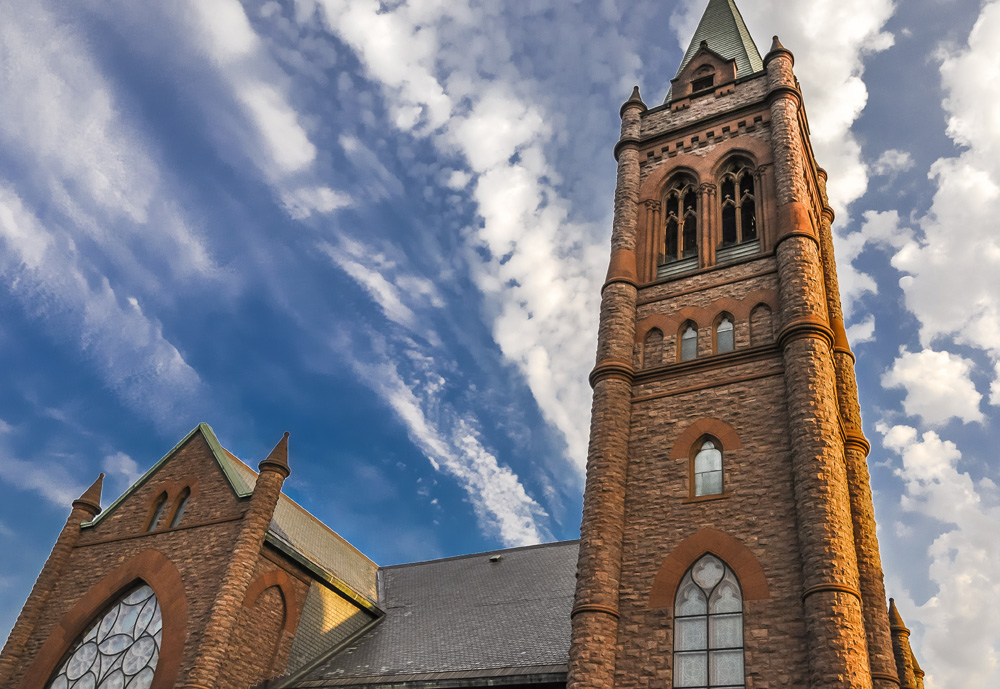
Man on the Stoop

Man on the Stoop, a creative nonfiction story, appears in the Spring 2014 issue of New Plains Review. Since the magazine does not have an online version of this issue, I thought I would post my story here:

On a sunny evening in early August 2012, I walked along James Street in Syracuse, trying to find a store where I could buy a bottle of water. I was in the Eastwood neighborhood to attend a poetry reading at Books & Melodies bookstore.

I passed a red brick building with a sign that read, “Furnished Efficiencies for Lease.” A slim man in his late 50s or early 60s sat on the small stoop of the building, his head raised and his eyes focused on the traffic moving along James Street.

I continued striding down the block until I found The Burger Joint restaurant. I went in, grabbed a bottle of water from the cooler and paid for it at the counter. I then walked back to the bookstore, approaching the apartment building again.

I wanted to stop and talk to the man on the steps; something about his appearance made me wonder about his life. I wanted to learn more about him, to introduce myself and ask him some questions. As I came within a few feet of the building, he looked up at me, acknowledging my presence, and our eyes met. But I lost my nerve to greet him. I lacked the courage to open my mouth and say “hello,” and the opportunity to interact with him and gain insight into his life was lost. I also regretted not having my camera with me because I think his strong profile would have made for a nice portrait.

He wore a dark T-shirt, jeans and sneakers, and his salt-and-pepper hair and thin mustache gave him a sort of rugged cowboy appearance. Wrinkles had worked their way into his careworn face and he had a lean, hungry look, like he could have been the Marlboro Man a few decades earlier. He had oval eyes that were more vertical than horizontal. Mostly, though, he just looked tired, as if life had been dragging him down.

I will call him Sam because he reminded me of a Sam. Perhaps he was a factory worker, a mechanic, a carpenter or a truck driver. I imagined if he spoke his voice would sound something like actor Sam Elliott’s.

And I pictured him in his small studio upstairs with its twin mattress, small desk and wooden chair, tiny bathroom and a window with broken Venetian blinds.

I wondered how this man spent his days. Was he retired? Did he work? Was he an alcoholic or a drug addict? I also thought about the hot, humid night and how he needed to sit on the stoop to escape the stifling air in his apartment devoid of air conditioning.

Something in his body language reflected the universal struggle of human beings grappling with the challenges of each day, carrying around our flesh as we creep toward death. I felt pity for this man, and I am not sure why. He looked exhausted but not depressed, and he seemed content to stare out at the street and see the activity going on, to pass some time before darkness descended and he would retire for the night, trying to fall asleep in the sauna of his apartment.

But driving home after the poetry reading I thought to myself, “Who am I to assume what this man’s life is like?” I only had his outward appearance to judge him by—and this was for just a few seconds as I walked to The Burger Joint for my water and headed back to the bookstore to attend the poetry reading.

What did I really know about this man?

Then again what do we ever know by sight alone? I couldn’t possibly understand the scope and scale and depth of this man’s life based on a few cursory glances in his direction. I would have loved to sit with him on the steps, share a cup of coffee and listen while he told me the story of his life. I bet it’s a great story.

He could’ve been a hit man for the mob or a former porn actor; maybe he had pulled a bank heist and had buried $500,000 in some cave deep in the Adirondacks. Maybe he had been a world-class heart surgeon who had revolutionized the practice, but had burned out and turned to drugs. Maybe he had a family somewhere out West and they were waiting for him to come home. Maybe he was a former relief pitcher and had won a World Series in the 1970s or ’80s; maybe his championship ring was tucked in a drawer upstairs. I will never know.

I understand it is hubris to evaluate a person’s worth based on outward appearance, to judge people by what we see, what their bodies and faces reveal to us. The physical can only be an entry point. It doesn’t tell us about the heart, mind and soul.

Yet I don’t fault myself for wanting to look, even if I am being a little nosy. Curiosity about others in the form of public people watching means we are peering out, being aware of the presence of others around us. And I find value in paying attention to people who are ignored or overlooked; in seeing them, I rediscover the central truths of humanity—the loneliness, illness, poverty and suffering that bind us.

We just can’t get fooled into thinking our initial impressions tell the whole story. The skin is only the first layer; we have to go deeper to plumb the depths of the person.

And this makes me want to be prepared for the next time I encounter an interesting character on the street. I will attempt, if fear does not choke me, to look the person in the eyes, to say “hello” and to start a conversation. I will try to get at the real story of the person, instead of being stuck with only glances and guesses that offer an unsatisfactory rough sketch. My curiosity demands the complete work.

So I might just walk down James Street again one night soon and look for the thin man sitting on the stoop and gazing at the evening traffic. I think we should have a talk. I owe him one, and I think it will be a nice conversation, that is, if I don’t chicken out again.

Standard

Trippin’ While Dining

I’ve been busy working on a couple of long-term writing projects, so I haven’t had a chance to update the blog in a while.

But I found this bit of overheard conversation interesting enough to transcribe:

Three young men, likely students, were walking down University Avenue yesterday afternoon. One of the men was carrying a 12-pack of beer. As I walked past the group, I heard one of the students say: “One time I was trippin’ so bad, and I went into this restaurant and I was eating dinner, and I was literally looking down on my body from outside of myself. Dude it was crazy.”

I’ll have what he’s having, I thought to myself, recalling the famous deli scene in When Harry Met Sally (1989) when Meg Ryan faked the orgasm (with all credit to Ryan and screenwriter Nora Ephron).

That’s all for now. I hope to post something more substantial in the near future.

Standard

Saturday Night with Bukowski

I finished Ham on Rye last night (or more accurately, early this morning), and while I enjoyed reading about the exploits of Charles Bukowski’s fictional alter ego Henry Chinaski, I don’t think I would want to live next to him. Being Henry’s neighbor could put you in peril. He’s loud, rude, gets drunk all the time and brawls with his pals and strangers who cross his path. Say the wrong thing to him and you’re likely to be on the receiving end of a right upper cut.

But in one scene toward the end of the book, we find Henry reflecting on his life as he drinks alone in his room in a Los Angeles rooming house. Bukowski paints the scene with humor, absurdity, loneliness and truth.

Our narrator Henry takes over from here:

It was a Saturday night in December. I was in my room and I drank much more than usual, lighting cigarette after cigarette, thinking of girls and the city and jobs, and of the years ahead … Then I heard the radio in the next room. The guy had it on too loud. It was a sickening love song.

“Hey buddy!” I hollered, “turn that thing down.”

There was no response.

I walked to the wall and pounded on it.

“I SAID, ‘TURN THAT F**KING THING DOWN!'”

The volume remained the same.

I walked outside to his door. I was in my shorts. I raised my leg and jammed my foot into the door. It burst open. There were two people on the cot, an old fat guy and an old fat woman. They were f**king. There was a small candle burning. The old guy was on top. He stopped and turned his head and looked. She looked up from underneath him. The place was very nicely fixed-up with curtains and a little rug.

“Oh, I’m sorry …”

I closed their door and went back to my place. I felt terrible. The poor had a right to f**k their way through their bad dreams. Sex and drink, and maybe love, was all they had.

Bukowski, Charles. Ham on Rye. Santa Barbara, California: Black Sparrow Press, 1982. 275. Print.

A short time later Henry walks back to the other room, knocks on the door and apologizes to the couple; he invites them over to his place for a drink. But the man, described by Bukowski as having a face “hung with great folds of sorrow,” refuses the offer and closes the door on Henry.

And so our Saturday night ends. Henry awakens the next day with what he calls, “one of my worst hangovers.”

Standard

Laughing with Bukowski

Charles Bukowski does it to me every time. His snappy dialogue and streamlined prose make his books a joy to read. I also like the first-person narration, with added sarcasm, and Los Angeles settings, which remind me of Raymond Chandler novels. Whenever I am reading one of Bukowki’s novels while lying in bed, I will come across a passage that incites laughter. I will read it again, only to laugh louder. Last night was no exception.

I am currently reading Ham on Rye. As we pick up the story, Bukowski’s protagonist, Henry Chinaski, is unemployed and has decided to enroll at L.A. City College.  And being a journalism major in college, I appreciated the humor of this conversation. I’ll let Bukowski take over from here:

My father was simply ashamed that I was unemployed and by going to school I would at least earn some respectability. Eli LaCrosse (Baldy) had already been there a term. He counseled me.

“What’s the easiest f@%*ing thing to take?” I asked him.

“Journalism. Those journalism majors don’t do anything.”

“O.K., I’ll be a journalist.”

I looked through the school booklet.

“What’s this Orientation Day they speak of here?”

“Oh, you just skip that, that’s bull****.”

“Thanks for telling me, buddy. We’ll go instead to that bar across the campus and have a couple of beers.”

“Damn right!”

“Yeah.”

Bukowski, Charles. Ham on Rye. Santa Barbara, California: Black Sparrow Press, 1982. 221. Print.

I am sure Bukowski will keep me laughing as I work my way toward the end of the book.

Standard

Lenten Reflections

Despite being a season of sacrifice, Lent is my favorite time of the year. For Christians, Lent marks a period of reflection, a time to pull inward, block out distractions, sweep away mental clutter and draw closer to the Lord in communion with the Spirit. It’s a spiritual status check and offers us a chance to recalibrate in pursuit of goodness and light.

Stained Glass Window. Photo by Francis DiClemente.

Since relocating from Arizona to my native central New York in 2006, I have enjoyed celebrating Easter more than Christmas; this preference is based partly on meteorological reasons.

Christmas leads to a descent into the clutches of winter; I think of Persephone returning to Hades and the Earth becoming barren. Here in Syracuse the clouds drop lake-effect snow continuously and ice coats streets and sidewalks as the cold gray days stretch for months. And it seems my body doesn’t fully thaw out until about mid-April. Let’s not even talk about the winter air causing dry itchy skin and my black knit hat producing static electricity and an Alfalfa-inspired hairstyle.

For those who don’t ski, snowboard or play ice hockey, winter is nothing but a drag. But with Lent there is hope in the form of spring renewal: we march through a series of events that herald a change of season—Daylight Saving Time, Major League Baseball spring training, St. Patrick’s Day, the NCAA basketball tournament, opening day of the baseball season and the start of the NHL playoffs. I realize the heavy sports theme, but your mind needs something to look forward to when you look out your window and see nothing but a wall of white.

Lent also brings the added benefit of Friday fish fries. I never quite understood the logic of Catholics giving up meat on Fridays only to eat a huge greasy piece of cod or haddock and a plate of French fries. But why complain? Moderation is everything, so pass the crispy potatoes and fish.

With the onset of Lent and the celebration of Easter, I know Mother Nature will alter the landscape in central New York. It may take a while, but the flowers will bloom, the trees will bud, the sun will shine again and the temperature will climb above 25 degrees.

St. Francis Xavier Church (Phoenix, AZ). Photo by Francis DiClemente.

Yet a spiritual renewal is even more important. Lent shifts the focus to the priorities of life: family and faith. I am reminded once again that this world and my place in it are passing away. Time ebbs and I need to strengthen my relationship with God, devoting time to it instead of making it ancillary, like squeezing in a few prayers before bed. I also strive to become more patient, more giving and less selfish. I don’t always succeed but that’s part of the growing process.

But here’s the real reason Easter beats Christmas in my opinion. Christmas is the beginning—the Incarnation, the Word Made Flesh. Easter culminates Christ’s mission on Earth. For believers, Christ’s death and Resurrection guarantee our salvation. Take away the Passion and we have no redemption. So that’s why Easter has always seemed the more solemn holiday for me. And in reviewing the Stations of the Cross, I recall the sacrifice Christ made for us. And as that knowledge sinks in, it gives me a sense of security in an insecure world.

Christ on Cross (St. Peter's Church, Rome, NY). Photo by Francis DiClemente.

Christ on Cross (St. Peter’s Church, Rome, NY). Photo by Francis DiClemente.

During Lent I also try to read the Bible more often. So I’ll leave you with a passage I ran across recently. It’s from the Apostle Paul, and although I am not one to quote Scripture, I feel this text can penetrate the darkness, bringing hope and shining light for anyone, even nonbelievers.

“We are hard pressed on every side, yet not crushed; we are perplexed, but not in despair; persecuted, but not forsaken; struck down, but not destroyed … therefore we do not lose heart. Even though the outward man is perishing, yet the inward man is being renewed day by day. For our light affliction, which is but for a moment, is working for us a far more exceeding and eternal weight of glory.” (2 Corinthians 4:8-9, 16-17; King James Bible).

Standard

Scam Spam

You’ll have to excuse me for this pointless blog post. But I got an idea and decided to run with it. So here it goes:

I have recently come into a large sum of money: 2.5 million Euros to be exact. This is according to a spam letter in my Yahoo inbox. When I received it, I asked my friends on Facebook where I should go on my European vacation in order to spend the money: Rome, Florence, Dublin, London, Vienna or Paris. There was no consensus, so I’m still trying to make up my mind.

I used to think the spam letters were annoying, and I would delete them right away. But now I find them entertaining.

There’s a perception that all of these letters originate in Ghana or Nigeria. But I think about the people who craft them and I imagine an editorial office in a corporation located in Chicago or Minneapolis. In my mind it resembles a contemporary version of Hudsucker Industries, the company Norville Barnes (Tim Robbins) worked for in Joel and Ethan Coen’s 1994 comedy The Hudsucker Proxy.

I can see rows of desks populated by writers, copyeditors and fact checkers who draft, edit and disseminate the letters. They are human cogs in a corporate machine, like the well-oiled wheels and moving parts of a huge clock tower like Big Ben (assuming it still has moving parts; but you get the point).

The managing editor is a guy named Bud who wears red suspenders and swallows Tums all day while sitting behind his oak desk in his glassed corner office.

I bet he sends the writers back to their desks for multiple revisions. I can hear him barking out, “No, no, no. South Dakota resident 4512-CU would never buy that. It has to be more convincing. Entice them. Sell the payoff.”

I wonder if the writers get assigned their targets or have to research them on their own. I am also curious if they need to bring work home, stuffing documents and thumb drives in their leather briefcases while rushing out of the office at 5 p.m.

I am afraid of giving away any personal information, but I am tempted to respond to one of the spam requests and engage in a conversation with one of the purported spammers. My goal would be to see how far they are willing to carry on the lie.

Here are some recent examples that showed up in my inbox. I’m not sure if you’ll find them as humorous as I do.

SCAM #1:

ATTN: BENEFICIARY,!!!

Now we have arranged your payment of ($8.5 millions) by ATM payment card which you will be withdrawing $5000.00 usd on daily base until the whole monies is completely withdrawn by you via the ATM . The minister trust funds of Federal Republic Of Nigeria, United Bank For Africa [UBA] West African States, The United Bank For Africa, Nigeria Declared your payment through this system to avoid another hoax as you had disappointed in the past on paying your inheritance funds. So get to the ATM of Asia Pacific of United Bank For Africa for your ATM card.

Thus is their email contact (Not Listed Here).

Contact the ATM card payment center and they will send the card to you within 48 hours on comply with them. With the following details below. Reconfirm your information bellow to him.

Receiver name—————–

Country———————–

City————————–

Tel— ————————

Your Occupation—————–

Home Address————————

sex___________________________

age___________________________

ID____________________________

Contact him immediately you receive this mail with your full information.

Best Regard,

Mr. (Name Removed)

###

SCAM #2

Anti-Terrorist And Monetary Crimes Division
FBI Headquarter, Washington, D.C.
Federal Bureau Of Investigation,Washington, D.C.
J.Edgar Hoover Building
935 Pennsylvania Avenue, Nw Washington, D.C. 20535-0001
http://www.fbi.gov

This e-mail has been issued to you in order to Officially inform you that we have completed an investigation on an International Payment in which was issued to you by an International Lottery Company. With the help of our newly developed technology (International Monitoring Network System) we discovered that your e-mail address was automatically selected by an Online Balloting System, this has legally won you the sum of $2.4million USD from a Lottery Company outside the United States of America. During our investigation we discovered that your e-mail won the money from an Online Balloting System and we have authorized this winning to be paid to you via INTERNATIONAL CERTIFIED BANK DRAFT.

Normally, it will take up to 5 business days for an INTERNATIONAL CERTIFIED BANK DRAFT by your local bank. We have successfully notified this company on your behalf that funds are to be drawn from a registered bank within the worldwide, so as to enable you cash the check instantly without any delay, henceforth the stated amount of $2.4million USD has been deposited with IMF. We have completed this investigation and you are hereby approved to receive the winning prize as we have verified the entire transaction to be Safe and 100% risk free, due to the fact that the funds have been deposited with IMF you will be required to settle the following bills directly to the Lottery Agent in-charge of this transaction whom is located in Cotonou, Benin Republic.

According to our discoveries, you were required to pay for the following, (1) Deposit Fee’s (IMF INTERNATIONAL CLEARANCE CERTIFICATE)  (2) Shipping Fee’s (This is the charge for shipping the Cashier’s Check to your home address).

The total amount for everything is $96.00 We have tried our possible best to indicate that this $96.00 should be deducted from your winning prize but we found out that the funds have already been deposited IMF and cannot be accessed by anyone apart from you the winner, therefore you will be required to pay the required fee’s to the Agent in-charge of this transaction In order to proceed with this transaction, you will be required
to contact the agent in-charge Mr. (name removed) via e-mail.

Kindly look below to find appropriate contact information:

CONTACT AGENT NAME: Mr. (Name Withheld)
E-MAIL: (removed)
PHONE NUMBER: (removed)
You will be required to e-mail him with the following information:

FULL NAME:
ADDRESS:
CITY:
STATE:
ZIP CODE:
DIRECT CONTACT NUMBER:
OCCUPATION:

You will also be required to request Western Union or Money Gram details on how to send the required $96.00 in order to immediately ship your prize of $2.4million USD via INTERNATIONAL CERTIFIED BANK DRAFT from IMF, also include the following transaction code in order for him to immediately identify this transaction : EA2948-910. This letter will serve as proof that the Federal Bureau Of Investigation is authorizing you to pay the required $96.00 ONLY to Mr .(name removed) via information in which he shall send to you,

MR. (Name Removed)
Director Office of Public Affairs
Federal Bureau of Investigation F B I
Yours in Service,Photograph of Director
Welcome once more to FBI http://www.fbi.gov

###

SCAM #3:

Financial Intelligent Monetary Services ( FIMS)
56 Avenue Melbourne Australia
Tel- (removed)
Fax- (removed)
Reference order /ASXX/PO0-65RV

Scam Compensation sum of $4.9 million dollars approved in your name through World Bank mass assisted project funds. This compensation involves business investment failure, Inheritance, Contracts, Lottery, Dating, Diplomatic Payment, E.T.C, the mass assisted fund was approved to settle failed business / scam compensation.

Attention

Please indicate if you have received your compensation funds sum of (U.S.D $4.9M). We have tried all our possible means to contact you since your name and email were stated on the manifest list submitted by the world bank external auditors but it failed and we want to know if you are still alive, so that we can finalized this transaction once and for all. Note that you can visit this link (http://www.uncc.ch/status.htm) to see the data of all compensatory funds paid to individual through mass assisted project.

We have received your name in the New Year scam compensation list submitted by the external affairs department of World Bank Switzerland; your name was submitted through the secret security services of international scam watchers approved by World Bank to compile names of fraud victims globally. Security watchers verified intensively through their international server security detector device that you have unknowing engaged in negative transactions with some group of fraud syndicates operating to defraud unsuspected victims with none exiting mouthwatering proposals, we are using this opportunity to inform you that the transactions executed with those people where simply fraud, there was no money approved in your name for any reason, they were manipulating your sense of reasoning by using tricks that appears to be true with fabricated documents which does not have any government approved serial number. Have you asked yourself why they always demand for money consistently whenever they promi

In furtherance, I presumed you must have been wondering why after paying all the fees requested by them nothing was paid to you rather they enjoyed your hard earned money without remorse of their evil deeds. The only funds approved in your name is $4.9 million dollars from the new world bank mass assisted project, they operates through different avenues, locations and from many countries especially west Africa Nigeria, Spain, Ghana, Benin republic, London E.T.C.  The scam compensation has genuine source with all the legal clearance documents approved in your name; the scam compensation excise has absolute transparent background which integrates financial service policy.

Finally, you have the opportunity to enjoy positive New Year if you corporate and follow the official instructions mandated for the processing release of your scam compensation already in your name. You have to keep your scam compensation process utmost confidential then submit any further scam messages you receive for our perusal.

Regards

David (last name removed)

Editor’s note: My favorite part is that I can enjoy a positive New Year if I “corporate and follow the official instructions.”

###

THREAT #1:

This was dated Jan. 26 with a subject line of “Urgent (respond immediately)” from Agent John (last name removed):

Federal Bureau of Investigation, Intelligence Field Unit J. Edgar Hoover Building, 935 Pennsylvania Avenue, NW Washington, D.C.

I am Special Agent John (last name removed) from the Federal Bureau of Investigation (FBI) Intelligence Unit, we Intercepted two consignment boxes at JFK Airport, New York, the boxes were scanned but found out that it contained large sum of money ($4.1 million) and also some backup documents which bears your name as the Beneficiary/Receiver of the money, Investigation carried out on the diplomat that accompanied the boxes into the United States, said that he was to deliver the fund to your residence as overdue payment owed to you by the Federal Government of Nigeria through the security company in the United Kingdom.

Meanwhile, we cross check all legal documents in the boxes but we found out that your consignment was lacking an important document and we cannot release the boxes to the diplomat until the document is found, right now we have no other choice than to confiscated your consignment.

According to Internal Revenue Code (IRC) in Title 26 also contain reporting requirement on a Form 8300, Report of Cash Payment Over $10,000 Received in a Trade or Business, money laundering activity may violate 18 USC §1956, 18 USC 1957, 18 USC 1960, and provision of Title 31, and 26 USC 6050I of the United States Code (USC), this section will discuss only those money laundering and currency violation under the jurisdiction of IRS, your consignment lacks proof of ownership certificate from the joint team of IRS and IRC, therefore you need to reply back immediately for direction on how to procure this certificate to enable us relieved the charge of evading the law on you, which is a punishable offense in the United States.

You are required to reply back within 72hours or you will be prosecuted in a court of law for money laundering, also you are instructed to desist from further contact with any bank(s) or person(s) in Nigeria or the United kingdom or any part of the world regarding your payment because your consignment has been confiscated by the Federal Bureau here in the United States.

Yours In Service,

Agent John (last name removed)

Regional Deputy Director

Intelligence Field Unit

Editor’s note: This had me worried when I read I could be prosecuted for money laundering. I also wondered if the letter was in any way connected to the recent break in the Lufthansa heist investigation.

THREAT #2:

This came with an attached Zip file slugged “Lawsuit_Details”:

Notice to quit,

We regret to inform you that in the period until 04/28/14 you will have to relocate from the currently occupied premises.

If the property is not timely vacated we will have to apply sanctions against you.

Case details are attached to the present notice.

Court secretary,

(Name Removed)

###

So breaking it all down—according to my recent emails—I will be rich, but I will get evicted from my apartment and prosecuted by the federal government for money laundering. I guess everything is a trade-off.

Thank you for bearing with my silliness. Sometimes you have to write a piece strictly for the joy of it.

Standard

Kennedy Square Demolition Images

Two of my photographs appear in the latest issue of Stone Canoe, A Journal of Arts, Literature and Social Commentary published annually by Syracuse University.

The images are also part of a Stone Canoe art exhibition entitled Vein 8. The exhibit runs until Feb. 8 at ArtRage gallery in Syracuse.

The documentary photographs were captured at the demolition site of the Kennedy Square public housing project on East Fayette Street. They are part of an art project I am working on about declining buildings and structures in central New York.

I found the site haunting, possessing a stark beauty, and I thought about the lives of the people who once inhabited the housing units. I wondered where they were living now. And it seemed a dark spirit remained embedded in the disintegrating materials.

Since I am new to DSLR technology and I am still learning how to edit photographs in Lightroom 5, it will take me some time before I complete this project. But I’ve enjoyed the challenge so far, and I have a variety of building images to process and consider.

The two images in the journal were taken with my Pentax K1000 camera and the negatives were scanned so I could edit them in Photoshop.

Here they are:

Kennedy Square Demolition Site. Photo by Francis DiClemente.

Refrigerator Demolition Site. Photo by Francis DiClemente.

Standard

The Defiled Ice Cream Cone

The Defiled Ice Cream Cone, a creative nonfiction story, was published in the Fall 2013 issue of New Plains Review. Since the magazine does not have online version, I thought I would post the story here, along with some relevant photos from the neighborhood described in the piece. The text follows:

Before my family moved to a rural stretch of land in south Rome, New York, in the late 1970s, we lived in a duplex at 126 Stanwix Street in the heart of the city, a block away from the Oneida County Courthouse, a red brick building with white columns and a dome top. Stanwix Street connects two of Rome’s main thoroughfares, Black River Boulevard and James Street. And the neighborhood’s appeal was limited to its proximity to downtown, the post office, city hall, gas stations and stores; otherwise, it offered residents a rough, neglected setting where potholes often went unfilled and you could find smashed beer bottles and other trash scattered on the sidewalks following summer weekends.

Oneida County Courthouse. Photo by Francis DiClemente.

Our house, much like the neighborhood, needed some work. The unstable porch steps creaked whenever someone walked on them, the white paint and emerald trim were cracked and the whole structure seemed to tilt slightly to the left.

But the house did have a working washer and dryer in the cellar and a sewing machine for my mother, and Dad could grow tomato plants in a small garden area on our property near a sloping chain-link fence.

I spent hours tossing a basketball toward the rusted, netless hoop already attached to the garage and turned the small backyard into my personal Wiffle ball domain. My sister and I could also play on a swing set in the backyard, and I remember picking dandelions when they popped up on the lawn in the spring after the blanket of winter snow receded.

Linda and Robbie Blackwood (names changed) lived across the street in an apartment building covered with cedar shake shingles. The building was often ensconced in shade and I remember Linda and Robbie spending a lot of time at our house. They were poor and their mother may have been on welfare. They wore frayed clothes and I heard other people refer to them as “wellies.”

But their financial situation had no bearing on our friendship; they lived nearby and we just had fun playing together.

Linda and I were about the same age. She was short and wiry and had blond hair. As an athlete, she could rival any boy in the neighborhood. She could beat me from home plate to first base in a sprint and her mix of fastballs and off-speed pitches usually left me dizzy in the backyard batter’s box.

I think Robbie was older than Linda, but only by a year or two; he was stocky and also had blond hair. I don’t think I ever saw their mother, not even once, but she would often yell at Robbie and Linda from her window and tell them “to get their asses inside.”

Robbie and Linda never mentioned their father, but it seemed like he was away and may have left them. They did not discuss his absence from their lives and so I did not ask them about it. But I always wondered if he would show up one day. Or was he already dead?

Routine ruled our summer months. In the mornings, after breakfast, Linda and Robbie would stop at my house. We would run through the neighborhood, exploring whatever caught our attention. We would build forts, jump rope, play hopscotch or hide-and-seek, shoot hoops and play kickball or Wiffle ball.

I also remember digging for musket balls and arrows in a plot of land near the site of Fort Stanwix, which had been reconstructed as a national monument in Rome. We had learned in school that many historians considered the siege of Fort Stanwix a turning point in the Revolutionary War because the Continental Army, under the command of Colonel Peter Gansevoort, repelled a lengthy British assault led by General Barry St. Leger and thus helped to thwart a three-pronged plan by the British to divide the colonies.

Colonel Peter Gansevoort. Photo by Francis DiClemente.

But we didn’t care about the historical significance of Fort Stanwix; we just wanted to find some artifacts that we could trade with each other or use in our “war games.”

We would eat lunch, separately, and then meet again in early afternoon and play Wiffle ball or some other game the rest of the day, taking brief breaks to chug a few glasses of cherry or grape Kool-Aid, which I would grab from inside the house. And it seemed like Robbie never washed off the red or purple Kool-Aid stain that circled his mouth the entire summer.

We would split up at about five in the afternoon, as Mrs. Blackwood made her kids eat an early supper at a fast food restaurant. Throughout the summer months they rotated between McDonald’s, Burger King, Dairy Queen, Kentucky Fried Chicken and other fast food spots in Rome.

Linda said her mom refused to cook in the summer because their apartment lacked air conditioning. I was envious of their diet of burgers, chicken, fries and shakes, and I asked my mom why we couldn’t eat out every night like the Blackwoods. She gave me some explanation about the importance of home-cooked meals, but as a kid I didn’t understand her reasoning.

Dad would come home from his job at the Sears store at about 6:15 p.m. every weekday, and I would shovel down whatever Mom placed on my plate, before excusing myself and racing out to meet Linda and Robbie for a few games of kickball or hide-and-seek before I had to come inside for the night.

But one July day our playtime schedule was altered by a selfish act I would regret for years to come. The Blackwoods had returned home from their fast food dinner, and Linda and Robbie were playing outside. I was inside the house at the time, most likely watching “The Electric Company” or another PBS show, when I heard the sound of the ice cream truck luring me away from the television.

“Not before dinner,” Mom said after I jumped out of the reclining chair and begged her for money.

“Please Mom, just a small twist cone.”

“I said no.”

I threw my arms up in protest and ran to the window. I focused my gaze on the “Ice Cream Man” as he distributed the frozen treats at the curb. Clad in his clean, white uniform, he appeared like a modern-day knight, rushing to the succor of the Stanwix Street children, bringing cooling relief to the kids and quenching the heat that rose from the asphalt.

“Mom, I’ll be outside until Dad gets home.”

“Stay inside the yard,” she hollered from the kitchen.

“OK,” I said on my way out the door.

I pushed open the screen door and let it slam behind me, and the porch groaned as I leapt off the top step. Linda and Robbie were standing on the other side of the chain-link fence that separated our backyard from an adjacent lot. They were both holding ice cream cones and they were licking them quickly because the sun was still bright and the heat was melting the ice cream.

I walked up to my side of the fence and Linda came toward me on the other side.

“We got ice cream,” Linda said.

“Yeah,” I said.

Robbie followed his sister and approached the fence. His flavor was chocolate and I noticed a trickle of brown liquid rolling down his forearm. He then started taunting me because he had ice cream and I did not.

I have replayed this incident in my head more times than I would like to admit. And no matter how much I want to, I can’t stop myself, or more accurately, the memory of myself, from doing what I did that day.

“You want a lick?” Robbie asked me.

“Sure,” I said, my eyes fixed on his cone.

I think Linda may have told her brother they needed to get home before their ice cream melted. But Robbie ignored her. Instead, he extended his arm and held the cone over the top of the fence. He may have said something like, “Here, try it.”

Yet when I reached up to take the cone, he yanked it away and I clutched a handful of air.

“Madge ya [Made you] look, now suck my dick,” squealed Robbie. He indulged in a long, satisfying lick of the cone and then opened his mouth, revealing a brown froth swishing around inside.

I think Linda laughed at her brother, and then she tried again to make him go inside, but he wouldn’t listen.

His laughter seemed to ricochet off the facade of a nearby tan brick building and then resonate inside my ears. And he kept repeating the little phrase: “Made you look, now suck my dick.” He also alternated the wording, saying, “Wanna lick … suck my dick.”

I could feel sweat bubbling on my face and neck as an internal rage started to swell and demanded a release. I was standing near Dad’s tomato plants. And so after Robbie repeated his mocking phrase, I bent down, scooped up some of Dad’s fertilized soil and threw it across the fence at Robbie. The dirt covered almost the entire surface of his ice cream and also smacked him square in the face before settling in his eyes and hair. I rejoiced when his laughter ceased and a frown appeared on his face; he also looked liked he was going to start crying. He dropped his dirt-sprinkled cone on the ground and ran away screaming, “I’m gonna tell my mom.”

Linda was still standing near the fence. I shrugged my shoulders and said something like “sorry, I guess” or “well, he was asking for it.” But she just looked at me with a blank expression and then turned her back and followed her brother across the street to their apartment building.

I must admit I felt proud of my actions. I convinced myself Robbie had provoked me to a point where a response was needed.

I awaited repercussions from Mrs. Blackwood. I was nervous all through dinner that night, as I expected her to come marching across the street at any moment, bang on our screen door and start swearing at me and demanding repayment for the ice cream cone. But it never happened; no retaliation came.

I thought I got away with it. Or did I?

I think I may have told my parents about the incident later that night, just before bed, when the guilt had started weaving its way through me. I don’t remember what they said, but most likely they told me to go to bed and apologize to Robbie the following day.  They may have also suggested I give him some money to make up for the ice cream.

But I don’t think they meted out any punishment. And as for Linda, Robbie and I, we remained friends and continued to play together the rest of that summer.

The ice cream event did not ruin their lives. They forgot about it in a couple of days. I think that’s because childhood is all about living in the present. You’re not thinking about yesterday because you’re always looking forward to what’s next; you’re always searching for the next fun thing to do.

So then why does it stay with me? Why does this scene still haunt me? Maybe it’s because the image of the dirt covering the cone remains so vivid in my mind. I can close my eyes and feel the hot sun on my neck. I can see a rivulet of chocolate ice cream sliding down Robbie’s forearm. I can picture the hurt and disappointment on his face when the dirt hit the cone and he realized it was ruined, that he wouldn’t be able to take another lick. I can see the cone lying on the ground at the base of the fence. I can see Robbie’s squat body running away.

But there’s something else. I think the reason I threw the dirt on the cone was because I thought I was better than the Blackwoods. I was getting angry as Robbie was teasing me and in that moment—right before I reached down to grab the dirt—I thought of him like other people did, as a nothing but a “wellie,” just white trash. And I was also jealous. They had something I didn’t and some sickness in me wanted to take it away. I thought, “If I can’t have ice cream, then you shouldn’t either.”

My family wasn’t rich, but we could have had ice cream just about anytime we wanted. All my sister and I had to do was ask our mother or father to buy some at the store. The Blackwoods were different. How much did it set Mrs. Blackwood back to give Linda and Robbie some change for the ice cream man? Where else would she have to save to make up for it? This was a special treat for them and I wrecked it.

Of course I was only about nine years old at the time. I was irrational and immature—a stupid selfish kid. But if I start to think about the incident and relive the memory again, I feel ashamed when I see myself stealing Robbie’s joy.

I think we moved away from the neighborhood around 1978 or ’79 and I never saw Robbie or Linda again. Our house at 126 Stanwix Street is no longer standing. It was demolished by the city several years ago.

In 2011 when I was visiting my mother and stepfather at their home in Rome, I went for a long walk on a clear summer evening. I walked southbound on James Street, heading toward Gansevoort Park and St. Peter’s Church. When I got near the police station and the courthouse, I crossed the street and started walking on Stanwix Street.

St. Peter’s Church. Photo by Francis DiClemente.

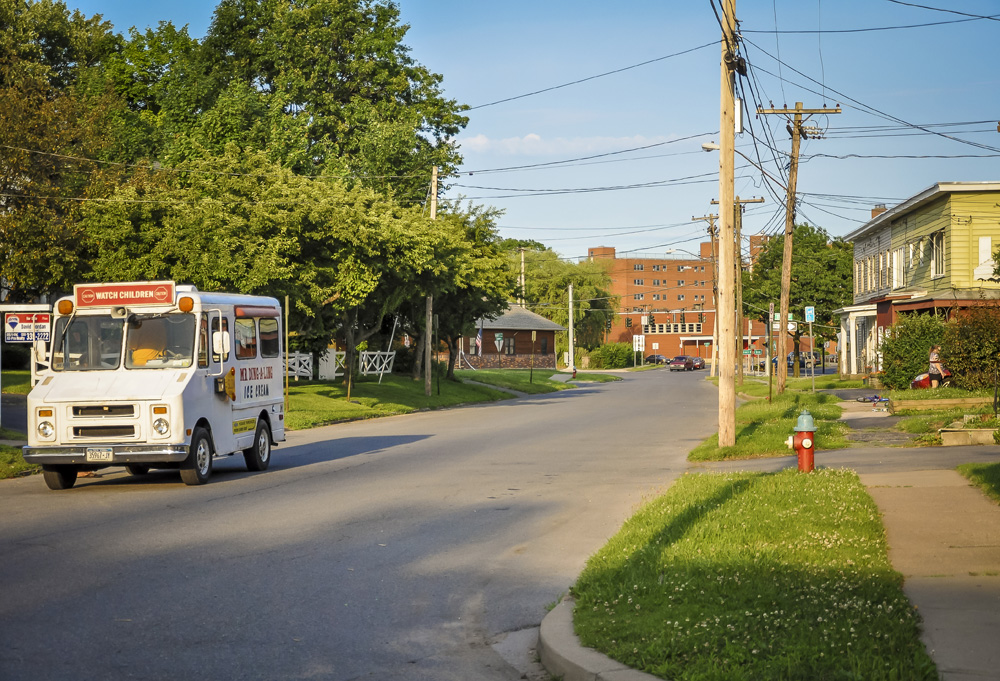
As I scanned the block, I realized not much had changed in the neighborhood. It still looked ragged. Some of the small front lawns needed mowing, a tan cat was crossing the street and a kid’s bike was lying on its side in a driveway. And if you can believe this, a white Mr. Ding-A-Ling truck was parked at the curb and the man inside was selling ice cream treats to customers.
Stanwix Street, Rome, N.Y. Photo by Francis DiClemente.

I thought about Linda and Robbie; I wondered where they were and what they had done with their lives. Were they still in Rome? Were they both married? Did they have kids of their own? Was their mother still around? And what happened with their father?

Of course I had no way of finding out the answers to the questions that came flooding to me as I stood on Stanwix Street.

I wished Linda and Robbie would have appeared on the block at that moment, walking westbound on Stanwix Street toward James Street. I wanted to see them again and offer to buy them both ice cream cones to make up for what I had done and what was lost as a result.


Standard

Black Box on Reelhouse

My experimental short film Black Box can now be viewed on the online distribution platform Reelhouse.org. I have submitted the piece to a number of film festivals, but I also wanted to have an online video presence so I could share the work. In addition to the film, the Reelhouse page offers background information about the project, production credits and still photos from the shoot. And so, here is Black Box.

And here are some of the still photos of dancer and choreographer Brandon Ellis.

Dancer Brandon Ellis. Photo by Michael Barletta/Courtney Rile.

Dancer Brandon Ellis. Photo by Michael Barletta/Courtney Rile.

Dancer Brandon Ellis. Photo by Michael Barletta/Courtney Rile.

Dancer Brandon Ellis. Photo by Michael Barletta/Courtney Rile.

Dancer Brandon Ellis. Photo by Michael Barletta/Courtney Rile

Dancer Brandon Ellis. Photo by Michael Barletta/Courtney Rile.

Dancer Brandon Ellis. Photo By Michael Barletta/Courtney Rile.

Dancer Brandon Ellis. Photo By Michael Barletta/Courtney Rile.

Standard

Message in the Snow

I found this note on the snow-covered ground while walking to a Rite Aid store today. I saw the scrap of faded blue paper and the heart icon caught my attention. I almost kept going, but the romantic amateur detective in me felt compelled to bend down, pick up the note and examine it.

photo by Francis DiClemente

The brevity and directness of the message made me smile.

“Dwight, I [heart] you. I don’t wanna fight.”

I assumed by the handwriting that the author was a young female. It could have been a note from a sister to a brother or a girlfriend to her boyfriend.

In just seven words, plus one icon, the girl had poured out her feelings to Dwight. She exposed her heart; she made the effort to reconcile.

I wondered if Dwight accepted her apology. But since I found the paper on the sidewalk, tossed aside in the snow, I suspected he did not. If that’s the case, I thought, maybe she’s better off without him.

Standard