Just a quick post to share some information about my latest poetry book, Sidewalk Stories, published by Kelsay Books. I have set up two giveaways: one on Amazon and one on Goodreads. No purchase is necessary. Best of luck if you decide to enter!
Monthly Archives: May 2017
Poetry Book Sidewalk Stories Published
I am busy at work on the revisions to my stage play Beyond the Glass (see previous post), but I wanted to share some good news.
I’m excited to announce that my full-length poetry book Sidewalk Stories, a collection of free-verse narrative and philosophical poems, has been published by Kelsay Books, an indie publisher based in California.

Cover art by Donatas1205 (via Shutterstock)
Some of the story poems are autobiographical; other works are fictional, including some that imagine the inner life of animals. The reflective poems explore the universal themes of gratitude, romance, self-esteem, family, illness, advancing age and death.
Here are the blurbs from the back of the book:
What poet and songwriter Rob McKuen created during the turbulent late ’60s and ’70s in San Francisco with his book Stanyan Street and Other Sorrows, Francis DiClemente has accomplished in Sidewalk Stories. With the backdrop of the gritty streets of Syracuse, New York, DiClemente manages to create a poetic canvas and find beauty in the midst of the harsh realities of life in upstate New York.
—Joanne Storkan, screenwriter and film producer (Honest Engine Films)
Sidewalk Stories is an inspired collection of meditations and personal vignettes, vividly capturing the range of human experience. Francis DiClemente channels his inner Charles Bukowski to present an unflinching look at youth and encroaching middle age. Amidst unprepossessing urban decay, we meet a cast of characters whose stories of regret and missed opportunity are probably as much DiClemente’s as they are their own. That some of them manage to remain sanguine about the future—and their mortality—is part of DiClemente’s charm as a storyteller. These poems leap off the page and onto the sidewalks of our imagination.
—Rob Enslin, author/journalist
In Sidewalk Stories, poet Francis DiClemente invites us to be his companion on an intimate journey. We walk with him on gritty sidewalks, observe through his eyes the plight and the beauty of the beings with whom we share the world. An old woman, a blind man, a little girl twirling, even a rabbit and an overturned turtle are viewed with deep compassion. Here is a poet who doesn’t just look; he sees. And his vision is no less unflinching when he brings us with him into his own life.
But don’t worry. Though many of DiClemente’s poems are infused with a sense of loneliness, they also convey a stronger sense of courage and endurance. And watch for the irrepressible whimsy and humor as, for example, a cowboy lassos a star, and when the poet rants about the tyranny of poetry. With each poem in this collection, DiClemente will take you deep inside a thoughtful man, and then, deeper inside yourself.
—Kathleen Kramer, playwright and poet; author of the poetry collections Boiled Potato Blues and Planting Wild Grapes
And here are a few excerpts from the collection:
Stooped
An old woman hunched over,
looking down at the sidewalk,
adjusting her knit hat.
She limps forward,
shuffling along,
riddled with pain.
Her face reveals
the hurt she endures.
She receives no aid,
no intercession
from human or heaven.
I pass her on the sidewalk,
and I say a quick prayer
that her suffering wanes.
It may not do any good,
but I send the thought aloft
and hope someone is listening.
The woman crosses the street
and fades out of sight.
I then hear an inner voice say,
“You were there,
you could have helped her.”
Hard Shell
What goes through the mind of a turtle
When it’s sprawled on its back and can’t roll over?
Does it panic as its legs squirm in the air?
Does it stick out its tongue and try to scream for help?
Does it curse its maker as it writhes on the asphalt,
With the sun scorching its belly?
How long does it wait before giving up and accepting fate?
No. This turtle does not think.
It lacks the capacity to reason.
Instincts fire as it battles to survive:
“Get off your shell. Roll over. On your feet.”
It rocks from side to side as it labors to turn over.
It strains, twists, and kicks … but fails.
And no one will intervene—
There’s no Tom Sawyer kid with a hickory stick,
Skipping along and flipping the turtle over.
No semi truck rumbles down the road,
Stirring up a blast of air and setting the turtle upright.
It struggles alone, refusing to quit
As it attempts to conquer physics.
The turtle keeps working
Until the sun desiccates its flesh,
And it releases a final breath—
A low croak that goes unheard along the deserted road.
The turtle is gone and no one witnessed the fight.
Ode to Thomas Wolfe
A pebble, a brook, a passageway
to time flowing in reverse,
a mirrored labyrinth reflecting
memories of adolescence.
A path leading back
to the days of my youth,
from whence I came,
to where I am,
brimming with a hunger—
a gnawing restlessness
that never wanes.
Landscape
Beauty abounds.
Just look around
and you will see—
a quivering leaf,
a patch of grass,
billowing clouds,
and a slash of light
beneath the bridge.
It’s not a bad world, really—
we just need
to train our eyes
to gaze with wonder,
and marvel at the
transcendental pageantry.
It’s there before you.
But you must zoom out,
zoom out
and refocus the image.
There. Hold it.
Do you see it now?
Rise
To find peace
One must
Unravel the self,
Let it fall away,
Drop to the floor.
Unencumbered by
This anchor weight,
The man or woman
Who pursues
Spiritual freedom
Discovers the
Ability to soar.
The book is available in print only and sold on Amazon.
Beyond the Glass Premieres in Las Vegas
My full-length stage play Beyond the Glass, inspired by the Edward Hopper painting Nighthawks, premiered last weekend at the Las Vegas Little Theatre. As the winner of its ninth annual New Works Competition, the LVLT has produced the play in the theater’s black box space.
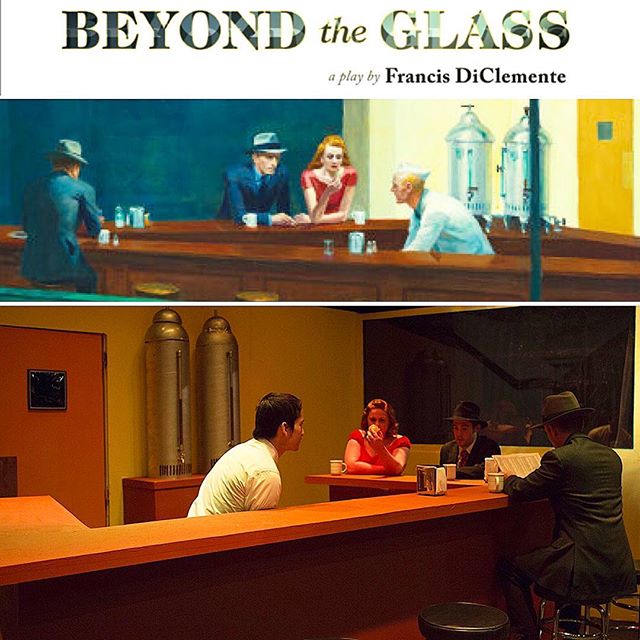
Images by Courtney Sheets and the Las Vegas Little Theatre.
The show closes on May 14, and I am going out to Las Vegas this weekend to see it. Prior to the production, the play had staged readings in Toronto and Chicago. Here is the synopsis for the work:
In Beyond the Glass, one of the diner’s customers, Ray, wrestles with an existence he abhors but cannot alter. Ray feels trapped inside the urban coffee shop, but he cannot leave, since there is no door. The character Ed then reveals that he once lived on the outside as the artist Edward Hopper and had painted the diner scene. Ray plots to escape, but his plans are thwarted by the restrictions of the space and the realization that he is a figure locked in a painting.

Images by Courtney Sheets and the Las Vegas Little Theatre.
As excited as I am about having my first play produced—with real sets, real costumes, and real actors speaking the words I wrote on the page—my greatest joy is that I finished the piece. The project proved to me the importance of persistence when it comes to the creative process.

Images by Courtney Sheets and the Las Vegas Little Theatre.
I started writing the play in the mid-1990s, but I struggled with the plot. None of the versions I wrote worked because I tried to make it so Ray could leave the diner. I thought about what would happen to him in the outside world, where he would go, how he would survive, etc. He ended up coming out of the painting and “falling” onto the floor in one of the gallery spaces at the Art Institute of Chicago. Security guards chased him and then he roamed the streets of the city, hiding out while the investigation into his disappearance from the painting continued. I even questioned whether his painted surface would wash away if it became exposed to rain. The whole idea seemed artificial and forced to me; I became blocked, and then I gave up and decided to shelve the script around 2006.

Images by Courtney Sheets and the Las Vegas Little Theatre.
But a couple of years ago, a question tickled my brain: What would happen if Ray could never leave the diner, if he found out he would remain stuck inside for all of eternity? How would he react? What would he do? That was my breakthrough, and the drama of the play laid itself out for me in a simple and direct fashion. I’m not sure if the story works in its current form, but I’ll be observing the play with the intention of revising the script after I return from Las Vegas.
 Francis DiClemente