WSB Documentary Teaser

The 48th annual World Series of Bocce kicks off today at the Toccolana Club in my hometown of Rome, New York. In celebration of the opening of the tournament, I want to share a teaser for our indie, work-in-progress documentary that hopefully captures the history, spirit, intense competition, and community impact of the WSB.

My lifelong friend and co-producer Bill Vinci and I had talked for many years about doing a documentary on the WSB. And I’m excited because I can see the light at the end of the tunnel as I work with award-winning editor Mary Kasprzyk (my colleague at SU) to complete a project fraught with problems.

A little backstory. As producer/director, I received a Russo Brothers Italian American Film Forum production grant in April of 2020. A special “thank you” to the National Italian American Foundation (NIAF), the Italian Sons and Daughters of America (ISDA), the Russo Brothers, and AGBO.

However, COVID intervened, and the cancellation of the WSB in 2020 and 2021 prohibited us from capturing on-scene interviews and tournament B-roll footage. Then, after filming was completed at last year’s event, a post-production quagmire threatened to terminate the project. Now the doc is back on track and in the trusted hands of Mary K. We’re hoping to complete a roughly 15 to 20-minute documentary short before the end of the year. The working title is The World Series of Bocce: A Celebration of Sport, Family and Community.

Here are a few “producing” lessons I learned along the way. One: I know cloud storage is more reliable, but I still believe media should be backed up on multiple external hard drives stored in different locations. Transferring all the raw footage shot last summer to a $150 hard drive literally saved this project. Two: In working within tight budget constraints, you must accept your limitations—reconciling the disparity between the film you envision and the film you can actually produce. Three: the most valuable currency in indie film production is the relationships you make with your collaborators. There’s no substitute for working with people you know and trust and who are committed to their craft and the successful outcome of a project.
Standard

George Saunders Video

I want to present this faculty/alumni profile video of George Saunders. Our Syracuse University marketing team produced the piece, and I was honored to interview George, who is a master of the short story form. He’s also kind, witty and genuine. Kudos to my colleagues who worked on the project with me—Joshua Waldby, Shane Johnson, Mary Kasprzyk, Bob Gerbin and Alex DeRosa.

Standard

Glimpses of Existence Now Streaming

I am excited and honored to announce that my experimental documentary short Glimpses of Existence has found a distribution home at OTV – Open Television. You can find it here.

“OTV is an Emmy-nominated nonprofit platform for intersectional television, with artists and their creative visions at the center.”

Glimpses of Existence premiered in 2021 in an online screening presented by NewFilmmakers NY.

It’s a zero-budget film in the form of video collage. I took inspiration from the experimental films of Jonas Mekas, in particular Walden. Using poetry and scenes captured with my iPhone—primarily during the pandemic—the film attempts to find meaning in the ephemeral moments of our lives, seeking the extraordinary amid the ordinary.

The central focus of the film is my son, Colin, who has been diagnosed with autism spectrum disorder. Despite his condition, Colin finds joy in everyday activities, and through his eyes we recognize the importance of treasuring the tiny segments of life we are granted—minutes, seconds, hours—while being reminded about the transitory nature of existence.

Glimpses is a companion piece to a previous experimental documentary—Fragments of the Living. You can download the @weareotv app Free on Apple, Android, Roku, and FireTV, or stream at watch.weareo.tv.

Standard

Real Bedford Falls Doc Airs on WXXI

For friends in the Rochester, New York, area, our Emmy-winning documentary, The Real Bedford Falls: It’s a Wonderful Life, airs Thursday, Oct. 20 at 9:30 p.m. on WXXI.

Photo by Stu Lisson.

The film was produced by Honest Engine Films and distributed by American Public Television and Virgil Films. It’s also available on Amazon Prime and Apple TV. Tis the season for George Bailey and Mary Hatch!

Standard

Morning Commute: Shadow Play

I captured this iPhone video while walking to work this morning. The bright sunlight produced a long shadow that preceded my footsteps.

Standard

Back to the Blog

It’s been too long since my last entry. I’ve been busy with work, family, creative side projects and a recent bout with a stomach flu (now resolved).

Winter has given way to spring-like weather in Central New York, although I’m not hauling my winter coat to the dry cleaner just yet.

And I wanted to return to the blog because today I made some interesting visual discoveries that I wanted to share. I left my cubicle at the office this afternoon to join one of my colleagues on a B-roll video shoot at Shaffer Art Building on the campus of Syracuse University. Some College of Visual and Performing Arts’ students were working on a professional film shoot for a project written and directed by a VPA professor.

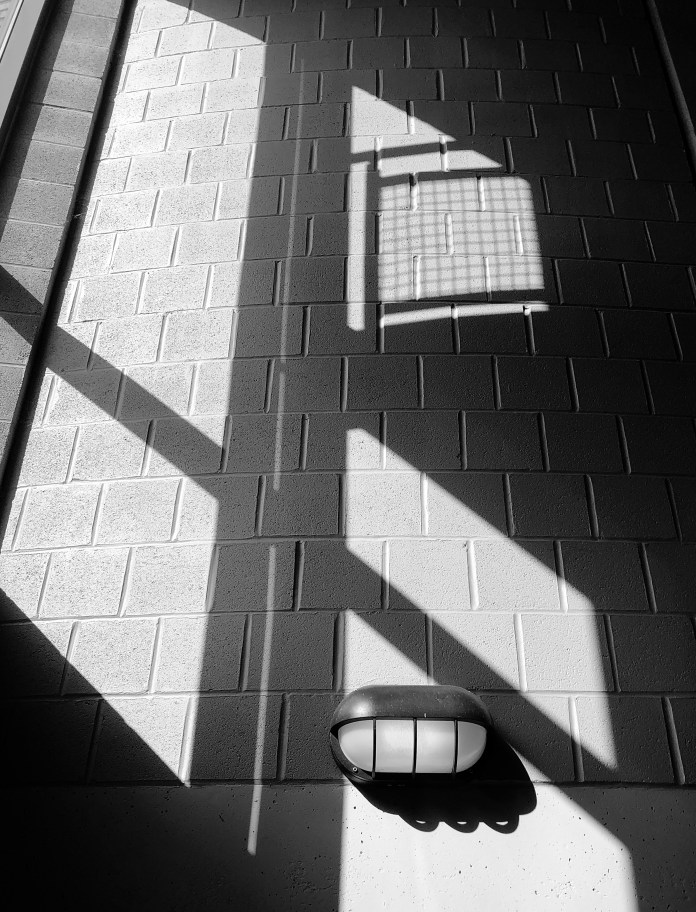
While I stood in the hallway, I took notice of my surroundings and captured these images.

Light hitting wall. Photo by Francis DiClemente.

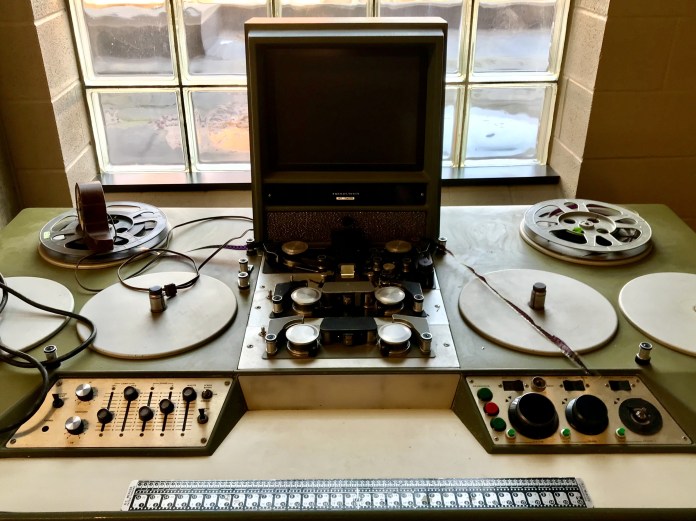
Steenbeck. Photo by Francis DiClemente.

I was so excited to see this Steenbeck editing machine. It made me think of Martin Scorsese’s longtime editor, Thelma Schoonmaker. I’m sure she edited some projects on a Steenbeck. I actually used one when I was a graduate film student at American University in the early 1990s. The machinery is now a dinosaur in a non-linear, Adobe Premiere/Avid/Final Cut world.

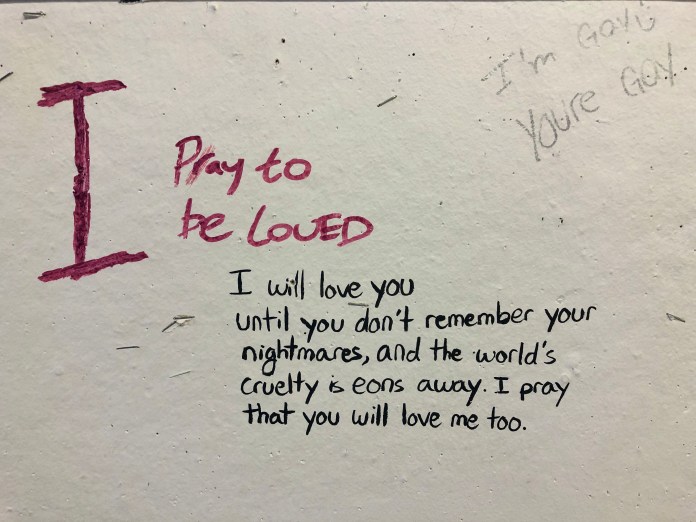
The next two images were terse, profound statements that I consider poetry. The words made me stop, pay attention and ponder their meaning. I wish I had the author’s name to give proper credit and supreme praise.

Selfishness and Loneliness. Photo by Francis DiClemente.

Pray to be Loved. Photo by Francis DiClemente.


Standard

Emmy Arrives

So my Emmy statuette arrived yesterday. My Real Bedford Falls documentary co-producer/director Stu Lisson was kind enough to drop it off at my apartment. He wanted to take a picture of me unboxing it, but I refused to give in to his request. I was masked and stayed on the other side of the glass in the lobby, as my son Colin is currently in isolation after testing positive for COVID for the second time in three months. (Fortunately, his symptoms are mild—knocking on the wood of my forehead.)

While walking in the hallway, carrying the rectangular box, hugging it close to my torso, I had a flash; the package reminded me of a cremation urn, similar in size and shape. It gave me pause. The object marks one of the best moments in my career, but it also foreshadows a fate I can’t escape. Dark thought, I know.

Once inside my apartment, I opened the box and took a quick glance, making sure the text at the base was correct and my name wasn’t misspelled. I then tucked it in the back of my bedroom closet, behind extra belts, pairs of long underwear, summer shirts, and miscellaneous computer cables.

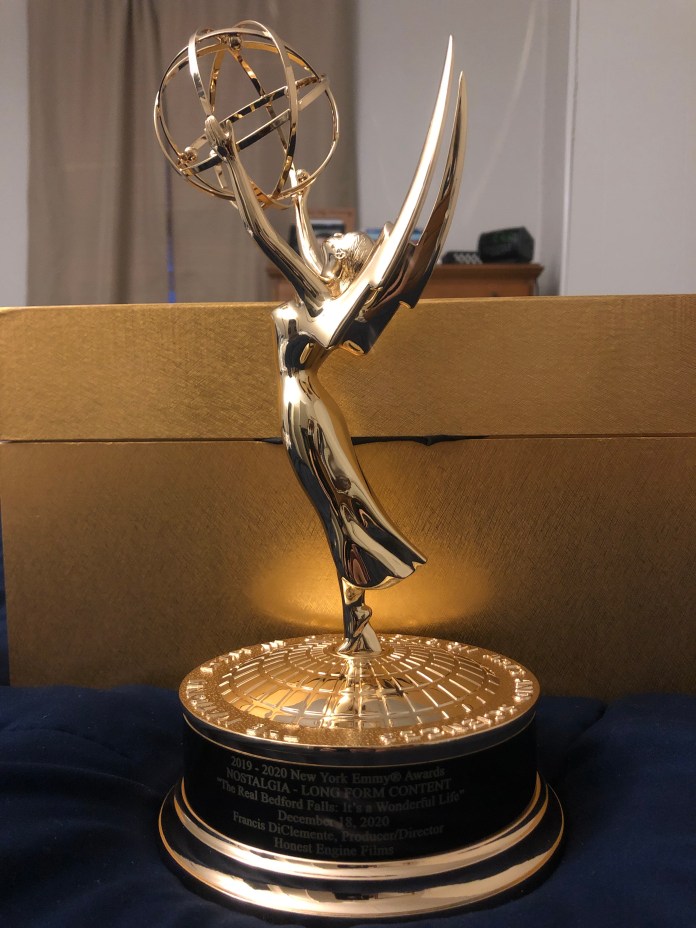
Emmy statuette. Photo by Pamela DiClemente.

I didn’t even take a picture of it. And I usually do not post accolades like this on social media. The images you see here were taken by my wife Pamela, who said something like, “It’s worth celebrating. It’s a beautiful memento and you might not win another one in the future.”

I thought the same thing. I don’t want to be covetous, but the goal is to collect a couple more Emmy awards during the remainder of my career. However, I also know one regional Emmy for an indie documentary short could be it for me—marking the highest honor I will ever achieve.

Emmy statuette base. Photo by Pamela DiClemente.

And if that’s the case, I want to acknowledge the moment, let it seep in, and be grateful for it. And then get busy working on the next thing.

I’m also storing the Emmy in the closet to keep it away from Colin. If know if the hardware was left out in the open, he would grab it and line it up next to his other figures. And in a matter of time, the poor gilded woman would be wingless.

Colin’s play area. Photo by Francis DiClemente.


Standard

Documentary Screening

Our independent documentary, The Real Bedford Falls: It’s a Wonderful Life, will be screened tomorrow, Dec. 11, in Seneca Falls, New York, as part of the It’s a Wonderful Life Festival. It will be shown at 1:30 p.m. at Trinity Church.

Drone photo by Chase Guttman.

Our film asks the question: Was one of the world’s most beloved motion pictures influenced by a small upstate New York town? The Real Bedford Falls: It’s a Wonderful Life is an Emmy Award-winning, half-hour documentary that explores the connections between Seneca Falls and Bedford Falls, the setting of the movie It’s a Wonderful Life.

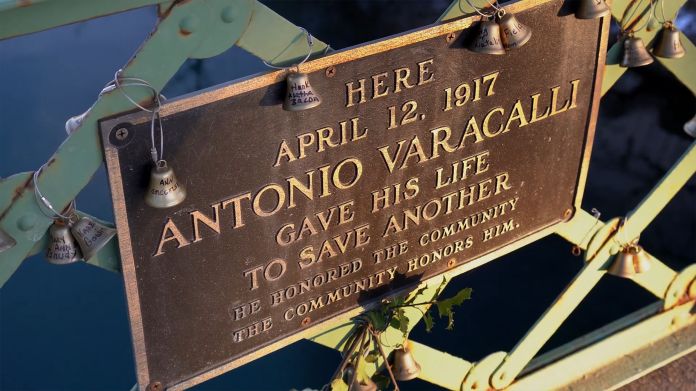
Frank Capra, the movie’s Academy Award-winning director, was reportedly visiting relatives in Auburn, New York, when he stopped in nearby Seneca Falls to get a haircut. The barber who styled his hair recalled Capra asking many questions about the town, including, “What’s the story with that bridge?”

Fast forward to when actress Karolyn Grimes, who played Zuzu Bailey in It’s a Wonderful Life, saw Seneca Falls for the first time. With snow falling and holiday lights glittering, she exclaimed, “I’m in Bedford Falls!”

Photo by Stu Lisson.

These and many other striking relates are touched upon in The Real Bedford Falls: It’s a Wonderful Life. The documentary also examines small-town life in Seneca Falls, captures the excitement of the annual It’s a Wonderful Life Festival, and celebrates the enduring themes of the Frank Capra classic.

The Real Bedford Falls: It’s a Wonderful Life features interviews with Karolyn Grimes, Jimmy Hawkins (who played Tommy Bailey), Monica Capra Hodges, granddaughter of Frank Capra, film critic Leonard Maltin and Syracuse University professor of pop culture Robert Thompson. Former NBC Today show correspondent Bob Dotson provides the narration.

The film was produced by Honest Engine Films and distributed by Virgil Films & Entertainment. It’s available here. The cost is $2.99 on both Amazon Prime and Apple TV.

Standard

The Real Bedford Falls Documentary Released

I just want to share the news that our independent documentary The Real Bedford Falls: It’s a Wonderful Life is now available on DVD and digital HD. The film was produced by Honest Engine Films and distributed by Virgil Films and Entertainment. It recently won a New York Emmy Award in the category of Nostalgia-Long Form Content. 

Here is the synopsis:

Was one of the world’s most beloved motion pictures influenced by a small upstate New York town? The Real Bedford Falls: It’s a Wonderful Life is an Emmy Award-winning, half-hour documentary that explores the connections between Seneca Falls, New York, and Bedford Falls, the setting of the movie It’s a Wonderful Life.

Aerial image by Chase Guttman.

The documentary examines small-town life in Seneca Falls, captures the excitement of the annual It’s a Wonderful Life Festival, and celebrates the enduring themes of the Frank Capra classic. The film features interviews with Karolyn Grimes (who played Zuzu Bailey in It’s a Wonderful Life), Jimmy Hawkins (who played Tommy Bailey), Monica Capra Hodges, granddaughter of Frank Capra, and film critic Leonard Maltin. Former NBC Today show correspondent Bob Dotson provides the narration.

The release of the documentary comes at the right time, as this year marks the 75th anniversary of the release of It’s a Wonderful Life.

Standard

Frankenstein, 1931

On Friday night, I watched the 1931 film Frankenstein, starring Colin Clive and Boris Karloff. And Henry Frankenstein’s creature, called The Monster, played by Karloff, elicited my empathy as he jolted to life in a lightning storm with an abnormal brain incapable of functioning in society. I won’t relay the plot summary since the story is very familiar. And the movie version is much different from the novel it was based upon, Mary Shelley’s Frankenstein; or, the Modern Prometheus.

Frankenstein poster

But one scene stood out. In it, Karloff plays a game with a little girl, both of them tossing flowers into a lake. He then picks up the girl and throws her in, and she disappears below the surface of the water. Why? He doesn’t know any better.

Frankenstein movie still.

And the film made me think of my autistic son and about all disabled people. What do we do with humans who don’t live up to perceived standards of normalcy? Where do they go? Are they given a chance to function, to thrive, to pursue happiness, and to find a place in this world? I have no answers—just a desire to express kindness toward every person.

And the movie inspired a short poem.

Halloween Screening:
Frankenstein, 1931

You can’t fault
Frankenstein’s creature
For what he became.

He never had a choice.
He didn’t ask to be born.
He didn’t seek existence.

With an abnormal brain
And cobbled parts,
He can’t be blamed for
The terror he wrought.

He was only acting
According to his nature.
The real monster here
Is the man who
Created the creature.

Standard