Mark Strand: The Negative of Night

Over the weekend I finished reading Mark Strand’s poetry collection The Late Hour. I was introduced to the poet only after reading about his recent passing at the age of 80. Here’s the story from NPR.

The Canadian-born Strand, who was also an artist and wrote prose, was named the U.S. Poet Laureate in 1990 and won the Pulitzer Prize for poetry in 1999 for his collection Blizzard of One.

Mark Strand, 1934-2014

Mark Strand, 1934-2014

In The Late Hour, Strand writes in a spare, clear style that reaches readers on an emotional level. There’s no verbal clutter to get in the way of what Strand is trying to express; these are poems worth revisiting to ponder their meaning.

I particularly liked Snowfall. And it seems fitting to mention it as we head into the slumber of another long winter in the Syracuse area. In fact, a Winter Storm Warning remains in effect for central New York until Thursday morning, with the National Weather Service calling for eight to 12 inches of snow.

So I’ll probably think about Strand’s words as the snowfall accumulates over the next couple of days.

Snowfall

Watching the snow cover the ground, cover itself,
cover everything that is not you, you see
it is the downward drift of light
upon the sound of air sweeping away the air,
it is the fall of moments into moments, the burial
of sleep, the down of winter, the negative of night.

Another poem that caught my attention was Night Pieces, and I loved the imagery of the line, “where the dim quilted countryside seems to doze.” Here’s the full stanza.

Not only is it still a night
on deserted roads and hilltops
where the dim, quilted countryside seems to doze
as it fans out into clumps of trees dark and unbending
against the sky, with the gray dust of moonlight upon them,

Strand, Mark. The Late Hour. New York: Atheneum, 1979.

To read more about Mark Strand, visit his page at the Poetry Foundation’s website.

Standard

MRI Music

I recently had an MRI done at 550 Harrison Center in Syracuse.

550 Harrison Center. Photo by Sutton Real Estate Company.

550 Harrison Center. Photo by Sutton Real Estate Company.

I’ve had several over the years as part of multiple follow-ups for a craniopharyngioma diagnosed in 1984.

Craniopharyngioma

This latest one was for undiagnosed pain in the lower back/sacroiliac joint region. Fortunately, the MRI revealed no abnormalities, although the pain has not diminished.

MRIs never bother me because I have grown so accustomed to receiving them.

I try to get the earliest appointment possible, around 7 a.m., so that way I am half asleep when the X-ray technician straps me in, covers me with a white cotton blanket and leaves the room to take the pictures. Soon the machine begins moving and the noise starts. And I close my eyes, shutting out the fluorescent light and drifting off to sleep inside the white tube. I also like to imagine I am a NASA astronaut blasting off in a shuttle, heading to the International Space Station to deliver much-needed supplies.

Before the MRI begins at 550 Harrison, you are handed a set of Upstate University Hospital scrubs, led to a small locker area and instructed to change into the medical attire. So before I come out of the changing room, I look at myself in the mirror and pretend I am Dr. Mark Greene (Anthony Edwards) from ER getting ready to start an overnight shift.

Anthony Edwards. Photo by Paul Drinkwater/NBC.

Yes, I suffer from an advanced case of Walter Mitty complex.

The techs at the Harrison Center allow patients to pick music to listen to during the MRI. Before you step into the exam room, you are handed a laminated list of artists and you can choose who you want to listen to.

The genres on the list include country, children’s music, world music, male artists, female artists, easy listening, classical, etc.

I always select U2 because you can never go wrong with the Dublin quartet.

My latest MRI playlist consisted of the following songs: Angel of Harlem, Still Haven’t Found What I’m Looking For, Walk On (Live), The Unforgettable Fire, With or Without You and Peace on Earth.

Here are some other choices on the list that caught my eye:

Male Vocalists: Andrea Bocelli and Luciano Pavarotti

Classical: Bach and Beethoven

Female Artists: Pink and Alicia Keys

Male Artists: Rod Stewart and Elton John

Rock: Boston and Aerosmith (the heavy guitar sound could partially compete with the noise of the MRI machine)

Country: Johnny Cash and Patsy Cline


During my recent MRI I was instructed to lie down on the flatbed of the Hitachi open MRI unit.

Open MRI Unit

It was the first time I had experienced the open MRI version and I must confess I missed the narrow tube. I like the snug feeling of the space-shuttle-like machine.

The tech, a thin middle-aged woman with dark brown hair and black-rimmed glasses, covered me with a blanket, tucking my arms in, and then left the room. A short time later the familiar wup-wup-wup sound started up, as did the music by U2; Bono and the boys did their best to compete with the grating sound of the machine, but they could not drown out the loud mechanical sound.

The woman’s voice came over the intercom and she said, “OK, this round will be six minutes long. Just lie still.” I closed my eyes and tried to sleep.

I was tired and would have preferred to remain locked in the MRI position for the rest of the day, listening to music and catching some ZZZs while the world carried on without me.

And I realize the time spent confined in the MRI tube (or on the table for the open MRI) leads to serious reflection. You start thinking about your life and you pinpoint what is truly important. No matter what body part you have scanned, you are always afraid of the outcome, and you become weighted down with a foreboding sense. You anticipate the worst-case scenario, the discovery of a flaw in your body that will prove fatal.

You think about how you will handle the news if the MRI shows a tumor or cancer. The “what ifs” penetrate your mind. What if it’s an inoperable brain tumor? What if it’s cancer and it has already spread from the lung to the liver? What if I only have six months to live? Of course these are morbid thoughts, but when you’re confined to the machine with your eyes closed and the wup-wup-wup is roaring in your head, you drift into a higher level of thought, one that reaches a profound plane, separated from the trivial concerns of everyday life. And your thoughts become tilted toward your health, your family and your faith.

And in the peaceful white room you realize most of what you worry about in life is insignificant. Your thinking crystalizes. And you tell yourself what matters most is being healthy, living a decent, productive life and loving your family and friends. You tell yourself you will stop worrying about the small stuff. But after a few days, the old inconsequential concerns bubble to the surface. It can’t be helped. It’s human nature.

But I know in my case, the next MRI appointment will give me time for meditation and offer another opportunity to reset my thinking.

The next time, though, I will take a risk and listen to something other than U2. Wup-wup-wup.

Standard

Come On In! by Charles Bukowski

Over the weekend I finished reading Come On In!: New Poems by Charles Bukowski, and I felt a twinge of sadness when I returned the book to the library. I had enjoyed spending some evenings at home with old Buk.

Come On In by Charles Bukowski

Come On In by Charles Bukowski

Bukowski died in 1994 and the collection was published posthumously in 2006. Here we find the author facing old age, illness and death and never flinching. He presents several gems in the book—accessible poems packed with emotion. The tender, humane side of Bukowski is exposed, as if the onion skin had been peeled.

Charles Bukowski (Richard Robinson/Black Sparrow Press)

Here are four of my favorite works from the volume. I think they contain lessons for the living, as Bukowski seems to offer instructions as we face our own demise.

moving toward the dark

if we can’t find the courage to go on,
what will we do?
what should we do?
what would you do?
if we can’t find the courage to go on,
then
what day
what minute
in what year
did we go
wrong?
or was it an accumulation of all the years?

I have some answers.
to die, yes.
to go mad, maybe.

or perhaps to
gamble everything away?

if we can’t find the courage to go on,
what should we do?
what did all the others
do?

they went on
living their lives,
badly.
we’ll do the same,
probably.

living too long
takes more than
time.

###

no leaders please

invent yourself and then reinvent yourself,
don’t swim in the same slough.
invent yourself and then reinvent yourself
and
stay out of the clutches of mediocrity.

invent yourself and then reinvent yourself,
change your tone and shape so often that they can
never
categorize you.

reinvigorate yourself and
accept what is
but only on the terms that you have invented
and reinvented.

be self-taught.

and reinvent your life because you must;
it is your life and
its history
and the present
belong only to
you.

###

Charles Bukowski

Charles Bukowski

my song

ample
consternation,
plentiful
pain.

restless days
and
sleepless nights

always fighting
with all your
heart and soul
so as not
to fail at living

who could ask
for anything
more?

###

mind and heart

unaccountably we are alone
forever alone
and it was meant to be
that way,
it was never meant
to be any other way–
and when the death struggle
begins
the last thing I wish to see
is
a ring of human faces
hovering over me–
better just my old friends,
the walls of my self,
let only them be there.

I have been alone but seldom
lonely.
I have satisfied my thirst
at the well
of my self
and that wine was good,
the best I ever had,
and tonight
sitting
staring into the dark
I now finally understand
the dark and the
light and everything
in between.

peace of mind and heart
arrives
when we accept what
is:
having been
born into this
strange life
we must accept
the wasted gamble of our
days
and take some satisfaction in
the pleasure of
leaving it all
behind.

cry not for me.

grieve not for me.

read
what I’ve written
then
forget it
all.

drink from the well
of your self
and begin
again.

Bukowski, Charles. Come On In!: New Poems. New York: Ecco (An imprint of HarperCollins Publishers), 2006.

Standard

The Coin Collector

A woman approached me recently while I walked home on Genesee Street between South Crouse and University avenues. She was a tall, thin African-American woman, and she wore a puffy black winter coat, blue-gray sweatpants and brown-rimmed glasses. She also carried a brown leather purse in the crook of her right arm.

I saw her asking people for money and she had asked me for change on at least one other occasion.

As I came to the intersection at Genesee and University, the woman lost a coin and it fell in the street near the curb. She bent down to pick it up and then she turned to me and waved.

Photo by Francis DiClemente

Photo by Francis DiClemente

I was listening to music on my iPod and I took off my headphones. “Excuse me,” she said. “Do you have 95 cents for the bus?”

I said, “no,” but I pulled out a dollar bill from my wallet and handed it to her; I remember being aggravated because it was cold and I had to remove my gloves. “Thanks honey,” she said as she accepted the money. And then she took off, walking along Genesee Street.

She approached a small group of people gathered on the sidewalk and praying outside Planned Parenthood. I admired her persistence and the swiftness of her routine.

She would either receive some change or get brushed off. Either way, she didn’t waste any time. It was a quick exchange and then she marched away, heading for the next person.

Photo by Francis DiClemente

Photo by Francis DiClemente

After I went inside my apartment building, I reflected on the incident and took into consideration the following information. You can decide for yourself what parts may be true.

A. The woman scammed me and everyone else and had no intention of using the money she received for bus fare.

B. Her request for bus fare was legitimate and she just needed some help getting home.

C. I know nothing about her life, so who am I to judge?

D. If Christ had been there, what would he have done? That’s an easy answer. I thought about two Bible verses. “Give to everyone who asks you, and if anyone takes what belongs to you, do not demand it back.” (Luke 6:30; New International Version)

“The King will reply, ‘Truly I tell you, whatever you did for one of the least of these brothers and sisters of mine, you did for me.'” (Matthew 25:40; New International Version)

E. I accept the fact that the woman probably scammed me. But it was only a dollar and I considered it my gift to her; she could do whatever she wanted with the money.

F. I wonder how I will respond the next time she comes up to me asking for change. Will I reach into my pocket or keep on walking? I’ll let you know if I find out.

Have a wonderful and safe Thanksgiving everyone. I wish for you a day of relaxation and fun with your families.

Standard

A Reminder

I rarely write about my faith life. But I thought I would share this story because it seemed important to me.

 ##

I often forget about the Lord, and my Christian faith becomes an afterthought. I get preoccupied with work, with my side projects, with daily errands and to-do lists. The result—Christ gets shoved out, pushed to the side.

He never enters my mind during the course of my day.

And that’s when the Holy Spirit steps in and prods me. He never lashes me across the back or drops a tree branch on my head. But I receive a gentle nudging and a whisper: “Wake up Francis. I’m still here. Remember me?”

On a recent Saturday night, after I finished working out at the Marshall Square Mall Fitness Center, I walked down University Avenue toward my apartment on Genesee Street. The cold air felt good against my skin, and I was bundled up in my black pea coat, knit hat and winter gloves.

I was listening to “Mr. November” by The National on my iPod as I passed by Grace Episcopal Church at the corner of Madison Street and University Avenue.

Grace Episcopal Church. Photo by ZeWrestler.

Grace Episcopal Church. Photo by ZeWrestler.

I looked up and saw through the circular stained-glass window light coming from inside the church. It looked warm and inviting; I also stopped and peered at the stone cross perched on top of the pitched roof.

And that’s when it hit me. “Oh right. I am a Christian too.”

I realized I had not spoken to or acknowledged the Lord the entire day. I said no prayers and I failed to express gratitude for the gift of my life. I went about my day in pursuit of worldly ambitions; I served myself and Jesus did not fit into my plans.

And it seems I repeat this scenario often. There is little room for God in my world these days.

But on this Saturday night, while swinging my arms to keep warm, I said a quick prayer as I hurried toward my apartment building.

It went something like this:

“Dear Lord, break open my heart. Shatter it. Let it fall away. And then rebuild it according to your model. Let my heart be like your heart, full of love for others. Let me pour out this love and not save it all for myself.”

Heart Sunlight. Photo by Francis DiClemente.

Heart Sunlight. Photo by Francis DiClemente.

I felt better after I said the prayer. And I hope it will serve as a reminder to myself to reserve space in my day for what I need most.

Standard

Poetry Pals

I can’t seem to get enough of writer Charles Bukowski these days.

Charles Bukowski

Charles Bukowski

I recently finished reading his novel Hollywood, a fictionalized account about Bukowski’s experience writing the screenplay for the movie Barfly.

I then ran out to the library and checked out two poetry books by Bukowski—The Flash of Lightning Behind the Mountain: New Poems and Come On In!: New Poems.

I don’t even read much poetry but I felt I needed more Bukowski books in the house, like I wanted to keep my friend around for a while. Bukowski seems less like a deceased author and more like a buddy spending his vacation with me. When I’m engrossed in a Bukowski work, I often picture him sitting in my living room and reading aloud from his book while taking sips of beer from a can of Pabst Blue Ribbon or Miller High Life.

Anyway, that’s just a fleeting image. The writing speaks for itself. And I’ve only read up to page 57 in The Flash of Lightning, but here’s a poem I found worthy of sharing. I hope you enjoy it too.

Born Again

this special place of ourselves
sometimes explodes in our
faces.
I got a flat on the freeway yesterday,
changed the right rear wheel on the
shoulder,
the big rigs storming by,
slamming the sky
against my head and
body.
it felt like I was clinging to the
edge of the earth,
30 minutes late for the first
post.

but strangely, something
about the experience
was very much like emerging reluctantly
a second time
from my
mother’s womb.

Bukowski, Charles. The Flash of Lightning Behind the Mountain: New Poems. New York: Ecco (An imprint of HarperCollins Publishers), 2004.

I also ran across an old interview with Bukowski in the New York Times in which he discusses his style of writing and being a lucky late bloomer.

Standard

No More Cheap Umbrellas: Four Compact Models Worth Trying

The following is a consumer service article I wrote as part of an online course I took over the summer. The course, Boot Camp for Journalists, was  provided by Mediabistro.

##

I am done with flimsy umbrellas. No longer will I fall victim to the allure of cheap models found at grocery, discount or drug stores.

I’m on a quest to find an umbrella that can withstand wind pressure and provide superior protection from the rain. I am also willing to spend a little more money to buy one that will last.

GustBuster Metro. Photo Courtesy of Innoventions Enterprises, Ltd.

GustBuster Metro. Photo Courtesy of Innoventions Enterprises, Ltd.

I am sure you can you relate to this experience, and I have repeated this scenario multiple times over the last few years:

You are walking on the street in the rain and you retrieve your compact umbrella from the pocket of your coat or pull it out of your book bag (or purse for women). You open it up and within seconds a gust of wind catches your umbrella and turns it inside out. You try to fix it, but the flaps won’t snap back to their original shape. You may even scrape your knuckles in the struggle with the metal frame.

There’s nothing left to do but toss the umbrella in the next garbage can you pass. Your clothes are soaked and you pledge never to buy another cheap umbrella again.

So now I seek one compact umbrella that will not invert. One umbrella that can endure what Mother Nature unleashes.

Here are four suggested models from companies that offer limited warranties and claim their products can resist wind.

Samsonite Windguard Auto Open/Close Umbrella

Named the most durable model between $5 and $99 by the Good Housekeeping Research Institute (April 2013), the Samsonite Windguard Auto Open/Close Umbrella scored high marks for its broad canopy, water resistance, comfortable handle and an automatic open/close function. The GHRI also noted the fabric was attached securely to the spokes of the frame.

The Windguard Auto Open/Close is made with a Teflon-coated polyester canopy and is about 12 inches long when folded.

Cost: about $30

Colors: red or black

Warranty: 10-year limited (defects only)

Windjammer Vented Auto Open & Close Compact (#2282A) by ShedRain

The Windjammer has an ergonomic rubber handle and steel shaft and ribs, and ShedRain claims the vented, 43-inch arc canopy is engineered to resist wind.

It opens and closes automatically and folds down to 12-and-a-half inches long.

The Windjammer fared well in the GHRI’s inversion force tests and received praise for its water resistance and quick-drying fabric. Another benefit for users: the umbrella has a low number of “pinch points,” reducing the chances of fingers getting caught in the frame.

Cost: $34

Colors: black, black/white, charcoal, navy, navy/white, red, royal and royal/white

WindPro Vented Auto Open & Close Compact (#1760) by ShedRain

Another ShedRain model was rated highly by Good Housekeeping. ShedRain says its WindPro Vented Auto Open & Close Compact is aerodynamically engineered to allow the wind to flow through the canopy—thus reducing the chances of inversion (not to mention frustration).

The WindPro closes to less than a foot in size and comes with a fiberglass frame and ribs and a cushioned handle.

ShedRain is a third-generation, family-owned company based in Portland, Oregon. It began making umbrellas and raingear in 1947 and stands by its products with a full lifetime warranty. If an umbrella fails due to a defect, ShedRain will repair it or replace it with a similar model.

Cost: $41 (cheaper on Amazon)

Colors: navy or black

GustBuster Metro Umbrella

According to Farmingdale, New York, manufacturer Innoventions Enterprises, Ltd., the GustBuster’s patented wind-release vents and flow-through design can withstand winds of more than 55 miles per hour, as tested by Vaughn College of Aeronautics and Technology.

GustBuster Metro. Photo Courtesy of Innoventions Enterprises, Ltd.

GustBuster Metro. Photo Courtesy of Innoventions Enterprises, Ltd.

Steve Asman, president of Innoventions, says, “Our claim is simple. We make an un-flippable unflappable and un-leakable umbrella … and it comes with a limited lifetime warranty.”

Some of the features of the GustBuster Metro include a 43-inch, double-canopy design, a pinchless open and close release system, steel joint connectors and a reinforced shaft.

Consumer Reports put the model to the test by attaching an open GustBuster umbrella to a car and driving at high speeds. In its November 2013 issue, the magazine reported the GustBuster inverted at 30 miles per hour but did not break, even at speeds above 50 mph.

Asman says consumers have responded to the quality of GustBuster products. “We are selling out faster than we can make them right now.” He says Innoventions is preparing to open another factory, its fourth, to handle the demand.

Cost: About $40 on Amazon

Colors: multiple, including black, red, burgundy, hunter green and navy

Standard

A freelance travel story I wrote about the All Things Oz Museum in Chittenango, New York, birthplace of Wizard of Oz author L. Frank Baum, appears on the website Narratively. You can read the article here.

Photos by Pamela DiClemente

A Visit To Oz

Gallery

The Happy Couple Exhibit

This essay was published in the 2014 edition of Words & Images literary magazine, a student-run publication at the University of Southern Maine.

##

I heard the woman first before I saw her or her partner inside the museum of the Onondaga Historical Association in Syracuse. She said in loud voice, “Rick, where are you hon?” The OHA had a few exhibitions running simultaneously on this Saturday in early January 2013, and so it was possible to lose sight of your friend or partner as you made your way through the different gallery spaces and inspected the various works. “Hon, come here, look at this,” she added.

Onondaga Historical Association

Onondaga Historical Association

At the time I was examining the exhibit Manifest Destiny and The American West by Buffalo artist Robert Hirsch. Hirsch presented nearly one-thousand images in a three-dimensional display—with the pictures placed inside jars and serving as a commentary on how the geographic progression across North America shaped U.S. culture.

After I finished looking at the Manifest Destiny jars, I started walking toward where the couple was standing. They were planted in front of some panels of an exhibit highlighting historic stereoscopic photographs.

Rick was probably in his sixties. He was tall, broad-shouldered and bald except for a tuft of grayish-white hair at the back of his head. He had a bushy mustache that curled downward and matched his hair color and he was wearing a tan jacket. The woman, whom I will call Ruth, was small and also appeared to be in her sixties. She was wearing a black fur coat, tall black boots and bronze earrings that looked like costume jewelry. She had short black hair, a birthmark on the right side of her face and she had applied a little too much burgundy lipstick to her mouth.

But it was her dialogue that made her memorable. I am not a casting director, but I believe you could pick Ruth up and place her in a Woody Allen film and without even reviewing the script, she would fit in with no problem. In fact I bet she would steal scenes away from Scarlett Johansson or Penélope Cruz.

I heard her tell her husband, as I assumed they were married, “See, I should have lived in the 1920s. I’d be dead now, but look at all the stuff I would have remembered.”

Something else about Ruth struck me on a personal level; she reminded me a lot of my late mother. My mother had never attended an art exhibit in her life and was not loquacious like this museum visitor, but the two women shared some physical features. Both were short and had short black hair.

My mom: Carmella Ruane, 1945-2011

And just like Ruth, my mother would often smear too much of the same shade of burgundy lipstick on her mouth. My mom also had the habit of applying a little too much rouge to her cheeks. If she was getting ready to leave the house to attend the Saturday vigil mass at St. Peter’s Church in Rome, New York, where she lived, I would tell her, “Mom, you need to blot your cheeks. The rouge is caked on.” Her standard reply would be, “Oh shut up. Can’t you ever say anything nice?”

Ruth, Rick and I were gathered inside a small gallery space where Carl Lee’s multi-channel video Last Housewhich documents the destruction of a house in Buffalo, was being screened.

In the piece, on what looks like a bright spring or summer day, a backhoe starts demolishing the house and three separate camera angles capture the action simultaneously. Viewers watch as the scoop of the backhoe starts eating away the roof and walls of the structure, while a man stands near the rubble and uses a power hose to spray water on the scoop and house so no sparks jump to life.

As arresting as Lee’s video was, his exhibit became trumped by a living breathing work of art—the older couple that had seized my attention. And as I stood near the back wall of the room, my focus shifted from the images on the screen in front of me to Rick and Ruth seated on a black bench nearby.

“You see that, it’s three angles of the same thing,” Rick said.

“Yes, I know,” Ruth replied. She paused and then added, “You must think I’m a real idiot.”

I almost burst out laughing because her delivery was a spot-on impersonation of my mother, using the same words my mother had said to me on numerous occasions. But I managed to suppress the laughter swelling inside of me and kept it contained in my throat.

A short time later Rick said to Ruth, “Hon, are tired?” Ruth rubbed her thighs and said, “A little, but I’m OK.”

“Well it’s 2:30,” Rick said.

“No, it’s later.” She checked her watch and said, “It’s 2:40.”

“Your watch is fast,” he said.

“No it’s not. I set it by the stove, and it’s always slow.”

They stopped chatting and watched in silence as the house was being ripped apart in the video. Then, a little while later, amid the grating sounds of the backhoe and the walls tumbling down, Rick turned his head toward Ruth and said, “Are you sure you’re not too tired?”

“No, I’m fine,” she said.

And that’s how I left them. The couple was still sitting there, watching the video when I stepped out of the exhibition space and exited the OHA.

I think what intrigued me most about the couple was their ease of interaction and level of comfort with one another. And I was thankful for having witnessed this slice of life from their apparent happy marriage, a snapshot of two older people behaving in an unguarded fashion in a public museum on an ordinary Saturday afternoon.

I did not assume they lived a perfect life without worry or conflict. But it appeared Rick and Ruth understood and accepted one other unconditionally. In spending a few moments in their presence, it seemed like neither partner had any illusions about the other person, and there appeared to be no mysteries in their relationship still waiting to be uncovered. They had likely revealed all their flaws and weaknesses a long time ago, and yet, they still enjoyed spending time together and remained happily married and devoted to one another. Or at least that’s the impression they gave to outsiders.

I often get a rush of creative energy after visiting an art museum, attending a play or concert or seeing a great film. And while I was walking home my rumination about the couple sparked an idea. I decided they would make a compelling subject for a modern art exhibit.

So here’s my proposal:

A museum would build a large installation showcasing Rick and Ruth as one of the last surviving happy couples in America. It would be a spectacle like something 19th Century showman P.T. Barnum could have curated and promoted.

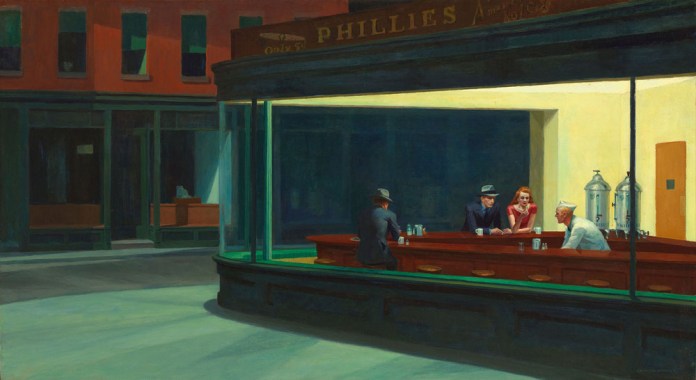
Rick and Ruth would be placed inside a large kitchen space encased in glass like the diner scene in Edward Hopper’s iconic painting Nighthawks.

Nighthawks by Edward Hopper, 1942

Nighthawks by Edward Hopper, 1942

We would observe them sitting in their kitchen—drinking coffee, talking, cooking and eating breakfast, lunch or dinner, reading the newspaper, playing Scrabble, baking cookies, celebrating their birthdays and washing and drying dishes.

The display would offer viewers an unfiltered window into the life of the couple, and the images, sounds and conversations would document Rick and Ruth’s ease of interaction. The goal would be to reveal the secrets of this happy marriage.

As a result, the exhibit would aim to answer these central questions: What makes this couple different from others? What is the key to their bliss? And what advice or insights do they have for other couples in terms of making a relationship last?

From a technical standpoint, Rick and Ruth would need to be well-lit and microphones would need to be placed on or near them to pick up clean sound; the museum would also have to mount speakers or headphones near the display so the viewer could listen as the couple communicates.

As this idea spun wildly inside my brain, I felt a sense of joy bubbling within and I smiled when I imagined Rick and Ruth hanging out in their hermetically-sealed museum kitchen.

I could almost hear him saying something like, “You know, we’re gonna have to eat a little later because the chicken still needs to defrost before we put it in the oven.”

Ruth would then shoot Rick a dirty look, smack her lips or maybe place a hand on her hip. “Do you think so?” she would say. “God, you must think I’m a real idiot.”

Moments later Ruth would be standing at the counter making a salad and Rick setting the table, and Ruth might turn to him and ask, “Hon, what do you feel like for dessert?”

“Oh I don’t care,” he would say, his eyes lifting from the cutlery on the table. “Anything.”

“Well we have that Entenmann’s crumb cake in the freezer. You want me to take it out?”

“Sure.”

“Yeah, that sounds good, doesn’t it hon?”

“You bet Ruth. It does.”

Then, as the museum would get ready to close for the day, the lights to the kitchen display would be dimmed and Rick and Ruth would depart the exhibition space. And we wouldn’t be allowed to tag along with them when they walk outside the walls of the museum, get into their car and head home for the night.

But I suspect not much would change between them, and I find this reassuring because I wouldn’t want to miss anything.


Standard

nobody but you

Over the weekend I finished reading Sifting Through the Madness for the Word, the Line, the Way, a book of poems by Charles Bukowski.

One of the last poems in the book, nobody but you, serves as a punctuation mark and a pep talk from the late author to all human beings.

After reading it, I imagined Bukowski, an avid horse racing bettor, standing up in the grandstand at Santa Anita Park in Arcadia, California.

Santa Anita Park in Arcadia, California.

Santa Anita Park in Arcadia, California.

I pictured him holding a microphone and shouting the words of the poem to the people around him and the crowd below.

He would say: “OK listen up, this is what I have to say. I’m only gonna say it once.”

And in a rough voice he would recite his poem:

nobody but you

nobody can save you but
yourself.
you will be put again and again
into nearly impossible
situations.
they will attempt again and again
through subterfuge, guise and
force
to make you submit, quit and/or die quietly
inside.

nobody can save you but
yourself
and it will be easy enough to fail
so very easily
but don’t, don’t, don’t.
just watch them.
listen to them.
do you want to be like that?
a faceless, mindless, heartless
being?
do you want to experience
death before death?

nobody can save you but
yourself
and you’re worth saving.
it’s a war not easily won
but if anything is worth winning then
this is it.

think about it.
think about saving your self.

your spiritual self.
your gut self.
your singing magical self and
your beautiful self.
save it.
don’t join the dead-in-spirit.

maintain your self
with humor and grace
and finally
if necessary
wager your life as you struggle,
damn the odds, damn
the price.

only you can save your
self.

do it! do it!

then you’ll know exactly what
I am talking about.

Bukowski, Charles. Sifting Through the Madness for the Word, the Line, the Way. New York: Ecco (An imprint of HarperCollins Publishers), 2003.

After receiving thunderous applause, Bukowski would say, “That’s it. Enough poetry for today. I need to go make an exacta bet—six and four in the fifth.”

He would drop the microphone and head toward the betting windows, getting lost in the crowd of other patrons. It’s a fitting image since the man is gone but his words remain with us.

Standard