Fragments of the Living: A Short Film

I am excited to announce the completion of a short film, a personal project I tackled in my spare time.

Fragments of the Living is an experimental work composed of public domain home movie clips. The piece is a celebration of the American family, a nostalgic salute to the past and a meditation on the fleeting nature of life.

In researching stock footage libraries for a work project last year, I discovered several home movie files on the website Archive.org; most of the clips were dated from the 1940s to the 1960s. I became fascinated with the videos—the cinematic vestiges that originated from reels of old film stuffed in boxes and stored in dusty attics or garages.

I have always been enamored with the past, and the lure of nostalgia remains strong for me, with two examples being my love of Frank Sinatra songs and classic film noir movies. And I realized these Super 8 movies were the forerunners of today’s selfies and YouTube videos.

It’s worth noting I had no connection with the people seen on screen; the films were not my family’s home movies. As a result, I observed the images from an objective viewpoint.

I enjoyed watching the subjects’ reactions when they noticed the camera capturing their movements. Some of the people smiled and waved, while others acted coy and some girls even ran away from the lens.

One stretch of the film takes place on a street in the late 1930s or early 1940s. I’m not sure where the black and white scenes were recorded, but the place reminded me of a small town in Nebraska or Colorado, the type of community that could serve as the setting for a Kent Haruf novel.

And I wondered: were the people smiling in the frame really happy or were they just acting that way for the camera? Were they trying to present an image of a happy family because that’s what was expected of them? I wish I could have been there to see what happened when the camera turned away from them.

I also understood that many of the men and women on screen were now either dead or very old. Yet in the clips they are alive and joyous as they celebrate holidays, vacations and special occasions with their families and friends.

I wondered if the subjects realized at the time that they were experiencing the prime of their lives, that the events captured by the camera marked their happiest moments.

I wondered if it all went downhill from there? Did they watch their loved ones grow old, become sick and die? Did they suffer economic misfortune? No doubt some of the couples later divorced. Did the children in the videos grow up and leave their parents, severing family ties?

The snippets of film revealed the ephemeral nature of life. In editing the piece, I limited each clip to only a few seconds. So we see a bob of the head, a smile, a wave, a blink of the eye and then we cut to something else. And I guess that “cut to” serves as a reminder to me that time is slipping away for all of us living here in the present.

Standard

The Old Man’s Morning Ritual

I have a short nonfiction story that appears online in this month’s issue of Foliate Oak Literary Magazine. The text of the piece follows:

The old man leaves his nursing home in the grayness of early morning, walking up the steep incline of South Crouse Avenue in Syracuse, as a stiff wind smacks him in the face. He swings his right arm out to the side—pumping it in rhythm—almost as if he is matching the beat of a marching band playing in his head. He has gray-black hair, balding in the front, and he wears a light blue jacket, tan pants, and gray sneakers.

Looking southbound along South Crouse Avenue.

Looking southbound along South Crouse Avenue.

I often see him sitting on the steps outside Bruegger’s Bagels near Marshall Street, sipping a cup of coffee and smoking a cigarette, a blank expression pressed to his face. What does he think about as he sits there and watches the world rush by? What goes through his mind as he observes college students chattering in groups, nurses starting or ending their shifts, and cab drivers pulling over to the curb to pick up or drop off a fare or grab a quick cup coffee?

Despite his age the man asserts his independence as he escapes the white walls and the fetid smells of the nursing home. Each day he goes to Bruegger’s his creaky legs carry him up the hill and his lungs circulate oxygen. He remains alive, connected to the outside world as he savors the simple pleasure of a drinking cup of coffee and a smoking a cigarette in public.

No one seems to notice the man sitting there; he’s a faceless figure taking up space on a crowded street. I see him, recognizing his existence, and I am tempted to stop and talk to him, to find out about his life. But his blank expression dissuades me, as I don’t want to disturb him or cause him to become frightened, thinking that I may want something from him.

No, I do not say a word to the man. But I preserve his image in my mind, recording his likeness in detail. I do this because I think he foreshadows my existence 20 to 25 years from now, if I am not already dead.

A fence located on South Crouse Avenue near an apartment building serving senior citizens.

A fence located on South Crouse Avenue near an apartment building serving senior citizens.

If I am still able to walk then, I hope to mimic the old man’s movements, making an attempt to cling to a normal life despite being confined to a nursing home. I too will leave my bed in the morning, walk to a coffee shop nearby, grab a cup coffee or a bagel, and then sit down somewhere and say to the world, or only to myself, “It’s another day and I’m still here.”

Standard

Quiet Intersections: The Graphic Work of Robert Kipniss

The ventilation system hums inside the Palitz Gallery at Syracuse University’s Lubin House in New York City. But standing in front of some of the graphic works of Robert Kipniss currently on view at the gallery, you may imagine other sounds—a screen door swinging shut, a train roaring in the distance, cicadas singing and the wind moving through tree limbs.

Quiet Intersections: The Graphic Work of Robert Kipniss presents more than 30 prints depicting interior still life scenes and rural landscapes composed of plants, windows, houses, trees, hills and fields. Most of the works are black and white, while others have subtle earth tones like mauve, green and brown.

Branches by Robert Kipniss (1967)

The prints are part of the Syracuse University Art Collection, a gift from James F. White, and cover more than 40 years of Kipniss’ career—from 1967 to 2013. Most are small works, the largest measuring 24 by 18 inches (height to width).

These pieces show a consistency in style and composition, as the artist uses a dark palette, dynamic angles and carefully constructed geometric patterns to draw the viewer’s eye and create a moody atmosphere.

Four Houses by Robert Kipniss (1991)

Four Houses by Robert Kipniss (1991)

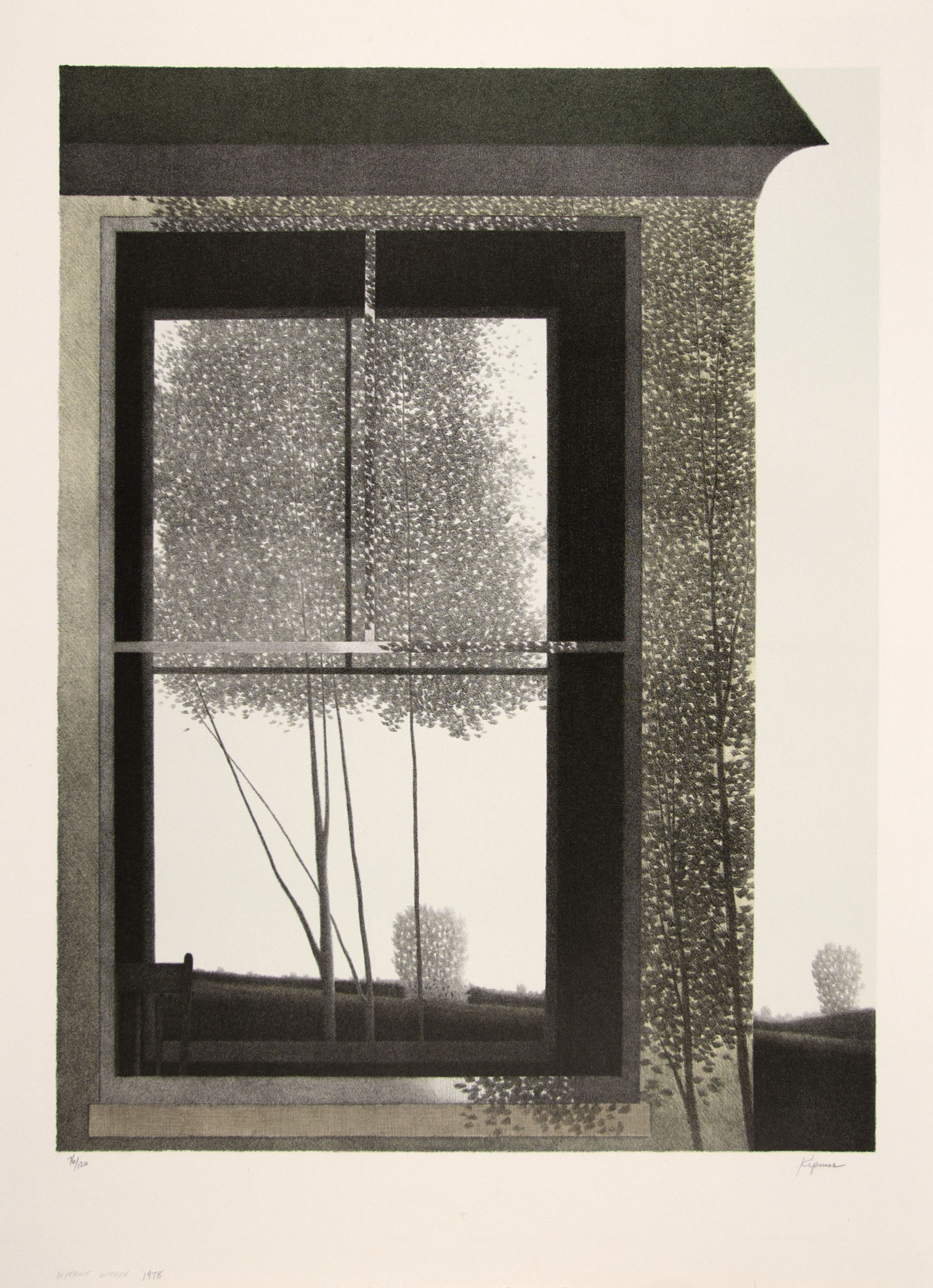
With the human figure pulled from the scenes, we get the sense of seeing the subjective point of view of a person standing in a living room and looking out a window at a dew-covered backyard or hillside in southern Indiana, or sitting at the kitchen table in the early morning hours, sipping that first cup of coffee and observing the sunlight filtering through parted curtains. Hence, the works stimulate introspection and possess greater allure than straight still life or landscape prints. Their power lies in what they are able to represent or conjure in the mind of the viewer.

Without Within by Robert Kipniss (1978)

Without Within by Robert Kipniss (1978)

And Kipniss prevails in his subtlety. This is not art on a grand scale showcased in a massive and overcrowded gallery space; instead, this is art to live with and reflect on, objects to hang on a wall and return to on a daily basis.

Kipniss was born in Brooklyn in 1931. Both of his parents were artists and he developed an interest in both verbal and visual expression. He studied at the Art Students League and earned two degrees from the University of Iowa—a bachelor’s in English literature in 1952 and a master of fine arts in painting and art history in 1954.

He won an art competition in New York in 1951 and was awarded his first one-man show. After serving in the Army, he and his wife returned to New York City. He worked evenings at the U.S. Post Office and spent his days painting and writing poetry. He then made the decision to devote his time entirely to painting, which meant he shelved his writing.

He would, however, jot down observations about his life and work over the next several years, and these memories would form the basis of his 2011 memoir, Robert Kipniss: A Working Artist’s Life (University Press of New England).

Kipniss has exhibited his work in more than 200 solo shows. He is represented in the permanent collections of several prominent museums, including the Metropolitan Museum of Art, the Whitney Museum of American Art, the Art Institute of Chicago, the Los Angeles County Museum of Art and the Museum of Fine Arts in Boston.

He was elected to the National Academy of Design and to the Royal Society of Painter-Printmakers in London.

Vase with Branches and Chair (2013)

Vase with Branches and Chair (2013)

The exhibition will remain on view through Nov. 12; it is open Monday to Friday from 10 a.m. to 6 p.m. and Saturday from 11 a.m. to 4 p.m. It is free and open to the public. The Lubin House is located at 11 East 61st Street between Madison and Fifth avenues. Contact 212-826-0320 or lubin@syr.edu for more information.

After it closes in New York, the exhibit will travel north and then open in January at the Syracuse University Art Galleries in Syracuse, New York.

Standard