This essay was published in the 2014 edition of Words & Images literary magazine, a student-run publication at the University of Southern Maine.
##
I heard the woman first before I saw her or her partner inside the museum of the Onondaga Historical Association in Syracuse. She said in loud voice, “Rick, where are you hon?” The OHA had a few exhibitions running simultaneously on this Saturday in early January 2013, and so it was possible to lose sight of your friend or partner as you made your way through the different gallery spaces and inspected the various works. “Hon, come here, look at this,” she added.

Onondaga Historical Association
At the time I was examining the exhibit Manifest Destiny and The American West by Buffalo artist Robert Hirsch. Hirsch presented nearly one-thousand images in a three-dimensional display—with the pictures placed inside jars and serving as a commentary on how the geographic progression across North America shaped U.S. culture.
After I finished looking at the Manifest Destiny jars, I started walking toward where the couple was standing. They were planted in front of some panels of an exhibit highlighting historic stereoscopic photographs.
Rick was probably in his sixties. He was tall, broad-shouldered and bald except for a tuft of grayish-white hair at the back of his head. He had a bushy mustache that curled downward and matched his hair color and he was wearing a tan jacket. The woman, whom I will call Ruth, was small and also appeared to be in her sixties. She was wearing a black fur coat, tall black boots and bronze earrings that looked like costume jewelry. She had short black hair, a birthmark on the right side of her face and she had applied a little too much burgundy lipstick to her mouth.
But it was her dialogue that made her memorable. I am not a casting director, but I believe you could pick Ruth up and place her in a Woody Allen film and without even reviewing the script, she would fit in with no problem. In fact I bet she would steal scenes away from Scarlett Johansson or Penélope Cruz.
I heard her tell her husband, as I assumed they were married, “See, I should have lived in the 1920s. I’d be dead now, but look at all the stuff I would have remembered.”
Something else about Ruth struck me on a personal level; she reminded me a lot of my late mother. My mother had never attended an art exhibit in her life and was not loquacious like this museum visitor, but the two women shared some physical features. Both were short and had short black hair.

My mom: Carmella Ruane, 1945-2011
And just like Ruth, my mother would often smear too much of the same shade of burgundy lipstick on her mouth. My mom also had the habit of applying a little too much rouge to her cheeks. If she was getting ready to leave the house to attend the Saturday vigil mass at St. Peter’s Church in Rome, New York, where she lived, I would tell her, “Mom, you need to blot your cheeks. The rouge is caked on.” Her standard reply would be, “Oh shut up. Can’t you ever say anything nice?”
Ruth, Rick and I were gathered inside a small gallery space where Carl Lee’s multi-channel video Last House, which documents the destruction of a house in Buffalo, was being screened.
In the piece, on what looks like a bright spring or summer day, a backhoe starts demolishing the house and three separate camera angles capture the action simultaneously. Viewers watch as the scoop of the backhoe starts eating away the roof and walls of the structure, while a man stands near the rubble and uses a power hose to spray water on the scoop and house so no sparks jump to life.
As arresting as Lee’s video was, his exhibit became trumped by a living breathing work of art—the older couple that had seized my attention. And as I stood near the back wall of the room, my focus shifted from the images on the screen in front of me to Rick and Ruth seated on a black bench nearby.
“You see that, it’s three angles of the same thing,” Rick said.
“Yes, I know,” Ruth replied. She paused and then added, “You must think I’m a real idiot.”
I almost burst out laughing because her delivery was a spot-on impersonation of my mother, using the same words my mother had said to me on numerous occasions. But I managed to suppress the laughter swelling inside of me and kept it contained in my throat.
A short time later Rick said to Ruth, “Hon, are tired?” Ruth rubbed her thighs and said, “A little, but I’m OK.”
“Well it’s 2:30,” Rick said.
“No, it’s later.” She checked her watch and said, “It’s 2:40.”
“Your watch is fast,” he said.
“No it’s not. I set it by the stove, and it’s always slow.”
They stopped chatting and watched in silence as the house was being ripped apart in the video. Then, a little while later, amid the grating sounds of the backhoe and the walls tumbling down, Rick turned his head toward Ruth and said, “Are you sure you’re not too tired?”
“No, I’m fine,” she said.
And that’s how I left them. The couple was still sitting there, watching the video when I stepped out of the exhibition space and exited the OHA.
I think what intrigued me most about the couple was their ease of interaction and level of comfort with one another. And I was thankful for having witnessed this slice of life from their apparent happy marriage, a snapshot of two older people behaving in an unguarded fashion in a public museum on an ordinary Saturday afternoon.
I did not assume they lived a perfect life without worry or conflict. But it appeared Rick and Ruth understood and accepted one other unconditionally. In spending a few moments in their presence, it seemed like neither partner had any illusions about the other person, and there appeared to be no mysteries in their relationship still waiting to be uncovered. They had likely revealed all their flaws and weaknesses a long time ago, and yet, they still enjoyed spending time together and remained happily married and devoted to one another. Or at least that’s the impression they gave to outsiders.
I often get a rush of creative energy after visiting an art museum, attending a play or concert or seeing a great film. And while I was walking home my rumination about the couple sparked an idea. I decided they would make a compelling subject for a modern art exhibit.
So here’s my proposal:
A museum would build a large installation showcasing Rick and Ruth as one of the last surviving happy couples in America. It would be a spectacle like something 19th Century showman P.T. Barnum could have curated and promoted.
Rick and Ruth would be placed inside a large kitchen space encased in glass like the diner scene in Edward Hopper’s iconic painting Nighthawks.
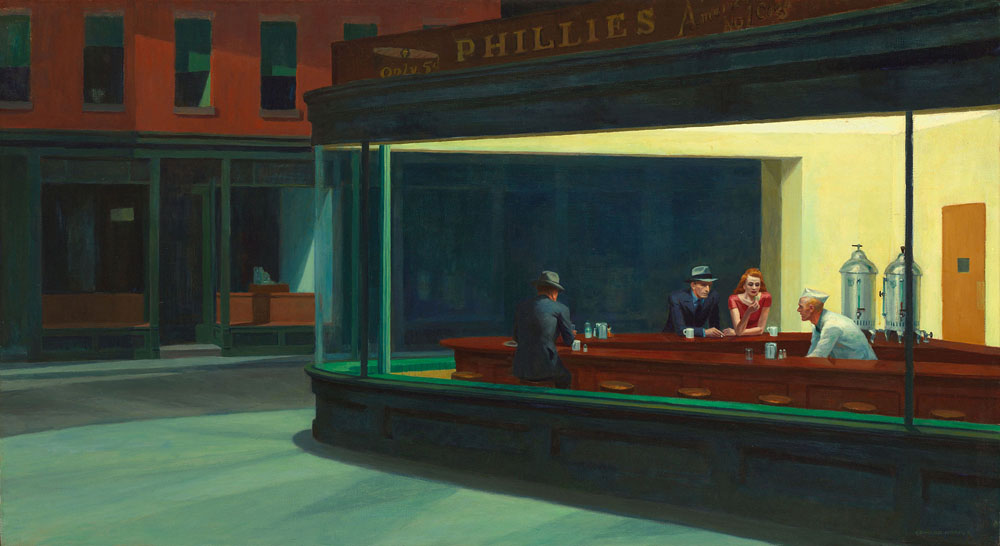
Nighthawks by Edward Hopper, 1942
We would observe them sitting in their kitchen—drinking coffee, talking, cooking and eating breakfast, lunch or dinner, reading the newspaper, playing Scrabble, baking cookies, celebrating their birthdays and washing and drying dishes.
The display would offer viewers an unfiltered window into the life of the couple, and the images, sounds and conversations would document Rick and Ruth’s ease of interaction. The goal would be to reveal the secrets of this happy marriage.
As a result, the exhibit would aim to answer these central questions: What makes this couple different from others? What is the key to their bliss? And what advice or insights do they have for other couples in terms of making a relationship last?
From a technical standpoint, Rick and Ruth would need to be well-lit and microphones would need to be placed on or near them to pick up clean sound; the museum would also have to mount speakers or headphones near the display so the viewer could listen as the couple communicates.
As this idea spun wildly inside my brain, I felt a sense of joy bubbling within and I smiled when I imagined Rick and Ruth hanging out in their hermetically-sealed museum kitchen.
I could almost hear him saying something like, “You know, we’re gonna have to eat a little later because the chicken still needs to defrost before we put it in the oven.”
Ruth would then shoot Rick a dirty look, smack her lips or maybe place a hand on her hip. “Do you think so?” she would say. “God, you must think I’m a real idiot.”
Moments later Ruth would be standing at the counter making a salad and Rick setting the table, and Ruth might turn to him and ask, “Hon, what do you feel like for dessert?”
“Oh I don’t care,” he would say, his eyes lifting from the cutlery on the table. “Anything.”
“Well we have that Entenmann’s crumb cake in the freezer. You want me to take it out?”
“Sure.”
“Yeah, that sounds good, doesn’t it hon?”
“You bet Ruth. It does.”
Then, as the museum would get ready to close for the day, the lights to the kitchen display would be dimmed and Rick and Ruth would depart the exhibition space. And we wouldn’t be allowed to tag along with them when they walk outside the walls of the museum, get into their car and head home for the night.
But I suspect not much would change between them, and I find this reassuring because I wouldn’t want to miss anything.






 Francis DiClemente