I am excited about the restoration of my old Pentax K1000 camera. A few of my younger colleagues at work are avid photographers who practice analog photography; this interest extends beyond a hobby. When I mentioned my busted Pentax K1000, one of my co-workers, Shane, offered to repair the camera, and he and another co-worker, Josh, pitched in to process my first roll and scan the negatives. I had a lot of misfires, but I was also happy a few of the images came out—somewhat in focus and exposed properly.

Alley test shot, photo by Francis DiClemente.
The Pentax K1000 has a nostalgic pull for me. I bought a used one in 1995 from a copyeditor at The Venice Gondolier newspaper, my first employer in journalism. I cut my teeth covering symphony concerts, senior fashion shows, and garden party events.
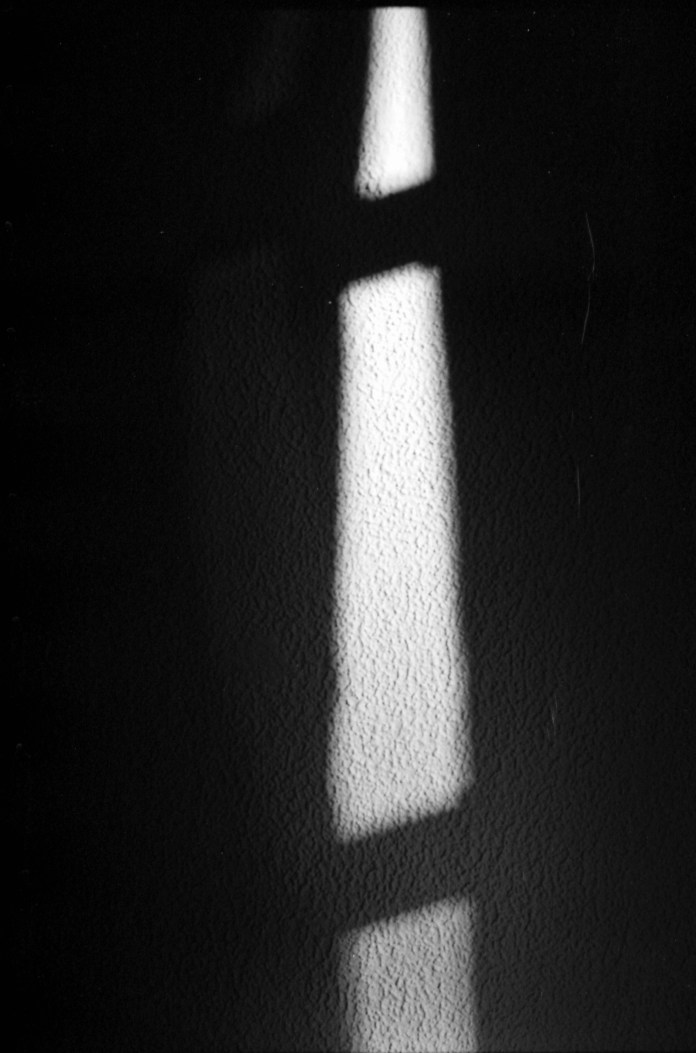
Patch of Light, test shot; photo by Francis DiClemente.
And in a moment of complete stupidity, I picked up the camera and looked through the viewfinder while driving along the Tamiami Trail near Osprey, Florida, causing me to slam into the back of a car driven by an older lady. Fortunately, she wasn’t hurt. My Chevette was transferred to the auto graveyard, but the Pentax stayed with me.

Have A Nice Day, test shot; photo by Francis DiClemente.
Now we’ll see what new pictures I can produce with my heavy-duty camera. One thing I like about analog photography—you have to make your shots count. Using an old camera also reminds me that sometimes the best photos come from pure luck or a gift from the universe.
And because this photography experiment resurrected some memories, I want to share an essay I wrote about my Pentax K1000 in 2010. It was published in a now-defunct online magazine.
Outdated Image Maker
I can’t bring myself to betray my beloved Pentax K1000. We’ve been together for 14 years, the longest relationship I’ve had in my life. I know it sounds absurd. Digital technology is here to stay, and we need to evolve in order to grow. I am also not delusional. I know my Pentax is an inanimate object. It can’t reciprocate my love. Yet I still can’t give it up, not just yet.
Sam, a veteran copyeditor at The Venice Gondolier, a small newspaper in southwestern Florida, sold it to me in 1995 for a price of 100 dollars, including the flash. I needed it for my first job in journalism, as a feature reporter and editor at the paper.
I befriended the camera right away, and it helped me to cover symphony concerts, outdoor festivals, senior citizen fashion shows, and early bird suppers. It accompanied me on my journey to the Midwest, to the gritty environs of Toledo, Ohio. It snapped pictures of barns in rural Monroe County, Michigan, battered warehouses in downtown Toledo, and oak trees stripped of their leaves in late autumn.

Toledo Warehouse; photo by Francis DiClemente
It crossed the Continental Divide when I relocated to Phoenix, Arizona. In the Valley of the Sun, I took pictures of Sonoran cacti, the McDowell and Camelback mountain ranges, and breathtaking sunrises from the roof of an office building at the Scottsdale Airpark, after my night shift as a copyeditor. But in Phoenix, my camera was especially fond of dancing light patterns created by early morning or late afternoon sunlight in my small, first-floor apartment.

Kitchen Garbage Can; photo by Francis DiClemente.
It also snapped photos on top of the Space Needle and outside the Experience Music Project when I visited Seattle.
When I relocated to upstate New York in 2006, it captured my most treasured photo—the stoic picture of my father, weeks after he was diagnosed with terminal lung and liver cancer.

My late father, Francis DiClemente Sr.
I just love the weight and girth of the camera, the rough black metal, and the feel of the spool of film as it catches the sprockets when I load it.
I am not buying film in bulk, but if I’m in a drug store or other outlet that still sells film, I find myself picking up a roll or two—a necessity like Folgers coffee, smoked turkey, and Kraft Macaroni and Cheese.
But it’s come to the point where almost all of the rolls of film I burn, particularly the black and white ones, need to be sent out for development.
I know the time will come soon when retail outlets will no longer sell or process film and manufacturers like Kodak and Fuji will stop making film altogether (if they haven’t already). But there are certain things we just can’t part with when the attachment remains so strong.
I guess that’s why I don’t want to sell my Pentax at some garage sale or on Craigslist and have it end up in someone’s attic or damp basement. As long as the K1000 works, I’ll still put it to use; and when it doesn’t, I will thank it profusely for its years of service and then clear a spot for the camera on my bookshelf, where it can retire with honor alongside the works of writers like Albert Camus, Raymond Chandler, and Thomas Wolfe.
Then I will not feel guilty about going out and buying a brand-new digital camera, which I imagine will be sleek, efficient, and devoid of shared personal history.




 Francis DiClemente